
Instructions for Avoiding Relief
read slowly, do not skip steps

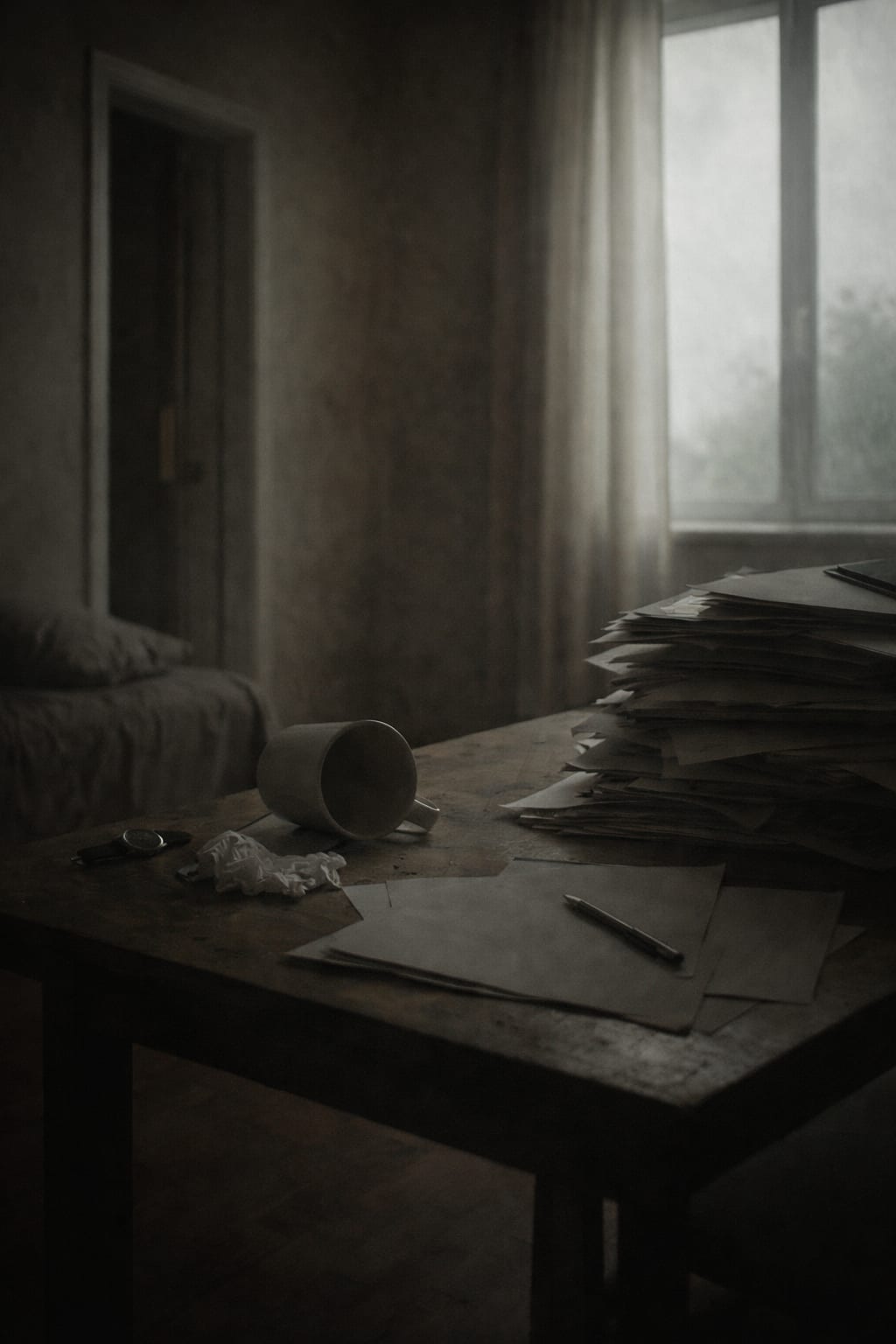
Begin by postponing the obvious.
If something has ended, do not mark it.
Leave the door as it was.
Do not close it.
Do not stand in it either.
Breathe, but shallowly.
Enough to function.
Not enough to settle.
When the body suggests release
(a sigh, a softening, a sentence that feels final),
interrupt it with inventory.
Name what is unfinished.
There is always something.
Keep your hands busy.
Fold paper.
Reorder files.
Wash the same cup twice.
Repetition delays arrival.
If relief approaches anyway,
it will feel like lightness,
or silence expanding behind the ribs.
Counter this by remembering sequence.
What happened first.
Then what followed.
Then what never corrected itself.
Do not blame.
Blame is too clean.
Instead, catalogue variables.
Weather. Timing. Minor choices.
The angle of a sentence spoken too late.
Sleep helps relief.
Therefore, reduce sleep.
Lie down, but think structurally.
What holds.
What bears weight.
What would fail if loosened.
Should relief still appear,
brief and uninvited,
acknowledge it without agreement.
Say nothing.
Let it pass through
without being housed.
End by doing nothing definitive.
No conclusion.
No gesture that implies safety.
Relief cannot stay
where nothing has been cleared for it.
About the Creator
Alain SUPPINI
I’m Alain — a French critical care anesthesiologist who writes to keep memory alive. Between past and present, medicine and words, I search for what endures.
Keep reading
More stories from Alain SUPPINI and writers in Poets and other communities.
Mastering French Without Losing Your Sanity: A Realistic Guide for Beginners
Learning French can feel like solving a Rubik’s Cube blindfolded. The tricky pronunciation, the never-ending grammar rules, and the surprising exceptions make it seem impossible. But don’t worry—equipping yourself with key expressions and effective strategies can turn frustration into fluency. Let’s simplify French and make learning enjoyable.
By Alain SUPPINIExclusive • 12 months ago
Blessed 33
So I woke up on the morning of February 5, 2026 and guess what and you know what I realized? It’s my 33rd birthday. Do you know what that means? Yes, technically I’m getting old, but what I couldn’t have guessed was this would be one of the best days of my life.
By Joe Pattersonabout 10 hours ago in Confessions



Comments (1)
oof. This stressed me out. Which means it was written very well. It indeed made me want to just take a deep breath. Nice job!