
Manual for Carrying Broken Things
Instructions for the Weight You Cannot Put Down

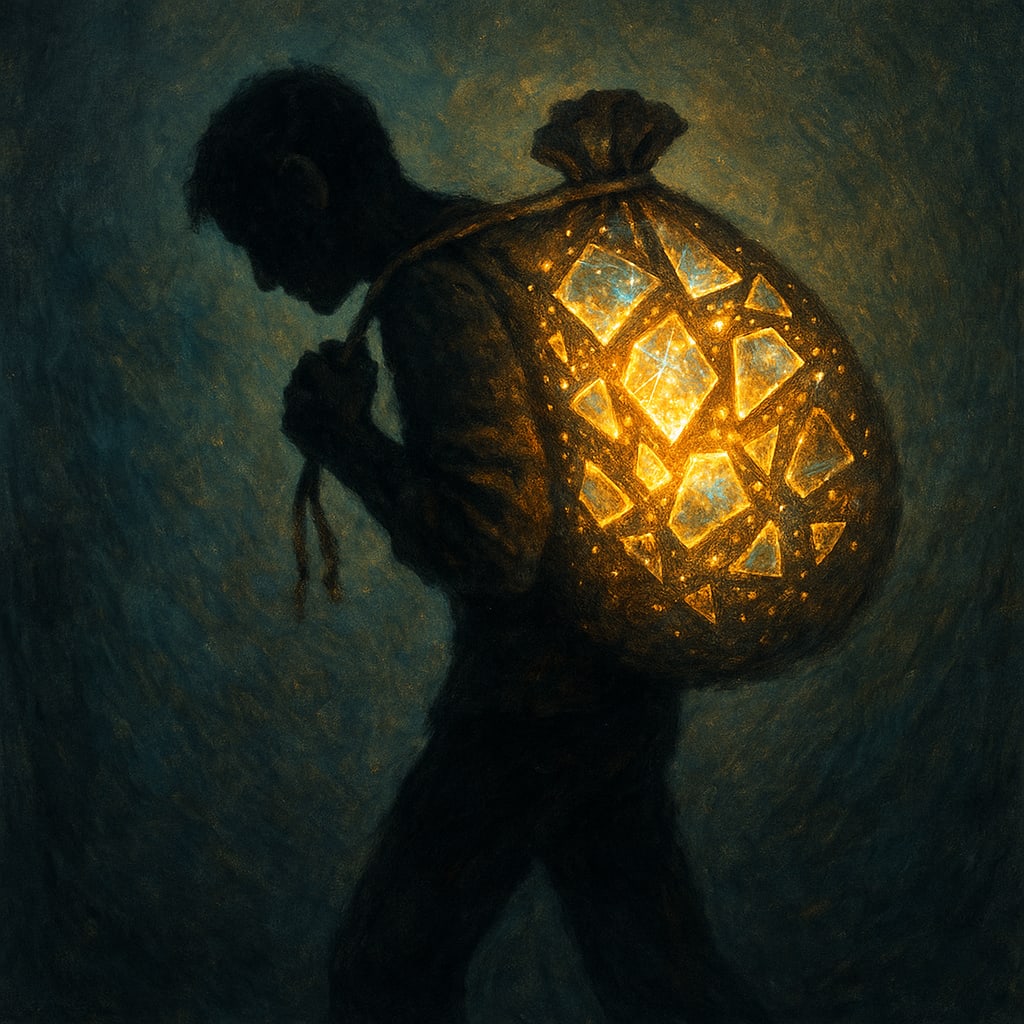
Step 1. Acknowledge the shards.
Do not pretend your hands are empty.
Name the fractures, the splinters, the edges sharp enough to wound.
They cut less when they are recognized.
Say aloud: This is mine. This broke. This remains.
Step 2. Choose your container.
Some carry their brokenness in silence,
wrapped in cloth and hidden in pockets.
Others carry it in glass jars,
letting the cracks catch the light like stained glass.
Decide how much of yourself you want the world to see.
Neither choice is wrong.
Step 3. Learn the posture.
Carrying broken things changes your stance.
You will hunch, you will guard,
you will curve your body around what you hold.
Straighten when you can,
but forgive the crookedness.
It is the shape survival takes.
Step 4. Walk carefully.
Balance is everything.
The ground will tilt, the wind will push.
Move slowly enough to keep the pieces from spilling,
quickly enough to keep from freezing in place.
Listen for the music of your own careful steps.
Step 5. Accept the weight.
Your arms will ache.
Your breath will shorten.
Some days the load will feel unbearable.
Do not deny it.
Let your muscles learn the rhythm of carrying.
In time, the weight becomes a strange companion,
a presence you recognize even in the dark.
Step 6. Clean the wounds.
Shards will cut you.
There will be blood.
Do not be ashamed.
Wash your hands gently,
bind them if you must,
but remember: even scars are proof that you stayed.
Step 7. Notice what grows.
Flowers bloom between the shards.
Moss softens the cracks.
Sometimes, light glows faintly in the dark places.
Brokenness has its own fertility.
Carry it long enough,
and it will root inside you,
teaching you a new kind of beauty.
Step 8. Share the burden.
There will come a day when another hand reaches out.
Let them take one piece, just one.
You are not meant to bleed alone.
Even broken glass reflects more light
when joined with another fragment.
Step 9. Rest without dropping.
Set the pieces down when you must,
but do not abandon them.
Lay them gently at your side,
like a sleeping child.
Rest your spine, stretch your arms.
Pick them up again when you are ready.
Step 10. Bless the fragments.
Whisper thanks to what remains.
Say: You are what survived the breaking.
Hold each shard to the light,
see how it refracts the world differently now.
Call it sacred.
Call it yours.
Step 11. Build from them.
Not repair—
but creation.
Use the edges to carve new paths.
Use the weight to anchor you when storms rise.
Let the fractures become windows
where light can enter.
Step 12. Never mistake broken for useless.
This manual is not about repair.
It is about carrying—
with dignity, with tenderness, with endurance.
Your fractures are not failures.
They are maps.
They are proof you survived the breaking.
Final Note.
At the end of the journey,
when you set the weight down for the last time,
you may discover this:
What you thought was ruin
was always becoming mosaic.
What you thought was burden
was always teaching you how to hold.
And those who come after you
will see not the breaking,
but the pattern you left glowing in its wake.
About the Creator
Alain SUPPINI
I’m Alain — a French critical care anesthesiologist who writes to keep memory alive. Between past and present, medicine and words, I search for what endures.
Reader insights
Outstanding
Excellent work. Looking forward to reading more!
Top insights
Easy to read and follow
Well-structured & engaging content
Excellent storytelling
Original narrative & well developed characters
Expert insights and opinions
Arguments were carefully researched and presented
Eye opening
Niche topic & fresh perspectives
Heartfelt and relatable
The story invoked strong personal emotions
Masterful proofreading
Zero grammar & spelling mistakes
On-point and relevant
Writing reflected the title & theme
Keep reading
More stories from Alain SUPPINI and writers in Poets and other communities.
Mastering French Without Losing Your Sanity: A Realistic Guide for Beginners
Learning French can feel like solving a Rubik’s Cube blindfolded. The tricky pronunciation, the never-ending grammar rules, and the surprising exceptions make it seem impossible. But don’t worry—equipping yourself with key expressions and effective strategies can turn frustration into fluency. Let’s simplify French and make learning enjoyable.
By Alain SUPPINIExclusive • 11 months ago
A Letter to the Firestarter
Dear Firestarter, We can all see you, we've been watching you since you began. In case you didn't know we were here before you and we will be here after. We witnessed your rise, your setbacks, your guilt and your lies. We witnessed you start the fire.
By Donny Foley4 days ago in Poets



Comments (2)
We all carry broken pieces of life as we move forward. However, it is the way we learn to carry the broken pieces as we place them in a backpack. Do we regret and cry over broken pieces or do we slide them out of the backpack and sing a song?
💖