
“The Architecture of Dreams”
A poem about building hope from fragments.

The Architecture of Dreams
A poetic story about building hope from fragments
By [Ali Rehman]
I was told once that dreams are fragile things—soft, vaporous, easily broken by the noise of the waking world. But I’ve learned they’re not fragile at all. They are architectural. They require blueprints, foundations, a quiet kind of engineering that begins in the soul.
And like all great buildings, dreams begin with ruins.
When I was younger, I imagined my life as a perfect city — marble towers of success, bridges of love, streets paved with laughter. I thought the future was something I could design precisely, like a cathedral sketched by divine hands. But life, I’ve learned, does not care for symmetry.
One by one, my imagined walls crumbled.
A friendship that I believed unshakable vanished without explanation.
An ambition I had pursued for years fell apart in the space of a single rejection letter.
A love that once illuminated everything turned into quiet ash.
For a time, I lived among the ruins. I sat in the dust and told myself that maybe some people are not meant to build anything lasting — that maybe my hands were made only to carry broken things.
But then one night, I dreamed.
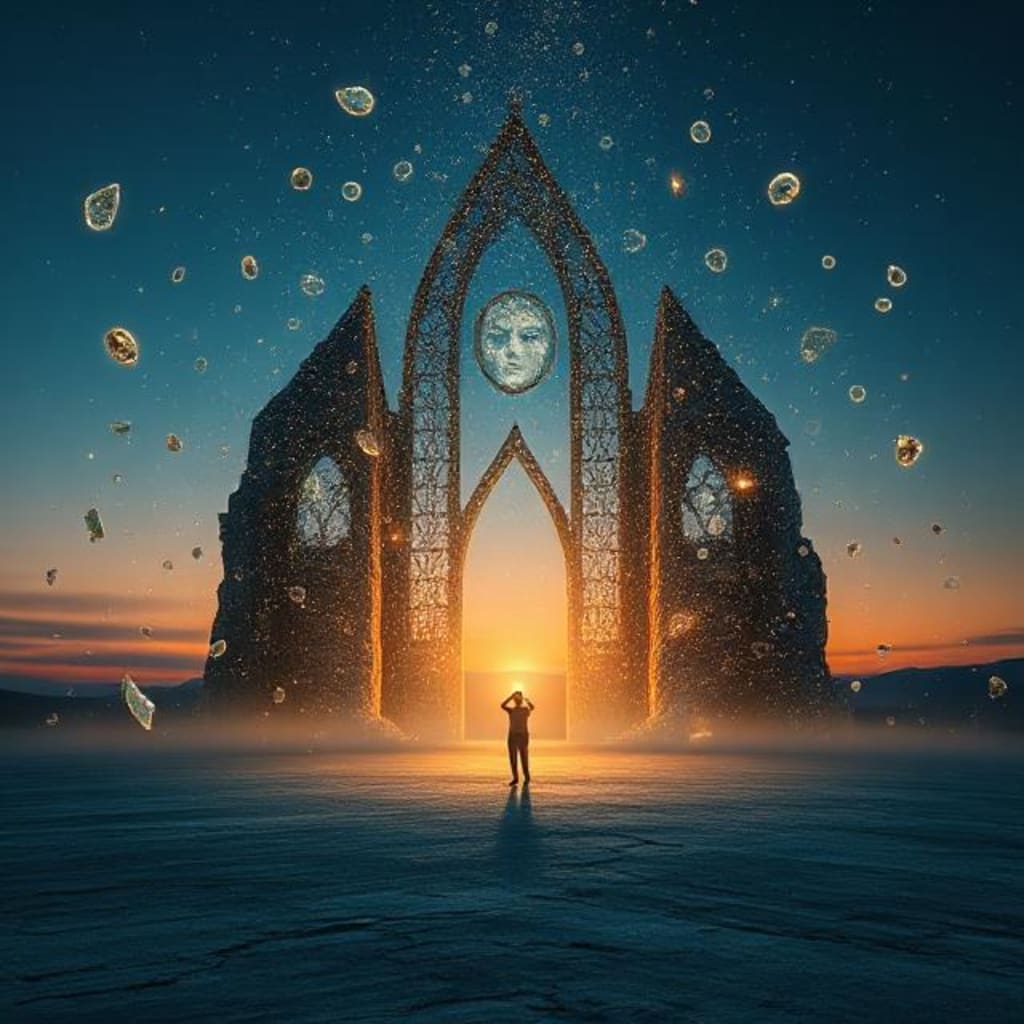
In my dream, I stood before an endless field of glass shards — fragments of mirrors reflecting pieces of the sky. The stars above shimmered like scattered blueprints, waiting to be drawn together. I knelt, picked up one of the shards, and saw my reflection fractured into a hundred versions of myself: the hopeful child, the grieving friend, the tired adult still pretending to be fine.
Each fragment hurt to hold.
Each one mattered.
When I woke, I understood: the dream wasn’t random. It was an invitation.
So, I began to build again — not from perfection, but from fragments.
Every morning, I wrote down one thing I had lost and one thing I had learned. The pages filled slowly — not with triumph, but with truth. I called it my “foundation journal,” because the first thing any architect learns is that before you raise towers, you must understand the ground you stand upon.
The ground of my life was uneven, cracked with memory.
But it was real.
And that was enough to start.
Hope, I discovered, is built like a spiral staircase — not in straight lines, but in upward circles that sometimes make you dizzy. You rise, then dip, rise again, never sure if you’re truly higher until you look back and realize how far you’ve come.
I rebuilt my city in silence.
I wrote poems when I couldn’t speak.
I reached out to old friends, even when fear told me not to.
I learned that forgiveness is not about forgetting the cracks, but about learning how to walk barefoot through them.
And slowly, the architecture of my dreams began to take form.
The walls were made of words I once whispered to myself in dark rooms: You can begin again. You are not finished yet.
The ceiling was made of small kindnesses from strangers — moments that reminded me that not all light burns out.
And the floor — that sturdy, grounding floor — was made of the lessons I used to wish I’d never learned.
One day, I returned to that dream in meditation. The field of glass was still there, but this time, the shards no longer cut me. They fit together like puzzle pieces, reflecting not my brokenness but my wholeness. The mirrors had become windows — and through them, I could see a new world forming.
In it, my failures were not erasures; they were foundations.
My grief was not a void; it was a doorway.
My lost dreams had not died; they had simply changed shape.
That’s when I realized — hope is not something we find.
It’s something we build.
Piece by piece.
Fragment by fragment.
Heart by heart.
Years later, when people ask me how I survived the collapse, how I learned to create again, I tell them this:
I built my life the way architects build cathedrals — knowing that it might take a lifetime to finish, and that even if I never see the final structure, the act of building itself is sacred.
And now, when I walk through the corridors of my own becoming, I hear echoes — whispers of the person I used to be, applauding softly.
She does not grieve anymore.
She builds with me.
Dreams, I’ve come to understand, are not airy fantasies or whimsical escapes. They are living blueprints drawn by our scars. Every time something breaks, it gives us another line to trace, another curve to shape.
The architecture of dreams is messy, unpredictable, and endlessly human.
But when sunlight hits its walls just right — when laughter and pain and resilience meet in a single moment — it’s the most beautiful thing we will ever build.
And so I keep building.
With trembling hands, with stubborn faith,
with broken glass and open sky.
Because even from fragments, we can raise something eternal —
something that looks, at last, like home.
About the Creator
Ali Rehman
please read my articles and share.
Thank you
Keep reading
More stories from Ali Rehman and writers in Poets and other communities.
Harpoon to the Heart
When it comes to storytelling in music, few artists can match Paul Kelly. The Australian singer-songwriter, renowned for his poetic lyricism and heartfelt melodies, has done it again with his latest single, “Harpoon to the Heart.” Released in late 2024 as part of his acclaimed album Fever Longing Still, this song captures the intensity, vulnerability, and complexity of love — all with Kelly’s signature storytelling touch.
By Ayesha Lashari3 days ago in Poets
The Light Turns
It's Tuesday 7:13 a.m. A cold and clear November morning awaits Ray on his morning commute. Ray rubs his hands together in the front seat of his Subaru. He turns the air temperature up, but keeps the air on low until the air warms up. He looks at the backup camera screen and reverses the Subaru out of his driveway onto Trimble Road.
By John R. Godwin3 days ago in Fiction



Comments
There are no comments for this story
Be the first to respond and start the conversation.