
🌍 Global Power Rankings 2026: Who Really Controls the World?
A clear explanation of military, economic, technological, and political power in a world shaped by AI, nuclear weapons, and global competition

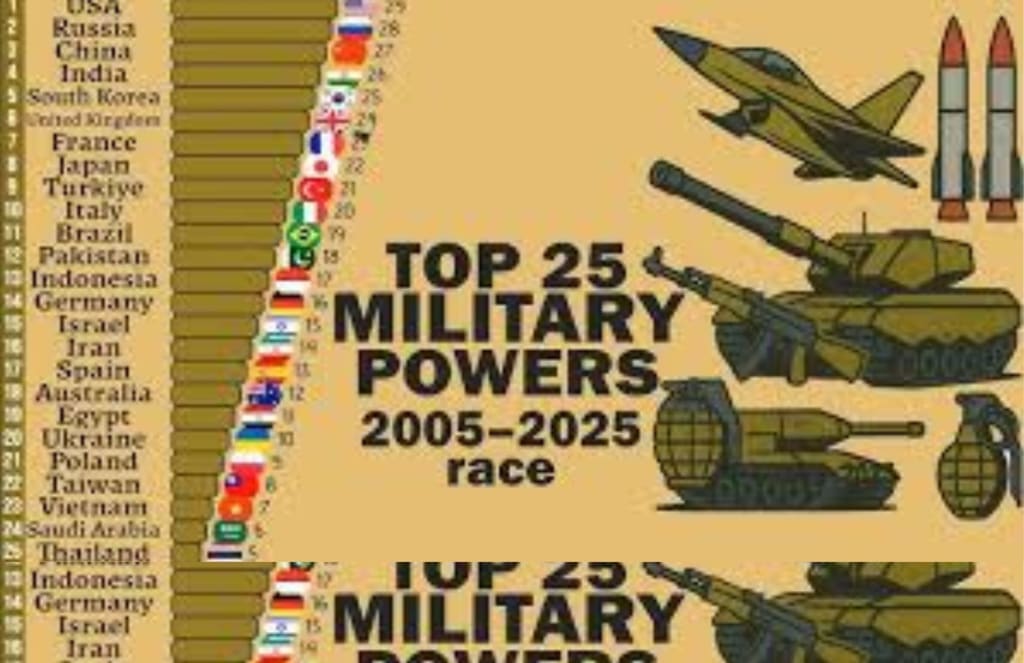
🌍 Global Power Rankings 2026: Who Really Controls the World?
📊 Global Power Rankings Chart
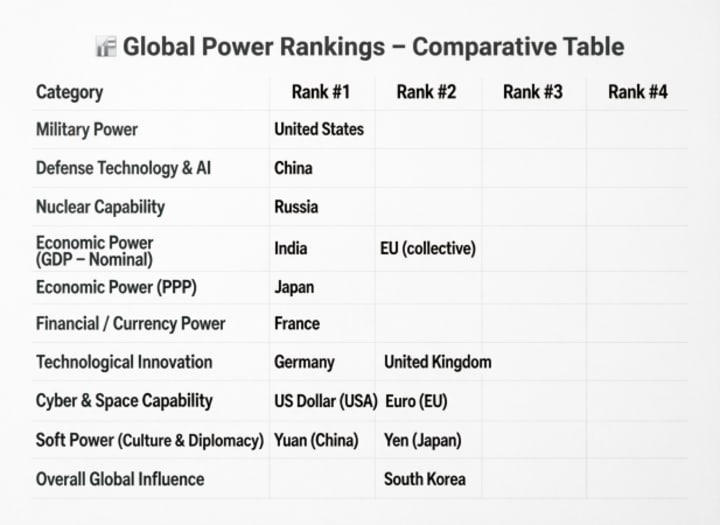
In today’s world, power is no longer measured only by the size of an army or the number of tanks a country owns. Global power has become complex, multi-layered, and deeply connected to technology, money, information, and influence. The global power rankings shown above help us understand who really controls the world in 2026 and why the balance of power is becoming more unstable than ever before.
The United States still holds the top position in overall global power. It has the strongest military in the world, with unmatched global reach. American aircraft carriers, air bases, satellites, and alliances allow it to operate almost anywhere on Earth. In addition, the United States leads in advanced defense technology, artificial intelligence, cyber warfare, and space systems. Most importantly, the US dollar remains the world’s dominant currency. Oil trade, global debt, international banking, and financial markets still depend heavily on the dollar, giving Washington enormous economic influence.
However, China is the fastest-rising challenger. China now ranks second in most categories and first in some. In terms of economic power measured by purchasing power parity (PPP), China has already overtaken the United States. It is the world’s manufacturing center and a leader in infrastructure, supply chains, and industrial production. China is also investing heavily in artificial intelligence, surveillance technology, cyber capabilities, and space programs. While the Chinese yuan is not yet a true global reserve currency, Beijing is actively working to reduce global dependence on the dollar through trade agreements, digital currency experiments, and partnerships with countries in Asia, Africa, and the Middle East.
Russia remains a major power mainly because of its nuclear weapons and military experience. Even though its economy is much smaller than that of the US or China, Russia has one of the largest nuclear arsenals in the world. It also has strong cyber warfare capabilities and intelligence networks. Russia’s influence is often indirect, using energy supplies, political pressure, and information warfare rather than direct economic strength.
Europe, when viewed as individual countries, may seem weaker, but as a combined force, it remains extremely powerful. Germany, France, and the United Kingdom play key roles in global finance, diplomacy, and technology. The Euro is the second most important currency in the world after the US dollar. European countries also hold significant soft power, meaning influence through culture, diplomacy, values, and institutions. However, Europe faces challenges such as internal political divisions, energy dependence, and slower military coordination.
India is an emerging power that deserves close attention. It has a large population, growing economy, strong IT sector, and nuclear weapons. India is becoming more important in global politics as countries look for alternatives to China in manufacturing and supply chains. However, India still needs time to develop its infrastructure, industrial base, and global financial influence.
One of the most important changes in global power today is the rise of artificial intelligence and cyber warfare. Countries no longer need to invade another nation physically to cause damage. A cyberattack on banking systems, power grids, communication networks, or nuclear warning systems can paralyze a country within hours. This makes technology and data control just as important as tanks and missiles.
Another serious risk comes from nuclear command systems. As AI becomes more involved in early-warning systems and military decision-making, the risk of accidental war increases. A false signal, hacked system, or AI miscalculation could trigger a nuclear response before humans have time to verify the threat. This is why many experts believe the future of global power will depend on how responsibly countries manage AI and nuclear technology together.
Soft power also plays a major role. Countries like the United States, the UK, and France influence the world through media, education, culture, and international institutions. This influence shapes public opinion, alliances, and global narratives. China is trying to increase its soft power, but it still faces trust issues in many regions.
In conclusion, the global power rankings show a world moving toward multipolar competition. The United States remains the most powerful nation, but China is closing the gap rapidly. Europe, Russia, and India each hold important pieces of global influence. The future will not be decided by one single factor, but by a combination of military strength, economic stability, technological leadership, and the ability to control information without triggering global chaos.
The biggest danger ahead is not just war — but miscalculation in an age where AI, nuclear weapons, and digital systems control the fate of humanity.
About the Creator
Wings of Time
I'm Wings of Time—a storyteller from Swat, Pakistan. I write immersive, researched tales of war, aviation, and history that bring the past roaring back to life
Keep reading
More stories from Wings of Time and writers in Proof and other communities.
Contrary Global Power Rankings: Who Really Leads Today?
Contrary Global Power Rankings: Who Really Leads Today? When we talk about the “most powerful countries in the world,” many people immediately think of military strength or economic size. But real global power is complex and multidimensional. A country may have the largest economy, while another may have the strongest army, and yet another may wield outsized cultural influence. Different ranking systems lead to different leaders — and sometimes surprising results.
By Wings of Time a day ago in Earth
Cultivating Mindful Leadership for a Balanced Life
Mindful leadership is about bringing awareness and presence into how we lead ourselves and others. It helps us respond rather than react, listen deeply, and create calm in the midst of challenges. Developing this quality begins with simple daily habits that ground us in the present moment.
By Marina Gomez7 days ago in Proof
Exploring Open Awareness Meditation for Calm and Clarity
Open awareness meditation is a gentle practice that invites you to rest your attention in the present moment without focusing on any single object, thought, or sensation. Instead, you allow your awareness to be open and receptive to whatever arises—sounds, feelings, thoughts—without judgment or attachment. This practice helps cultivate a spacious, calm mind and a deep sense of presence.
By Black Mark3 days ago in Proof




Comments
There are no comments for this story
Be the first to respond and start the conversation.