
Cutting The Mind
The Lobotomy Era and Its Human Consequences

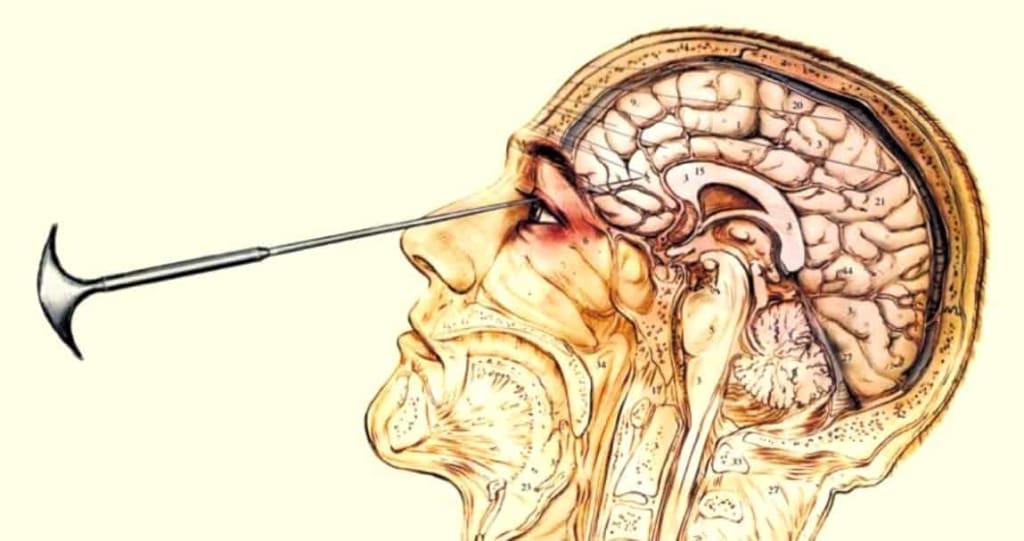
A Lobotomy is a surgical operation developed to treat severe mental health conditions. This procedure has varied throughout history, but it typically involved inserting a sharp instrument into a patient's brain to sever certain neural connections.
Today it is described as barbaric and unnecessary, however, experts once believed that it was a miracle cure for mental health conditions including treatment-resistant depression, schizophrenia, and some personality disorders.
While a lobotomy is effective at altering behavior, and some patients even improving after the operation. But many suffered significant and irreparable brain damage.
The earliest version of the procedure involved drilling holes into a patient's skull and then injecting ethanol into the brain to destroy the nerve connections. Later, it was refined into the prefrontal and transorbital lobotomy, this involved using the famously known ice pick-like instrument called a leucotome.
The prefrontal lobotomy is where the surgeon drills holes in either side of the top of a patient's head and uses a leucotome to sever the nerves between the frontal lobe and other regions of their brain. While the transorbital lobotomy the surgeon accesses the patient's brain through the eye sockets.
It was in 1935 when Portuguese neurologist Egas Moniz invented the lobotomy, which at the time was called a leucotomy. He was inspired by the earlier work of a Swiss psychiatrist Gottlieb Burkhardt whom performed some of the earliest noted psychosurgeries in the 1880s.
Moniz performed the procedure for the first time in November 1935 in a Lisbon hospital. He drilled holes into the patient's skull and then injected pure alcohol into the frontal lobe to destroy the tissue and nerves. He would go on to win the Nobel Prize in medicine in 1949 for inventing the procedure.
The following year, an American neurologist, Walter Jackson Freeman, adopted the procedure and then renamed it the lobotomy. He would modify the surgery and introduced the use of a surgical tool rather than the use of alcohol, creating the prefrontal lobotomy.
Freeman and his neurosurgeon partner, James Watts, performed the first lobotomy in the United states in September 1936. In 1945, Freeman then modified the procedure again and created the transorbital lobotomy, this way he could perform quickly and leave no scars.
Moniz believed that he could cure a person of a physical malfunction in their brain that would cause them to suffer from psychosis and depression if he severed the connection between the frontal lobe and other regions, it was as he was forcing a kind of reset in the brain.
Moniz and Freeman alike reported significant improvements of patients, although many of them showed no improvement and some even presented worse symptoms. Even with this, the lobotomy sky rocketed in popularity.
In the early 40s, people acclaimed the procedure as a miracle cure for mental health conditions and experts were adopting it as part of mainstream psychiatry.
During a 1942 presentation at the New York Academy of Medicine, Freeman explained: "These patients can be treated a good deal like children, with affectionate references to their irresponsible conduct. They harbor no grudges."
Many of the patients lost their ability to feel emotions, they rather became apathetic, unengaged, and unable to concentrate. Others became catatonic, and some procedures resulted in death.
Roughly 60,000 lobotomies were performed in the US and Europe from the 1930s to early 1950s. However, by the 1950s, the dangers and side effects of the procedure were becoming widely known, this drew more scrutiny from doctors as well as the public.
High-profile lobotomies helped turn the public opinion against it, including the lobotomy Freeman gave to President John F. Kennedy's sister Rosemary, which left her permanently incapacitated.
Watts even became disillusioned with the procedure in the 50s, this was when medications such as antipsychotics and antidepressants were becoming widely available. This made it easier to provide outpatient treatment for these mental illnesses as well as treat symptoms without surgery.
The lobotomy is banned in some countries, but is still performed on a limited basis in many others. The Soviet Union was the first to ban the use in 1950, deeming it was "contrary to the principles of humanity." Japan and Germany banned it in later years.
Freeman was banned from performing further lobotomies in 1967 after one of his patients suffered from a fatal brain hemorrhage following the procedure. However, the US and much of western Europe never banned the lobotomy, and it was still performed throughout the 80s. Lobotomies are rarely performed today, but they are technically still legal.
Surgeons use a psychosurgery called a cingulotomy in place of a lobotomy occasionally. This procedure targets and alters specific areas of brain tissue. Some surgeons may use this to treat obsessive-compulsive disorder that has failed to respond to other treatments and it is also sometimes used by doctors to treat chronic pain.
About the Creator
Max
I wish for a better world
Responsibility, Repair, and the Quiet Architecture of Human Change in Modern Recovery by Rising Star Martin Lowery
I did not set out to become a voice in recovery discourse. I set out to become someone who could be trusted again. That difference shaped everything that followed.
By Martin Lowery8 days ago in Psyche



Comments