
Positive Punishment
Psychological effects of positive punishment

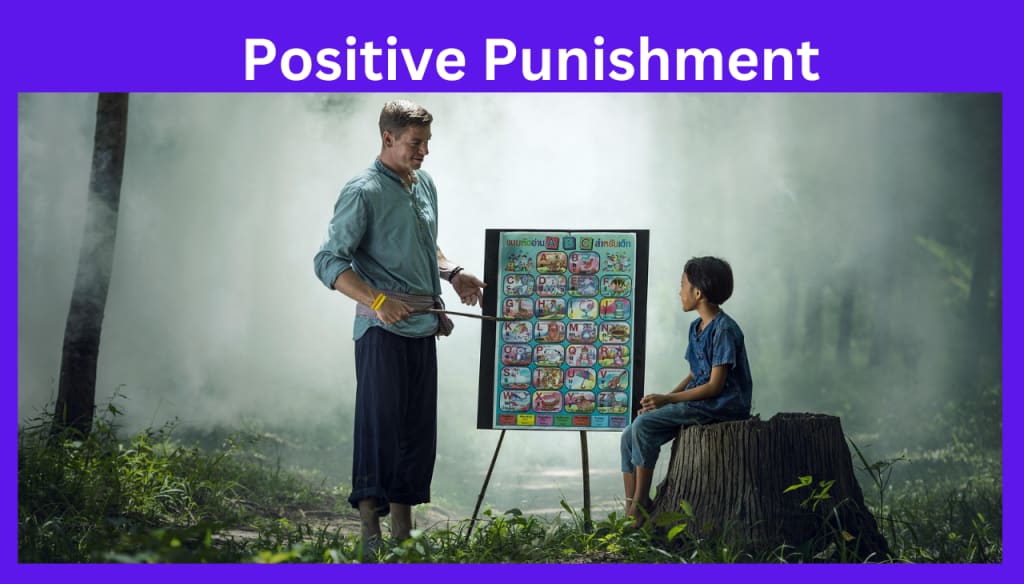
Positive Punishment
Punishment is a concept commonly used in psychology and daily life to correct unwanted behavior. One type of punishment is **positive punishment**, which involves adding an unpleasant stimulus to decrease the likelihood of a behavior occurring again. Unlike **negative punishment**, which involves taking something away, positive punishment introduces a consequence that discourages the behavior. This article explores positive punishment, its effectiveness, examples, advantages, disadvantages, and ethical concerns.
### **What Is Positive Punishment?**
Positive punishment is a method of behavior modification where an unfavorable outcome follows an undesirable action. The goal is to reduce or eliminate unwanted behavior. This technique is based on **operant conditioning**, a concept introduced by psychologist **B.F. Skinner**. In simple terms, positive punishment means adding something unpleasant after a behavior to prevent it from happening again.
For example, if a child touches a hot stove and feels pain, they learn not to touch it again. The pain is the punishment, and it discourages the child from repeating the action.
### **Examples of Positive Punishment**
Positive punishment occurs in various settings, including homes, schools, and workplaces. Some common examples include:
1. **Parental Discipline**
A child misbehaves, and the parents scold them. The scolding discourages the child from repeating the behavior.
A teenager stays out past curfew, and the parents give extra household chores as punishment.
2. **School Discipline**
A student talks loudly in class, and the teacher assigns additional homework as a consequence.
A student arrives late to school and has to write lines or stay for detention.
3. **Workplace Consequences**
An employee frequently arrives late, so the boss gives them additional work or reduces their break time.
A worker makes repeated mistakes, and the supervisor issues a warning letter.
4. **Legal and Social Punishments**
A person breaks traffic laws and receives a fine.
A criminal is sentenced to community service as punishment for their actions.
5. **Self-Inflicted Positive Punishment**
A person eats too much junk food and experiences stomach pain, which discourages them from overeating again.
A person neglects to exercise and later feels tired or unhealthy, motivating them to be more active.
### **Effectiveness of Positive Punishment**
Positive punishment can be effective in changing behavior, but its success depends on several factors.
1. **Immediate Application** Punishment is most effective when given immediately after the unwanted behavior. If delayed, the individual may not associate the punishment with their actions.
2. **Consistency** The punishment should be consistent to reinforce learning. If a child is sometimes punished for an action and sometimes not, they may become confused.
3. **Appropriate Intensity** The punishment should be strong enough to discourage behavior but not so severe that it causes harm or resentment.
4. **Clear Explanation** The individual should understand why they are being punished so they can learn from the experience.
### **Advantages of Positive Punishment**
Positive punishment has several benefits when used correctly:
**Quick Behavior Correction** It can quickly reduce unwanted behavior.
**Clear Consequences** It helps individuals understand which actions are unacceptable.
**Useful in Dangerous Situations** It can prevent harmful behaviors, such as touching fire or running into traffic.
**Encourages Self-Control**
It teaches discipline and the importance of following rules.
### **Disadvantages of Positive Punishment**
Despite its advantages, positive punishment also has drawbacks:
**May Cause Fear or Anxiety** Frequent punishment can create fear rather than understanding.
**Can Lead to Aggression** Harsh punishment may encourage aggressive behavior in children and adults.
**Does Not Teach Correct Behavior** It stops bad behavior but does not teach the correct alternative.
**Short-Term Effectiveness** The behavior may stop temporarily but return later.
### **Ethical Considerations**
When using positive punishment, it is important to ensure it is ethical and does not cause harm. Ethical punishment should be:
**Fair and Justified** It should match the severity of the misbehavior.
**Non-Harmful** Physical or emotional harm should be avoided.
**Focused on Learning** The goal should be improvement, not just punishment.
### **Alternatives to Positive Punishment**
Instead of using punishment alone, positive reinforcement and other behavior modification techniques can be more effective:
1. **Positive Reinforcement** Rewarding good behavior encourages individuals to repeat positive actions.
2. **Negative Punishment** Removing privileges instead of adding negative consequences can be effective.
3. **Behavioral Guidance** Teaching and modeling good behavior can prevent misbehavior.
4. **Verbal Warnings and Discussions** Explaining the consequences of actions helps individuals learn without fear.
### **Conclusion**
Positive punishment is a widely used method for correcting unwanted behavior by introducing an unpleasant consequence. While it can be effective in certain situations, it also has risks and limitations. The key to using positive punishment successfully is applying it ethically, consistently, and in combination with positive reinforcement. By balancing punishment with encouragement, individuals can learn and grow in a healthy and constructive way.
About the Creator
Muhammad Iqbal
Experienced writer creating research-based articles on medicine, pharmacy, and motivation. I simplify complex topics to educate readers on health, pharmaceuticals, and positive life change.
Keep reading
More stories from Muhammad Iqbal and writers in Psyche and other communities.
Leadership Principles
Leadership Principles Leadership is an essential quality that influences people, teams, and organizations. Strong leadership is built on a set of principles that guide decision-making and inspire others. Effective leaders are not just born; they develop their skills and characteristics over time. Below are some key leadership principles that every leader should follow.
By Muhammad Iqbal11 months ago in Motivation
Feelings Never Die
It is Valentine's Day again, and it bought back memories that were over fifty years old. It bought me back to 1971, and I woke up and I knew my baby was due today. I was big and pregnant, and I felt like I was about to burst wide open. Imagine my surprise when the doctor told my I had a due date of February 14. I couldn't believe it, and since my baby was due today, I felt I could indulge myself a bit. I had gained a lot of weight, and chocolate was on the no-no list, but I had came to the end of this pregnancy, and I hoped it would be okay, after all I would deliver this baby today. So I walked across the street to the grocery story, and bought myself, a peppermint patty, covered in chocolate, my favorite. Me and my Valentine's baby would enjoy it together.
By Susan Payton2 days ago in Fiction




Comments
There are no comments for this story
Be the first to respond and start the conversation.