
The Shape of Unbecoming
Reckoning with a Beautiful Ruin

Blankness. All I felt was a moment of blank, muffled dissociation. Like one of those war scenes in a movie—an explosion goes off, and while the battle rages in chaos around the main character, they stand dumbfounded in shock, hearing only the vague ringing in their head.
I knew what had likely happened. But I didn’t want to feel it. I didn’t want to know. Because once I knew, once I let the truth in, it would become unbearable.
I had suspected it for so long. So much more had already happened—things I had buried, ignored, rationalized. I must have done a good job of suppressing it all, because I had managed to keep functioning. Smiling. Surviving. But the recent two-week fast I did—it brought a strange kind of clarity. A quiet, surreal sharpness that sliced through the fog.
And more than I wanted to keep suppressing the chaos, I needed the truth. I was starved for it.
For too long, everything had been hidden behind twisted uncertainties and gaslit versions of reality.
Too many times, my questions were met with silence, or deflected with confusion and blame.
Too often, my exhaustion—my fear of conflict—had been hijacked and used against me.
But this time, it was different. This time, it was blatant.
So cruel. So pointed. So opportunistic.
Did they really expect me to come have dinner with them—knowing they had shared a bed the night before?
I stood in the living room, having just gotten home—my heartbeat sporadic, my body quivering.
I had just confirmed with my brother that he and his girlfriend had gone out to the bars the night before with my boyfriend, Brent. And that our mutual friend, Chad, had apparently made the hour and a half drive from another city to join them.
My fingers were trembling as I typed the message:
"I really deserve for at least one of you to respond to me. I know that you stayed the night last night; did you have sex?"
With a heavy breath, I hit send.
First to Brent. Then, in a separate message, to Chad.
Seven years prior I was a naive, doe-eyed twenty-four-year-old. A meek and earnest Christian, still mostly in the closet, with a big heart and an enormous—yet unmet—capacity for love. I wasn’t ignorant, but I was naive. I had only given away my virginity the summer before, and I’d never truly been in a relationship with someone I was actually attracted to.
Newly living on my own, with my own job, and on the heels of my parents' turbulent divorce, I was in a season of loosening my grip on vain perfectionism, and trying to figure out what it meant to want something for myself. To choose desire over duty.
We met on a dating app. The messages were charming, casual, promising. We agreed to meet in person. I remember sitting on a bench downtown outside the bar we’d chosen, my stomach fluttering with nerves. Then he came around the corner.
Cowboy boots. Leather jacket. Handsome. Confident.
My heart jumped. And when his eyes found mine, he broke into a smile that felt like gravity.
From our messages, I understood we had faith in common—shared roots in small-town sensibility, discretion, and quiet restraint. There was a sense of unspoken mutual understanding.
It was cute.
It was sweet.
It was all a lie.
Several weeks after meeting, Brent received orders from his branch of the military for a three-month deployment. The distance didn’t weaken the spark—it made it grow. Even halfway around the world, we messaged every day. We video chatted when he could. He told me how much it meant to him—to have someone to talk to, someone to miss, someone to come home to.
He marveled at me. Said I was keeping him grounded. Said it was rare to meet someone who understood him. I believed him. I wanted to believe him.
I shared stories from my daily life—camping trips with friends, weekend swing dancing with my brother’s girlfriend. He loved hearing about it all. Said it helped him feel alive while stuck in a tent in the desert. I guess I didn’t think much about the fact that he didn’t seem to have much of a social life back home. I assumed it was just the nature of military life.
Honestly, I was glad for the deployment. It gave us space to be prudent—to grow slowly. And by the time he returned safely, we were completely infatuated.
There was no defining moment when we “became” a couple. We just were. We were a unit, and we just started doing life together. No label needed. No questions asked. It felt effortless. Natural. Looking back, I would come to forge a quiet proverb for myself:
Ambiguity is a cauldron for destruction.
He had a beautiful house. A nice truck. A solid military career. He was stability, provision, excitement. A comrade and a protector. And the intimacy—God, the intimacy—was electric!
With our somewhat opposite schedules, I’d spend my days off at his place. He’d head to the base, and I’d have the house to myself. He’d come home for lunch—sometimes we’d talk, sometimes we’d make love—and when his shift ended, I’d be waiting, ready for us to dive into the evening together.
It was sweet. Domestic. Everything I thought I wanted.
And in the quiet comfort of it all, I didn’t notice the cracks beginning to form.
There were tiny moments—barely noticeable then, blinding in hindsight. I remember once, I was in a playful mood and jokingly shushed him. A silly, lighthearted gesture. But his response was immediate and ice-cold. He looked me dead in the eye and said, “Don’t ever shush me again.” It struck a strange chord in me, the sharpness of it. But I brushed it off. Maybe he didn’t like being interrupted. Maybe I’d crossed a line. It was just a mood, right?
His military career gave him a sort of mystique. His job involved classified work—he told me he couldn’t talk about much of it, and I respected that. I didn’t think much of the burner phone, the late-night texts, the things he wouldn’t—or couldn’t—explain. I chalked it up to national security. I trusted him. What else was I supposed to do?
I didn’t even know what gaslighting was at the time. I couldn’t fathom it.
I strived to make the relationship work. I did little to nothing without him and I began to see how unhealthy that was. So I found a local group that played volleyball in the city park on Wednesdays—a large mix of people, all ages, all walks of life. It was a little sliver of joy and autonomy.
I of course invited Brent, but he would never go. In fact, he’d get upset with me for going. One week, determined to avoid any misunderstanding, I reminded him on Sunday, then again on Tuesday, and even texted him the morning of. However, that evening, while at his house, I started to get ready—and he suddenly began cooking dinner. As I got my things to leave, he blew up, accusing me of being inconsiderate. I stood frozen, confused, saying “I told you. I reminded you. I said I’d be going.” But he turned it into something sinister—accusing me of hiding something, implying I must be cheating.
I wasn’t. I pleaded with him to come next time, to see for himself it was just innocent fun.
And when he finally did come, he managed—despite the crowd of over 70 strangers—to find the one other gay guy in the group and befriend him. Brent insisted that it was only platonic, and suggested that I should support the friendship since it was my idea to make new friends.
My reality had become a shirt buttoned up all wrong, but I didn’t know how to fix it. I just kept wearing it, tugging at the edges, pretending it wasn’t strangling me. I fell in step with the delusion that Brent benefited from me living in.
It was a quiet kind of erosion.
Not a single collapse, but a slow, almost imperceptible unraveling of who I was. Brent had a way of rewriting reality in real time. If I was in a good mood, he’d be moody—disapproving, passive-aggressive, like my joy was a form of selfishness. If I was upset, he'd shine with artificial optimism, belittling me for being a “downer,” asking why I was always so negative. There was no right way to feel, no safe place to land. It didn’t matter what I felt—because I was always wrong. Too loud. Too quiet. Too needy. Too distant.
It was like trying to dance with someone who changed the rhythm every four beats and then blamed you for stepping on their toes. Eventually, I gave up trying to have my own tempo. He trained me like a dog without me even realizing it—rewarding obedience, punishing assertion.
I stopped trusting my own experience. If I remembered something one way, I must’ve misunderstood. If I confronted something hurtful, I was being dramatic. He was the arbiter of truth. I learned to second-guess myself, to defer to his version of things.
My family used to have a running joke that “Jesse is always right,” but since being with Brent, that didn’t seem to hold true anymore—he had made sure of that. I was always scrambling to appease him. Always chasing the high of when it was right, yearning for a return of the softness that had disappeared months—or maybe years—ago.
Eventually I realized that I didn’t know who I was. I’d stopped believing in me, and the still small voice in my heart, that spoke when I prayed, became a vapid thought.
Because when someone installs themselves as the only reliable narrator of your life, you begin to disappear.
Not suddenly.
But slowly.
Like fog burning off under a sun that only shines for them.
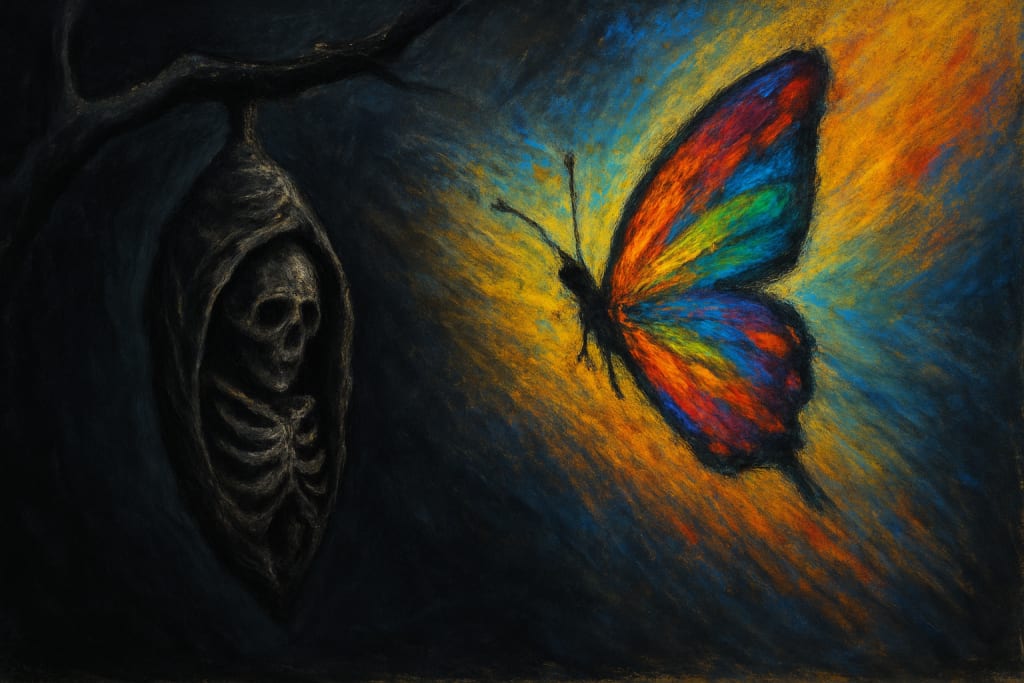
And in that fog, in that despair, a wind began to blow. An unseen force awoke in me—like when a caterpillar suddenly feels the instinctual need to start preparing a cocoon.
I’m not sure why a caterpillar begins to build a cocoon, but I wonder if it is because it senses how helpless it is as a worm. Perhaps it feels the branches shake in the wind, and it understands the danger of gravity, and the fragility of a twig.
Much the same, I didn’t know why, but I felt a deep need to draw near to my God. I began to fast. The more I fasted, the more I felt the turbulent wind ripping through the branches of my life.
One Wednesday I walked with Chad back to our cars. He and Brent had been hanging out a lot. I asked him if there was anything physical between them. He said there was not—that Brent was just a friend.
“That’s good,” I said. “Because it would absolutely destroy me if anything did happen.”
That Saturday Brent had lightheartedly texted both my brother and me, inviting us to his house to have dinner with him and Chad. My brother confirmed that he and his girlfriend went out drinking with Brent the night before—and that Chad had shown up too, driving from another city.
A strong wind thrashed through the branches of the caterpillar’s tree.
I knew. I knew.
It was like my body recognized it before my brain did. That buzzing, nauseating clarity. My fingers trembled as I texted them both, my mind playing the likely scenario over and over.
"I really deserve for at least one of you to respond to me. I know that you stayed the night last night; did you have sex?"
No response. Just that paralyzing, suffocating silence. The kind of silence that screams the truth.
Finally Chad was the one to respond:
“Yes” flashed across my screen. “I’m so sorry, I didn’t know how to tell you.”
The worst part wasn’t even the sex. It was that I had brought Brent to volleyball to prove he could trust me. I had exposed a tiny sliver of my own joy—an innocent thing I had carved out for myself—and he turned it into a weapon. He spun my independence into suspicion, accused me of hiding something. And then, he found the only other gay man in the crowd of seventy.
That was when I finally saw it for what it was.
This wasn’t love. This was war.
I had been living under siege for years—my sanity under constant attack, my identity dismantled piece by piece. Brent didn’t want a partner. He wanted a mirror. Someone to reflect back the version of himself he could tolerate. And when I failed to do that—when I showed any sign of individuality, joy, anger, grief, need—he punished me for it.
I broke. The truth was suffocating, and the clarity that came with it was violent.
I didn’t blow up. I didn’t respond. I didn’t scream. I just… detached. I slipped into a cocoon.
When a caterpillar enters a cocoon, it doesn't just rearrange itself into a butterfly—it dissolves itself. It dismantles into nothing but a soup of base proteins. The caterpillar that was dies in the cocoon. And so did I.
I had nightmares every night about Brent and Chad. I barely slept. While at my computer at work, I caught myself forgetting to breathe. For months, I honestly couldn’t tell you if the sun even showed, for my world was only night. I was dissolving. I forgot to eat. I lost 20 pounds off of my already slim figure. I was dismantling.
We look at a cocoon from the outside like it is a beautiful thing, but I don’t think we understand the horrific death happening inside.
But perhaps one of the more profound miracles in nature is that unseen force that speaks to the dead soup and tells it to rise. Proteins begin to link, exoskeletons begin to form, and tiny microscopic feathers grow. The new creature must struggle for its life to break out of the cocoon. It isn’t easy. It takes work. It takes determination. The new creature probably doubts the purpose of the struggle.
I know I did.
But when that still small voice spoke to my dissolved and dismantled death, I began to build into something new. Eventually, I knew that I couldn’t stay in the darkness. I had to break out.
It felt awkward and frightening. I forced myself to attend social engagements. I started a new job at my favorite brewery. I made myself talk to new people.
I was becoming a new creation. Something freer. Stronger. The wind that once made me fear falling now lifted me. I learned to fly. And as I looked back at the empty shell I had left behind, I didn’t mourn it.
I thanked it.
Because without that unraveling, I never would’ve known I could soar.
About the Creator
Jesse Struble
Start
Keep reading
More stories from Jesse Struble and writers in Psyche and other communities.
...And I'm Back!
I missed this. I missed this site and this community and I really, really missed writing. My last post was 2 years ago. A lot has happened since then, personally and globally. I’m not an expert on the latter, but I can share with you parts of my story since I was last here.
By Tasha McIntosh6 days ago in Psyche
Nancy Guthrie: Is a miracle still possible after close to two weeks?
Close to two weeks since Nancy Guthrie's abduction As of February 12, 2026, Nancy Guthrie remains classified as missing for 12 days, but there is no official confirmation that she is deceased. Blood matching Guthrie’s DNA was found on her front porch, indicating she likely suffered an injury during the abduction.
By Cheryl E Preston5 days ago in Geeks


Comments
There are no comments for this story
Be the first to respond and start the conversation.