
Chinese J-10C vs. Russian MiG-29M: Which is the Best Choice For Egypt’s Air Force?
"Evaluating Two Contenders in Egypt’s Fighter Jet Modernization Drive: A Head-to-Head Comparison of China's J-10C and Russia's MiG-29M"

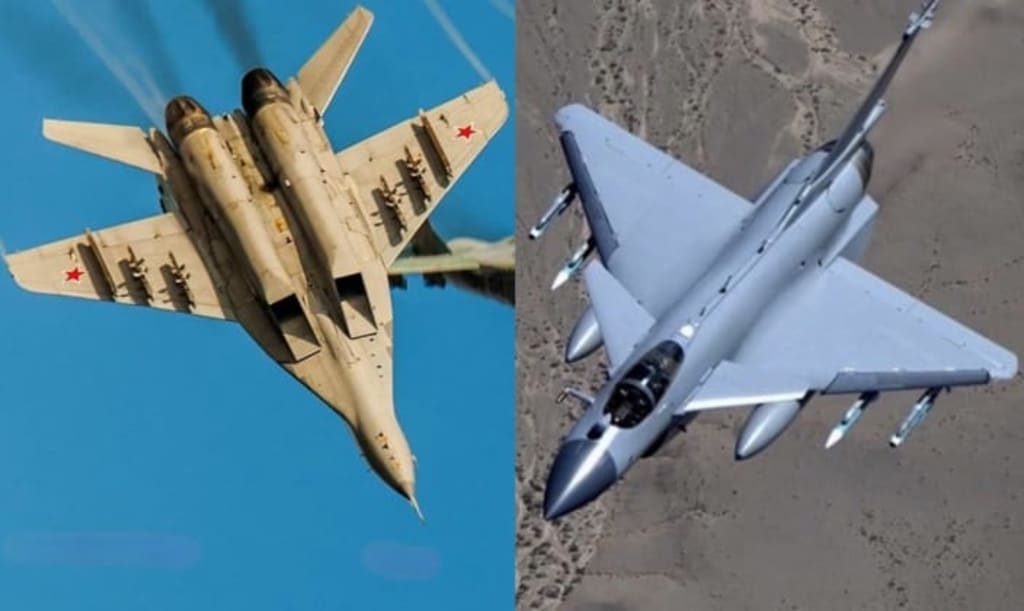
Chinese J-10C vs. Russian MiG-29M: Which is the Best Choice For Egypt’s Air Force?
As Egypt continues to modernize its military and diversify its defense partnerships, one of the key considerations is the selection of advanced multirole fighter jets. The country already operates a mixed fleet of American F-16s, French Rafales, and Russian MiG-29Ms. However, emerging regional threats and the need for technological parity with rivals have sparked interest in new acquisitions—most notably between the Chinese J-10C and the Russian MiG-29M. But which of these two aircraft better suits Egypt's strategic needs?
1. Technical Overview: J-10C vs. MiG-29M
The J-10C is a fourth-generation-plus multirole fighter developed by China’s Chengdu Aerospace Corporation. Featuring an active electronically scanned array (AESA) radar, infrared search and track (IRST) systems, and advanced datalink capabilities, the J-10C is designed to perform both air superiority and precision strike missions. It is powered by the domestically produced WS-10B turbofan engine, giving it improved thrust and maneuverability.
In contrast, the MiG-29M is an upgraded variant of the legacy MiG-29 Fulcrum. While retaining the basic design, it boasts modernized avionics, reduced radar cross-section, and improved multi-role capabilities. It has mechanically scanned pulse-Doppler radar, helmet-mounted sights, and compatibility with a wide array of Russian munitions. Powered by two RD-33MK engines, the MiG-29M has better survivability and performance at high speeds.
2. Combat Capabilities
In terms of air-to-air combat, the J-10C holds a significant edge due to its superior radar and modern missiles such as the PL-10 short-range and PL-15 beyond-visual-range air-to-air missiles, the latter featuring an impressive range of over 200 km. Its integrated electronic warfare systems further enhance survivability and effectiveness in modern combat scenarios.
The MiG-29M, while a solid dogfighter with excellent agility, is hampered by relatively outdated sensors compared to the J-10C. It can carry R-77 and R-73 missiles, but these lag behind China's latest missile technology in both range and electronic counter-countermeasures (ECCM).
When it comes to ground attack, both aircraft are capable of precision strikes. However, the J-10C’s avionics and sensor fusion allow better targeting accuracy and situational awareness. It also offers superior integration of guided bombs and missiles, making it a more effective platform for multirole operations.
3. Operational Cost and Maintenance
One of the key considerations for any air force is operational cost. The J-10C, being a single-engine fighter, is more fuel-efficient and generally cheaper to maintain than the twin-engine MiG-29M. Additionally, the J-10C benefits from China’s relatively low-cost production infrastructure, which translates into reduced acquisition and lifecycle costs.
The MiG-29M, while upgraded, still inherits the MiG-29 family’s reputation for high maintenance demands and relatively short engine lifespan. Countries operating MiG-29 variants have frequently cited concerns over logistics and spare parts, which could present a long-term challenge for Egypt.
4. Geopolitical Considerations
Egypt has traditionally maintained strong defense ties with Russia, evident in its purchase of MiG-29Ms, Su-35s (later canceled), and Ka-52 helicopters. However, recent concerns over Western sanctions on Russia due to the Ukraine conflict have made future acquisitions more politically sensitive and logistically risky.
On the other hand, China offers a non-interventionist, flexible arms policy and is eager to expand its footprint in the Middle East. Acquiring the J-10C could strengthen Egypt’s strategic partnership with China and provide access to a new axis of defense technology without entangling the country in political complications.
5. Interoperability and Training
Egypt’s diverse air force faces challenges in interoperability, with aircraft sourced from the U.S., France, and Russia. Introducing a Chinese fighter adds another layer of complexity. However, the J-10C’s modern digital cockpit and fly-by-wire system may actually make it easier for pilots trained on Western platforms to adapt.
MiG-29M pilots would require less transition training, as Egypt already operates this platform. However, expanding its use would mean committing more deeply to a system that may become harder to support in the coming years.
Conclusion: The Better Choice for Egypt
While the MiG-29M is a proven platform with familiarity in Egypt’s current fleet, it is gradually becoming outdated and harder to support due to geopolitical realities. The J-10C, on the other hand, offers superior avionics, modern weaponry, cost-effectiveness, and a future-proof supply chain.
For an air force looking to remain agile, technologically advanced, and independent of over-reliance on any single defense partner, the J-10C emerges as the smarter, forward-looking choice for Egypt.
About the Creator
Adnan Rasheed
Author & Creator | Writing News , Science Fiction, and Worldwide Update| Digital Product Designer | Sharing life-changing strategies for success.
Keep reading
More stories from Adnan Rasheed and writers in Serve and other communities.
German Soldiers’ Perspective on American Warfare in World War II
German Soldiers’ Perspective on American Warfare in World War II During World War II the German soldiers who fought against the Allies had varying opinions about their adversaries. While some respected the Americans for their resilience and firepower others found their tactics frustrating if not outright infuriating. A key reason for this frustration was the fundamental difference in how the two sides approached combat. American forces relied heavily on artillery and airpower before engaging in direct combat a strategy that many German soldiers perceived as unfair or dishonorable.
By Adnan Rasheed10 months ago in Serve
Iran's plan to hit $20 billion asset of USA
U.S. Military Deployment Toward Iran Explained Recently, U.S. President Donald Trump confirmed that a large American naval force — including the aircraft carrier USS Abraham Lincoln and several warships — has been sent toward the Middle East amid rising tensions with Iran. Trump described this as a “big armada” heading in that direction, though he also said he hopes conflict can be avoided.
By USA daily update 6 days ago in Serve
Middle East on Edge
Escalation on Multiple Fronts The United States and Iran find themselves in a high-stakes standoff that is drawing global concern. In response to mounting tensions with Tehran, Washington has significantly increased its military footprint in the Middle East. This buildup, which includes naval units, air assets, and joint exercises, comes amid heated rhetoric and conflicting strategic aims that could shape the region’s security environment for months — or years — to come.
By USA daily update 5 days ago in Serve



Comments
There are no comments for this story
Be the first to respond and start the conversation.