
The Great Leap Forward:
From Tribe to SuperpowerAmbition, Famine, and Silence

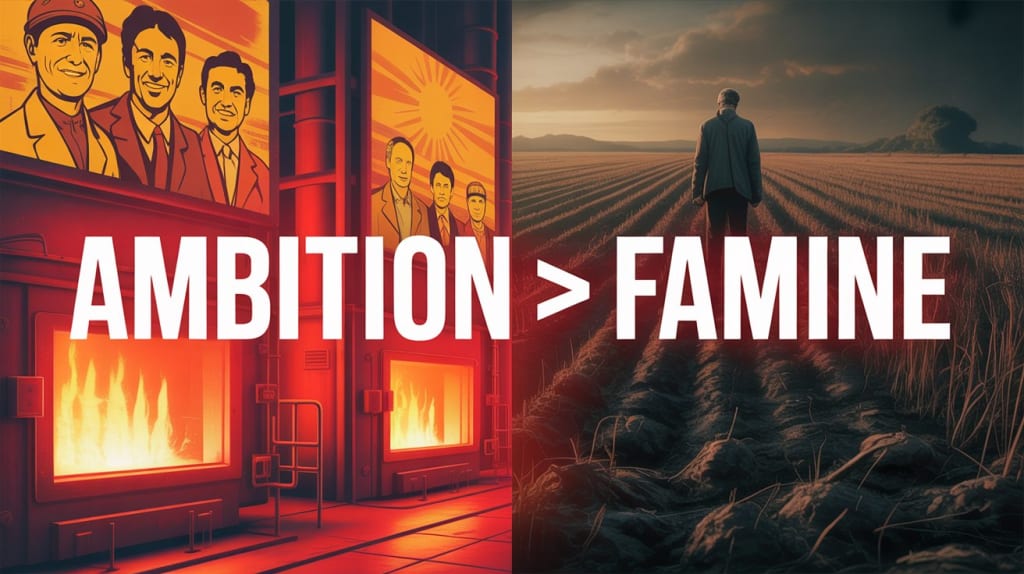
In 1958, the People’s Republic of China embarked on a campaign of breathtaking ambition. Mao Zedong called it the Great Leap Forward, a drive to propel a largely rural nation into the ranks of industrial powers almost overnight. Steel output would soar, agriculture would surge, and China would prove that revolutionary will could bend history itself. Villages were reorganized into vast people’s communes, private farming was abolished, and daily life was reshaped by collective labor and shared mess halls. Across the countryside, millions were mobilized with slogans and songs, urged to outproduce the West through sheer determination. It was a vision of speed and scale without precedent—and it would end in catastrophe.
The heart of the plan lay in transforming agriculture and industry at the same time. Farmers were ordered to abandon traditional practices in favor of untested methods promoted as “scientific,” including deep plowing and dense planting, ideas influenced by Soviet agronomy that ignored local conditions. Harvests were reported as miraculous, not because fields were overflowing, but because officials feared punishment if they told the truth. At the same time, steel became a national obsession. Backyard furnaces sprang up across China, where peasants melted tools, pots, and household metal in crude fires to meet impossible quotas. The result was unusable pig iron, while farms were left without equipment and workers were pulled from the fields at the most critical moments of the growing season.
As exaggerated reports flowed upward, the state requisitioned grain based on imaginary surpluses. Storehouses were filled, exports continued, and urban areas were prioritized, while rural communities were left with little to eat. When food ran out, the system allowed no retreat. To admit failure was to challenge the revolution itself. Local leaders enforced quotas with violence and intimidation, branding dissenters as enemies of progress. Communal kitchens closed when supplies vanished, yet families were forbidden to cook privately. Across vast regions, people survived on leaves, bark, and mud, and many did not survive at all.
Between 1959 and 1962, China descended into one of the deadliest famines in human history. Exact numbers remain contested, but most historians agree that tens of millions died from starvation and related causes. Entire villages were hollowed out. Children were orphaned, elders collapsed in fields, and the social fabric frayed under the strain of hunger and fear. Natural disasters occurred during these years, but they do not explain the scale of the tragedy. The famine was primarily man-made, driven by policy, coercion, and a political culture that rewarded silence over truth.
At the top, warning signs were visible but slow to prompt change. Some leaders quietly investigated conditions and reported disaster, while others continued to echo optimistic statistics. Mao himself eventually stepped back from day-to-day economic management, allowing more pragmatic figures to reverse the most extreme policies. Communes were scaled down, private plots cautiously returned, and grain procurement reduced. By 1962, the famine eased, not because the original vision succeeded, but because it was abandoned.
Yet the Great Leap Forward did not end with public reckoning. There were no national memorials, no open trials, no official admission of responsibility. Discussion of the famine was suppressed for decades, folded into vague references to “three years of difficulty.” Survivors learned to keep their memories private, sharing stories only in whispers. The silence became part of the legacy, as enduring as the loss itself.
Today, the Great Leap Forward stands as a stark reminder of how power, ideology, and fear can combine to devastating effect. It reveals the human cost of policies that prioritize targets over lives and loyalty over evidence. Behind the grand promises of rapid progress were ordinary people whose suffering went unseen and unspoken. Their story is not only about China’s past, but about a universal warning: when ambition refuses to listen, history records its verdict in hunger, loss, and silence.
About the Creator
The Role of Cryptocurrency Coins in Digital Business Ecosystems
Digital business ecosystems are increasingly built on decentralized infrastructure, where trust minimization, programmability, and transparency are essential. Within this environment, the cryptocurrency coin functions as more than a speculative asset. It operates as an economic primitive that enables value exchange, incentivizes participation, and aligns network behavior. As enterprises experiment with blockchain-based models, understanding how cryptocurrency coins integrate into digital ecosystems has become strategically important.
By Siddarth Dabout 12 hours ago in The Chain



Comments
There are no comments for this story
Be the first to respond and start the conversation.