
India HVAC Systems Market Size and Forecast (2026–2034)
Urbanization, Energy Efficiency, and Indoor Air Quality Redefine Climate Control in India

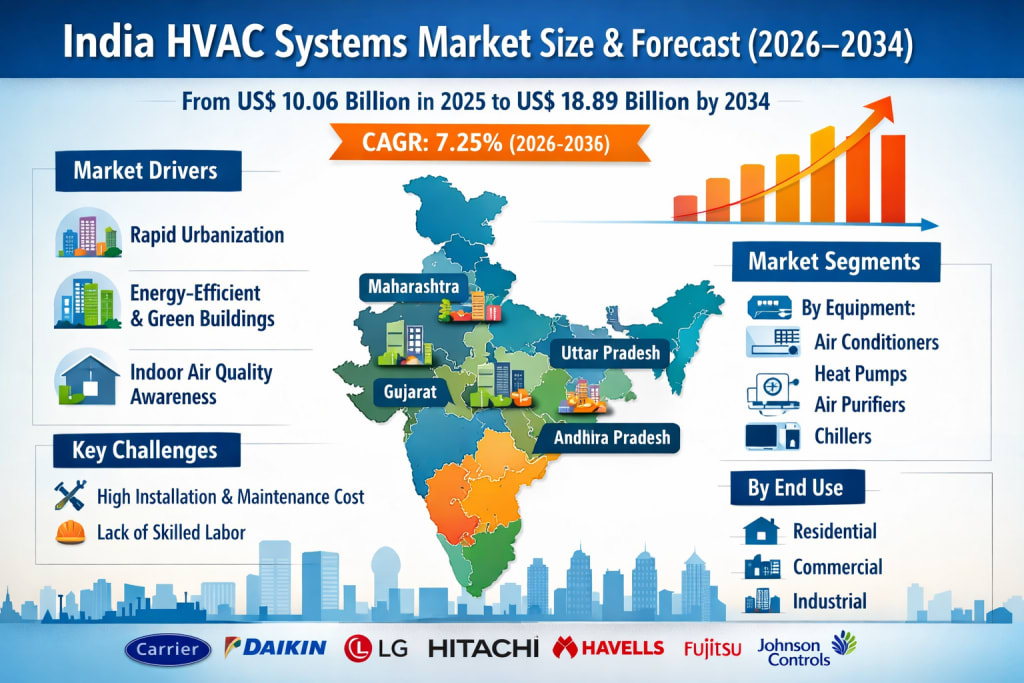
India HVAC Systems Market Overview
The India HVAC Systems Market is entering a decisive phase of transformation, supported by rapid urbanization, infrastructure expansion, climate challenges, and a growing focus on energy efficiency. According to Renub Research, the market is expected to expand steadily from US$ 10.06 billion in 2025 to US$ 18.89 billion by 2034, registering a compound annual growth rate (CAGR) of 7.25% during the forecast period 2026–2034.
HVAC—Heating, Ventilation, and Air Conditioning—systems play a critical role in regulating indoor temperature, humidity, and air quality across residential, commercial, industrial, and institutional environments. In India’s diverse climatic conditions, where extreme heat, humidity, and pollution prevail in many regions, HVAC systems have evolved from being a luxury to an essential infrastructure component.
The market’s expansion is closely tied to India’s urban population growth, rising disposable incomes, large-scale construction activity, and increasing awareness of indoor air quality. From homes and offices to hospitals, airports, data centers, and metro systems, HVAC adoption continues to rise across every major sector.
India HVAC Systems Market Outlook
India’s HVAC ecosystem includes air conditioners, chillers, furnaces, boilers, heat pumps, air handling units, ventilation fans, air purifiers, and dehumidifiers. These systems are widely deployed in residential apartments, commercial complexes, industrial facilities, healthcare institutions, educational campuses, and transport infrastructure.
Several macroeconomic and environmental factors are accelerating HVAC adoption in India. The country’s tropical and subtropical climate drives consistent demand for cooling solutions, while rapid urban expansion fuels the need for climate-controlled indoor environments. Additionally, the rise of organized retail, IT parks, data centers, and modern healthcare facilities has significantly boosted demand for advanced HVAC installations.
Government initiatives promoting smart cities, green buildings, and energy efficiency have further strengthened the market outlook. Post-pandemic awareness regarding ventilation and indoor air quality has also reshaped consumer priorities, increasing the adoption of air purification and advanced ventilation technologies.
Key Growth Drivers in the India HVAC Systems Market
Rapid Urbanization and Infrastructure Development
Urbanization remains one of the most powerful growth engines for the Indian HVAC market. India’s urban population is projected to rise from nearly 500 million to 820 million by 2047, leading to massive construction of residential complexes, office buildings, malls, airports, metros, and public infrastructure.
With rising urban density, climate-controlled indoor spaces are no longer optional. HVAC systems have become standard installations in new residential and commercial developments, especially in metro and Tier-II cities. Government initiatives such as smart cities, metro rail expansion, and airport modernization are further driving large-scale HVAC deployment.
In the Union Budget 2025–26, proposals to develop and connect 120 new airports over the next decade are expected to significantly increase demand for commercial HVAC systems across terminals, lounges, and auxiliary facilities.
Growing Demand for Energy-Efficient and Green Buildings
Energy efficiency is reshaping the HVAC market in India. Rising electricity tariffs and sustainability goals have accelerated demand for inverter-based air conditioners, VRF (Variable Refrigerant Flow) systems, smart HVAC controls, and energy-optimized chillers.
India’s strong commitment to green construction is reflected in its global ranking. In 2023, the country ranked third worldwide for Leadership in Energy and Environmental Design (LEED)-certified projects, with 248 completed green buildings covering over 7.23 million gross square meters. These developments require advanced HVAC systems that minimize energy consumption while maintaining optimal indoor comfort.
Government policies promoting energy conservation and reduced carbon emissions continue to favor HVAC manufacturers offering high-efficiency and eco-friendly solutions.
Rising Awareness of Indoor Air Quality and Health
Indoor air quality (IAQ) has emerged as a major market driver, particularly after the pandemic. High pollution levels in Indian cities have heightened health concerns related to respiratory illnesses, allergies, and long-term exposure to contaminated air.
Residential consumers, hospitals, schools, and commercial establishments are increasingly adopting HVAC systems equipped with advanced filtration, ventilation, and air purification features. In April 2025, India’s Technology Development Board supported indigenous innovation by funding a clean-air project focused on developing wall-mounted indoor air purification systems, highlighting national efforts to improve indoor air standards.
This rising health consciousness is expected to sustain long-term growth in ventilation systems and air purifiers across India.
Challenges in the India HVAC Systems Market
High Installation and Maintenance Costs
Despite strong demand, high upfront installation costs remain a major challenge. Advanced HVAC systems require significant investment in equipment, electrical infrastructure, and skilled installation. For small businesses and price-sensitive residential users, this can act as a barrier to adoption.
Additionally, maintenance and operational expenses contribute to higher total cost of ownership, limiting penetration in budget-constrained markets.
Lack of Skilled Workforce and Infrastructure Constraints
The HVAC industry in India faces a shortage of trained professionals capable of designing, installing, and maintaining advanced systems. Improper installations often lead to energy inefficiency, system failures, and increased operational costs.
Power supply fluctuations in certain regions further affect HVAC performance. Addressing skill development and infrastructure reliability remains crucial for sustained market growth.
India Heat Pump Systems Market
The heat pump segment is gaining traction as India seeks energy-efficient and environmentally friendly heating and cooling solutions. Heat pumps offer superior efficiency by transferring heat rather than generating it, making them suitable for water heating, space heating, and combined heating-cooling applications.
Rising electricity costs, sustainability mandates, and government focus on reducing carbon emissions are supporting increased adoption of heat pump systems in residential and commercial buildings.
India Air Purifier Market
The India air purifier market is witnessing rapid growth due to worsening air pollution and rising health awareness. Modern air purifiers equipped with HEPA filters, activated carbon filters, and smart sensors are becoming mainstream across households and offices.
Commercial spaces such as hospitals, hotels, and corporate offices are also adopting air purification solutions to ensure healthier indoor environments. As respiratory health awareness continues to grow, air purifiers are transitioning from premium products to essential household appliances.
India Residential HVAC Systems Market
The residential HVAC segment is expanding rapidly due to urban housing growth, rising disposable incomes, and changing lifestyle expectations. Split ACs and inverter-based systems dominate residential demand due to their energy efficiency and precise temperature control.
Homeowners increasingly prioritize comfort, low noise levels, and improved air quality, driving adoption of advanced HVAC solutions across apartments, villas, and high-rise buildings.
India Commercial HVAC Systems Market
Commercial HVAC demand continues to rise with the expansion of offices, malls, hotels, hospitals, airports, and data centers. Centralized HVAC systems, chillers, and VRF installations are widely used to support high-occupancy and continuous operations.
Energy efficiency regulations, sustainability targets, and productivity requirements heavily influence HVAC selection in the commercial sector, making this one of the most lucrative market segments.
State-Wise Market Insights
Maharashtra HVAC Market
Maharashtra leads the Indian HVAC market due to extensive urbanization and industrial activity in cities such as Mumbai, Pune, and Nagpur. High humidity levels and growing data center infrastructure drive demand for advanced, energy-efficient HVAC systems.
Uttar Pradesh HVAC Market
Rapid urban development in Noida, Greater Noida, Lucknow, and Kanpur is fueling steady HVAC adoption across residential and commercial projects. Government infrastructure initiatives further strengthen market prospects.
Andhra Pradesh HVAC Market
Industrial corridors, ports, and smart city developments in Visakhapatnam, Vijayawada, and Amaravati are driving HVAC demand in both industrial and commercial applications.
Gujarat HVAC Market
Gujarat’s strong manufacturing base, rising urban temperatures, and emphasis on industrial development make it a key HVAC market, particularly for energy-efficient cooling solutions.
Market Segmentation
By Equipment:
Heat Pumps, Air Conditioning, Boilers, Air Purifiers, Chillers, Air Handling Units, Unitary Heaters, Ventilation Fans, Dehumidifiers, Others
By End Use:
Residential, Commercial, Industrial
By Top States:
Maharashtra, Tamil Nadu, Karnataka, Gujarat, Uttar Pradesh, West Bengal, Rajasthan, Telangana, Andhra Pradesh, Madhya Pradesh
Competitive Landscape
Major players operating in the India HVAC Systems Market include Carrier Corporation, Daikin Industries, Ltd., Fujitsu, Haier Group, Havells India Ltd., Hitachi Ltd., Johnson Controls, and LG Electronics.
Each company is evaluated across five key viewpoints: overview, key leadership, recent developments, SWOT analysis, and revenue performance.
Final Thoughts
The India HVAC Systems Market is on a strong and sustainable growth trajectory. With market value expected to nearly double by 2034, HVAC systems are becoming a foundational element of India’s urban and industrial development. Rising infrastructure investments, energy-efficient technologies, and health-focused indoor environments will continue to drive long-term demand.
While challenges such as high installation costs and workforce shortages persist, technological innovation, government support, and increasing consumer awareness are set to outweigh these barriers. As India advances toward smarter, greener, and healthier cities, HVAC systems will remain central to the nation’s built environment and economic progress.
About the Creator
Sakshi Sharma
Content Writer with 7+ years of experience crafting SEO-driven blogs, web copy & research reports. Skilled in creating engaging, audience-focused content across diverse industries.
Keep reading
More stories from Sakshi Sharma and writers in The Swamp and other communities.
Global Consumer Electronics Market Size & Forecast 2025–2033: Smart Devices, Connectivity, and the Next Digital Wave
Global Consumer Electronics Market Overview The Global Consumer Electronics Market is entering a new era of accelerated digital transformation. According to Renub Research, the market is expected to grow from US$ 1,196.45 billion in 2024 to US$ 2,099.93 billion by 2033, expanding at a CAGR of 6.45% during 2025–2033. This growth reflects the world’s increasing dependence on smart devices, advanced connectivity, and integrated digital lifestyles.
By Sakshi Sharma2 days ago in The Swamp
Shipping Giant Maersk to Take Over Panama Canal Ports After Court Ruling
In a major development with far-reaching implications for global trade and geopolitics, Danish shipping giant Maersk is set to assume control of key port operations along the Panama Canal following a landmark ruling by Panama’s Supreme Court. The decision comes after long-standing contracts held by Hong Kong-based CK Hutchison were ruled unconstitutional, paving the way for Maersk’s subsidiary to temporarily operate the strategic Balboa and Cristóbal terminals at either end of the canal. Al Jazeera +1 The Panama Canal is one of the world’s most vital maritime chokepoints, handling nearly 40 percent of U.S. container traffic and about 5 percent of global seaborne commerce. Control of the adjacent port facilities has historically been a symbol of influence in global shipping routes and geopolitical power. Al Jazeera Court Ruling Ends Long-Standing Concession On January 30, 2026, Panama’s Supreme Court annulled the contracts granting CK Hutchison’s subsidiary, Panama Ports Company (PPC), the rights to operate the Balboa and Cristóbal ports. The court found that the concession — first awarded in the 1990s and extended most recently in 2021 — violated constitutional requirements and lacked sufficient competitive bidding and public interest safeguards. Investing.com The ruling effectively terminated nearly three decades of CK Hutchison’s involvement at these strategic terminals — a decision that will have ripple effects across the global shipping industry. The nullification also affects a planned $23 billion sale of CK Hutchison’s global port assets, involving major investors such as BlackRock and Mediterranean Shipping Company. ft.com Maersk Steps In as Temporary Operator In response to the court’s decision, Panama’s Maritime Authority confirmed that APM Terminals Panama — a local subsidiary of Maersk Group — will act as temporary administrator of the Balboa and Cristóbal ports once the concession formally ends. This move ensures operational continuity while the government prepares a new bidding process for long-term port concessions. s President, José Raúl Mulino, emphasized that port operations will continue without disruption during the transition period. He underscored the economic importance of these terminals to Panama’s economy and the global shipping network. mb.com.ph Maersk’s temporary stewardship reflects its deep experience in maritime logistics and container transportation, underscoring the company’s central role in global supply chains. The firm’s stewardship is seen as a stabilizing force, ensuring that trade flows through the canal region remain steady even amid legal and political upheavals. Geopolitical Context and Reactions The court’s ruling has stirred international debate, especially given the strategic significance of the Panama Canal region in U.S.–China competition. For years, the United States has expressed concern about Chinese influence over critical global infrastructure. Panama’s decision aligns with broader efforts to limit foreign control over strategic assets and reaffirm sovereign oversight of its key ports. isp.netscape.com Beijing has publicly criticized the ruling, with Hong Kong officials stating they “firmly reject” the decision and view it as hostile to legitimate business interests. Chinese authorities have vowed to protect the rights of their companies through appropriate legal channels. euronews Meanwhile, critics of the ruling argue that nullifying longstanding contracts could undermine investor confidence and legal certainty in Panama, potentially impacting future foreign investment. PPC itself warned that the decision could harm the welfare of thousands of Panamanian families dependent on port-related activity. taipeitimes.com Economic and Trade Implications The Panama Canal and its adjacent ports are linchpins of global maritime trade. Cargo moving between the Atlantic and Pacific oceans accounts for a significant share of international shipping — particularly for container traffic involving goods between Asia, Europe, and the Americas. Any disruption to port operations could have cascading effects on global logistics costs and supply chain efficiency. Maersk’s entry as a temporary operator may reassure markets and shippers that commercial continuity remains a priority. By maintaining the operation of the Balboa and Cristóbal terminals, Maersk helps ensure that cargo flows through one of the globe’s busiest trade arteries will not be interrupted. KOB.com The transition also highlights the competitive nature of global port management. As nations and multinational corporations vie for influence over key logistics hubs, companies like Maersk — with extensive expertise in port operations and maritime transport — are well positioned to play pivotal roles in shaping the future of international trade infrastructure. Looking Ahead Panama has signaled that a new tender process will soon be launched to award long-term operating contracts for the canal’s major ports. This open process aims to attract top global logistics firms and ensure that future concessions serve Panama’s strategic interests while promoting efficient and secure global trade. KOB.com In the meantime, Maersk’s temporary administration of the canal’s ports marks a major shift in the region’s maritime dynamics. It underscores how legal decisions can quickly reshape economic and geopolitical landscapes — especially when involving critical infrastructure that underpins global commerce. As Panama navigates this transition, stakeholders around the world will be watching closely how the new port concession process unfolds and how it might influence the balance of power in global shipping and trade.
By Fiaz Ahmed 2 days ago in The Swamp




Comments
There are no comments for this story
Be the first to respond and start the conversation.