
King George VI
"The Highest Of Distinctions Is Service To Others"
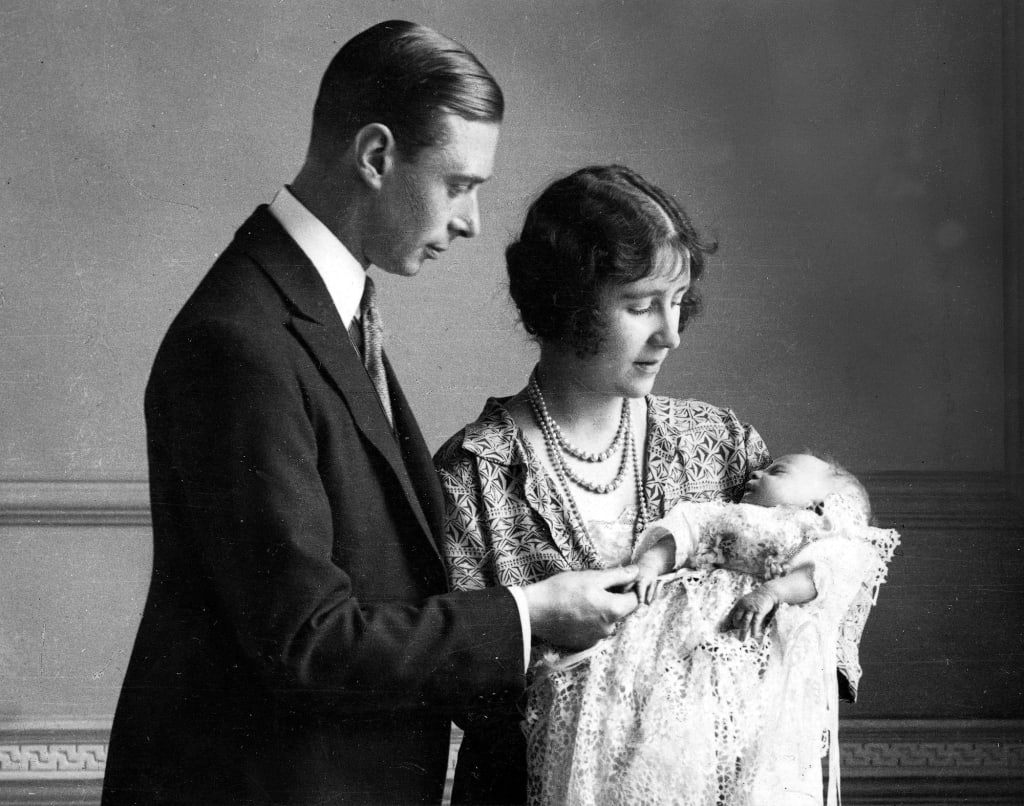
Our dear Queen’s (Elizabeth II) father, this King served our country through the Second World War. Unexpectedly becoming King after King Edward VIII abdicated, George VI became a conscientious and dedicated King, working hard to adapt to the role he was “suddenly thrown into.” With the support of his wife, Elizabeth, being reserved in nature with a deep religious belief, George VI overcame hardships --- both physical and political --- to become the King we admire today.
Albert Frederick Arthur George was born at York Cottage, Sandringham Estate in Norfolk, on 14th December, 1895, 34 years after Prince Albert, the Prince Consort to Queen Victoria, died. The Prince Consort was his great-grandfather. Queen Victoria remarked on this birth, on such a sad day: “I am all impatience to see the new one, born on such a sad day but rather more dear to me, especially as he will be called by that dear name which is a byword for all that is great and good.” The new baby was baptized 3 months later at St.Mary Magdalene Church, Sandringham. Within the family he was known as “Bertie,” who was fourth in line to the throne. As young man, many knew him as “Albert.” This new baby was ‘formally’ known as “His Highness Prince Albert of York.”
Bertie was the second son of King George V and Victoria May (Mary of Teck). Hi childhood was not an easy one. Like all children of the upper-classes, Bertie was looked after by a nanny. Although he loved his mother, the affection was not always returned, and his father came across as harsh and critical. At about eight years of age, Bertie developed a stammer, and he also suffered having to wear painful leg braces to correct knock knees. Being often ill and 'easily frightened,’ Bertie was prone to tears as a child. The stammer lasted for many years and Bertie even had therapy for this, which helped him through many a Royal speech. Being naturally left-handed, he was ‘forced’ to write with his right hand (a common practice at the time) which did not help. Bertie also suffered from chronic stomach problems.
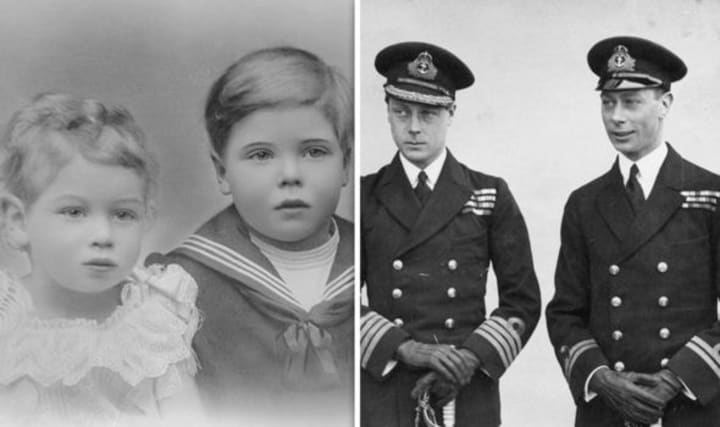
Queen Victoria died on 22nd January, 1901, and Bertie was now third in line to the throne.
Bertie now attended the Royal Naval College, Osborne, as a naval cadet. Passing the final examination in 1911, he progressed to the Royal Naval College, Dartmouth. In 1910, his grandfather died, King Edward VII, and Bertie’s father now became King George V. His elder brother was now the Prince of Wales and Bertie was now second in line to the throne.
Bertie joined the Royal Navy and served on the HMS Collingwood during The Great War (World War One). He saw action at the Battle of Juteland in May 1916, and in 1919 Bertie joined the Royal Air Force and certified as a pilot.
After the War, Bertie studied at the Trinity College, Cambridge. Here he studied history, economics and civics for a year. His father, the King, ‘created’ him the Duke of York, Earl of Inverness and Baron Killarney on 4th June, 1920. Taking on more ‘official duties,’ the now Duke of York toured coal mines, factories and rail yards representing the King. He now became known as the “Industrial Prince.”
Being physically active, Bertie enjoyed tennis, playing at Wimbledon in the Men’s Doubles with Louis Greig in 1926. They lost in the first round. Developing an intense interest in the working conditions of the day, Bertie became the President of the Industrial Welfare Society. “His series of annual summer camps for boys between 1921 and 1939, brought together boys from different social backgrounds.”
In 1920, Bertie fell in love with Elizabeth Bowes-Lyon and proposed to her --- three times. Finally accepting him, the young couple married in Westminster Abbey on 26th April, 1923. Marrying Elizabeth, who was not of Royal birth, was considered ‘a modernising gesture.’
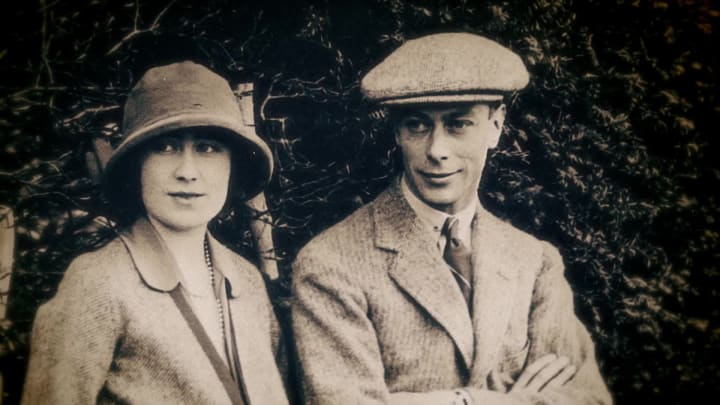
From December 1924 to April 1925, the Duke and Duchess of York toured Kenya, Uganda and the Sudan, travelling via the Suez Canal and Aden. Knowing how her husband’s stammer was making life difficult, Elizabeth sought the help of Lionel Logue, who was an Australian speech therapist living in London. Gradually, the Prince’s began to improve.
In 1926, their first daughter was born, Elizabeth (‘Lilibet’ within the family) and their second daughter, Margaret, was born in 1930. The young family had a quiet and happy life living at 145, Piccadilly.
Life now changed quickly for the Duke and Duchess of York. King George V died in January 1936 and King Edward VIII abdicated in December of the same year. Bertie now became King George VI and his Coronation took place at Westminster Abbey on 12th May, 1937. His wife, Elizabeth, was crowned as Queen Consort. Breaking with tradition, the new King’s mother, Queen Mary, attended her son’s Coronation to show her support. Bertie was now the King of England, a ‘post’ he never expected to have.
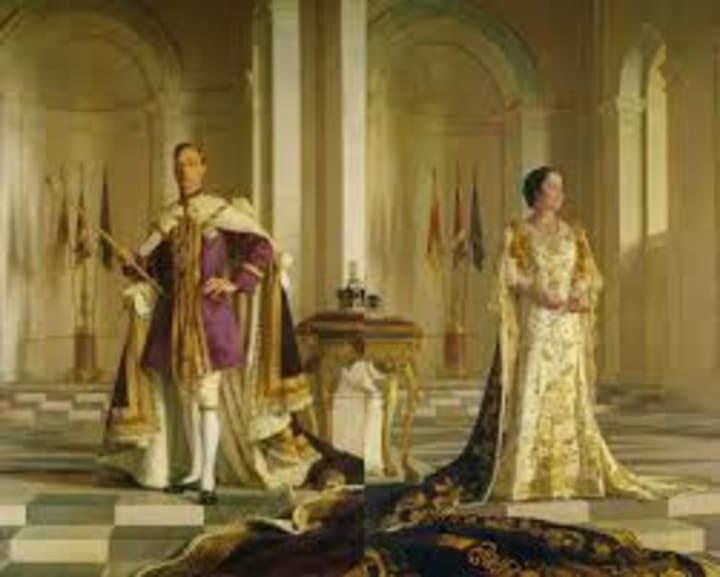
The new King and Queen took two overseas tours, to France and to North America, both of which promised greater strategic advantages just before World War Two.
World War Two started in September, 1939. The King and Queen stayed in London during the War, staying at Buckingham Palace and spending some nights at Windsor Castle. The Royal family shared with their people the same dangers and deprivations the War brought, including food and clothing rationing. In August 1942, the Duke of Kent, the King’s brother, was killed on active service. In 1940, Winston Churchill became the Prime Minister and had lunch, privately, with the King for four and a half years, discussing the war in secret and with ‘frankness.’ The two developed the “closest personal relationship in modern British history between a Monarch and a Prime Minister.” The King visited the troops in North Africa in 1943, and later King George VI visited the troops at Malta, bestowing on the entire island the honour of the George Cross, which he himself had instituted to honour exceptional acts of bravery by civilians. Ten days after the D-Day Invasion, the King visited the troops in Normandy.
VE Day (Victory in Europe) was on 8th May, 1945. People flocked to Buckingham Palace where King George VI and Queen Elizabeth, with their two daughters, Princess Elizabeth and Princess Margaret, and Winston Churchill (the then Prime Minister) stood on the balcony and everyone cheered --- the Royal family and the people together. “The war had immeasurably strengthened the link between the King and his people.”
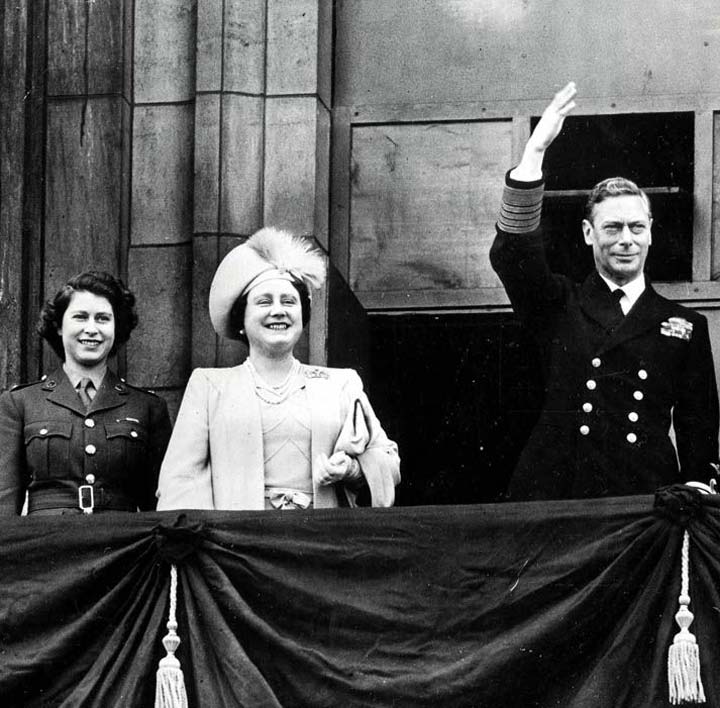
In 1947, the King undertook a major tour of South Africa, with the Queen and the two Princesses. This was the first time a Monarch had gone on tour with his ‘whole’ family. It was in this same year (1947) that King George VI ceased to be the Emperor of India. The year before (January 1946), King George VI addressed the United Nations at their first assembly, held at the time in London, and reaffirmed “our faith in the equal rights of men and women and of nations great and small.”
The stress of the War had made the King ill, his health becoming worse by his heavy smoking. The King developed lung cancer, as well as arterio sclerosis and Buerger’s disease. As her father’s health became worse, the Princess Elizabeth and her husband, Prince Philip, took on more and more ‘Royal duties.’ The young couple went on a month-long tour of Canada in October 1951. September, the month before, King George VI had his left lung removed.
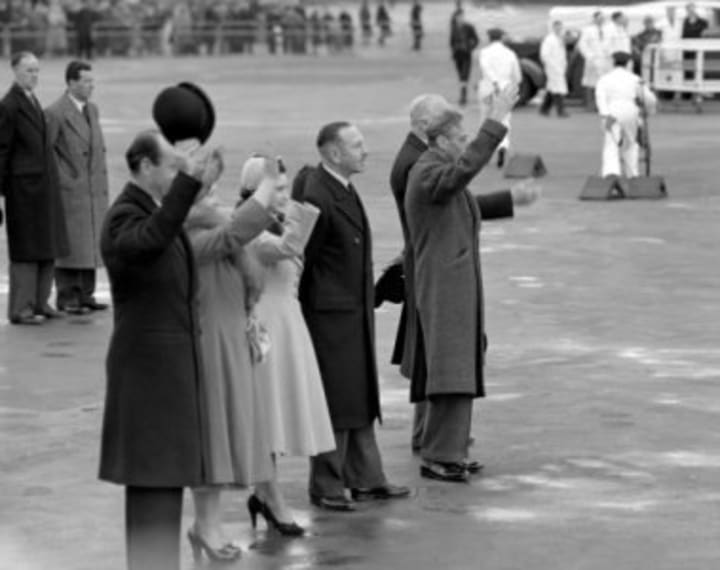
Princess Elizabeth and Prince Philip left from London Airport, 31st January, 1952, for their tour of Australia via Kenya. The King saw his daughter off. It was the last time that father and daughter saw each other. Six days later, on the 6th February, 1952, the King died in his bed at Sandringham House, Norfolk. His daughter, who was now Queen Elizabeth II, came straight home to Britain from Kenya.
King George VI laid in state at Westminster Hall from 11th February. The King’s funeral was on the 15th at St. George’s Chapel, Windsor Castle. “Bertie” was buried in the King George VI Memorial Chapel inside St. George’s on the 26th March, 1969, after having been interred (initially) in the Royal vault.
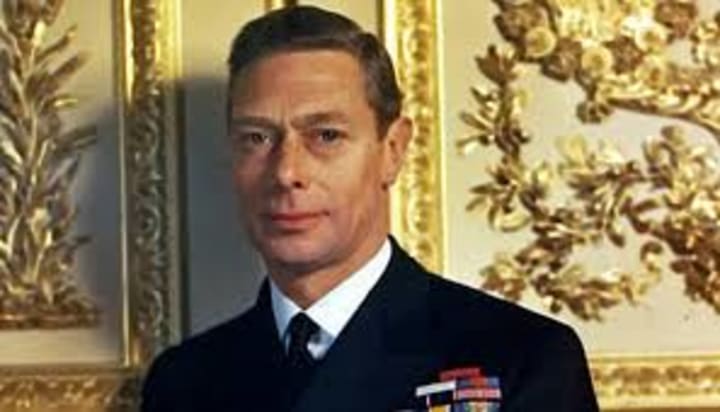
Prince Albert, “Bertie,” became the King of England when he was not expected to and so did an amazing ‘job.’ Not only was this man a loving and caring family man, he overcame “hurdles” with the support of his wife, Elizabeth, to become the King to steer England through the Second World War, restoring the popularity of the British Monarchy. To me, King George VI comes across as a very “human” King.
(My research comes from: Wikipedia, The Royal Family and Biography.com)
About the Creator
Ruth Elizabeth Stiff
I love all things Earthy and Self-Help
History is one of my favourite subjects and I love to write short fiction
Research is so interesting for me too
Keep reading
More stories from Ruth Elizabeth Stiff and writers in The Swamp and other communities.
The Victorian Era
“A Golden Age” “A Golden Calm” “An Indian Summer” “A Long Afternoon” “When she came to the throne coaches still ran; men wore stocks, shaved their upper lips and ate oysters out of barrels. Women said ‘La!’ and owned no property. Well-nigh two generations had slipped by --- of steamboats, railways, telegraphs, telephones, bicycles, electric light and now these motor cars. Morals had changed, manners had changed. The middle class (had been) buttressed, chiselled, polished, till it was almost indistinguishable from the nobility. (It was) an era that had canonised hypocrisy, so that to seem respectable was to be.” (Soames Forsyte reflects on Victoria’s reign, he was a character in “The Forsyte Saga” by John Galsworthy)
By Ruth Elizabeth Stiff5 years ago in The Swamp
China's Net Gold Imports Through Hong Kong Fall 24% in December, but Premiums and Retail Demand Soar in January
China’s gold market sent mixed signals at the turn of the year. Net gold imports through Hong Kong — a key conduit for bullion flows into mainland China — fell by 24% in December, reflecting a seasonal slowdown and tighter price conditions. Yet by January, domestic premiums jumped and retail demand surged, underscoring resilient appetite among Chinese consumers and investors despite global price volatility.
By Salaar Jamali6 days ago in The Swamp




Comments
There are no comments for this story
Be the first to respond and start the conversation.