
Skywatching in February 2026
Planetary Pairings, Winter Constellations, and Celestial Highlights You Can’t Miss
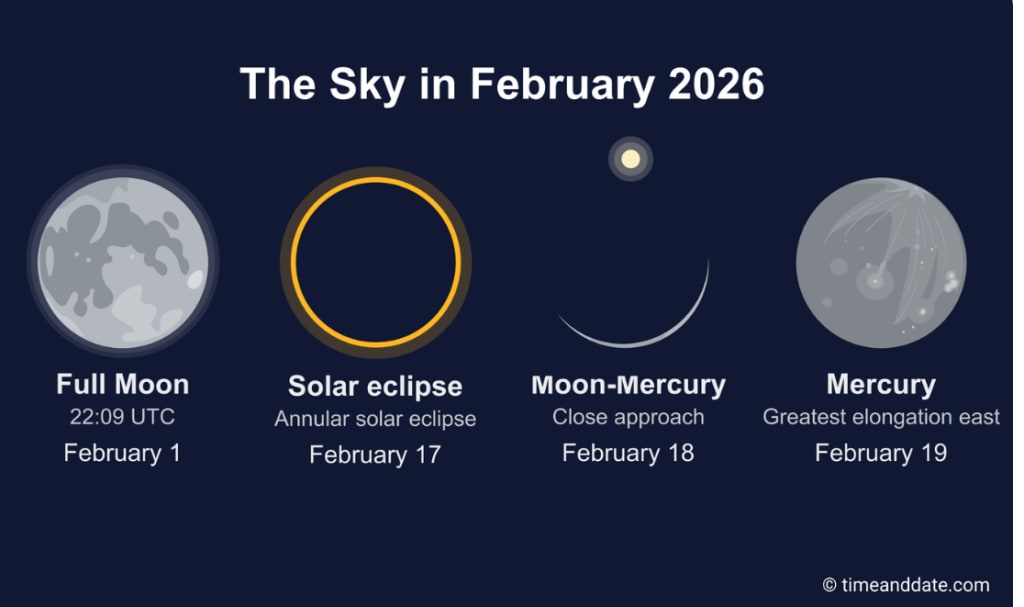
February 2026 offers skywatchers a dramatic blend of brilliant planets, deep-sky treasures, and crisp winter constellations. Long nights and cold, clear air make this one of the best months of the year to step outside and look up. Whether you’re an early riser catching planets before dawn or an evening observer scanning star clusters, this month’s sky promises memorable moments.
Below is your complete guide to skywatching in February 2026.
Brilliant Planets Light Up the Sky
Venus Dazzles Before Sunrise
The unmistakable glow of Venus dominates the predawn sky throughout February. Rising well before the Sun, Venus shines like a brilliant beacon in the east. Its steady, silvery light outshines every star and most planets, making it easy to spot even for beginners.
With binoculars or a small telescope, observers may notice Venus displaying a distinct phase, similar to the Moon. As it orbits closer to Earth in its interior path around the Sun, its crescent shape becomes more pronounced. February mornings are an excellent time to appreciate this planetary transformation.
Jupiter Reigns in the Evening
High in the evening sky, Jupiter remains a dominant presence. As the largest planet in our solar system, Jupiter shines steadily and does not twinkle like nearby stars.
Through a modest telescope, you can witness the planet’s cloud bands and possibly its four largest moons — Io, Europa, Ganymede, and Callisto — often called the Galilean moons after their discoverer, Galileo Galilei. Watching these moons shift position night after night adds a dynamic dimension to winter observing.
Mars Adds a Reddish Glow
The ruddy light of Mars continues to catch attention in February’s night sky. Though not as bright as during opposition, Mars is still easily visible to the naked eye.
With a telescope, patient observers might detect subtle surface markings or the planet’s polar ice caps, depending on atmospheric conditions. Mars’ distinct orange hue makes it easy to identify among surrounding stars.
The Splendor of Winter Constellations
February evenings are prime time for the grand parade of winter constellations.
Orion the Hunter
The most recognizable constellation of the season is Orion. Its three evenly spaced belt stars form a straight line that serves as a celestial signpost.
Below the belt lies the Orion Nebula, one of the most breathtaking deep-sky objects visible without advanced equipment. This stellar nursery appears as a faint, misty patch to the naked eye under dark skies and reveals intricate detail through binoculars or a telescope.
Taurus and the Pleiades
To the upper right of Orion sits Taurus, the Bull. Taurus hosts two famous star clusters.
The first is the Hyades cluster, forming a V-shape that outlines the Bull’s face. The second is the stunning Pleiades, also known as the Seven Sisters. This compact cluster sparkles like a tiny dipper of diamonds and is best viewed through binoculars, which reveal dozens of stars.
Gemini Shines Bright
Nearby, Gemini rises prominently. Marked by the bright twin stars Castor and Pollux, Gemini is another zodiac constellation that commands attention on winter nights. Pollux, slightly brighter and more golden in color, makes an attractive contrast with its twin.
A Glimpse of the Moon’s Phases
February 2026 offers several striking lunar phases.
The Full Moon, often called the Snow Moon in North America due to heavy winter snowfall, illuminates the sky mid-month. While bright moonlight can wash out faint stars, it also provides an excellent opportunity to explore lunar craters and mountain ranges with binoculars or a telescope.
During the First Quarter and Last Quarter phases, shadows along the Moon’s terminator (the line dividing light and dark) enhance surface detail. These phases are ideal for close inspection of lunar features.
Deep-Sky Delights for Dark Nights
When the Moon is absent from the sky, February’s long nights reveal extraordinary deep-sky objects.
The Orion Nebula remains the crown jewel, but other treasures await patient observers. The Beehive Cluster in Cancer and various galaxies in Leo begin climbing higher in the late evening, hinting at the approaching spring galaxy season.
Even suburban observers can appreciate bright clusters and nebulae with binoculars. Rural skywatchers, however, will be rewarded with far richer detail and faint background stars invisible under city lights.
Tips for Comfortable Winter Observing
Skywatching in February requires preparation. Cold temperatures can quickly cut an observing session short if you’re not dressed properly.
Wear multiple thermal layers.
Use insulated gloves that still allow you to handle equipment.
Bring a thermos of a warm drink.
Allow telescopes time to acclimate to outdoor temperatures for clearer views.
Red flashlights help preserve night vision while reading star charts. And remember — patience is key. The longer your eyes adjust to darkness, the more stars you’ll see.
Why February Is Special for Stargazers
February offers a unique balance: long nights like January but slightly milder conditions as spring approaches. The winter constellations remain in full display, while early hints of spring star patterns rise later in the evening.
The crisp air often provides exceptional atmospheric clarity, making stars appear sharper and more brilliant. For photographers, this can mean improved opportunities to capture Orion, Taurus, and bright planetary conjunctions.
Final Thoughts
Skywatching in February 2026 combines dazzling planets, iconic constellations, and deep-sky wonders into one unforgettable month. From the radiant glow of Venus before sunrise to Jupiter’s commanding evening presence and Orion’s majestic stance overhead, the heavens offer something for every observer.
Bundle up, step outside, and take a moment to reconnect with the cosmos. The winter sky is waiting — brilliant, vast, and full of stories written in starlight.
About the Creator
Keep reading
More stories from Aqib Hussain and writers in The Swamp and other communities.
Japan Seizes Chinese Fishing Boat and Arrests Skipper Amid Rising East China Sea Tensions
In a dramatic escalation of long-standing maritime tensions, Japan has seized a Chinese fishing boat and arrested its skipper in disputed waters of the East China Sea. The incident, which unfolded near the contested Senkaku Islands, has reignited diplomatic friction between Tokyo and Beijing and drawn international attention to one of Asia’s most sensitive geopolitical flashpoints. The waters surrounding the uninhabited islands—known as the Senkaku Islands in Japan and Diaoyu Islands in China—have long been a source of confrontation between the two regional powers. Administered by Japan but claimed by China, the islands sit in resource-rich waters believed to hold valuable fishing grounds and potential undersea energy reserves. According to Japanese authorities, the vessel entered what Japan considers its territorial waters near the Senkaku Islands without authorization. The Japan Coast Guard reportedly intercepted the fishing boat after it ignored repeated warnings to leave the area. Officials stated that the skipper was detained under Japanese law on suspicion of violating fisheries regulations and maritime boundaries. The Chinese government swiftly condemned the action, describing it as “illegal” and demanding the immediate release of both the vessel and its captain. Beijing maintains that the islands are inherent Chinese territory and routinely dispatches fishing fleets and coast guard vessels to assert its sovereignty claims. A Familiar Flashpoint Incidents like this are not unprecedented. In 2010, a similar episode saw a Chinese trawler collide with Japanese patrol boats, triggering a diplomatic crisis that lasted weeks. The current arrest mirrors that earlier confrontation, underscoring how fragile stability remains in the East China Sea. Tokyo insists its enforcement actions are lawful and consistent with international maritime standards. Japanese officials argue that they are protecting national sovereignty and ensuring compliance with domestic fishing laws. The government in Tokyo has emphasized that any vessel entering its territorial waters without permission risks detention. Beijing, however, views Japan’s control of the islands as illegitimate. Chinese authorities frequently lodge diplomatic protests when Japanese forces intercept Chinese vessels in the disputed zone. The latest seizure has once again led to heated rhetoric between the two capitals. Strategic and Economic Stakes The confrontation is not merely about fishing rights. The East China Sea holds significant strategic value. Beyond its abundant marine resources, the area is believed to contain potential oil and gas reserves. Control over these waters also carries broader security implications, as both nations seek to project maritime power in the region. For Japan, the incident reinforces concerns about increased Chinese maritime activity near its southwestern islands. Japanese officials have reported a steady rise in Chinese coast guard and naval presence in recent years. This pattern, they argue, demonstrates a coordinated effort by Beijing to strengthen its territorial claims. China, on the other hand, accuses Japan of provocation and of escalating tensions through patrols and surveillance operations. Chinese state media often frames such encounters as defensive actions aimed at safeguarding national sovereignty. Diplomatic Fallout The arrest of the skipper could have immediate diplomatic consequences. Historically, such incidents have led to ambassadorial summons, public protests, and temporary freezes in high-level talks. Analysts suggest that both sides may attempt to manage the dispute carefully to prevent further deterioration of bilateral relations. Trade ties between the two countries remain substantial despite political tensions. China is Japan’s largest trading partner, and economic interdependence acts as a moderating force during diplomatic crises. Nevertheless, public sentiment in both nations can quickly turn nationalistic, limiting leaders’ room for compromise. In Beijing, officials have urged Japan to “correct its mistakes” and avoid actions that could inflame regional tensions. Meanwhile, Japanese leaders have reiterated their commitment to upholding maritime law and protecting national territory. International Implications The East China Sea dispute also intersects with broader regional security dynamics. The United States, a key ally of Japan, has previously affirmed that the U.S.-Japan Security Treaty covers territories administered by Japan, including the Senkaku Islands. While Washington takes no official position on ultimate sovereignty, it opposes unilateral changes to the status quo. As maritime disputes become more frequent across Asia, the international community watches closely for signs of escalation. Analysts warn that even minor confrontations between coast guard vessels could spiral into larger crises if mismanaged. The current incident highlights the delicate balance between law enforcement and geopolitical signaling. While Japan frames the seizure as routine maritime policing, China perceives it as a direct challenge to its sovereignty claim. The arrest of the skipper personalizes what is otherwise a complex territorial dispute, making diplomatic resolution more urgent. Legal and Political Ramifications Under Japanese law, foreign nationals detained in territorial waters may face investigation and potential prosecution. However, in past cases involving the Senkaku Islands, Japanese authorities have sometimes released detained Chinese captains to defuse tensions. Whether Tokyo will pursue legal action this time remains uncertain. Political leaders on both sides must weigh domestic expectations against diplomatic pragmatism. Nationalist voices in Japan demand firm enforcement, while Chinese citizens expect their government to defend territorial claims vigorously. Social media in both countries has already amplified the incident, intensifying public scrutiny. A Test for Crisis Management Ultimately, the seizure of the Chinese fishing boat and arrest of its skipper represent more than a maritime law enforcement action. They serve as a test of crisis management between two of Asia’s most powerful nations. Observers suggest that quiet diplomatic negotiations may soon follow public statements. Historically, back-channel communications have helped de-escalate similar disputes. The coming days will reveal whether both governments prioritize stability or allow tensions to rise. For now, the waters around the Senkaku Islands remain a volatile arena where fishing boats, coast guard ships, and geopolitical ambitions intersect. The latest confrontation underscores the enduring complexity of Sino-Japanese relations and the challenges of maintaining peace in contested seas. As regional powers navigate these troubled waters, the world watches closely—aware that even a single fishing vessel can become the catalyst for far-reaching diplomatic consequences.
By Aqib Hussainabout 9 hours ago in The Swamp
The Saddest Thing - The Billionaires Who Rule America Aren't Even Enjoying Themselves
This single post says more about our ruling class than a thousand policy papers. The saddest thing about today's system is that the men robbing the rest of us - sabotaging our economic prospects, our pensions, our access to affordable healthcare - are not even happy.
By Scott Christenson🌴7 days ago in The Swamp
Don’t Drop PM Over Mandelson, Minister Urges Labour MPs
As tensions simmer within the Labour Party, a senior minister has urged MPs not to abandon the Prime Minister over the controversial role of Peter Mandelson. The warning comes amid rising internal criticism, renewed factionalism, and growing concerns that infighting could weaken Labour at a crucial political moment. While Mandelson’s return to influence has reignited old debates, party leadership is calling for unity and strategic discipline over internal revolt.
By Ayesha Lashari5 days ago in The Swamp
A Monk, The Om, A Metronome
David Harlann had spent 14 years as a field medic. The horrors of mangled bodies and shot-off limbs were commonplace to him. Just another Tuesday strewn with blood. Those who started with him had moved on. They wanted to use the experience as an impressive line on their CV, or to run a triage unit. David, though, didn’t know what he wanted. He just… stayed.
By Gabriel Shamesabout 22 hours ago in Fiction


Comments
There are no comments for this story
Be the first to respond and start the conversation.