
The Bizarre Story of the World’s First Floating Hotel
From the Great Barrier Reef to North Korea, the world’s first floating hotel lived a dramatic life of engineering ambition, financial collapse, and political intrigue.

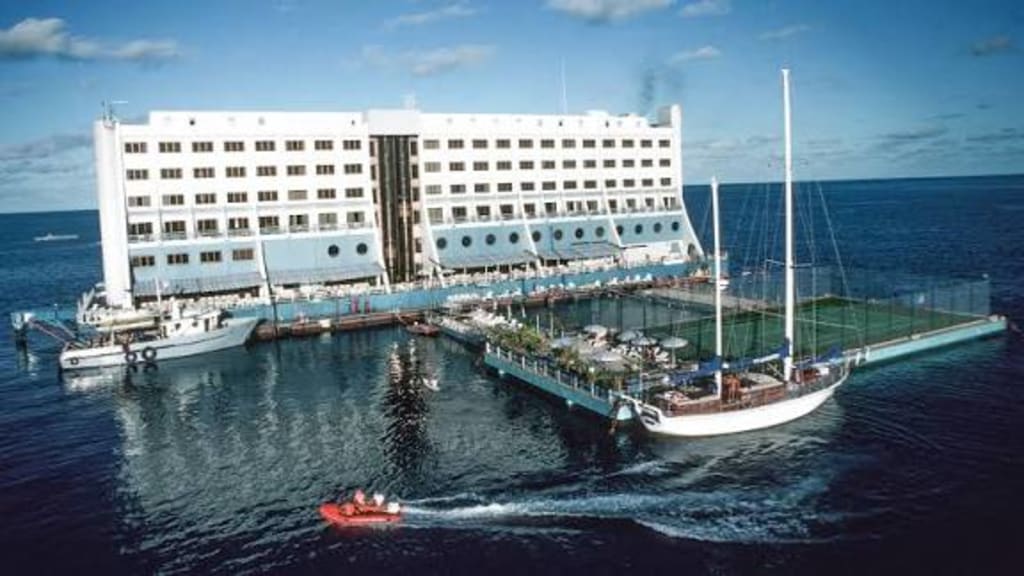
In the late 1980s, an ambitious idea promised to redefine luxury travel: a fully operational hotel floating directly on the ocean. Marketed as a revolutionary way to experience marine beauty without long boat trips, the project became the world’s first floating hotel—an engineering marvel whose fate would turn into one of the strangest journeys in modern tourism history.
The structure was originally launched as the Four Seasons Barrier Reef, positioned near the Great Barrier Reef. Built in Singapore and towed thousands of kilometers to Australian waters in 1988, the hotel resembled a stationary cruise ship anchored above one of the planet’s most fragile ecosystems.
It boasted nearly 200 luxury rooms, fine-dining restaurants, bars, a tennis court, and even an underwater viewing chamber that allowed guests to observe coral and fish without diving. The vision belonged to entrepreneur Doug Tarca, who believed travelers would pay a premium to sleep directly over the reef and wake to panoramic ocean views.
A Bold Dream Meets Harsh Reality
Before the hotel could even welcome its first guests, nature intervened. Cyclones damaged its mooring system and delayed its opening, pushing costs far beyond initial projections. By the time operations began, expenses had skyrocketed while reservations lagged behind expectations.
Running a hotel at sea proved far more complicated than anticipated. Every meal, towel, and fuel delivery had to be transported by boat or helicopter. Waste management and freshwater supply became constant technical challenges. Saltwater corrosion rapidly increased maintenance costs, and rough weather frequently disrupted guest experiences.
Although early visitors praised the novelty and scenery, the business model quickly collapsed. Within a year, the project declared bankruptcy. What was meant to be the future of tourism had become a financial disaster.
A Second Life in Vietnam
Rather than scrapping the structure, investors sold it to new owners who relocated it to Vietnam. Renamed the Saigon Floating Hotel, it was anchored along the Saigon River in Ho Chi Minh City.
There, it found a surprising new purpose—not as a luxury resort, but as a nightlife destination. Its floating bars and clubs became popular with locals and foreign visitors alike. Neon lights replaced reef excursions, and the hotel became a symbol of novelty and excess during Vietnam’s economic opening in the 1990s.
For several years, the floating hotel thrived as a social hotspot. But aging infrastructure, rising maintenance costs, and shifting political priorities eventually led to its decline once again.
Final Journey to North Korea
In the late 1990s, the structure was sold for a third time and towed across Asia to North Korea’s Mount Kumgang tourist zone. There, it was intended to host South Korean tourists as part of a rare cooperative venture between the two Koreas.
For a brief period, the hotel served as a symbol of fragile diplomatic progress. But political tensions soon ended the tourism program, and the floating hotel was abandoned along the coastline. Left without maintenance, it rusted visibly year after year.
In 2019, North Korean authorities reportedly condemned the building as outdated and unfit for modern tourism. Orders were given for it to be dismantled, bringing its strange global journey to an end.
Why It Failed
Experts say the project failed because it was decades ahead of its time. Environmental exposure, massive logistical demands, and the absence of modern offshore technology made the hotel economically unsustainable. Today’s floating structures benefit from advanced materials and automation that did not exist in the 1980s.
“The concept was visionary,” said one maritime architect. “But the technology and business planning weren’t ready for the realities of operating a luxury facility in open water.”
A Legacy of Ambition
Though it never achieved long-term success, the world’s first floating hotel left an important legacy. It demonstrated humanity’s willingness to push architectural boundaries and inspired later experiments in floating resorts, offshore platforms, and even proposals for floating cities.
Its story—spanning Australia, Vietnam, and North Korea—remains one of the most unusual chapters in modern travel history: a five-star dream that drifted across oceans and political systems before disappearing into legend.
What began as a bold symbol of innovation ultimately became a cautionary tale of ambition colliding with nature, economics, and geopolitics.
About the Creator
Fiaz Ahmed
I am Fiaz Ahmed. I am a passionate writer. I love covering trending topics and breaking news. With a sharp eye for what’s happening around the world, and crafts timely and engaging stories that keep readers informed and updated.
Keep reading
More stories from Fiaz Ahmed and writers in The Swamp and other communities.
Missile Strike Destroys Galvanic Shop at Russia’s Iskander Missile Plant
A missile strike has reportedly destroyed a critical galvanic processing workshop at a facility connected to Russia’s Iskander missile production network, dealing a significant blow to one of the country’s most important weapons manufacturing centers. Satellite imagery and preliminary intelligence assessments indicate that the targeted building housed equipment essential for electroplating and chemical treatment of missile components, a step vital to ensuring durability and precision in modern guided weapons. The damaged facility is part of a larger industrial complex supporting Russia’s tactical missile forces. While authorities in Russia have not officially named the plant or confirmed the scale of destruction, multiple defense observers say the strike appears deliberate and carefully planned to disrupt production rather than cause mass casualties. Why the Galvanic Shop Is Critical Galvanic workshops play a central role in missile manufacturing. They are responsible for coating metal components with protective layers that prevent corrosion and ensure proper functioning of guidance systems, fuel tanks, and electronic housings. Without galvanic treatment, many parts cannot pass quality control or withstand the stress of storage and launch conditions. Military industry specialists explain that these facilities are difficult to replace quickly. The equipment requires controlled chemical environments, specialized waste-handling systems, and trained personnel. Rebuilding or relocating such a workshop can take months, even under emergency conditions. “Destroying a galvanic shop creates a bottleneck in the entire production chain,” said one defense analyst familiar with Russian manufacturing infrastructure. “Even if other sections of the plant remain intact, output drops sharply because the process cannot be bypassed.” Extent of the Damage Post-strike imagery shows extensive structural damage to a large industrial building, with portions of the roof collapsed and heavy burn marks visible across the complex. Secondary explosions were reported shortly after impact, likely caused by chemicals stored inside the workshop for electroplating and surface treatment. Local emergency services were deployed to contain fires and prevent toxic substances from spreading beyond the site. Residents in nearby districts were reportedly advised to remain indoors for several hours, though no official casualty figures have been released. Russian officials described the incident as an attack on “industrial infrastructure” without confirming its connection to missile production. Strategic Implications The Iskander missile system has been a cornerstone of Russia’s long-range strike capability and has been used extensively during the conflict in Ukraine. Western analysts believe Russia has faced growing pressure on its missile stockpiles due to sustained usage and supply chain constraints. Damage to a specialized production facility could further slow replenishment efforts. Targeting industrial nodes rather than frontline forces reflects a shift in modern warfare strategy. Instead of focusing only on battlefield positions, attackers aim to weaken the enemy’s ability to manufacture and repair advanced weapons. “This is industrial warfare,” said a European security researcher. “It’s about degrading the capacity to fight over time, not just winning a single battle.” Environmental and Safety Risks Galvanic plants store hazardous chemicals such as acids and heavy metals used in electroplating processes. A direct strike on such a facility raises serious environmental concerns, including soil and water contamination. Independent environmental observers warned that long-term damage could occur if chemical runoff is not properly contained. There has been no confirmation of toxic leaks, but the incident highlights the broader risks associated with strikes on industrial military infrastructure located near civilian areas. Information Control and Propaganda As with many attacks involving sensitive defense sites, information remains tightly restricted. Russian state media has provided minimal coverage, while unofficial channels have circulated unverified videos and images showing smoke rising from the complex. Analysts caution that both sides may use the incident for propaganda purposes—either to claim operational success or to minimize the scale of damage. What is clear is that the strike demonstrates the vulnerability of even heavily guarded weapons facilities in the current phase of the conflict. Conclusion The destruction of a galvanic shop linked to Russia’s Iskander missile production represents more than a single tactical blow. It strikes at a crucial link in the country’s defense manufacturing chain, potentially delaying missile output and repairs for months. As the war increasingly targets logistics and industry rather than just troops and territory, such attacks signal a deeper transformation in how modern conflicts are fought—one that reaches into factories as much as battlefields.
By Fiaz Ahmed about 22 hours ago in The Swamp
A Gathering of Evil Bosses
“I’m the queen of chin jutting while I smooth my hair, attacking, insulting, and deflecting to protect my appointer.” “Oh, please, Blondi, my hair is curled, highlighted, and longer than yours. I feature television commercials telling immigrants that we will give them a free plane ride home, and if they voluntarily turn themselves in, they will be allowed to legally apply for re-entry. It runs everywhere, and I look good in it! You can’t compete because of your blond hair. Mine is nicer, and my lips are prettier than yours.”
By Andrea Corwin 5 days ago in The Swamp




Comments
There are no comments for this story
Be the first to respond and start the conversation.