
Why before the elections? US pressure to demarcate Lebanon's maritime borders
At Israel's request, the United States established itself as a mediator in the dispute over the maritime borders between Lebanon and occupied
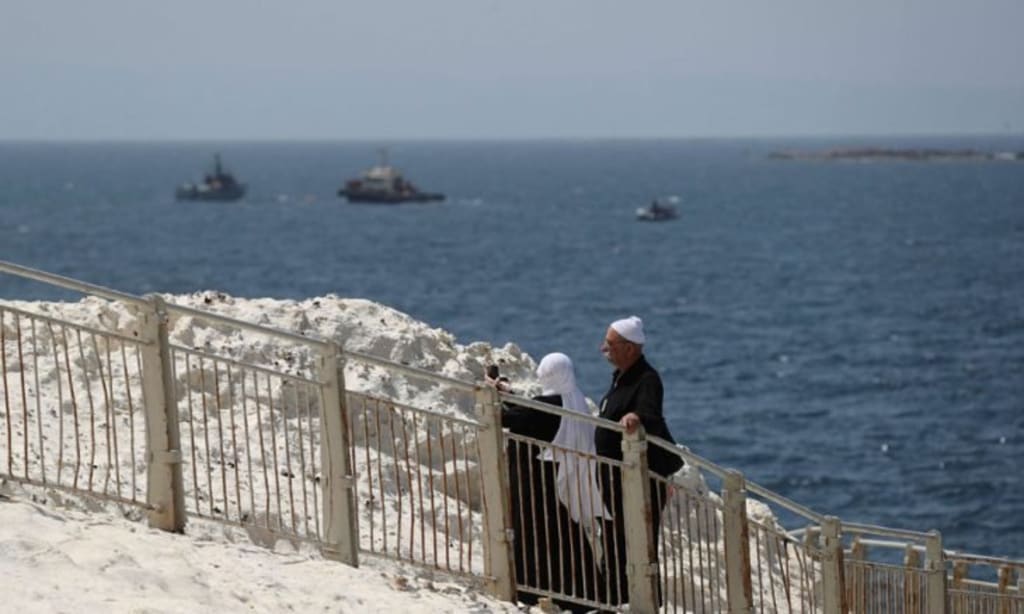
At Israel's request, the United States established itself as a mediator in the dispute over the maritime borders between Lebanon and occupied Palestine. The conflict is old, and Washington sent Frederick Hof as a mediator, years ago, who conducted research and surveys in the disputed area, and came up with a proposal to give Lebanon about 500 square kilometers out of its total area of 860 square kilometers, with the rest going to the Zionist entity.
Lebanon rejected Hof's proposal, so Washington's efforts were frozen for years, then they were resumed several months ago, without being accompanied by an agreement. After that, a new American mediator, Amos Hochstein, who holds Israeli citizenship and served in the Israeli army, came and gave his opinion to settle the conflict, without reaching a conclusion, although he claimed that he outlined a possible settlement project for the conflict, which he will inform the two parties to the conflict on his next visit.
Hochstein did not come according to his promise, but sent a message to Lebanon carried by Dorothy Shea, the American ambassador in Beirut, to the President of the Republic, General Michel Aoun
. 23 in drawing the southern maritime borders, provided that this line deviates upwards to the north at Blocks 8 and 10 so that they and the outer part of the Lebanese Qana field become the share of the Israeli enemy.
The French “Total” company on the part of Lebanon and the Greek-American “Halliburton” company on the part of “Israel” will manage the joint fields.
The works that take place in this area shall be under Qatari sponsorship.
Minister of Public Works Ali Hamiyah, who represents Hezbollah in the government, refused to be a member of the committee, stressing that the party told him that it “will not participate in any meeting or direct talks through the minister or through an intermediary related to the file of maritime border demarcation, especially if the committee will meet with American delegations.” ». As strong voices are rising in political and media circles rejecting the content of Hochstein's new offer, questions are increasing in parallel about the significance of presenting this offer during the parliamentary elections scheduled for mid-May, and with the escalation of war in and against Ukraine, and the most prominent skeptical questions:
Does Hochstein's offer imply an implicit settlement of US sanctions imposed on President Aoun's son-in-law, Minister and Representative, Gebran Bassil?
Are some of the authorities aiming to achieve an economic achievement that will generate thousands of millions of dollars for Lebanon as a result of extracting oil and gas from its territorial waters?
Is the settlement envisaged at this time intended to capitalize on it politically and in the media in the upcoming parliamentary elections?
Is it possible to pass this settlement - the deal despite Hezbollah's strong opposition to it?
Why is Parliament Speaker Nabih Berri not represented in the committee tasked with studying Hochstein's proposal and presenting its recommendations regarding it?
- Did Hochstein offer a decreed role in an attempt to drag Lebanon into normalization with "Israel" directly or indirectly?
It is difficult for those concerned to provide convincing answers to these questions in the current difficult stage that Lebanon is going through. However, I have an opinion that I previously made, which constitutes a decent national way out of the problem of demarcation of the maritime borders that Lebanon has been suffering from for years.. How?
Lebanon has ten sectors along the Lebanese coast containing rich oil and gas deposits. It can adopt one of two rewarding investment approaches: Directing
oil and gas exploration in sectors relatively far from the border with occupied Palestine, provided it adheres relentlessly to what the government defines as sovereign lines of the exclusive economic zone in the face of ambitions Israel and who is behind it.
- Commencement of exploration in Blocks 8, 9 and 10 adjacent to the maritime borders with occupied Palestine, where Israel has established offshore facilities to extract oil and gas and threatens to destroy these facilities, especially since the resistance is capable of doing so, if the enemy tries to prevent Lebanon from exploration and investment in its sectors Neighboring. Both approaches secure for Lebanon two goals and two very important interests: protecting its sovereignty over its land and territorial waters, and collecting thousands of millions of dollars from investing oil and gas deposits. It does not tell us that Lebanon suffers from a chronic and severe crisis, and that it does not currently have leaders capable of making fateful decisions, because waiting for a time that has the appropriate conditions and leaders capable of making fateful decisions remains more useful and safer than compromising sovereignty and rights and suffering the curse of history.
About the Creator
Keep reading
More stories from Zernouh abderrahman and writers in The Swamp and other communities.
Brutus... an American proposal to end the Russian war on Ukraine
Even you, Brutus” with that famous phrase in world literature, Shakespeare embodied in his novel “Julius Caesar” the scene of the historical assassination of Caesar of Rome, which took place in the meeting of the Senate, and it was the great bereavement that prompted Julius Caesar to utter this phrase while covering his face with his clothes in Sadness and surrender, that he was among the conspirators who assassinated him, his closest man to him, Marcus Junius Brutus, so these words became symbols of the stab that comes from within, or at the hands of those closest to him. The wheel of time turns, and the character of Brutus becomes present in the most severe crises that the world is going through at the present time, which is the Russian war on Ukraine. In a Russian "Proteas", Putin addresses the marble-faced stab of salvation. The proposal or the wish, which Russia considered public incitement to assassinate Putin, leads us to wonder about the possibility of ending the crisis in this way, meaning: Is it really possible for Putin to be assassinated by his associates or his men? This issue raised by the American senator is based on the assumption that Russia is ruled by an individual leader, who alone controls the fate of the state, in the presence of opposition in power and the street, which cannot express its rejection of his policies, and then it is easy for “Brutz” to emerge from among them to assassinate the president. , Russian foreign policies are turned upside down, the Russian armies withdraw from Ukraine, and the crisis ends. Directly, I say that the possibility of Putin being assassinated by his men and those close to him is out of the question, according to realistic calculations, given the following. Although Putin is a dictator, he surrounded himself with a fence of loyal men, he equipped them well, any politician in Russia must obtain the support of the ruling class in the country, before he makes decisive political decisions, and this is what was stated in a study and analytical follow-up The course of events in Russia, during Medvedev's tenure of the presidency, while Putin was in the position of prime minister, was prepared by Russian researcher Olga Kreshtnovskaya, to answer the question of who actually rules Russia, or Putin, and which of them is more important? The study stated that the powers granted, or giving orders, need someone to implement them on the ground. Therefore, whoever reaches the first position in power has to form his own team, and the first person in power usually needs to form such a special team during the two-year period, which is the period needed by Presidents Brezhnev, Gorbachev and Yeltsin to form their own teams. The members of these teams are usually loyal to their superiors, and they move with them to any place or position to which these chiefs move. As for President Putin, he spent more than two years to form his team, and since the beginning of 2003 he has been able to surround himself with loyal supporters. A major country like Russia, in its important international and regional standing, cannot pursue blatant foreign policies in this way, which portends a global catastrophe. Putin, a strong intelligence man, has established a special method since his presence in power, through what is known as the Saturday Group. Every Saturday in his office in the Kremlin, he held a meeting that included the Prime Minister, the Chief of the Kremlin Presidency, the Ministers of Defense and Interior, and the Head of the Intelligence and Counterintelligence Service, including It means that Putin maintains solid institutions in the mold of consensus. A man with great political weight, a great influence in the security and intelligence services, and a high parliamentary power, it is difficult to say that Putin, with such a strong fence loyal to him, could be assassinated. The war on Ukraine was not a unilateral, autocratic decision that was made in isolation from the consensus of influential forces and solid institutions in Russia. For the historical weight of the country, Putin's followers say that if it were not for Putin, we would have made him, expressing their need for that leader who restores the glory of the Soviet empire. Putin's political, military and security track made him worthy of the trust of state institutions, and his history confirms that he is the owner of a project and a national goal to restore Russia, the heir to the Soviet Union, to the former Soviet glory that is still stuck in the Russians' conscience.He is the son of Saint Petersburg, a graduate of the Faculty of Law, specializing in international relations, and a doctorate in the philosophy of economics. In the Soviet era, he joined the KGB, and was its agent in the former East Germany, and after his return he worked as Director of Administrative Affairs in the Russian Presidency, and assumed the position in 1997 The position of Director of the Russian President’s Office, and President Yeltsin appointed him as Prime Minister in 1998. After Yeltsin stepped down, Putin became acting president until he won the 2000 elections. He was re-elected for a second term in 2004 after a landslide victory. He was unable to serve a third term in 2008 due to constitutional obstacles. He exchanged roles with His prime minister, Medvedev, assumed the position of prime minister, then returned for a third presidential term after winning the 2012 elections, annexing the Crimea, ending the Chechnya issue, and ran in the 2018 elections for a fourth term for six years, and in the 2020 referendums on constitutional amendments, the votes came in favor of Putin in those Amendments that allow him to rule Russia until 2036. A man with such a rich history of success in electoral elections, even if he says that he has been tampered with, must be strongly supported by state institutions in addition to his great popularity among the Russian masses, which makes it difficult to say that Putin works alone and plays alone in his policies. Can he expect such an atmosphere Where does the man be liable to assassination? Putin's popularity soared when he annexed Crimea, and then rose recently after the war on Ukraine, according to a poll by the Russian Public Opinion Foundation FOM, and the number of Russians who trust Putin increased from 60% to 71% in less than two weeks, in addition to other opinion polls. And statements by Russian officials about the increasing popularity of Putin. Although these polls were wounded, the Western media, despite conveying the fears of the Russian people about the consequences of the war, could not prove the low popularity of Putin, which means that most of the Russian people so far support Putin's policies, despite the difficult regional conditions. However, in the eyes of the Russians, Putin embodies the historical strength of Russia. Putin did not enter the war in the suicidal kamikaze manner. Rather, like Europe and America, he does not want war to erupt, but he knows that the West is escalating out of priorities, and its priorities are gas and oil, so these countries will not sacrifice it and ignite a war for Ukraine. Clear determinants give him confidence in maneuvering and negotiating with the West to achieve the greatest gains. Based on all of the above, we realize when the incendiary security launched by the American senator is superficial. According to the calculations of reality, it is very difficult to have a Brutus within this strong enclosure surrounding Putin - who is in agreement with the ruling class and a mass popularity - who can end the case by assassinating the Russian tsar, God often on the order, but most people do not know.
By Zernouh abderrahman4 years ago in The Swamp
The Saddest Thing - The Billionaires Who Rule America Aren't Even Enjoying Themselves
This single post says more about our ruling class than a thousand policy papers. The saddest thing about today's system is that the men robbing the rest of us - sabotaging our economic prospects, our pensions, our access to affordable healthcare - are not even happy.
By Scott Christenson🌴14 days ago in The Swamp
The Cairn Beside the Lake
And so it came to pass that King Ertharion, Tenth King of Lombaia, stood beside the still lake below unrelenting and unassailable cliffs with the remainder of his harried host. In what was the tenth year of his reign and his forty-fourth upon this great green earth, Menigo the Betrayer, cousin of King Ertharion, pressed home his false claim.
By Matthew J. Frommabout 12 hours ago in Fiction


Comments
There are no comments for this story
Be the first to respond and start the conversation.