
Allergy Relieving Eye Drops Market Size & Forecast 2026–2034
Rising Allergic Eye Conditions and OTC Awareness to Drive Steady Global Growth

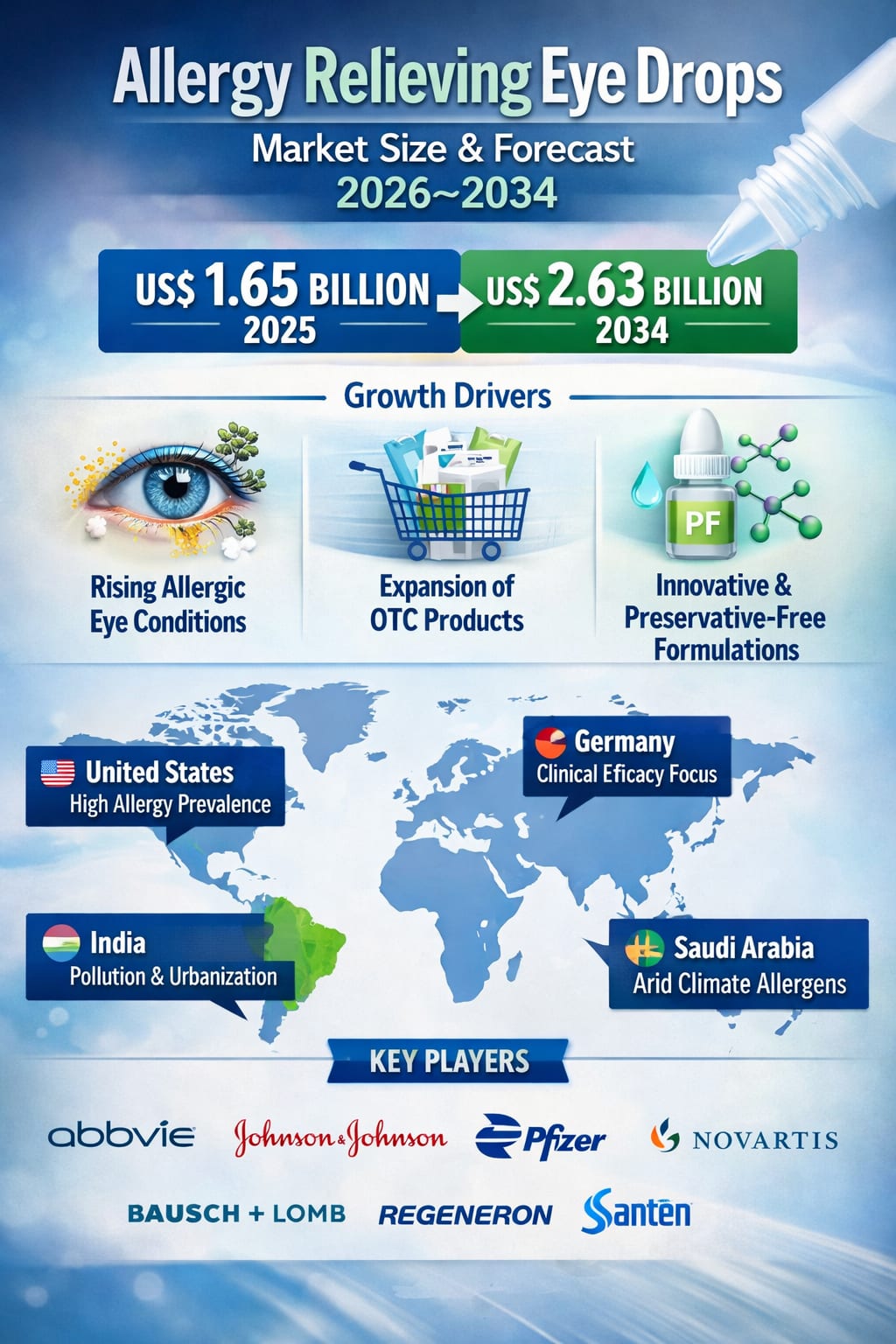
The Allergy Relieving Eye Drops Market is projected to grow from US$ 1.65 billion in 2025 to US$ 2.63 billion by 2034, expanding at a CAGR of 5.31% during 2026–2034. This steady growth trajectory reflects the increasing global burden of allergic eye diseases, rising pollution levels, extended pollen seasons, and greater awareness around over-the-counter (OTC) eye care solutions.
As per Renub Research, the market outlook remains positive as consumers increasingly prefer fast-acting, non-invasive, and easily accessible treatment options for ocular allergies. With allergic conjunctivitis affecting a significant share of the global population, eye drops remain the first line of defense in symptom management.
Allergy Relieving Eye Drops Market Outlook
Allergy-relieving eye drops are ophthalmic formulations designed to reduce symptoms such as itching, redness, watery discharge, burning sensation, and swelling caused by allergic reactions. Common triggers include pollen, dust mites, pet dander, mold spores, and environmental pollutants.
Different formulations operate through distinct mechanisms:
Antihistamines block histamine receptors to reduce itching and redness.
Mast cell stabilizers prevent the release of histamine.
Decongestants minimize redness by constricting blood vessels.
Lubricants soothe irritation and dryness.
Modern formulations increasingly focus on preservative-free options suitable for frequent or long-term use, particularly among contact lens users. Combination therapies—antihistamines paired with mast cell stabilizers—are gaining popularity due to their dual-action benefits.
The growing global prevalence of allergic conjunctivitis, supported by urbanization, climate change, and pollution, continues to fuel demand. Easy OTC availability and rising health awareness are strengthening market penetration across developed and emerging economies alike.
Growth Drivers of the Allergy Relieving Eye Drops Market
1. Rising Prevalence of Allergic Eye Conditions Worldwide
Allergic conjunctivitis affects approximately 15%–20% of the global population, with many cases remaining untreated or self-managed. Environmental deterioration, urbanization, and prolonged pollen seasons have increased allergen exposure across regions.
According to the CDC (2025), over 100 million Americans suffer from at least one allergic disease, with 25.7% of adults experiencing seasonal allergies often accompanied by ocular symptoms. Eye-related symptoms are frequently the earliest manifestations of allergic reactions, leading to early and repeated use of eye drops.
Chronic forms such as vernal keratoconjunctivitis and atopic keratoconjunctivitis, though less common, require long-term management—ensuring sustained pharmaceutical demand.
2. Increasing Availability of Over-the-Counter and Self-Care Products
The shift toward self-medication and preventive healthcare is a major contributor to market expansion. OTC allergy eye drops are widely available in pharmacies, supermarkets, and online platforms. Consumers prefer quick relief without scheduling physician appointments for mild to moderate symptoms.
In January 2026, Dr. Reddy’s Laboratories launched OTC Olopatadine Hydrochloride Ophthalmic Solution in the United States following USFDA approval. The introduction of generic alternatives enhances affordability and market volume.
Clear labeling, educational campaigns, and pharmacist guidance have further empowered consumers to choose suitable products confidently.
3. Product Innovation and Improved Formulations
Pharmaceutical innovation is redefining patient convenience and safety. Developments include:
Long-acting, once-daily formulations
Preservative-free multi-dose bottles
Combination antihistamine and mast cell stabilizer drops
Improved squeeze-dispenser packaging
In August 2024, OCuSOFT Inc. introduced Retaine Allergy, expanding its portfolio beyond dry eye treatment.
Technological enhancements in formulation chemistry and packaging continue to strengthen patient adherence and repeat purchases.
Challenges Facing the Market
1. Risk of Misuse and Side Effects
Excessive use of vasoconstrictor drops can cause rebound redness, worsening symptoms over time. OTC misuse may delay proper diagnosis of infections or more serious ocular conditions. Healthcare professionals emphasize the need for patient education to mitigate these risks.
2. Intense Competition and Price Sensitivity
The market is highly competitive, with branded and generic alternatives vying for shelf space. In emerging markets, price sensitivity limits premium product penetration. Store-brand generics intensify margin pressure for established pharmaceutical companies.
Manufacturers must balance innovation, compliance, and affordability to sustain profitability.
Segment Analysis
Antihistamines Allergy Relieving Eye Drops Market
Antihistamine-based eye drops represent the largest segment due to rapid symptom relief and broad OTC availability. These formulations directly block histamine receptors, reducing itching and redness within minutes.
Combination formulations offering preventive and therapeutic effects are gaining preference. Seasonal demand peaks remain evident, but urban pollution ensures year-round consumption in major cities.
Vernal Keratoconjunctivitis Market
Vernal keratoconjunctivitis (VKC) is a chronic, severe allergic eye condition affecting primarily children and adolescents. Symptoms include intense itching, photophobia, and mucus discharge.
Though affecting a smaller patient pool, VKC requires prolonged management, supporting consistent demand for prescription therapies including antihistamines and corticosteroid drops. Increased diagnostic awareness has strengthened treatment adoption globally.
Atopic Keratoconjunctivitis Market
Atopic keratoconjunctivitis (AKC) is a chronic inflammatory condition often associated with atopic dermatitis. Unlike seasonal allergies, AKC requires sustained management due to potential corneal complications.
Treatment includes antihistamines, mast cell stabilizers, and occasionally immunosuppressive therapies. Growing recognition of systemic allergic disorders contributes to segment expansion.
Regional Insights
United States Allergy Relieving Eye Drops Market
The United States represents one of the largest markets globally. High allergy prevalence, strong consumer awareness, and extensive OTC access drive growth.
In January 2026, LENZ Therapeutics, Inc. launched the “Make it VIZZable” consumer campaign to promote its ophthalmic solution portfolio.
Innovation, high healthcare spending, and proactive allergy management position the U.S. as a dominant market through 2034.
Germany Allergy Relieving Eye Drops Market
Germany’s market is physician-driven, with strong regulatory oversight and preference for clinically proven, preservative-free formulations. Seasonal pollen exposure and environmental allergens contribute to demand peaks.
In July 2025, Santen Pharmaceutical Co. launched Ryjunea in Germany following European Commission approval, signaling continued innovation in ophthalmology.
India Allergy Relieving Eye Drops Market
India’s market is expanding rapidly due to worsening air pollution, urbanization, and increasing allergen exposure. Seasonal allergic conjunctivitis is highly prevalent in metropolitan regions.
In January 2024, Lupin Limited received FDA approval for loteprednol etabonate ophthalmic suspension 0.2%, strengthening India’s generic manufacturing footprint.
Although price sensitivity remains high, expanding pharmacy networks and rising healthcare awareness create strong volume-driven opportunities.
Saudi Arabia Allergy Relieving Eye Drops Market
Saudi Arabia’s arid climate, dust storms, and pollution significantly contribute to allergic eye conditions. Urban centers such as Riyadh and Jeddah show increasing OTC adoption.
In January 2026, Lunatus entered into a distribution agreement with LENZ Therapeutics to commercialize VIZZ in the Middle East.
Improved healthcare infrastructure and rising awareness continue to support market growth in the region.
Market Segmentation
By Drug Class
Antihistamines
Non-Steroidal Anti-Inflammatory Drugs (NSAIDs)
Vasoconstrictors
Others
By Type
Seasonal & Perennial Allergic Conjunctivitis
Vernal Keratoconjunctivitis
Atopic Keratoconjunctivitis
Giant Papillary Conjunctivitis
Others
By Region
North America, Europe, Asia Pacific, Latin America, and Middle East & Africa (including key countries such as the United States, Germany, India, Saudi Arabia, China, Japan, Brazil, and South Africa).
Competitive Landscape
Major players shaping the Allergy Relieving Eye Drops Market include:
AbbVie Inc. (Allergan Plc)
Johnson & Johnson
Pfizer Inc.
F. Hoffmann-La Roche Ltd
Novartis AG
Bausch Health Companies Inc
Regeneron Pharmaceuticals
Santen Pharmaceutical Co.
Each company has been analyzed across five viewpoints: overview, key persons, recent developments & strategies, product portfolio, financial insights, and company analysis.
These players are focusing on strategic acquisitions, OTC portfolio expansion, preservative-free innovations, and geographic expansion to maintain competitive advantage.
Final Thoughts
The Allergy Relieving Eye Drops Market is positioned for stable and sustained growth through 2034. Rising allergy prevalence, environmental deterioration, growing self-care culture, and pharmaceutical innovation collectively shape a resilient demand outlook.
While challenges such as misuse risks and pricing pressures remain, continuous R&D investment and OTC expansion strategies are likely to offset market constraints.
With a projected value of US$ 2.63 billion by 2034, the market reflects a healthcare segment that is not only essential but increasingly integrated into everyday wellness routines worldwide.
About the Creator
Smart Investing in Uncertain Markets: How to Protect and Grow Your Money
Financial markets go through cycles of growth, slowdown, and uncertainty. Economic slowdowns, inflation concerns, geopolitical events, and interest rate changes often create volatility that makes investors nervous. While uncertainty can feel risky, it also presents opportunities for those who approach investing with a clear strategy. Smart investing during uncertain markets is less about predicting outcomes and more about managing risk and staying disciplined.
By Hammad Nawaz7 days ago in Trader
Stanislav Kondrashov on Sandoz and Idorsia as Swiss Pharma Adjusts to a New Phase
The pharmaceutical sector rarely stands still. In Switzerland, recent developments at Sandoz Group AG and Idorsia Ltd. have highlighted how different parts of the industry are adapting to changing healthcare demands and regulatory realities.
By Stanislav Kondrashova day ago in Trader
A Planetary Alignment will coincide with Mercury Retrograde
Double phenomena in the heavens Some people say in jest that the planets have aligned in their favor when life works the way they desire. Were you aware that there are seasons when things do line up in the heavens? There will be a planetary alignment AKA a planet parade, on February 28, 2026.
By Cheryl E Preston3 days ago in FYI



Comments
There are no comments for this story
Be the first to respond and start the conversation.