
Asia Pacific Artificial Intelligence Market Size and Forecast 2025–2033
From Smart Cities to Smart Economies: How AI Is Rewriting Asia Pacific’s Growth Story

Introduction: The Rise of an AI Super-Region
The Asia Pacific region is no longer just a fast follower in the global technology race—it is rapidly becoming one of the most influential centers of artificial intelligence (AI) innovation, deployment, and investment. From smart factories in China and precision healthcare in Japan to digital public infrastructure in India and AI-driven telecommunications in Southeast Asia, artificial intelligence is reshaping how economies in this region grow, compete, and serve their citizens.
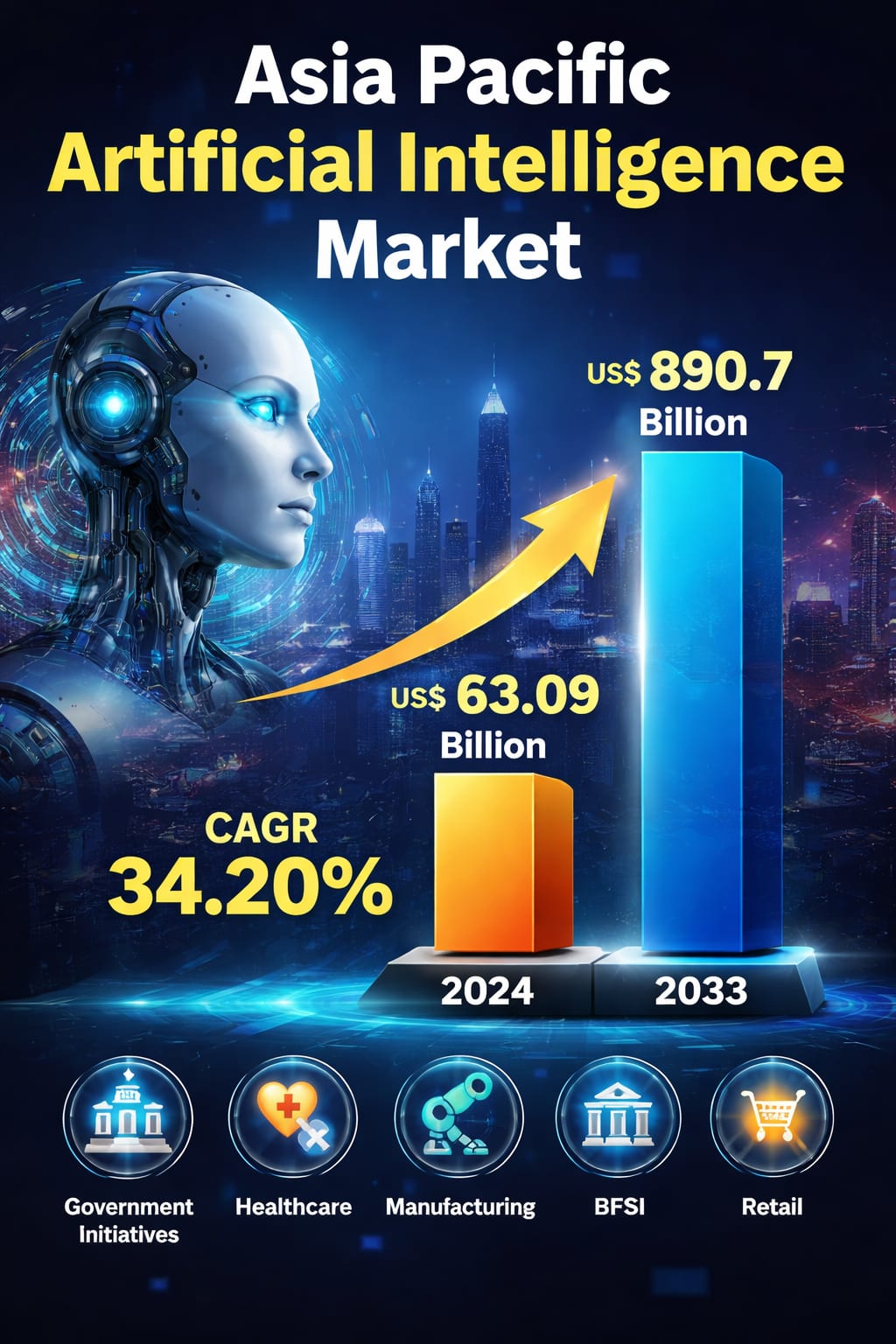
According to Renub Research, the Asia Pacific Artificial Intelligence Market is expected to reach US$ 890.7 billion by 2033, up from US$ 63.09 billion in 2024, expanding at a remarkable CAGR of 34.20% from 2025 to 2033. This explosive growth is being driven by a powerful mix of government support, private sector innovation, rapid digital infrastructure development, expanding industry adoption, and sustained investment in talent and research.
What makes the Asia Pacific story especially compelling is not just the scale of growth, but the diversity of applications. AI in this region is no longer confined to research labs or pilot projects. It is already embedded in banking systems, hospitals, manufacturing plants, retail platforms, logistics networks, and even public services. As cloud computing, 5G, and data ecosystems mature, AI is moving from being a competitive advantage to a foundational layer of economic activity.
Asia Pacific Artificial Intelligence Market Overview
Artificial intelligence aims to create systems capable of performing tasks that traditionally require human intelligence—such as learning, reasoning, problem-solving, speech recognition, and decision-making. In practical terms, today’s AI ecosystem consists of two major pillars: hardware (high-performance processors, chipsets, and data center infrastructure) and software, which includes AI platforms, machine learning models, deep learning frameworks, natural language processing tools, and application development environments.
In the Asia Pacific region, AI adoption is being accelerated by the rapid digitalization of key sectors such as banking, financial services and insurance (BFSI), healthcare, telecommunications, manufacturing, and retail. Organizations are increasingly relying on AI systems to analyze massive volumes of data, extract actionable insights, automate complex processes, and improve both customer experience and operational efficiency.
Another major catalyst is the rollout of 5G networks and cloud infrastructure, which enables real-time data processing, edge computing, and scalable AI deployment. The COVID-19 pandemic also played a role in accelerating AI adoption, particularly in healthcare, pharmaceutical research, supply chain management, and digital services, as companies and governments looked for technology-driven ways to increase resilience and efficiency.
Together, these factors have positioned Asia Pacific as one of the fastest-growing and most dynamic AI markets in the world.
Key Growth Drivers of the Asia Pacific AI Market
1. Government Initiatives and Strategic Investments
Government support is one of the strongest pillars behind the rapid expansion of the Asia Pacific AI market. Countries such as China, Japan, South Korea, and India have launched national AI strategies, funding programs, and regulatory frameworks aimed at building long-term technological leadership.
China, for instance, has set ambitious goals to become a global AI leader by 2030, backing this vision with large-scale public investment, policy support, and infrastructure development. South Korea’s “I-Korea 4.0” initiative focuses on integrating AI across industries, while Japan continues to invest heavily in AI-driven automation, robotics, and advanced manufacturing technologies.
These government-led efforts do more than just provide funding. They create innovation ecosystems that bring together universities, startups, large enterprises, and research institutions. They also help reduce regulatory uncertainty and encourage both domestic and foreign companies to invest in AI development and deployment across the region.
2. Private Sector Innovation and Big-Tech Momentum
The private sector is playing an equally critical role in shaping the Asia Pacific AI landscape. Major technology companies and fast-growing startups are continuously introducing new AI-powered products and services, ranging from smart devices and recommendation engines to enterprise automation platforms and generative AI solutions.
China’s tech giants such as Baidu, Alibaba, and Tencent have been at the forefront of AI research and commercialization, particularly in areas like search, cloud computing, autonomous driving, and smart city solutions. At the same time, global players are deepening their presence in the region. In April 2024, Nvidia announced a partnership with Indosat Ooredoo Hutchison to build a US$ 200 million AI center in Indonesia, highlighting Southeast Asia’s growing importance in the global AI value chain.
These investments not only increase regional capacity for AI development but also intensify competition, accelerate innovation cycles, and make advanced AI technologies more accessible to businesses of all sizes.
3. Expanding Industry Adoption Across Sectors
One of the clearest signs of AI’s maturity in Asia Pacific is its widespread adoption across industries. In healthcare, AI is being used for medical imaging, diagnostics, drug discovery, and personalized treatment planning. In BFSI, it supports fraud detection, risk assessment, algorithmic trading, and customer service automation. In manufacturing, AI powers predictive maintenance, quality control, and smart robotics.
Retailers and media companies are using AI to personalize content, optimize pricing, and improve supply chain efficiency, while the automotive and transportation sector is investing heavily in autonomous driving, traffic management, and fleet optimization systems. Even agriculture is seeing AI-driven solutions for crop monitoring, yield prediction, and resource management.
A notable example of AI’s expanding influence is Google’s launch of its Search Generative Experience (SGE) beta, which reflects the growing role of generative AI in everyday digital interactions, including in Asia Pacific markets. As more industries integrate AI into core operations, the market continues to expand both in depth and breadth.
Challenges Facing the Asia Pacific AI Market
Data Privacy and Security Concerns
Despite its rapid growth, the Asia Pacific AI market faces significant challenges related to data privacy and cybersecurity. AI systems depend heavily on large volumes of data, much of it sensitive or personal. This raises concerns about data breaches, misuse of information, and compliance with diverse national data protection laws across the region.
Different countries have different regulatory approaches to data governance, making it complex for multinational companies to deploy AI solutions at scale. As cyber threats become more sophisticated, ensuring secure data handling and building public trust will be critical for sustaining long-term AI adoption.
Ethical and Regulatory Issues
Ethical questions surrounding AI—such as algorithmic bias, transparency, accountability, and the social impact of automation—are becoming increasingly prominent. The lack of harmonized AI governance frameworks across Asia Pacific creates uncertainty for businesses and policymakers alike.
Governments are now under pressure to balance innovation with responsibility, ensuring that AI technologies are developed and used in ways that are fair, transparent, and beneficial to society. How effectively the region addresses these issues will play a major role in shaping the next phase of AI growth.
Country-Level Insights
China Artificial Intelligence Market
China is one of the world’s largest and most ambitious AI markets, driven by strong government backing, massive data availability, and a vibrant private sector. Companies such as Baidu, Alibaba, and Tencent are leading AI innovation in areas like cloud computing, healthcare, finance, and autonomous vehicles.
In September 2023, Alibaba announced partnerships with local governments to develop AI-powered smart city projects, integrating artificial intelligence into urban management, transportation, and public services. This illustrates how deeply AI is being embedded into China’s development strategy. With a clear national vision and strong execution capacity, China remains a central force in the Asia Pacific AI ecosystem.
India Artificial Intelligence Market
India’s AI market is growing rapidly, supported by government initiatives, a strong IT services sector, and a large pool of technical talent. Programs such as “IndiaAI” aim to promote research, innovation, and responsible AI adoption across industries.
In October 2024, the Ministry of Electronics and Information Technology (MeitY) and Meta announced a collaboration to advance AI innovation and open-source AI development under the IndiaAI framework. As part of this effort, the Srijan Centre for Generative AI was launched at IIT Jodhpur, signaling India’s ambition to become a global hub for next-generation AI technologies.
Japan Artificial Intelligence Market
Japan’s AI market is shaped by strong corporate adoption, government support, and close collaboration between industry and academia. Companies such as Hitachi and Advantest are using AI to enhance semiconductor testing, industrial automation, and advanced manufacturing processes.
With its focus on robotics, precision engineering, and high-quality manufacturing, Japan is leveraging AI to maintain global competitiveness while addressing challenges such as an aging population and labor shortages. This positions the country as a key contributor to applied AI innovation in the region.
Asia Pacific Artificial Intelligence Market Segmentation
By Solution:
Hardware
Software
AI Applications
AI System Infrastructure Software
AI Application Development & Deployment
Artificial Intelligence Platforms
Services
By Technology:
Deep Learning
Natural Language Processing (NLP)
Machine Learning
Machine Vision
By End User:
Healthcare
BFSI
Law
Retail
Advertising & Media
Automotive & Transportation
Agriculture
Manufacturing
Others
By Country:
China
Japan
India
South Korea
Thailand
Malaysia
Indonesia
Australia
New Zealand
Rest of Asia Pacific
Competitive Landscape
The Asia Pacific AI market features a mix of global technology giants and powerful regional players. Companies are typically analyzed across four dimensions: overview, key persons, recent developments, and financial insights.
Major players include:
Microsoft Corporation
IBM Corporation
Amazon
Baidu Inc.
Nvidia Corporation
Oracle Corporation
Hewlett Packard Enterprise
Salesforce Inc.
Alphabet Inc.
These companies are investing heavily in cloud AI platforms, generative AI models, enterprise automation tools, and industry-specific solutions, further intensifying competition and accelerating innovation across the region.
Final Thoughts: Asia Pacific’s AI Decade Has Just Begun
The numbers tell a compelling story. With the Asia Pacific Artificial Intelligence Market projected to grow from US$ 63.09 billion in 2024 to US$ 890.7 billion by 2033, the region is entering what can only be described as a defining decade for AI-driven transformation.
Government ambition, private sector innovation, expanding industry adoption, and rapidly improving digital infrastructure are converging to create one of the most dynamic AI ecosystems in the world. While challenges around data privacy, security, and ethics remain, the overall trajectory is clear: AI will be a central pillar of economic growth, competitiveness, and social development across Asia Pacific.
About the Creator
India Cashew Market Size and Forecast 2025–2033
Introduction India’s cashew industry is entering a decisive decade, driven by a blend of changing consumer habits, rising health awareness, and expanding export opportunities. According to Renub Research, the India Cashew Market is expected to reach US$ 3.31 billion by 2033, up from US$ 2.28 billion in 2024, registering a compound annual growth rate (CAGR) of 4.25% from 2025 to 2033. This steady growth reflects not just higher consumption at home, but also India’s continued importance in the global cashew trade.
By Sakshi Sharma3 days ago in Trader


Comments
There are no comments for this story
Be the first to respond and start the conversation.