
Asia Pacific Data Centre Market Size and Forecast 2025
Asia-Pacific Data Center Market Set to Triple by 2033 as Cloud, AI, and 5G Fuel Digital Infrastructure Boom

Introduction: The Digital Backbone of Asia-Pacific’s Future
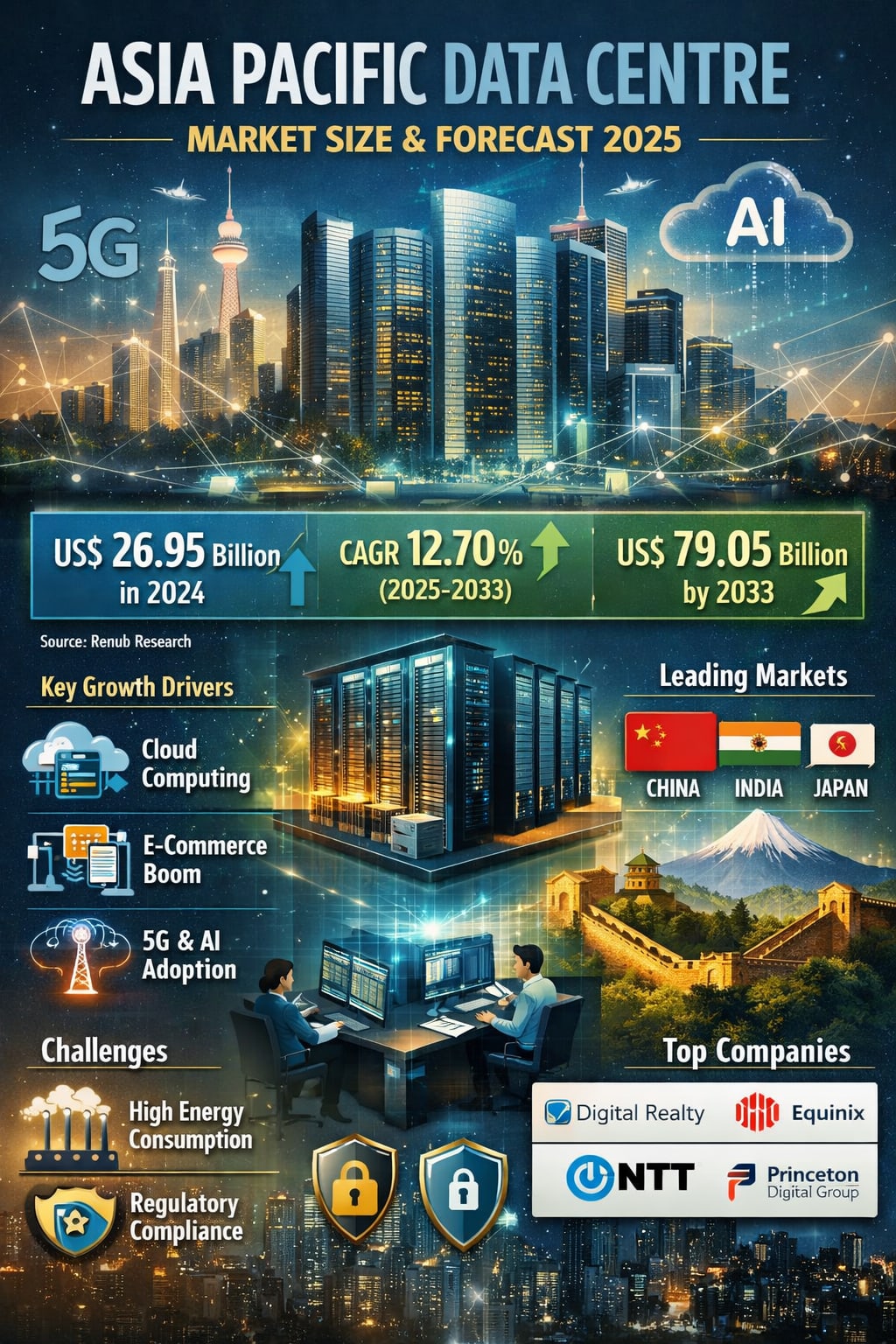
The Asia-Pacific data center market is entering a golden era of expansion as the region accelerates its digital transformation journey. Valued at US$ 26.95 billion in 2024, the market is projected to grow at a robust CAGR of 12.70% from 2025 to 2033, reaching an impressive US$ 79.05 billion by 2033. This growth reflects not just rising data consumption, but a fundamental shift in how businesses, governments, and consumers across the region operate in an increasingly digital-first world.
From cloud computing and artificial intelligence (AI) to 5G networks and e-commerce platforms, data centers have become the invisible engines powering modern economies. Asia-Pacific, home to some of the world’s fastest-growing digital markets, is witnessing unprecedented investments in hyperscale facilities, colocation centers, and energy-efficient infrastructure. Countries such as China, India, Japan, Singapore, and Australia are rapidly expanding their data center footprints to meet soaring demand for storage, processing power, and low-latency connectivity.
As digital ecosystems mature and data sovereignty becomes a strategic priority, the Asia-Pacific data center market is not just growing—it is reshaping the region’s technological and economic landscape.
Asia Pacific Data Centre Market Overview
A data center is a specialized facility that houses computing systems and networking equipment used to store, process, and distribute large volumes of data. These facilities form the foundation of cloud services, enterprise IT operations, digital platforms, and emerging technologies such as AI, Internet of Things (IoT), and big data analytics. Data centers range from small enterprise installations to massive hyperscale campuses operated by global technology giants.
In the Asia-Pacific region, the importance of data centers has surged due to rapid digitalization, widespread cloud adoption, and explosive growth in data generation. Businesses are migrating workloads to the cloud, consumers are streaming more content than ever, and governments are digitizing public services. This combination has created a powerful demand for reliable, scalable, and secure data center infrastructure.
Countries like China, India, Japan, and Singapore are at the forefront of this expansion, supported by strong technology ecosystems, rising internet penetration, and favorable investment climates. At the same time, sustainability has become a key focus area, with operators increasingly investing in energy-efficient designs, advanced cooling technologies, and renewable energy integration. With continuous technological advancements and a rapidly growing digital population, the Asia-Pacific data center market is poised for sustained long-term growth.
Key Growth Drivers in the Asia-Pacific Data Center Market
1. Surge in Cloud Computing Adoption
Cloud computing remains one of the most powerful growth engines for the Asia-Pacific data center market. Enterprises across industries are shifting from traditional on-premise IT systems to cloud-based platforms to gain scalability, flexibility, and cost efficiency. Global cloud providers such as AWS, Microsoft Azure, and Google Cloud are aggressively expanding their regional footprints to serve this growing demand.
The rise of hybrid and multi-cloud strategies has further strengthened the need for robust data center infrastructure. According to recent industry insights, a significant majority of Asia-Pacific organizations now operate workloads across multiple public clouds, with countries like India leading in hybrid cloud adoption. This trend is driving continuous investment in new facilities, network upgrades, and advanced data management solutions.
2. Expansion of E-Commerce and Digital Services
The explosive growth of e-commerce, digital payments, online entertainment, and app-based services has dramatically increased data traffic across the region. Asia-Pacific is home to some of the world’s largest and fastest-growing digital consumer markets, particularly in China, India, and Southeast Asia.
With hundreds of millions of consumers shopping online, streaming content, and using digital wallets, businesses require high-performance data centers to ensure seamless user experiences, secure transactions, and real-time analytics. The rapid adoption of smartphones and affordable internet access has only accelerated this trend, making data centers a critical pillar of the region’s digital economy.
3. Government Initiatives and Infrastructure Development
Governments across Asia-Pacific are actively promoting digitalization through policies supporting cloud adoption, smart cities, cybersecurity, and data localization. Countries such as Singapore, Japan, and Australia have introduced initiatives to attract foreign investment, encourage green data center development, and strengthen digital infrastructure resilience.
For instance, Japan has announced plans to align data center development with low-carbon energy clusters, highlighting the growing emphasis on sustainability. Such policy support not only boosts investor confidence but also ensures long-term growth opportunities for data center operators across the region.
Challenges Facing the Asia-Pacific Data Center Market
1. Environmental Concerns and High Energy Consumption
Data centers are energy-intensive facilities, consuming vast amounts of electricity for computing and cooling operations. As sustainability becomes a global priority, operators face increasing pressure to reduce carbon footprints and improve energy efficiency. Integrating renewable energy, optimizing cooling systems, and adopting green building standards add complexity and cost to new projects, even as they remain essential for long-term viability.
2. Regulatory and Compliance Complexities
The Asia-Pacific region is characterized by diverse regulatory frameworks related to data privacy, cybersecurity, and data sovereignty. Navigating these varying rules can be challenging, especially for operators managing cross-border data flows. Stricter compliance requirements often necessitate additional investments in local infrastructure, security systems, and legal expertise.
Market Segmentation Insights
By Data Center Size
Large Data Centers: Designed to serve enterprises and cloud providers, large data centers offer high-capacity storage and processing. China and India are seeing strong investment in this segment to support rapidly growing digital demand.
Massive Data Centers: These facilities cater to high-performance computing, AI workloads, and large-scale enterprise operations. They require advanced power and cooling systems to maintain efficiency and reliability.
Medium, Mega, and Small Data Centers: These serve a mix of regional enterprises, government agencies, and specialized applications, offering flexibility across different market needs.
By Tier Type
Tier 1 and 2: Suitable for smaller operations with basic redundancy.
Tier 3: Widely adopted for enterprise and colocation services due to higher reliability and uptime.
Tier 4: Designed for mission-critical applications, offering maximum redundancy and fault tolerance.
By Absorption
Non-Utilized and Utilized: Reflect the optimization of existing infrastructure.
Hyperscale: Driven by cloud giants and large digital platforms.
Retail and Wholesale: Support colocation services for SMEs and large enterprises respectively.
By End User
Key end-user segments include BFSI, Cloud, E-Commerce, Government, Manufacturing, Media & Entertainment, Telecom, and other industries. Each sector relies on data centers for secure data storage, real-time processing, and business continuity.
End-User Focus: Industry-Specific Demand
BFSI Data Center Market
The banking, financial services, and insurance sector requires highly secure and high-performance data centers to manage transactions, customer data, and regulatory compliance. The rise of digital banking, fintech platforms, and real-time payment systems has significantly increased demand for advanced data center solutions.
E-Commerce Data Center Market
E-commerce companies depend heavily on data centers to manage customer information, inventory systems, logistics, and personalized recommendations. As online shopping and digital payments continue to grow, the need for scalable and reliable infrastructure becomes even more critical.
Cloud Data Center Market
Cloud data centers are at the heart of digital transformation strategies across Asia-Pacific. They provide secure storage, high-speed connectivity, and AI-driven analytics, enabling businesses of all sizes to innovate faster and operate more efficiently.
Country-Level Market Outlook
China Data Center Market
China leads the Asia-Pacific data center market, supported by massive investments in cloud infrastructure and advanced technologies. Government-backed digital initiatives and a strong push toward AI-driven computing have further accelerated growth. The country’s booming e-commerce sector and expanding digital economy continue to drive demand for large-scale, high-capacity data centers. Strategic programs aimed at balancing regional computing resources have also played a role in shaping long-term investment trends.
India Data Center Market
India’s data center industry is experiencing rapid expansion, fueled by widespread digitalization, a booming fintech ecosystem, and supportive government policies promoting local data storage. The rollout of 5G, smart city projects, and rising internet penetration are creating strong demand for new facilities. With significant capacity additions planned over the coming years, India is emerging as one of the most attractive data center investment destinations in the region.
Japan Data Center Market
Japan boasts a mature and technologically advanced data center market, underpinned by strong cybersecurity standards and cutting-edge infrastructure. The country’s focus on smart cities, AI, and IoT is driving demand for high-performance facilities. At the same time, increasing investment in renewable energy highlights Japan’s commitment to sustainable data center development.
Other important markets include Australia, Singapore, South Korea, Indonesia, Malaysia, Vietnam, Thailand, Taiwan, Hong Kong, New Zealand, and the Philippines, each contributing to the region’s diverse and dynamic data center ecosystem.
Key Industry Trends Shaping the Market
Rapid growth in smartphone users and mobile data consumption
Rising data traffic per smartphone and demand for low-latency services
Improvements in mobile and broadband data speeds
Expansion of fiber connectivity networks
Strengthening regulatory frameworks around data protection and cybersecurity
These trends collectively reinforce the need for more resilient, scalable, and energy-efficient data center infrastructure across Asia-Pacific.
Value Chain and Distribution Channel Analysis
The market is structured around multiple dimensions, including:
Data Center Size: Large, Massive, Medium, Mega, Small
Tier Type: Tier 1 and 2, Tier 3, Tier 4
Absorption: Non-Utilized, Utilized, Hyperscale, Retail, Wholesale
End User: BFSI, Cloud, E-Commerce, Government, Manufacturing, Media & Entertainment, Telecom, Others
Country: Australia, China, India, Indonesia, Japan, Malaysia, and the Rest of APAC
This diversified structure allows operators to serve a wide range of customer needs, from startups to global enterprises.
Competitive Landscape and Company Analysis
Key players operating in the Asia-Pacific data center market include:
Digital Realty Trust, Inc.
Equinix, Inc.
KT Corporation
NTT Ltd.
Princeton Digital Group
Space DC Pte Ltd.
NEXTDC Ltd
Canberra Data Centre
These companies are evaluated across four key viewpoints: Overview, Key Persons, Recent Developments, and Revenue, highlighting their strategic positioning and growth initiatives in the region.
Final Thoughts: A Market Powering Asia-Pacific’s Digital Future
The Asia-Pacific data center market is on a powerful growth trajectory, driven by cloud adoption, digital services, AI, and next-generation connectivity. With the market expected to rise from US$ 26.95 billion in 2024 to US$ 79.05 billion by 2033, data centers are set to become one of the most critical infrastructure assets in the region’s digital economy.
While challenges related to energy consumption and regulation remain, continuous innovation in green technologies, efficient cooling, and smart infrastructure is helping the industry move toward a more sustainable future. For investors, technology providers, and governments alike, the Asia-Pacific data center market represents not just an opportunity—but a cornerstone of the region’s digital transformation story.
About the Creator
Sakshi Sharma
Content Writer with 7+ years of experience crafting SEO-driven blogs, web copy & research reports. Skilled in creating engaging, audience-focused content across diverse industries.
Keep reading
More stories from Sakshi Sharma and writers in Trader and other communities.
Saudi Arabia E-Commerce Market Size and Forecast 2025–2033
Introduction: A Digital Retail Revolution in the Kingdom Saudi Arabia’s retail landscape is undergoing a powerful transformation. Once dominated by traditional brick-and-mortar stores, the Kingdom is now witnessing a rapid shift toward digital commerce, fueled by technology adoption, government-backed digital reforms, and changing consumer behavior. According to Renub Research, the Saudi Arabia E-Commerce market was valued at US$ 24.67 billion in 2024 and is projected to grow at a compound annual growth rate (CAGR) of 12.10% from 2025 to 2033, reaching an impressive US$ 68.94 billion by 2033.
By Sakshi Sharmaabout 8 hours ago in Trader
NASDAQ 100 Alert: Smart Moves Investors Make to Stay Profitable
The NASDAQ 100 is one of the most influential stock indexes in the world. It includes 100 of the largest non-bank companies, mostly in technology, healthcare, and consumer sectors. Many investors follow the NASDAQ 100 because its movements often signal the health of the overall market. Smart investors watch the NASDAQ 100 closely. They do not wait for trends to pass they act early. Understanding how to approach the NASDAQ 100 can help you make informed decisions, reduce risk, and seize opportunities before the market moves.
By John.doe798about 4 hours ago in Trader
Asia Pacific Dairy Market Size & Forecast 2025–2033
Introduction: A Region Powering Global Dairy Growth The Asia Pacific dairy industry is entering a decisive growth phase, driven by changing consumer habits, urban expansion, and rising health awareness. According to Renub Research, the market is expected to expand from US$ 333.00 billion in 2024 to US$ 616.45 billion by 2033, registering a strong compound annual growth rate (CAGR) of 7.10% between 2025 and 2033.
By shibansh kumar2 days ago in Trader
Rachel Reviews: Lunch Tales: Teagan by Lucille Guarino
Well, I did enjoy this! Sometimes, all you need is just great storytelling and this is what Lucille Guarino delivers here. There's no big message to this book; it's just about folks and families, living their lives and coping with everything that's being thrown at them and finding their way. But when it's done well, like it is here, then you have characters to whom you can relate, tension which leaves you rooting for a better outcome, attraction which has your heart racing and an urge, as a reader, to see the characters happy with the people with whom they belong.
By Rachel Deeming4 days ago in BookClub



Comments
There are no comments for this story
Be the first to respond and start the conversation.