
Asia Pacific Menswear Market Trends & Summary (2025–2033)
Rising Incomes, Digital Fashion, and Changing Lifestyles Are Redefining Men’s Style Across Asia Pacific

Asia Pacific Menswear Market Outlook
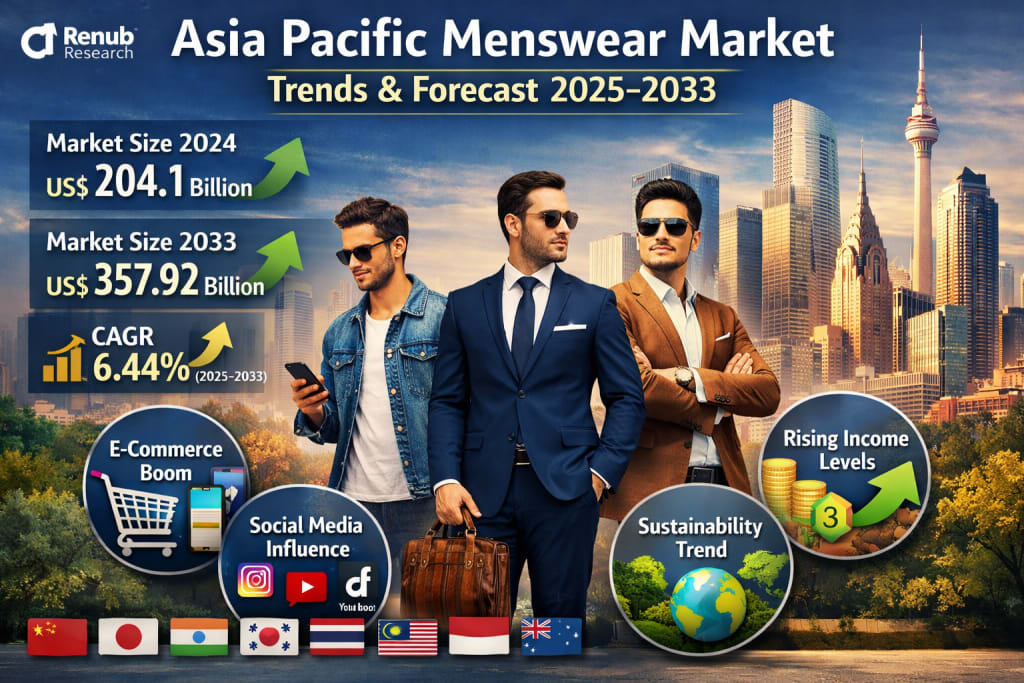
The Asia Pacific menswear market is entering a powerful growth phase, driven by rising disposable incomes, rapid urbanization, digital retail expansion, and evolving cultural attitudes toward men’s fashion. According to Renub Research, the Asia Pacific Menswear Market is expected to grow from US$ 204.1 billion in 2024 to US$ 357.92 billion by 2033, registering a compound annual growth rate (CAGR) of 6.44% from 2025 to 2033. This strong performance reflects not only economic growth across key Asian economies but also a fundamental shift in how men perceive clothing, personal style, and brand value.
Traditionally, menswear in many parts of Asia Pacific was viewed as largely functional, focused on durability and necessity rather than fashion. That mindset has changed dramatically over the past decade. Today’s consumers, especially younger and urban men, see clothing as a form of self-expression. They are more willing to experiment with styles, follow global trends, and invest in brands that align with their lifestyle and values. This cultural transformation is reshaping the entire menswear ecosystem, from mass-market apparel to premium and luxury segments.
The region’s diversity remains one of its biggest strengths and challenges. Asia Pacific includes some of the world’s most dynamic fashion markets, such as China, Japan, India, and South Korea, alongside fast-growing Southeast Asian economies and developed markets like Australia and New Zealand. Each of these markets has its own fashion sensibilities, climate considerations, and consumer behaviors, making the region both complex and full of opportunity for global and local brands alike.
Industry Overview: A Market in Transformation
The Asia Pacific menswear industry has undergone significant changes in recent years, supported by macroeconomic growth, expanding middle-class populations, and increasing exposure to global fashion trends. Urbanization has played a crucial role, as more consumers move to cities where fashion awareness, brand exposure, and purchasing power are typically higher. With better access to shopping malls, brand outlets, and online platforms, urban consumers are driving demand for a wider range of apparel, from casual and athleisure wear to formal and occasion-based clothing.
E-commerce has been one of the most powerful disruptors in this market. Online platforms have made international and domestic brands more accessible, even in smaller cities and semi-urban areas. Tech-savvy consumers appreciate the convenience, broader product selection, competitive pricing, and easy return policies offered by online retailers. As a result, many traditional brands are now adopting omnichannel strategies, blending physical retail with strong digital presence to stay competitive.
Social media has also become a central force shaping menswear trends. Platforms like Instagram, YouTube, and TikTok, along with region-specific platforms in China and other markets, have turned fashion influencers, celebrities, and athletes into powerful trendsetters. Their impact is especially strong among younger consumers, who look to these figures for inspiration on how to dress, style, and present themselves.
At the same time, sustainability and ethical fashion are gaining importance across the region. While price and style remain key purchase drivers, a growing segment of consumers is paying attention to how clothes are made, what materials are used, and whether brands follow responsible sourcing and production practices. This shift is encouraging brands to invest in eco-friendly materials, transparent supply chains, and longer-lasting products.
Key Growth Drivers
Influence of Social Media and Celebrities
Social media and celebrity culture have become major forces shaping men’s fashion choices across Asia Pacific. Influencers, film stars, sports icons, and music artists regularly showcase their personal styles online, turning everyday outfits into trend statements. This constant exposure has shortened fashion cycles and increased consumers’ willingness to try new looks, brands, and categories.
Younger consumers, in particular, view fashion as part of their identity and social presence. They are more likely to follow trends promoted by their favorite public figures and replicate those styles in their own wardrobes. Brands are responding by increasing their digital marketing budgets, collaborating with influencers, and launching social-media-first campaigns to reach their target audiences more effectively.
Increasing Focus on Sustainability
Sustainability is no longer a niche concept in the Asia Pacific menswear market. As awareness of environmental and social issues grows, more consumers are seeking products made from organic cotton, recycled fibers, and other eco-friendly materials. There is also rising interest in brands that promote fair labor practices and ethical sourcing.
This trend is encouraging the growth of “slow fashion,” which emphasizes quality, durability, and timeless design over fast-changing trends. While fast fashion still plays a major role in the region, many brands are now balancing speed and affordability with more responsible production models. Over time, sustainability is expected to become an even stronger differentiating factor, especially in premium and luxury segments.
Rising Disposable Incomes
One of the strongest drivers of the Asia Pacific menswear market is the steady rise in disposable incomes, particularly in emerging economies such as China, India, Indonesia, and Vietnam. As more consumers enter the middle class, spending on lifestyle products, including clothing, increases significantly.
Higher purchasing power is not only boosting overall consumption but also supporting the growth of premium and luxury menswear categories. Consumers are increasingly willing to pay more for better quality, well-known brands, and distinctive designs. This shift is creating opportunities for both international labels and strong domestic brands to expand their presence across the region.
Challenges Facing the Market
Diverse Consumer Preferences
The Asia Pacific region is extremely diverse in terms of culture, climate, income levels, and fashion tastes. What works in Japan may not resonate in India, Indonesia, or Australia. Even within a single country, preferences can vary widely between metropolitan and smaller cities.
This diversity makes standardization difficult. Brands must invest in localized designs, region-specific sizing, tailored marketing strategies, and flexible pricing models. While this increases operational complexity, it is also essential for building long-term customer loyalty and achieving sustainable growth in the region.
Counterfeit Products
Counterfeit goods remain a major challenge, especially for premium and luxury menswear brands. Fake products not only hurt sales but also damage brand reputation and consumer trust. The growth of e-commerce and online marketplaces has made it easier for counterfeiters to reach a wide audience, increasing the scale of the problem.
To combat this, brands are investing in advanced authentication technologies, stronger legal enforcement, and consumer education initiatives. However, fighting counterfeiting remains an ongoing battle and continues to be a key risk factor in several Asia Pacific markets.
Country-Level Insights
China Menswear Market
China represents one of the largest and most dynamic menswear markets in the region. Rapid urbanization, rising incomes, and increasing fashion awareness among male consumers are driving strong demand across both mass and premium segments. Chinese consumers are showing growing interest in stylish yet functional clothing, reflecting changing lifestyles and work patterns.
E-commerce and digital marketing play a central role in China’s fashion ecosystem, with live-streaming, influencer marketing, and social commerce becoming key sales channels. At the same time, sustainability and quality are gaining importance, especially among younger, more educated consumers. Despite challenges such as intense competition and counterfeit products, China remains a crucial growth engine for the Asia Pacific menswear market.
India Menswear Market
India’s menswear market is expanding rapidly, supported by a young population, rising disposable incomes, and increasing urbanization. Both traditional and western-style clothing continue to perform well, reflecting the country’s unique blend of cultural heritage and modern influences.
E-commerce has significantly improved access to a wide range of brands and styles, particularly in smaller cities. However, the market also faces challenges such as intense competition, price sensitivity, and growing expectations around sustainability and ethical production. Even so, India offers vast long-term opportunities for both domestic and international players.
South Korea Menswear Market
South Korea’s menswear market stands out for its strong fashion consciousness and global cultural influence. The rise of K-pop, Korean dramas, and social media has turned South Korean fashion into a global trendsetter, influencing styles well beyond the region.
Consumers in South Korea show a growing preference for premium and luxury menswear, focusing on quality materials, refined tailoring, and unique designs. Digital platforms and e-commerce have further expanded access to both local and international brands. While competition is intense, the market continues to thrive on innovation, cultural influence, and a highly style-aware consumer base.
Market Segmentation Overview
By Apparel:
Top Wear
Bottom Wear
Innerwear
By Category:
Mass
Premium
Luxury
By Distribution Channel:
Online
Offline
By Country:
China
Japan
India
South Korea
Thailand
Malaysia
Indonesia
Australia
New Zealand
Rest of Asia Pacific
Competitive Landscape and Company Analysis
The Asia Pacific menswear market features a mix of global giants and strong regional players. Companies are competing on the basis of brand strength, design innovation, pricing strategies, distribution reach, and sustainability initiatives.
Key companies covered include:
PVH Corp
Arvind Limited
Nike, Inc.
Grasim Industries Limited
Adidas AG
H & M Hennes & Mauritz AB
Alok Industries Ltd
Levi Strauss & Co
Ralph Lauren Corp
Corteva Agriscience
All key players are analyzed from four viewpoints: Overview, Key Persons, Recent Developments, and Revenue. This comprehensive approach highlights how leading brands are strengthening their positions through product innovation, retail expansion, digital strategies, and partnerships.
Recent industry developments also reflect the market’s dynamism. For example, Myntra’s acquisition of distribution and management rights for the UK fashion brand Next in India and DaMENSCH’s aggressive retail expansion plans underline the growing importance of both online and offline channels in capturing consumer demand.
Final Thoughts
The Asia Pacific menswear market is on a strong growth trajectory, supported by economic expansion, demographic shifts, digital transformation, and changing cultural attitudes toward men’s fashion. With the market projected to grow from US$ 204.1 billion in 2024 to US$ 357.92 billion by 2033 at a CAGR of 6.44%, the region offers immense opportunities for brands that can adapt to its diversity and fast-changing consumer preferences.
Success in this market will depend on a brand’s ability to balance global trends with local relevance, combine digital and physical retail strategies, and respond to rising expectations around sustainability and ethical production. While challenges such as counterfeiting and intense competition remain, the long-term outlook for the Asia Pacific menswear industry remains highly positive.
In many ways, the region is not just following global fashion trends—it is increasingly shaping them. And as men across Asia Pacific continue to embrace fashion as a form of identity and self-expression, the menswear market is set to remain one of the most dynamic and exciting segments of the global apparel industry.
About the Creator
Sakshi Sharma
Content Writer with 7+ years of experience crafting SEO-driven blogs, web copy & research reports. Skilled in creating engaging, audience-focused content across diverse industries.
Keep reading
More stories from Sakshi Sharma and writers in Trader and other communities.
North America Drone Market Size and Forecast 2025–2033
Introduction: Drones Move from Niche to Necessity Over the last decade, drones—also known as unmanned aerial vehicles (UAVs)—have evolved from hobbyist gadgets and military tools into essential assets across multiple industries. In North America, this transformation has been especially visible. What was once a niche technology is now deeply embedded in sectors such as agriculture, construction, logistics, energy, media, and public safety.
By Sakshi Sharma3 days ago in Trader
DC Tax Filing 2026: Step-by-Step Guide to Maximize Your Refund/
DC Tax Filing 2026 is an important task for every Washington, DC resident. Filing taxes correctly not only ensures you avoid penalties but also helps you get the maximum refund possible. Many people miss simple opportunities to increase their refund because they don’t plan or track their expenses properly. They will walk you through a step-by-step approach to DC Tax Filing 2026 that is easy to follow and practical. From organizing documents to claiming deductions and credits, these steps will help you file accurately and confidently.
By John.doe7986 days ago in Trader
Junk Silver in 2026: Is It Still a Good Investment?
Junk silver refers to US currency coins in circulation prior to 1965. They are often considered a great way to get into silver investments. The reason for this is that junk silver coins have a 90% silver composition, which allows them to track the spot price of silver.
By Sound Money6 days ago in Trader




Comments
There are no comments for this story
Be the first to respond and start the conversation.