
ATM Market Trends, Deployment & Forecast 2025–2033 | Renub Research
Global ATM Market Set to Reach US$ 35.50 Billion by 2033 as Financial Inclusion, Self-Service Banking, and Contactless Technologies Reshape Cash Access Worldwide

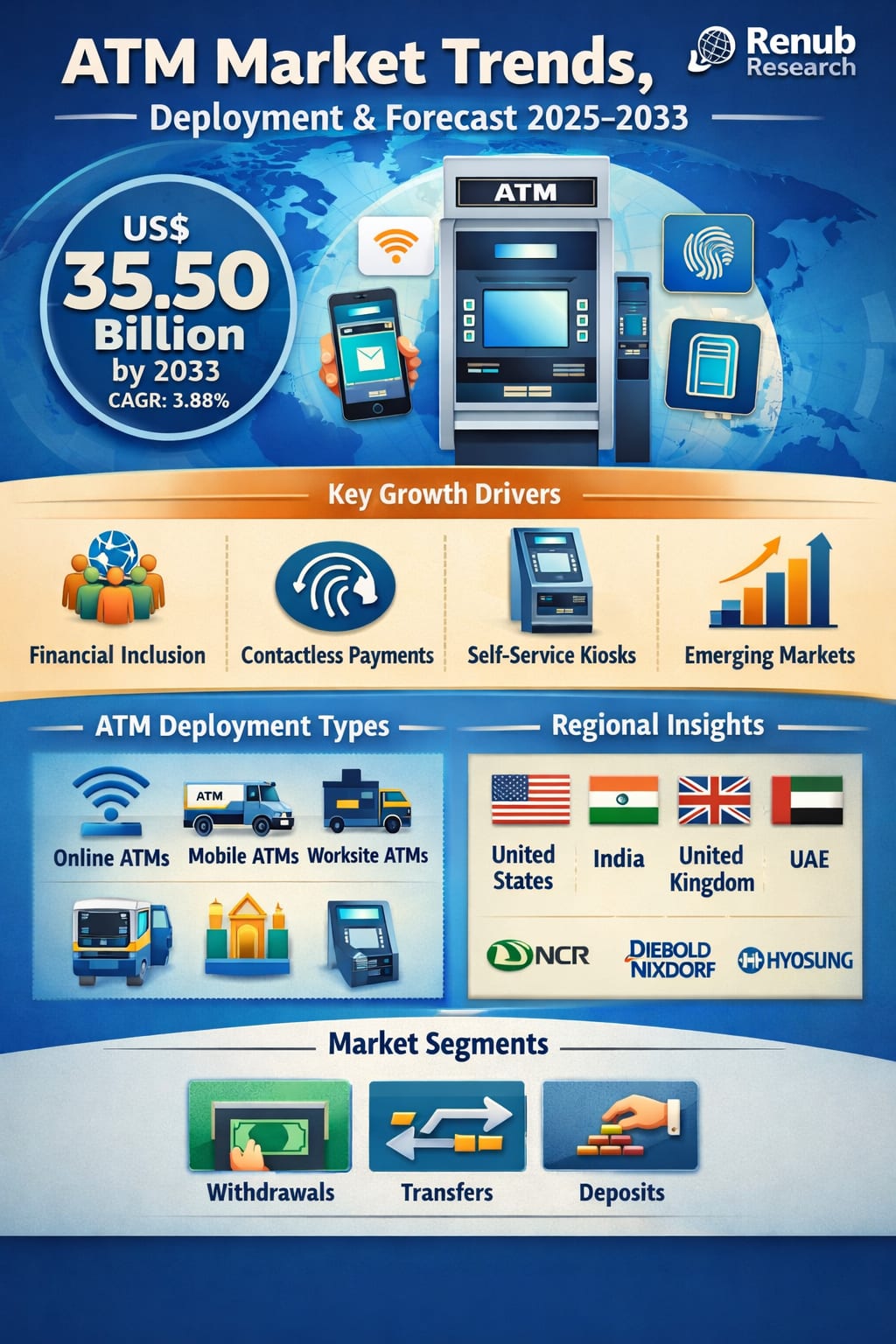
Global ATM Market Outlook
The global Automated Teller Machine (ATM) market continues to play a crucial role in the modern financial ecosystem, even as digital payments and mobile banking platforms gain momentum. According to Renub Research, the ATM Market is expected to grow from US$ 25.20 billion in 2024 to US$ 35.50 billion by 2033, registering a compound annual growth rate (CAGR) of 3.88% from 2025 to 2033.
This steady expansion reflects the ongoing relevance of cash in many economies, combined with rising financial inclusion initiatives, technological upgrades in self-service banking, and the continued deployment of ATMs in both urban and rural regions. While cashless transactions are increasing, cash remains a vital medium of exchange for millions of consumers worldwide, particularly in developing and emerging markets.
ATMs today are no longer just cash-dispensing machines. They have evolved into multifunctional financial service points that allow users to withdraw cash, check balances, transfer funds, deposit money, and even access value-added services. Their ability to operate 24/7, offer convenience, and reduce pressure on traditional bank branches makes them an indispensable part of the global banking infrastructure.
Global ATM Industry Overview
An Automated Teller Machine (ATM) is an electronic banking terminal that enables customers to perform basic financial transactions without the assistance of a bank teller. Typically located in banks, shopping malls, airports, petrol stations, and convenience stores, ATMs provide round-the-clock access to essential banking services. Users authenticate themselves using debit or credit cards and a personal identification number (PIN), after which they can select from a range of transactions.
Over the years, ATMs have become a symbol of banking accessibility and efficiency. By supporting self-service banking, they reduce operational costs for financial institutions while improving customer convenience. This dual benefit has encouraged banks and independent operators to expand ATM networks across both developed and developing economies.
The demand for ATMs is driven by the need for secure, simple, and reliable access to cash and basic banking services. Urbanization, expanding middle-class populations, and government-led financial inclusion programs have further accelerated ATM adoption, especially in countries where traditional bank branch coverage is limited.
Technological advancements such as touchscreen interfaces, biometric authentication, real-time cash deposits, and cardless withdrawals are significantly improving user experience. In addition, the integration of ATMs with mobile banking and digital payment ecosystems is helping these machines remain relevant in an increasingly digital financial world. Enhanced security features, anti-skimming technologies, and regulatory compliance measures are also shaping the future of the ATM industry.
Key Growth Drivers for the ATM Market
ATM-Related Convenience and Accessibility
One of the strongest drivers of the ATM market is the unmatched convenience these machines offer. Unlike traditional bank branches with limited working hours, ATMs provide 24/7 access to essential financial services. This is especially valuable for customers with busy schedules or those living in areas where bank branches are scarce.
ATMs are strategically placed in high-traffic and remote locations alike, including business districts, shopping centers, transport hubs, and rural communities. This widespread availability ensures that a broad range of users can access cash and basic banking services whenever they need them.
For instance, as of 2023, about 36.4% of India’s population lived in urban areas, highlighting the importance of accessible financial infrastructure in both urban and semi-urban regions. ATMs play a crucial role in bridging the gap between formal banking systems and populations that may not have easy access to physical bank branches.
Rapid Digital Transformation
The ATM industry is also benefiting from the rapid digital transformation of the global banking sector. Modern ATMs now support contactless transactions, biometric authentication, and integration with mobile banking apps, creating a safer and more seamless user experience.
Biometric technologies such as fingerprint and facial recognition are increasingly being used to enhance security and reduce fraud. In 2020, more than 671 million people used facial biometrics for payments, and this number is expected to rise significantly in the coming years. Such technologies are now finding their way into ATM systems, improving both security and convenience.
Near Field Communication (NFC) technology has also enabled cardless and contactless ATM transactions, allowing users to withdraw cash using their smartphones or contactless cards. This not only speeds up transactions but also aligns ATMs with broader trends in digital and mobile payments.
Technological Advancements and Service Innovation
Technological innovation remains a core pillar of ATM market growth. Enhanced software platforms, advanced security systems, and new service models are transforming how ATMs are deployed and managed.
A notable example is the rise of ATM as a Service (ATMaaS). In June 2023, NCR Corporation partnered with Members ATM Alliance (MAA) to provide comprehensive ATMaaS solutions to credit unions. This model covers software management, cash management, transaction processing, and deployment, allowing financial institutions to simplify operations and reduce costs.
Such service-based models make ATM networks more efficient and scalable, particularly for smaller banks and credit unions that may lack the resources to manage large ATM fleets independently. This trend underscores how innovation is not only improving ATM functionality but also reshaping the business models around ATM deployment and management.
Challenges in the ATM Market
Declining Cash Dependency
One of the major challenges facing the ATM industry is the gradual decline in cash usage due to the rapid adoption of digital payments, mobile wallets, and contactless transactions. In many urban and developed markets, consumers increasingly prefer electronic payment methods for everyday purchases, reducing the frequency of cash withdrawals.
This shift directly impacts ATM transaction volumes and, in some cases, the profitability of ATM operations. As cashless ecosystems expand, ATM operators may find it harder to justify the costs associated with installing, maintaining, and servicing machines, particularly in high-cost locations.
However, despite this trend, cash continues to play a vital role in many economies, especially in emerging markets, rural areas, and among certain demographic groups. This creates a mixed outlook, where ATM growth may be slower in some regions but remains resilient in others.
Regulatory Compliance Pressures
Regulatory compliance is another significant challenge for the ATM industry. Financial institutions and ATM operators must adhere to a wide range of regulations related to data protection, accessibility, security, and anti-money laundering. These regulations often vary by country and region, making compliance both complex and costly.
Meeting these requirements frequently involves regular software updates, hardware upgrades, security enhancements, and staff training, all of which add to operational expenses. Non-compliance, on the other hand, can result in heavy fines, reputational damage, and even operational shutdowns. As a result, regulatory adherence remains a critical and ongoing concern for market participants.
Regional Insights
United States ATM Market
The United States represents one of the largest and most mature ATM markets in the world, with more than 400,000 ATMs installed across the country. The market continues to grow steadily, supported by ongoing demand for cash transactions, financial inclusion efforts, and technological upgrades.
Innovations such as mobile banking integration, contactless withdrawals, and enhanced security features are helping modernize the U.S. ATM network. In February 2023, NCR Corporation expanded its long-standing partnership with Walgreens to provide ATM services at nearly every Walgreens location across the United States, Puerto Rico, and the District of Columbia. This move significantly improved access to ATM services in high-traffic retail environments and highlighted the continued importance of cash access in the American financial system.
India ATM Market
India’s ATM market is experiencing notable growth, driven by rising financial inclusion, expanding banking networks, and sustained demand for cash transactions. With more than 200,000 ATMs across the country, India has one of the largest ATM networks in the world.
The market is also seeing increased adoption of white-label ATMs, particularly in rural and semi-urban areas where traditional bank branches are limited. In January 2025, ASX-listed Findi acquired fintech company BANKIT for INR 160 crore through TSI, a move aimed at strengthening digital banking services and expanding white-label ATM coverage across 28 states and more than 1.29 lakh locations.
This acquisition reflects India’s broader push to improve banking accessibility and digital financial services in underserved regions, reinforcing the long-term growth prospects of the ATM market in the country.
United Kingdom ATM Market
The UK ATM market is undergoing a period of transition as digital payments and mobile banking gain popularity. While the overall number of ATMs has seen a gradual decline, cash usage remains significant, particularly among older populations and in rural communities.
To address concerns about access to cash following bank branch closures, initiatives such as “super ATMs” have emerged. These machines offer multi-bank services and ensure that communities continue to have reliable access to cash. Additionally, the growing interest in digital currencies has led to the introduction of cryptocurrency ATMs, adding a new dimension to the UK’s ATM landscape.
United Arab Emirates ATM Market
The ATM market in the United Arab Emirates is expanding steadily, supported by the country’s strong focus on digital transformation and financial inclusion. Government initiatives such as the Financial Infrastructure Transformation (FIT) Program aim to enhance electronic payment systems while maintaining access to essential banking services.
The adoption of cardless ATM solutions using NFC, QR codes, and biometric authentication is also gaining momentum in the UAE. These innovations reflect the country’s commitment to offering secure, modern, and convenient banking experiences to its tech-savvy population.
ATM Market Segmentation
By Solution:
Deployment
Online ATMs
Offline ATMs
Worksite ATMs
Mobile ATMs
Managed Services
By Type:
White Label
Brown Label
By Application:
Withdrawals
Transfers
Deposits
By Country (25 Viewpoints):
North America: United States, Canada
Europe: France, Germany, Italy, Spain, United Kingdom, Belgium, Netherlands, Turkey
Asia Pacific: China, Japan, India, Australia, South Korea, Thailand, Malaysia, Indonesia, New Zealand
Latin America: Brazil, Mexico, Argentina
Middle East & Africa: South Africa, Saudi Arabia, United Arab Emirates
Competitive Landscape
The global ATM market is highly competitive, with several major players focusing on innovation, service expansion, and strategic partnerships. All companies are analyzed across four key viewpoints:
Company Overview
Key Persons
Recent Developments & Strategies
Sales Analysis
Key Players Include:
Diebold Nixdorf Incorporated
NCR Corporation
HESS Cash Systems GmbH
Hitachi Channel Solutions Corp.
Fujitsu
GRG Banking
Source Technologies
Hyosung TNS Inc.
These companies are investing heavily in next-generation ATM technologies, managed services, and software-driven solutions to stay competitive in a rapidly evolving financial services landscape.
Final Thoughts
The global ATM market is clearly in a phase of transformation rather than decline. While digital payments and cashless technologies are reshaping consumer behavior, the fundamental need for accessible, secure, and reliable cash services remains strong—particularly in emerging markets and underserved regions.
With the market projected to grow from US$ 25.20 billion in 2024 to US$ 35.50 billion by 2033 at a CAGR of 3.88%, ATMs will continue to play a vital role in the global financial ecosystem. Technological innovation, service-based deployment models, and financial inclusion initiatives are set to define the next chapter of the ATM industry.
In a world that is increasingly digital, ATMs are evolving—not disappearing—proving that self-service banking still has a strong and relevant future.
About the Creator
Keep reading
More stories from shibansh kumar and writers in Trader and other communities.
Business Process Outsourcing Market Forecast 2025–2033 | Renub Research
Business Process Outsourcing Market: A Strategic Engine of Global Business Growth The Business Process Outsourcing (BPO) market has evolved from a cost-cutting tactic into a strategic growth engine for enterprises worldwide. According to Renub Research, the global BPO market size was valued at US$ 298.6 billion in 2024 and is projected to reach US$ 643.19 billion by 2033, expanding at a CAGR of 8.90% during 2025–2033. This robust growth reflects how deeply outsourcing has become embedded in modern business strategy.
By shibansh kumara day ago in Trader
United States Tire Market Size, Share, Growth, Latest Trends and Forecast 2026-2034
How the United States Tire Market Keeps the Nation Moving Tires are one of the most overlooked components of modern transportation. They rarely attract attention unless something goes wrong, yet every commute, delivery, and road trip depends on their performance. The United States tire market reflects the country’s deep reliance on mobility — personal vehicles, freight transport, and industrial logistics all revolve around reliable tire technology.
By Jackson Watson7 days ago in Trader
Mexico Generic Drug Market Size, Share, Trends, Growth Factors and Forecast 2026-2034
How the Mexico Generic Drug Market Is Expanding Access to Affordable Healthcare Access to affordable medicine is one of the most important pillars of public health. In Mexico, generic pharmaceuticals have become a critical tool for making healthcare more accessible to millions of people. The Mexico generic drug market reflects a broader effort to balance medical innovation with affordability, ensuring that essential treatments reach diverse populations.
By Jackson Watson4 days ago in Trader



Comments
There are no comments for this story
Be the first to respond and start the conversation.