
Australia Co‑Working Office Space Market: Flexible Work Takes Center Stage
How shifting workplace paradigms and hybrid business models are propelling Australia’s co‑working office space market toward USD 736.1 million by 2034.


The Australia co working office space market is undergoing a period of transformation as businesses and professionals increasingly embrace flexible working arrangements. According to IMARC Group, the market was valued at USD 194.2 million in 2025 and is forecast to grow to USD 736.1 million by 2034, representing a compound annual growth rate (CAGR) of 15.96 % between 2026 and 2034. This strong growth trajectory reflects deep structural changes in how companies approach workspace strategies, alongside evolving employee expectations around work life balance, collaboration and productivity.
Co working office spaces — shared, flexible work environments that offer office infrastructure, amenities and networking opportunities — have shifted from niche to mainstream in Australia’s urban and suburban business landscapes. They serve as vibrant hubs for freelancers, startups, small and medium enterprises (SMEs), and increasingly, large corporate teams experimenting with hybrid work models. These spaces are reshaping how work gets done and are integral to the broader trend of workplace flexibility in the post pandemic era.
Why the Market Is Growing So Rapidly
1. The Rise of Hybrid Work Models
The widespread adoption of hybrid work — combining remote work with periodic in office collaboration — has driven demand for co working spaces. Many organisations are rethinking traditional long term office leases, opting instead for flexible workspace solutions that adapt to hybrid schedules and fluctuating team sizes. Co working spaces offer the convenience of office infrastructure without the fixed costs and commitment of conventional leases.
2. Surge in Freelance and Gig Economy Participation
Australia has seen robust growth in freelance, contract and gig economy work. Independent professionals often seek professional work environments beyond home offices and cafés. Co working spaces provide access to meeting rooms, high speed connectivity and professional atmospheres conducive to productivity, enabling freelancers to work more effectively and network with peers.
3. Cost Efficiency and Scalability for SMEs
Small and medium enterprises (SMEs) face significant cost pressures, particularly in high rent urban centres such as Sydney and Melbourne. Co working environments allow these businesses to access office amenities and prime locations without heavy capital expenditures. Flexible lease terms enable companies to scale their physical footprint up or down in response to growth, reducing financial risk while maintaining professional work settings.
4. Corporate Adoption of Satellite and Distributed Offices
Large corporations, too, are recognising the strategic benefits of co working spaces as satellite offices. By placing flexible work hubs closer to residential hubs, firms improve employee satisfaction, reduce commute times and support distributed teams. This approach not only enhances organisational agility but also helps companies maintain corporate culture in hybrid scenarios.
5. Innovation Ecosystems and Start Up Culture
Co working spaces often double as innovation hubs, fostering collaborations, networking events and cross industry interactions. Startups gravitate toward these environments to access community support, mentorship opportunities and investor exposure. This ecosystem driven growth reinforces the appeal of co working spaces, particularly in innovation clusters across major Australian cities.
What the Opportunities Are
The rapid evolution of the co working market presents multiple opportunities for stakeholders across real estate, workplace services and corporate strategy:
1. Expansion into Suburban and Regional Landscapes
With remote and hybrid work decentralising workforce locations, there is growing demand for co working sites outside central business districts. Suburban and regional co working facilities can capture professionals seeking local, flexible work environments that reduce commute burdens.
2. Tailored Co Working Offerings for Industry Verticals
Operators can develop niche spaces tailored to specific sectors such as tech, creative industries, legal services, or biotech. Sector focused co working models enhance collaboration among similar professionals and industries, strengthening community value.
3. Partnerships with Traditional Real Estate Portfolios
Commercial landlords can repurpose underutilised office space by partnering with co working operators. These collaborations optimise occupancy rates and diversify property income streams, particularly in markets with high vacancy rates.
4. Integration of Smart Workplace Technologies
Incorporating advanced workplace technology — such as IoT enabled facilities, AI driven space management systems, and seamless digital access controls — enhances user experience and operational efficiency, positioning co working operators at the forefront of smart work environments.
5. Enhanced Community and Networking Platforms
Co working spaces that prioritise community building through events, professional networks, and mentorship platforms strengthen member engagement and retention. These soft value features differentiate offerings beyond physical space.
6. Corporate Partnerships for Talent and Training Programs
Operators can cultivate partnerships with businesses to offer training spaces, corporate innovation programs, and professional development workshops, creating additional revenue streams and elevating the role of co working hubs in workforce development.
7. Sustainability Driven Workspace Designs
Developing environmentally conscious co working spaces with green certifications, energy efficient fixtures, and sustainable interior materials attracts eco aware tenants and aligns with corporate sustainability policies.
Recent News & Developments in Australia Co Working Office Space Market
March 2025: Government Office Modernisation Initiative: The Australian federal government announced a workplace modernisation framework encouraging flexible work arrangements, including co working space integration for public sector teams. The policy promotes decentralised work hubs to improve workforce accessibility, reduce congestion in city centres, and foster local economic activity, particularly in regional areas.
August 2025: Expansion of a Major Co Working Brand: One of Australia’s leading co working operators unveiled plans to open three new hybrid offices in Queensland and Western Australia. These new sites — comprising over 12,000 square metres of workspace — aim to serve professionals seeking flexible office solutions closer to home, reinforcing demand outside major metropolitan hubs.
October 2025: Market Growth & Adoption Milestone: Recent industry data showed that co working space occupancy rates across key Australian cities surpassed 78 % in late 2025, up from 65 % the previous year. This trend reflects strong post pandemic recovery and increasing corporate and freelance utilisation of flexible workspace offerings as part of hybrid work strategies.
Why Should You Know About Australia Co Working Office Space Market?
The Australia co working office space market exemplifies how work culture, technology and real estate are converging to reshape professional environments. For investors, the projected rise to USD 736.1 million by 2034 signals a compelling opportunity within flexible workspace and commercial real estate diversification. For business leaders, co working solutions offer scalable, cost efficient strategies to support hybrid workforces, improve employee experience, and strengthen organisational agility. For policy makers and urban planners, the growth of co working hubs presents tools for decentralising economic activity, revitalising regional markets, and aligning workforce development with contemporary mobility trends. As work environments continue to evolve, co working spaces are emerging as central players in the future of work — offering adaptability, community and value across Australia’s dynamic economy.
About the Creator
Amélie Belle
Hi, I’m Amélie Belle—27, New York writer, lover of quiet moments and honest words. I share poetry and reflections on love, healing, and life’s small miracles. If my writing makes you feel seen, I’m exactly where I’m meant to be.
Keep reading
More stories from Amélie Belle and writers in Trader and other communities.
Australia Flower Market Blooming to USD 1.8 Billion by 2034 on Shifting Consumer Preferences and E commerce Growth
The Australia flower market is experiencing steady expansion as cultural traditions, lifestyle trends, and digital adoption reshape how consumers engage with floral products. According to the latest IMARC Group analysis, the market reached USD 1.2 billion in 2025 and is expected to grow to USD 1.8 billion by 2034, registering a compound annual growth rate (CAGR) of 4.19% during 2026–2034.
By Amélie Bellea day ago in Trader
Vietnam Organic Food Market Size and Forecast 2025–2033
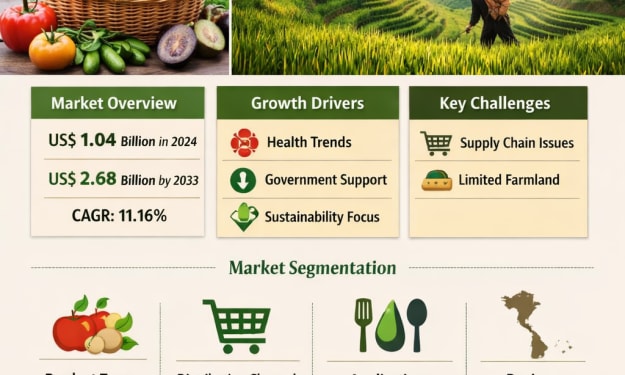
Vietnam Organic Food Market Overview The Vietnam Organic Food Market is entering a decisive growth phase, driven by changing consumer lifestyles, rising health awareness, and stronger focus on environmental sustainability. According to industry estimates, the Vietnam Organic Food Market is expected to reach US$ 2.68 billion by 2033, up from US$ 1.04 billion in 2024, expanding at a robust CAGR of 11.16% from 2025 to 2033. This impressive growth trajectory reflects a deep transformation in how Vietnamese consumers think about food quality, safety, and long-term wellbeing.
By shibansh kumar5 days ago in Trader
MSFT Stock: Microsoft’s Market Performance and Global Insights
MSFT Stock, representing Microsoft Corporation, is one of the most influential technology stocks in global financial markets. Microsoft has evolved from a software company into a technology powerhouse, with business lines spanning Windows, Office, cloud computing through Azure, AI technologies, and gaming with Xbox. This diversification has made MSFT Stock a favorite for both retail and institutional investors seeking long-term growth and stability.
By Hammad Nawaza day ago in Trader



Comments
There are no comments for this story
Be the first to respond and start the conversation.