
Australia Foodservice Packaging Market: Expansion Fueled by Sustainability and Rising Out-of-Home Consumption
Australia’s foodservice packaging market is booming — with strong industry growth driven by quick-service food demand, sustainable material adoption and regulatory change — nearly doubling by 2034.

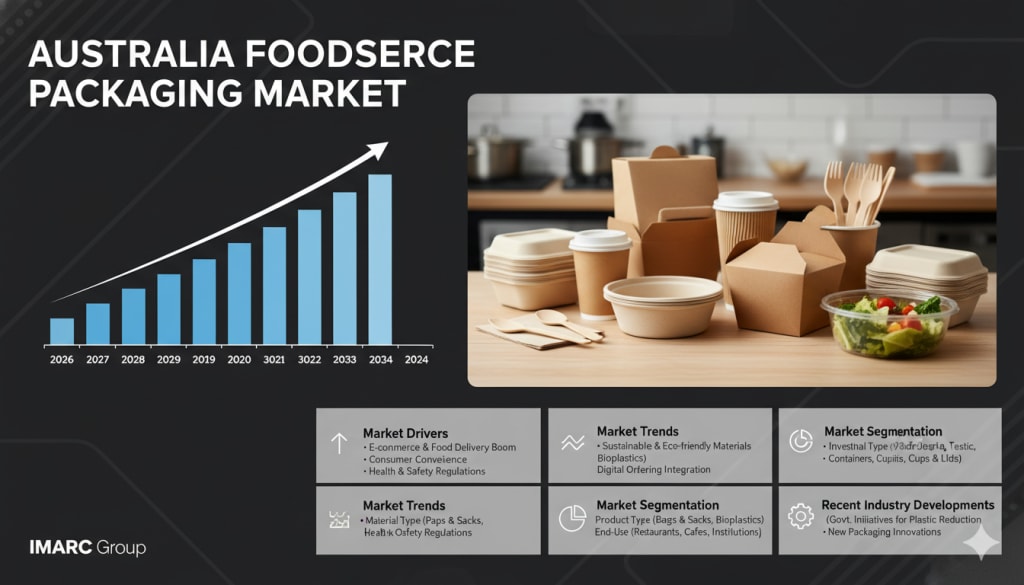
The Australia foodservice packaging market was valued at USD 2.05 billion in 2025 and is forecast to reach USD 3.91 billion by 2034, expanding at a CAGR of 7.44% from 2026 to 2034.
This rapid growth reflects fundamental shifts across Australia’s food consumption patterns, material innovation in packaging solutions, and a growing emphasis on environmental sustainability. With the foodservice sector — including quick-service restaurants, cafés, and delivery platforms — continuing to expand, demand for packaging that is functional, lightweight, and eco-friendly is shaping the competitive landscape.
Why the Market Is Growing So Rapidly
One of the most significant growth drivers of the Australia foodservice packaging market is the expansion of the foodservice and quick-service restaurant (QSR) industry. Australians are increasingly eating out, ordering takeaway meals and using food delivery services, which directly boosts demand for packaging solutions ranging from takeaway containers to beverage cups and trays. This shift toward off-premise consumption is a structural change in eating habits that continues to sustain strong packaging volumes.
Contributing to this trend is the continued rise of online food delivery platforms. Partnerships between foodservice operators and technology platforms such as Uber Eats and DoorDash have made takeaway and delivery ubiquitous, placing pressure on packaging producers to supply solutions that are sturdy for transport while still meeting consumer expectations for convenience and appearance.
Another powerful driver is stringent environmental regulation targeting single-use plastics. Across Australia, state governments and the federal government have introduced bans and recycling mandates for conventional plastic packaging. These include restrictions on plastic bags, cups, lids, cutlery and expanded polystyrene containers — measures that are accelerating the adoption of paper-based, compostable and recyclable alternatives.
Parallel to regulatory reform, there is a growing consumer consciousness around sustainability and corporate responsibility. Many consumers now prefer brands and foodservice operators that use recyclable or biodegradable packaging. According to industry surveys, Australians are willing to pay a premium for sustainable products, and restaurants are responding by integrating eco-friendly packaging options into their offerings.
Finally, innovation in packaging materials and design is stimulating demand from both foodservice operators and end consumers. New materials such as sugarcane-based compostables, bamboo fiber products, and enhanced recyclable paperboards offer improved performance while aligning with environmental goals. Functional design improvements — like spill-proof lids, microwave-safe trays, and smart labeling technologies — are also enhancing the appeal of modern foodservice packaging.
What the Opportunities Are
1. Sustainable Material Innovation: There is significant opportunity to develop and commercialize advanced compostable and biodegradable materials that meet or exceed performance expectations while satisfying regulatory and consumer demands.
2. Smart and Intelligent Packaging: Integrating smart features — such as QR codes for traceability, time-temperature indicators, or anti-tamper sensors — can add value for operators and consumers and differentiate offerings across competitive foodservice segments.
3. Expansion of Local Manufacturing: Australia’s regulatory landscape favors recyclable and compostable packaging, offering incentives for local manufacturers to grow production capacity and reduce reliance on imported materials.
4. Partnerships with Delivery Platforms: Packaging companies can partner directly with food delivery platforms and major QSR chains to co-develop custom solutions optimized for transport durability and brand visibility.
5. Eco-Branding Services: As sustainability becomes a brand differentiator, packaging suppliers can offer consulting and eco-branding support to foodservice companies looking to better communicate their environmental commitments.
6. Regional Market Growth: States like Queensland, Western Australia and South Australia are rolling out progressive sustainability policies and manufacturing grants — creating fast-growing regional markets for compliant packaging solutions.
7. Recycling and Composting Infrastructure Services: Companies that invest in recycling and industrial composting infrastructure — or partner with waste management firms — can capture value across the lifecycle of packaging products while supporting circular economy objectives.
Recent News & Developments in Australia Foodservice Packaging Market
January 2025: The Australian Government updated the National Packaging Targets, reinforcing commitments that 100% of packaging must be reusable, recyclable, or compostable and contain an average of 50% recycled content. These guidelines aim to accelerate industry transition toward sustainable materials and are expected to drive adoption of fiber-based and biodegradable packaging across the foodservice sector, creating predictable demand for compliant solutions throughout the supply chain.
April 2025: Leading sustainable packaging firm Foopak showcased an expanded paperboard product suite at Foodservice Australia, featuring microwave-safe, compostable containers and spill-resistant designs tailored for high-volume QSR operations. The launch underscores growing interest in functional, environmentally friendly packaging that meets both regulatory requirements and operational needs.
September 2025: Beverage packaging innovator Visy unveiled a new line of containers with 83% post-consumer recycled content at its Queensland facility. This strategic expansion reflects wider industry momentum toward high recycled-content products and reinforces the role of domestic production capability in meeting Australia’s sustainability targets.
Why Should You Know About the Australia Foodservice Packaging Market?
The Australia foodservice packaging market represents a nexus of consumer behavior change, business innovation and regulatory transformation. For investors, the strong projected CAGR and expanding addressable market point to long-term growth potential. For packaging producers, opportunities abound in sustainable materials, design innovation and strategic partnerships with foodservice operators and digital delivery platforms.
For policymakers and environmental advocates, this market exemplifies how regulation — such as single-use plastic restrictions and recycling mandates — can stimulate innovation and shift entire value chains toward more sustainable outcomes. And for foodservice brands, packaging isn’t just a cost center — it’s a visible symbol of environmental responsibility and brand identity in a crowded market.
Understanding and engaging with this evolving landscape is essential for any stakeholder aiming to thrive in Australia’s resilient, forward-looking foodservice ecosystem.
About the Creator
Rashi Sharma
I am a market researcher.
Keep reading
More stories from Rashi Sharma and writers in Trader and other communities.
Australia Electric Iron Market Poised for Strong Growth on the Back of Urban Lifestyles and Smart Innovation
The Australia electric iron market reached approximately USD 41.8 Million in 2025 and is projected to grow to USD 97.1 Million by 2034, expanding at a CAGR of 9.81% during the forecast period of 2026–2034. This striking growth reflects robust consumer demand for modern, efficient home appliances and an evolving retail environment where convenience and technology are increasingly central to purchase decisions.
By Rashi Sharma8 days ago in Trader
Supply Chain Security Market Set to Soar USD 6.2 Billion by 2033 | CAGR 9.64%
Overview – Supply Chain Security Market Supply chain security refers to technologies, policies, and practices implemented to safeguard supply networks from vulnerabilities such as cyberattacks, counterfeit products, data breaches, and logistical disruptions. The market encompasses various solutions including threat detection software, identity management systems, and real-time monitoring tools. Growing adoption of cloud computing, IoT-enabled logistics, and digital procurement platforms has transformed supply chain operations, but also increased security risks. As global trade networks become more interconnected, organizations are prioritizing supply chain resilience, transparency, and compliance to ensure smooth business continuity and protect sensitive data.
By James Smith6 days ago in Trader
PayPal Stock Analysis: Can PayPal Sustain Growth in the Digital Payments Industry?
Introduction PayPal stock is one of the leading names in the digital payments sector. PayPal provides a global platform for online payments, money transfers, and merchant services. As e-commerce continues to expand and digital transactions become mainstream, PayPal remains central to the evolution of financial technology. Investors closely monitor whether PayPal stock can maintain growth amid competition, regulatory challenges, and technological innovation.
By Hammad Nawazabout 15 hours ago in Trader
Goodbye, Mr. Duvall
It is turning out to be an interesting year. I was in the middle of teaching a class when a pop-up appeared on the screen announcing the death of Mr. Robert Seldon Duvall (yes, that was his full name). I was in the middle of a discussion on the obsession we have with winning when it comes to sports (the Winter Olympics was a theme), and I felt as though things were coming full circle. We had already lost Gene Hackman last year, and along with that titan, it feels though one particular golden age has closed off to be replaced by...?
By Kendall Defoe a day ago in Geeks




Comments
There are no comments for this story
Be the first to respond and start the conversation.