
Australia Wind Turbine Components Market: Renewable Growth, Local Manufacturing & Clean Energy Momentum
How Australia’s renewable energy commitments, offshore and onshore wind expansion, and supply-chain localization are driving demand for wind turbine components

Australia Wind Turbine Components Market
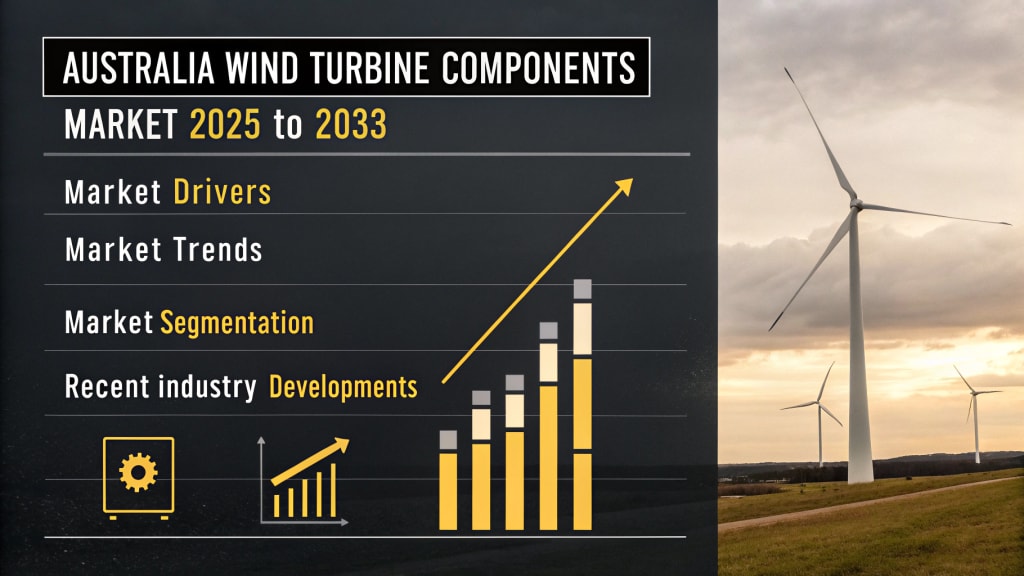
The Australia wind turbine components market is witnessing strong momentum as the nation accelerates its renewable energy agenda, expands wind power capacity, and strengthens supply-chain capabilities for clean energy infrastructure. Wind turbine components — including blades, towers, nacelles, hubs, gearboxes, generators, control systems and associated parts — are essential for building, maintaining and optimising onshore and offshore wind farms. The Australia wind turbine components market size reached USD 2.7 Billion in 2024. Looking forward, IMARC Group expects the market to reach USD 4.6 Billion by 2033, exhibiting a growth rate (CAGR) of 6.07% during 2025-2033. This robust growth reflects accelerating investments in wind energy projects, technological advancements, policy support for low-carbon solutions, and rising demand for locally manufactured components that can reduce costs and strengthen Australia’s renewable energy ecosystem.
Australia has set ambitious renewable energy targets that aim to decarbonise its power sector, driven by state-level commitments and federal policies that encourage wind, solar and hybrid energy deployments. Wind energy, in particular, is seen as a cornerstone of the nation’s energy transition due to its scalability, cost competitiveness and maturation of wind technologies. As capacity additions continue, demand for high-quality components that ensure performance, reliability and long service life is expanding.
What’s Driving Market Growth
Renewable Energy Targets and Wind Capacity Expansion
Australia’s clean energy targets — including commitments to increase the share of renewables in the energy mix and reduce greenhouse gas emissions — are catalysing wind power investments. Both onshore and emerging offshore wind projects are progressing, supported by regulatory frameworks, renewable energy zones (REZs), and competitive power-purchase arrangements that incentivise developers to expand capacity. These initiatives stimulate the demand for wind turbine components across multiple project lifecycles.
Local Manufacturing and Supply-Chain Development
To enhance energy independence and reduce import costs, Australia is promoting local manufacturing of wind turbine components. Supply-chain localisation not only supports local jobs but also improves lead times, logistics efficiencies and quality control. Partnerships between global component makers and Australian manufacturers are fostering technology transfer, skills development and domestic production capabilities for blades, towers and electrical components.
Technological Advancements and Efficiency Improvements
Advances in turbine design, lightweight materials, digital condition monitoring and predictive maintenance systems enhance the performance and durability of key components. Innovations in blade aerodynamics, gearbox reliability and power electronics are contributing to more efficient energy capture and reduced lifecycle costs, reinforcing the competitiveness of wind projects.
Investment from Public and Private Sectors
Public funding, renewable energy grants, tax incentives and private capital inflows are strengthening project pipelines and manufacturing investments. Institutional investors, green bonds and sustainability-linked financing increasingly target wind energy infrastructure and associated component production — showcasing broader confidence in the renewable transition.
What the Opportunities Are
Offshore Wind and Deep-Water Projects
While onshore wind has led historical capacity growth, offshore wind represents a transformative opportunity due to stronger wind resources and supportive regulatory signals. Developing offshore wind turbine components — such as corrosion-resistant towers, specialised nacelles, and maritime-grade electrical systems — can unlock new value streams.
Local Value Chain Strengthening
There is strong potential for domestic manufacturing clusters that focus on high-value components such as advanced blades, precision gears, power electronics and control systems. Public-private partnerships, skills training programmes and targeted investment incentives can accelerate local production capabilities.
Smart & Predictive Maintenance Solutions
Integrating digital monitoring systems, condition-based maintenance tools, sensors and AI-driven analytics can improve turbine uptime, reduce operational expenditures and optimise lifecycle performance. Providers of smart components and digital services are well-positioned to capture aftermarket opportunities.
Component Recycling and Sustainability Certification
Developing eco-friendly materials, recycling pathways for end-of-life components, and sustainability certification frameworks can appeal to environmentally conscious customers and align with circular economy agendas. This includes blade recycling innovations and reuse strategies for metals and composites.
Export and Regional Supply Integration
Australia can leverage its geographic position and trade agreements to supply wind components to regional markets in Southeast Asia and Oceania. Strategic export partnerships enhance demand flows and balance domestic production with global needs.
Recent News and Developments in Australia Wind Turbine Components Market
Jul 2025: Key renewable developers announced phased rollouts of large-scale onshore wind farms in Queensland and Victoria, triggering significant procurement of blade, tower and drivetrain components. These developments were supported by government renewable energy grants that lowered financing costs and improved project bankability, signalling continued confidence in wind energy investment.
Sep 2025: Major turbine component manufacturers expanded their Australian operations through joint ventures with local engineering firms to establish blade and tower fabrication facilities. These partnerships underscore efforts to localise supply chains, reduce dependence on imports and strengthen manufacturing resilience — with plans to serve both domestic projects and regional export markets.
Nov 2025: Industry reports indicated that demand for gearbox and generator replacements rose sharply among onshore wind operators, driven by reliability upgrades and preventative maintenance programmes. Operators emphasised that modern, digitally enabled components not only improve efficiency but also extend turbine life cycles, prompting increased aftermarket spending.
Why should You Know About Australia Wind Turbine Components Market?
You should know about this market because it embodies the intersection of renewable energy expansion, supply-chain innovation and investment in sustainable infrastructure — all critical pillars of Australia’s energy transition trajectory. As wind energy becomes an integral part of national energy planning, the demand for high-quality components reflects deeper structural shifts in how power is generated, integrated and managed in an increasingly decarbonised grid.
For investors, the wind turbine components market reveals opportunities tied to renewable capacity build-outs, technology innovation and local manufacturing growth. Greenfield projects, offshore wind opportunities and value-added component manufacturing present clear avenues for strategic capital deployment and long-term revenue streams.
For manufacturers and policymakers, understanding segmentation, distribution channels and emerging offshore markets supports better planning, policy design and industrial strategy. In essence, the Australia wind turbine components market shows how clean energy infrastructure, economic development and technological advancement converge — making it a compelling sector to follow, engage with and invest in for the years ahead.
About the Creator
Amyra Singh
Market research analyst who loves spotting patterns, digging into data, and turning insights into strategies that help brands grow and stay ahead of the curve.
Keep reading
More stories from Amyra Singh and writers in Trader and other communities.
Australia Enterprise Content Management Market: Digital Transformation, Efficiency & Intelligent Information Governance
Australia Enterprise Content Management Market The Australia enterprise content management (ECM) market is experiencing notable growth as organizations across industries seek scalable, secure and intelligent solutions to manage digital content, streamline workflows and mitigate information overload. Enterprise content management refers to integrated systems and tools that capture, organize, store, secure, retrieve and distribute enterprise content — including documents, records, emails, multimedia and structured data — across business processes. The Australia enterprise content management market size reached USD 1,518.00 Million in 2024. Looking forward, IMARC Group expects the market to reach USD 4,145.70 Million by 2033, exhibiting a growth rate (CAGR) of 11.81% during 2025-2033. This growth reflects rising digital transformation initiatives, compliance imperatives and the strategic importance of content intelligence in decision-making and operational efficiency.
By Amyra Singhabout a month ago in Trader
Global Beef Market Trends & Summary (2025–2033)
Global Beef Market Outlook: A Growing Industry with Strong Fundamentals The global beef market continues to hold a critical position in the world’s food and agriculture ecosystem, supported by steady demand, evolving consumer preferences, and continuous improvements in production and distribution. According to Renub Research, the Beef Market is expected to reach US$ 749.90 billion by 2033, rising from US$ 520.53 billion in 2024, growing at a compound annual growth rate (CAGR) of 4.14% from 2025 to 2033.
By Sakshi Sharma6 days ago in Trader
Fears of excessive AI and data center spending send Amazon's shares plunging.
Amazon’s share price has tumbled in recent weeks, marking one of the most challenging stretches for the e-commerce and cloud-computing giant in nearly two decades. A combination of massive capital expenditure plans, investor unease about profitability, and broader tech sector weakness has pushed the stock into an extended downturn that has erased hundreds of billions in market value and raised questions about how Wall Street views Amazon’s long-term strategy.
By Raviha Imran3 days ago in Trader




Comments
There are no comments for this story
Be the first to respond and start the conversation.