
Baby Monitor Market Trends & Summary: How Smart Parenting Is Powering a US$ 2.62 Billion Industry
From simple audio devices to AI-powered smart nurseries, the global baby monitor market is entering a new era of connected childcare.

Introduction: A New Age of Digital Parenting
The way parents care for and watch over their children has changed dramatically in the past decade. What was once limited to basic audio baby monitors has now evolved into a sophisticated ecosystem of smart, connected devices capable of video streaming, motion detection, temperature sensing, and even AI-powered alerts. In today’s fast-paced world—where dual-income households and nuclear families are increasingly common—technology has become a trusted partner in parenting.
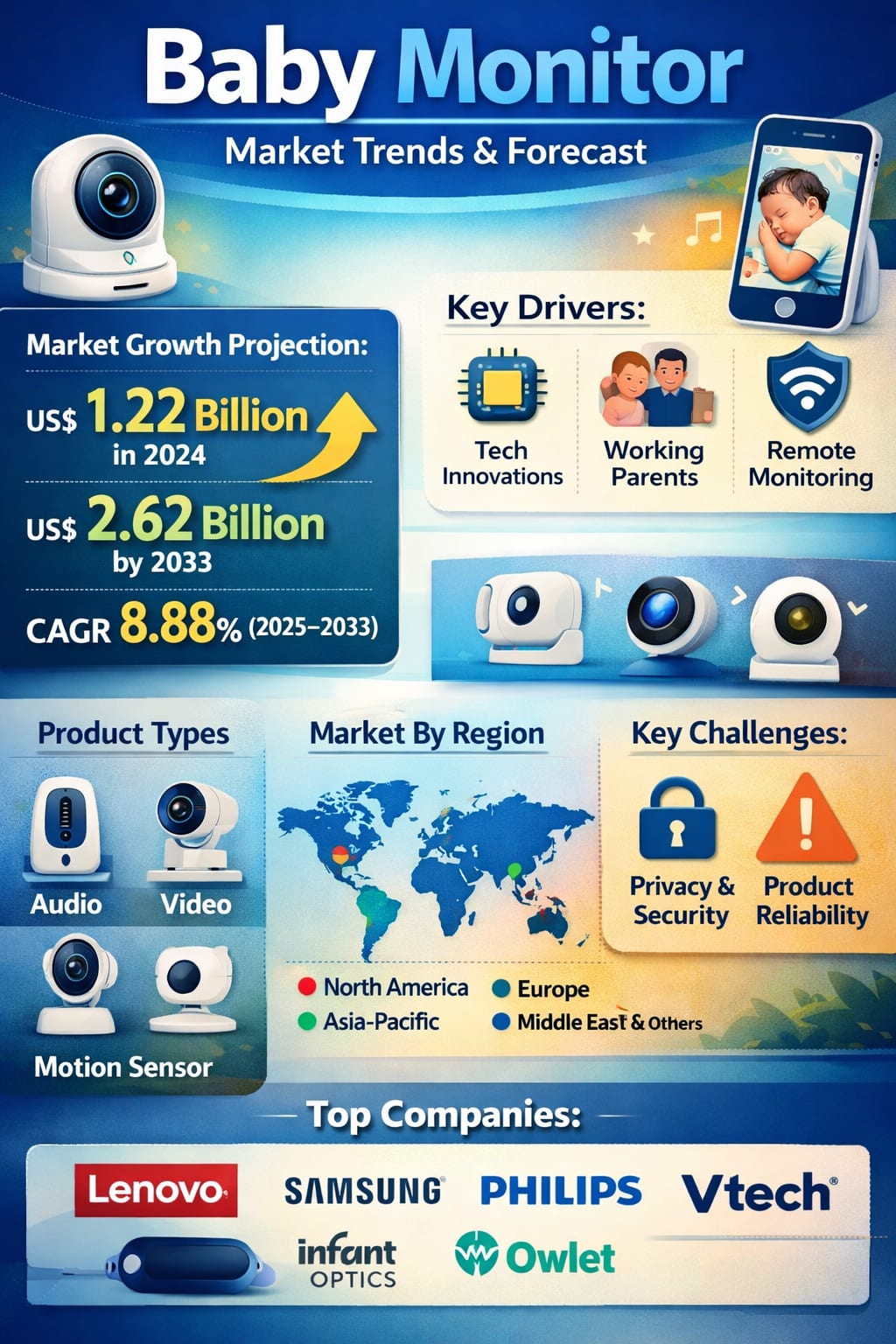
According to Renub Research, the global Baby Monitor Market is expected to reach US$ 2.62 billion by 2033, up from US$ 1.22 billion in 2024, growing at a CAGR of 8.88% from 2025 to 2033. This strong growth reflects not only rising awareness around child safety but also the increasing willingness of parents to invest in smart, reliable, and connected childcare solutions.
The growing number of working professionals with children is one of the biggest forces behind this expansion. Parents today want peace of mind—whether they are in another room, at work, or traveling—and baby monitors provide exactly that. At the same time, manufacturers are heavily investing in research and development to design products that are safer, easier to use, more secure, and more integrated with modern smart home ecosystems.
Global Baby Monitor Industry Overview
The global baby monitor industry is experiencing a steady transformation, driven by technological innovation and shifting consumer expectations. Earlier generations of baby monitors were largely limited to audio transmission, offering parents only basic listening capabilities. Today’s devices, however, are far more advanced. Modern baby monitors come equipped with high-definition video, night vision, temperature and humidity sensors, motion detection, two-way communication, and Wi-Fi connectivity, allowing parents to monitor their babies in real time through smartphones, tablets, and other smart devices.
This shift toward smart, feature-rich products is closely aligned with broader trends in consumer electronics and smart home technology. Parents are no longer just buying a monitoring device; they are investing in a connected childcare solution that integrates seamlessly with their digital lifestyle. The ability to check in on a sleeping baby from anywhere in the world, receive instant alerts, or even soothe a child remotely using two-way audio has become a major selling point.
Rising disposable incomes, especially in urban areas, have further supported market growth. While basic audio monitors remain popular in price-sensitive segments, a growing number of consumers are opting for video and motion-sensor monitors that offer enhanced safety and convenience. Manufacturers, in turn, are focusing on creating multi-functional devices that can work as part of a broader smart home ecosystem.
North America, particularly the United States and Canada, has been an early adopter of these technologies. According to data from the U.S. Census Bureau, two-person and single-person households accounted for 35.03% and 28.45% of all households in 2021, up from 34.52% and 28.01% in 2018. This shift in household structure, combined with strong consumer spending on electronics and childcare products, has supported the widespread adoption of baby monitors in the region.
Innovation continues to shape the competitive landscape. For example, in July 2022, baby monitor manufacturer Owlet introduced the Owlet Cam 2, which uses machine learning (ML) and artificial intelligence (AI) to detect whether a baby is crying in the nursery. Through the Owlet Dream app, parents receive notifications when the device detects sounds, movement, or crying, highlighting how AI is becoming an integral part of modern childcare technology.
Growth Drivers for the Baby Monitor Market
1. Innovation and Technological Progress
Rapid technological advancement is one of the strongest drivers of growth in the baby monitor market. High-definition cameras now provide sharper images and clearer video streams, even in low-light conditions. Advanced sensors can track temperature, humidity, and movement, giving parents a more complete picture of their baby’s environment.
Voice assistants and smart home integration have further enhanced usability. Parents can now use simple voice commands to control devices, check camera feeds, or receive updates, making monitoring more convenient than ever. In addition, developments in the Internet of Things (IoT) and cloud storage allow data to be stored, analyzed, and accessed securely from anywhere, adding another layer of functionality and value.
2. Growing Need for Remote Monitoring Solutions
As smart home devices become more common, awareness of the benefits of remote monitoring continues to grow. Parents today are more concerned than ever about their children’s safety and well-being, especially when they are not physically present. Whether it is during nighttime, while working, or when leaving a child with a caregiver, the ability to monitor a baby remotely provides immense reassurance.
Smart baby monitors enable real-time tracking of a child’s activities and surroundings from virtually anywhere, as long as there is internet access. The use of technologies such as AI and cloud computing improves accuracy, enhances features like smart alerts, and makes these devices an essential part of modern parenting.
3. Rise of Dual-Income Households and Nuclear Families
Changing family structures are also playing a major role in market expansion. The increase in dual-income households and nuclear families has made parenting more challenging, as both parents are often away from home for work. In such situations, smart baby monitors become a practical necessity rather than a luxury.
These devices do more than just monitor. Many models can send alerts, play lullabies or white noise, and even help soothe a baby back to sleep. For working parents, the ability to check in on their child at any time and from any place makes smart baby monitors an indispensable part of daily life.
Challenges in the Baby Monitor Market
1. Privacy and Security Concerns
Despite their benefits, baby monitors—especially Wi-Fi-enabled models—face serious concerns related to privacy and security. As these devices connect to smartphones and cloud platforms, they can become targets for hacking and unauthorized access. There have been reported cases where outsiders gained access to baby monitors, raising serious concerns about family privacy and child safety.
Such incidents can damage consumer trust and harm brand reputations. As a result, manufacturers are under increasing pressure to implement strong encryption, secure data storage, and robust authentication measures. For the market to sustain long-term growth, addressing these security concerns is not optional—it is essential.
2. Product Reliability and Durability
Reliability is critical in a product category that directly relates to child safety. Parents expect baby monitors to work consistently, without interruptions. Issues such as poor signal strength, short battery life, or unstable Wi-Fi connections can be extremely frustrating and may even compromise the device’s purpose.
Connectivity disruptions, hardware malfunctions, or frequent maintenance problems can push consumers to switch brands or avoid advanced models altogether. To maintain customer trust, manufacturers must prioritize quality control and ensure their products deliver consistent, long-lasting performance.
Regional Market Insights
United States Baby Monitor Market
The U.S. baby monitor market continues to grow steadily, supported by rising demand for child safety solutions and ongoing technological innovation. Modern devices offer features such as video streaming, motion detection, temperature sensors, and two-way communication, all accessible through smartphones and tablets.
This trend aligns well with the broader adoption of smart home technologies in the U.S. However, concerns around data security and the relatively high cost of advanced models remain challenges. Despite this, continuous innovation and strong consumer interest are expected to keep the market on a growth path.
United Kingdom Baby Monitor Market
In the UK, the market shows similar trends, with parents increasingly adopting smart, connected baby monitors for convenience and peace of mind. Wi-Fi and Bluetooth integration, along with real-time mobile access, are becoming standard expectations.
Security and privacy concerns, as well as the high price of premium models, remain key issues. Still, ongoing improvements in technology and product design are helping sustain steady market growth.
India Baby Monitor Market
India represents a fast-growing market, driven by urbanization, rising disposable incomes, and increasing awareness of child safety. As more households adopt smartphones and smart home devices, the demand for connected baby monitors is rising.
While price sensitivity and security concerns remain challenges, continuous innovation and expanding e-commerce channels are expected to support strong growth in the coming years.
United Arab Emirates Baby Monitor Market
In the UAE, demand for baby monitors is supported by high purchasing power, rapid adoption of smart technologies, and a strong focus on child safety. Parents are increasingly choosing feature-rich devices that integrate with their digital lifestyles.
Although privacy concerns and high costs can limit adoption for some consumers, the market continues to grow thanks to frequent product launches and technological upgrades.
Baby Monitor Market Segmentation
By Product Type (3 viewpoints):
Audio Baby Monitor
Video Baby Monitor
Motion Sensor Baby Monitor
By Mode of Communication (2 viewpoints):
Wired
Wireless / Wi-Fi
By Distribution Channel (4 viewpoints):
Online Retail Stores
Hypermarkets / Supermarkets
Specialty Stores
Other Distribution Channels
By Country (25 viewpoints):
North America:
United States
Canada
Europe:
France
Germany
Italy
Spain
United Kingdom
Belgium
Netherlands
Turkey
Asia Pacific:
China
Japan
India
Australia
South Korea
Thailand
Malaysia
Indonesia
New Zealand
Latin America:
Brazil
Mexico
Argentina
Middle East & Africa:
South Africa
Saudi Arabia
United Arab Emirates
Company Analysis: Key Players Covered
All major players are analyzed from four viewpoints: Overview, Key Persons, Recent Developments, and Revenue. Key companies include:
Lenovo Group Limited
Samsung Group
Hanwha Corporation
Panasonic Holdings Corporation
Koninklijke Philips N.V.
Infant Optics
Dorel Industries Inc.
VTech Communications Inc.
Anker Technology (UK) Limited
These companies are actively investing in innovation, product design, and security features to strengthen their positions in an increasingly competitive market.
Final Thoughts: The Future of Smart Childcare
The baby monitor market is no longer just about listening in from the next room. It has become a vital part of the smart home ecosystem and a symbol of how technology is reshaping modern parenting. With the market projected to grow from US$ 1.22 billion in 2024 to US$ 2.62 billion by 2033 at a CAGR of 8.88%, the future looks promising for manufacturers, investors, and consumers alike.
While challenges related to privacy, security, and reliability remain, continuous innovation and rising awareness of child safety are expected to keep demand strong. As smart homes become more common and AI-powered features become more refined, baby monitors will likely evolve even further—offering parents not just peace of mind, but a smarter, safer, and more connected way to care for their children.
About the Creator
United States E-Commerce Market Growth, Trends, Forecast, Key Players, and Opportunities
United States E-Commerce Market Overview The United States e-commerce market represents one of the largest and most advanced digital retail ecosystems globally. Driven by strong internet penetration, high consumer purchasing power, and a mature logistics infrastructure, the U.S. has consistently maintained leadership in online retail innovation. The shift toward digital shopping accelerated significantly in recent years, transforming consumer buying patterns across categories such as electronics, fashion, grocery, health products, and home goods.
By Kim Soo hyun6 days ago in Trader
In-Vitro Diagnostics Enzymes Market Set to Soar to USD 5.69 Billion by 2033 | CAGR 7.08%
Overview In-Vitro Diagnostics Enzymes Market In-vitro diagnostic enzymes are specialized biological catalysts used in laboratory testing to detect biomarkers, pathogens, or disease indicators outside the human body. These enzymes are widely utilized in polymerase chain reaction (PCR), next-generation sequencing (NGS), immunoassays, and biosensor technologies. The global in-vitro diagnostics enzymes market size was valued at USD 2.92 Billion in 2024. Looking forward, IMARC Group estimates the market to reach USD 5.69 Billion by 2033, exhibiting a CAGR of 7.08% during 2025-2033. North America currently dominates the market due to advanced healthcare infrastructure, while Asia-Pacific is anticipated to witness the fastest growth due to expanding diagnostic capabilities and increasing healthcare investments.
By James Smith5 days ago in Trader




Comments
There are no comments for this story
Be the first to respond and start the conversation.