
Canada Saskatchewan Grain Market Size & Forecast 2026–2034
How Canada’s Breadbasket Is Powering Global Food Security and Agricultural Trade

Introduction
The Canada Saskatchewan Grain Market stands at the heart of the country’s agricultural economy and continues to play a vital role in global food supply chains. Saskatchewan, often referred to as Canada’s “breadbasket,” has built its reputation on vast fertile land, favorable climatic conditions, and a deeply rooted farming culture that has evolved alongside modern agricultural technology. From wheat and barley to oats and specialty crops such as canary seed and pulses, the province has become one of the most reliable and influential grain-producing regions in the world.
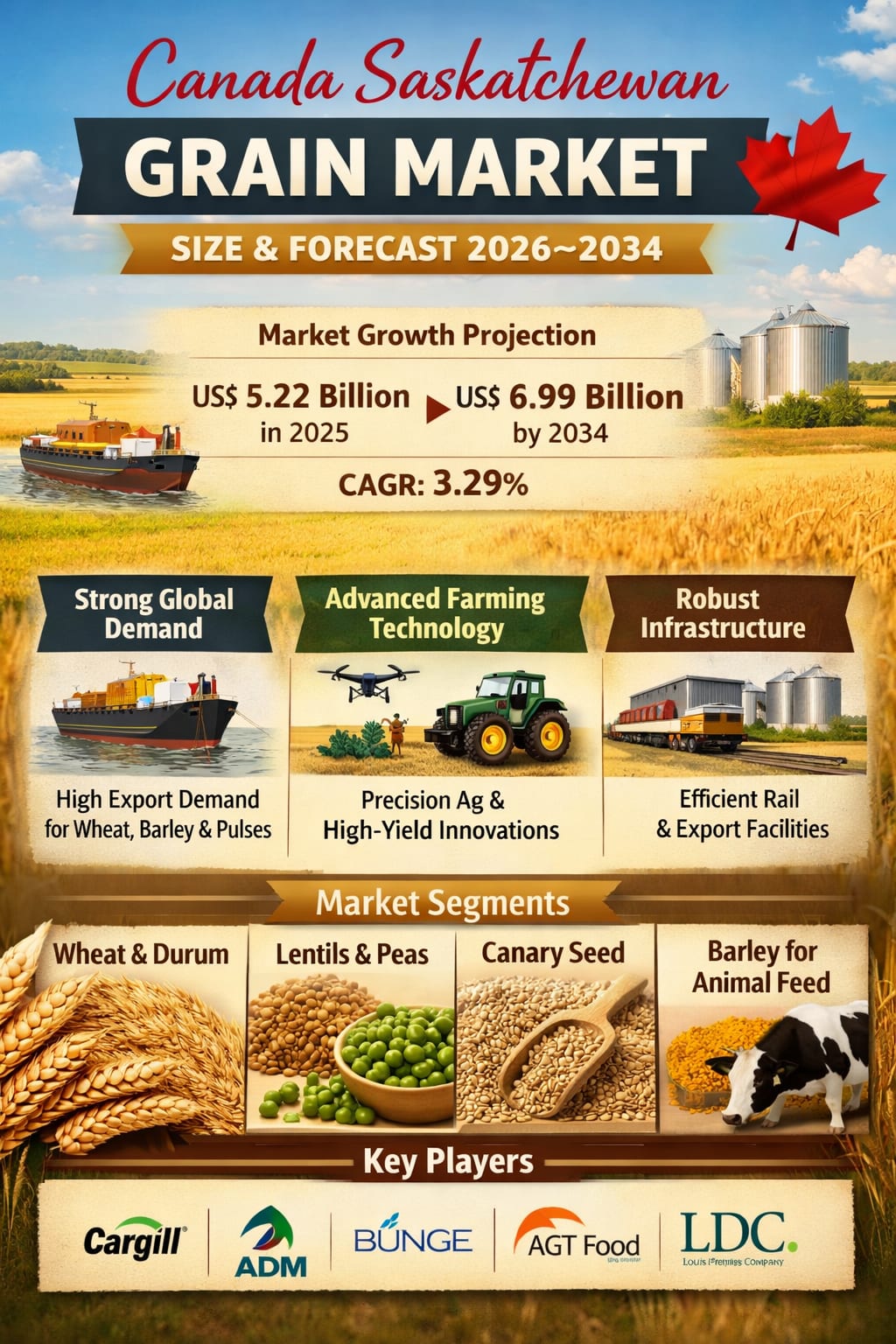
According to Renub Research estimates, the Canada Saskatchewan Grain Market is expected to grow from US$ 5,222.76 million in 2025 to US$ 6,989.15 million by 2034, registering a Compound Annual Growth Rate (CAGR) of 3.29% during the forecast period 2026–2034. This steady growth reflects not only strong global demand for food and feed grains but also Saskatchewan’s continued investments in productivity, infrastructure, and export-oriented agriculture.
Grains are small, hard, dry seeds cultivated for human consumption, animal feed, and industrial uses. Major examples include wheat, barley, oats, corn, rye, and pulses such as lentils and peas, which are often grouped with grains in agricultural markets. These crops form the backbone of the global food system, supplying raw materials for bread, pasta, breakfast cereals, animal feed, and even biofuels. Their long shelf life, high nutritional value, and versatility make them indispensable in both developed and developing economies.
Within Canada, Saskatchewan occupies a unique position. The province is a leading producer and exporter of wheat, durum, barley, canola, and pulses, supplying markets across Asia, Europe, Africa, and the Middle East. Grain farming contributes significantly to Canada’s agricultural GDP and remains a cornerstone of rural economic activity. As global population growth, urbanization, and food security concerns intensify, Saskatchewan’s role in feeding the world is becoming even more strategically important.
Canada Saskatchewan Grain Market Outlook
The outlook for Saskatchewan’s grain market remains positive and resilient. The province benefits from a combination of natural advantages and structural strengths: vast arable land, relatively low population density, advanced farming practices, and a well-established export ecosystem. Together, these factors create a stable environment for long-term agricultural expansion.
Grain production in Saskatchewan is not only large in volume but also high in quality. Canadian grading standards, traceability systems, and quality assurance programs have helped Saskatchewan grain earn a strong reputation in international markets. Buyers often pay a premium for consistent protein content, purity, and reliability of supply, especially for wheat and durum used in human food applications.
Moreover, the province has successfully diversified its crop mix. While wheat remains the flagship crop, barley, oats, canola, lentils, peas, mustard, and flaxseed all contribute to a more balanced and resilient agricultural economy. This diversification helps farmers manage risk, improve soil health through crop rotation, and respond more flexibly to changing global demand patterns.
Growth Drivers of the Canada Saskatchewan Grain Market
Strong Global Demand for Food and Feed Grains
One of the most powerful drivers behind the market’s growth is the steady rise in global demand for food and animal feed. Population growth, urbanization, and changing dietary habits—particularly increased protein consumption—are pushing many countries to rely more heavily on grain imports.
Saskatchewan plays a critical role in meeting this demand, especially for wheat, durum, barley, and pulses. Markets in Asia, the Middle East, and Africa continue to import large volumes of Canadian grain due to its quality, reliability, and consistency. The growing popularity of plant-based proteins has further boosted exports of lentils and peas, positioning Saskatchewan as a key supplier to the global health and nutrition market.
In 2025, a record production of 41.9 million tonnes of grains and oilseeds was reported, marking a significant increase over the previous year. This highlights both the production capacity of the province and the strength of international demand supporting the sector.
Advanced Agricultural Technology and Farm Productivity
Technological innovation has become a cornerstone of Saskatchewan’s agricultural success. Precision agriculture tools—such as GPS-guided machinery, satellite imaging, soil sensors, and data-driven farm management systems—have transformed how crops are planted, managed, and harvested. These technologies allow farmers to optimize input use, reduce waste, and maximize yields per acre.
Seed development has also made significant progress, with new varieties offering better disease resistance, improved drought tolerance, and higher productivity. Combined with strong support from research institutions and government-backed agricultural programs, Saskatchewan farmers are well-positioned to remain competitive in global markets.
The launch of new digital agriculture initiatives, such as advanced research institutes and innovation hubs, further reinforces the province’s commitment to modern, data-driven farming. Higher productivity not only improves farm profitability but also strengthens Saskatchewan’s role as a reliable supplier in international grain trade.
Well-Developed Export and Transportation Infrastructure
Saskatchewan’s grain market is underpinned by a robust transportation and export infrastructure network. An extensive rail system connects farms and grain elevators to major ports on the West Coast and the Great Lakes, enabling efficient bulk exports to global markets. Investments in high-capacity terminals, storage facilities, and logistics technology have significantly improved supply chain reliability.
Efficient infrastructure reduces post-harvest losses, minimizes bottlenecks during peak seasons, and ensures timely delivery to international buyers. With continued public and private investment in trade corridors and logistics modernization, Saskatchewan’s competitiveness in global grain markets is expected to strengthen further over the forecast period.
Challenges Facing the Canada Saskatchewan Grain Market
Climate Variability and Weather-Related Risks
Despite its strengths, the grain sector in Saskatchewan remains vulnerable to climate variability. Droughts, floods, heatwaves, and early frosts can all have a serious impact on crop yields and quality. These weather-related risks create uncertainty for farmers, affecting both production volumes and income stability.
While crop insurance programs and improved seed varieties provide some level of protection, climate change continues to introduce volatility into farming operations. Managing these risks will require ongoing investment in resilient farming practices, water management, and climate-smart agriculture.
Transportation Constraints and Market Volatility
Although Saskatchewan has a strong transportation network, capacity constraints can still arise during peak harvest periods. Rail congestion, labor shortages, and logistical disruptions may delay shipments and affect the ability to meet export commitments on time.
In addition, grain prices are highly sensitive to global market conditions, including geopolitical tensions, currency fluctuations, and changes in trade policies. This price volatility can impact farm incomes and investment decisions, making long-term planning more challenging for producers and agribusinesses alike.
Key Market Segments
Canada Saskatchewan Wheat Market
Wheat remains the backbone of Saskatchewan’s agricultural economy. The province is one of the world’s leading producers of high-quality spring wheat and durum wheat, both prized for their high protein content and excellent milling characteristics. Saskatchewan wheat is widely used in the production of bread, pasta, noodles, and other staple foods across international markets.
Strong quality control, grading systems, and ongoing seed development programs help maintain the global reputation of Canadian wheat. As global food demand continues to rise, the long-term outlook for Saskatchewan’s wheat market remains stable and positive.
Canada Saskatchewan Canary Seed Market
Saskatchewan holds a dominant position in the global canary seed market. Traditionally used as bird feed, canary seed has recently gained approval for human consumption in several international markets, opening new opportunities in the health food segment. The crop also provides valuable rotation options for farmers, helping improve soil health and reduce production risks.
Although smaller in scale compared to wheat or barley, the canary seed market offers attractive margins due to limited global competition and growing niche demand.
Canada Saskatchewan Wheat – Human Food Market
The human food segment for wheat focuses on premium-quality grain used for bread-making, pasta, noodles, and specialty flours. High-protein spring wheat and durum from Saskatchewan are particularly sought after for these applications. International buyers value the predictability, traceability, and strict quality standards associated with Canadian grain.
As consumers show increasing interest in premium and fortified food products, this segment is expected to remain stable and potentially grow in value over the coming years.
Canada Saskatchewan Barley Animal Feed, Waste, and Dockage Market
Barley plays a crucial role in livestock nutrition across Canada. In Saskatchewan, barley that does not meet malting or food-grade standards is efficiently utilized as animal feed, ensuring minimal waste. By-products and dockage are also incorporated into feed rations, contributing to cost-effective livestock production.
While margins in this segment are generally lower than in premium grain markets, demand remains steady due to the consistent needs of the livestock industry.
Canada Saskatchewan Oats Industrial Use Market
Beyond food applications, oats produced in Saskatchewan also serve industrial purposes, including animal feed, bio-products, health products, and cosmetics. Components such as beta-glucans are valued for their functional and health-related properties, including cholesterol reduction and skin-soothing effects.
Although smaller in scale, this industrial segment adds value to oat production and supports diversification within the grain economy.
Regional Demand Dynamics
Ontario
Ontario’s strong food processing and livestock sectors create steady demand for Saskatchewan grains. Wheat, barley, oats, and pulses are transported east to support flour mills, bakeries, cereal manufacturers, and feed producers. Saskatchewan supplies help stabilize Ontario’s grain availability and ensure consistent quality for processors.
Quebec
In Quebec, Saskatchewan grain is valued primarily for quality and reliability. High-protein wheat is especially important for bread-making and baking industries. Imports from Saskatchewan supplement local production, particularly during years of variable harvests influenced by regional climate conditions.
Alberta
Saskatchewan and Alberta share a closely integrated Prairie grain market. Grain flows freely between the two provinces to meet the needs of food processors and the livestock sector. This regional integration allows for flexibility and efficient allocation of supply based on production levels and demand conditions.
Market Segmentation Overview
By Grain Production Volume & Market:
Wheat
Barley
Oats
By Non-Grain (Oilseeds and Pulses) Production Volume & Market:
Canary Seed
Canola
Chick Peas
Flaxseed
Lentils
Mustard
Peas
By End User:
Human food
Seed requirements
Industrial use
Animal feed, waste and dockage
Others
By Region:
Ontario
Quebec
British Columbia
Alberta
Rest of Canada
Competitive Landscape
The Canada Saskatchewan Grain Market is supported by major global and regional agribusiness players. Key companies include:
Cargill, Inc.
Archer Daniels Midland Company
Bunge
AGT Food and Ingredients Inc
Louis Dreyfus Company
These players are evaluated across five key dimensions: Overview, Key Persons, SWOT Analysis, Recent Developments & Strategies, and Financial Insights. Their strong global networks, processing capabilities, and trading expertise play a critical role in connecting Saskatchewan farmers to international markets.
Final Thoughts
The Canada Saskatchewan Grain Market is entering the 2026–2034 period on solid footing. With the market projected to grow from US$ 5.22 billion in 2025 to nearly US$ 6.99 billion by 2034, Saskatchewan’s position as a global grain powerhouse is set to strengthen further. Strong international demand, continuous technological advancement, and reliable export infrastructure provide a robust foundation for sustainable growth.
While challenges such as climate variability, transportation constraints, and price volatility remain, the province’s diversified crop base, innovation-driven farming practices, and deep integration into global trade networks offer long-term resilience. In a world increasingly focused on food security and sustainable agriculture, Saskatchewan’s grain sector is not just growing—it is becoming more strategically important than ever before.
About the Creator
Philippines Ecotourism Market 2026: Sustainable Travel, Community Tourism & Nature-Led Growth
Philippines Ecotourism Market Overview The Philippines ecotourism market is emerging as a powerful force within the country’s broader tourism industry, driven by rising environmental awareness, community-based travel models, and a global shift toward responsible tourism. With its rich biodiversity, pristine coastlines, rainforests, and culturally diverse communities, the Philippines is uniquely positioned to benefit from ecotourism that prioritizes conservation while supporting local livelihoods. The Philippines ecotourism market size reached USD 4,898.7 Million in 2025. The market is projected to reach USD 12,388.0 Million by 2034, exhibiting a growth rate (CAGR) of 10.86% during 2026-2034.
By Manisha Dixit6 days ago in Trader
Stanislav Kondrashov: AI Is Quietly Rewriting the Rules for Bitcoin and XRP
Bitcoin has dropped to $74,000. XRP has slipped. Across the board, digital currencies have lost ground—at the same time that technology companies are facing renewed pressure. While headlines often point to policy changes or economic signals, another factor is emerging in the background: artificial intelligence. According to TELF AG founder Stanislav Kondrashov, the ripple effects of AI development are playing a much larger role than many realise.
By Stanislav Kondrashov7 days ago in Trader



Comments
There are no comments for this story
Be the first to respond and start the conversation.