
Casino Gambling Market Trends & Summary: A Global Industry in the Fast Lane
From legalization and digital innovation to mobile gaming and crypto payments, the global casino gambling market is entering a new era of growth and reinvention.

Global Casino Gambling Market: A High-Stakes Industry on the Rise
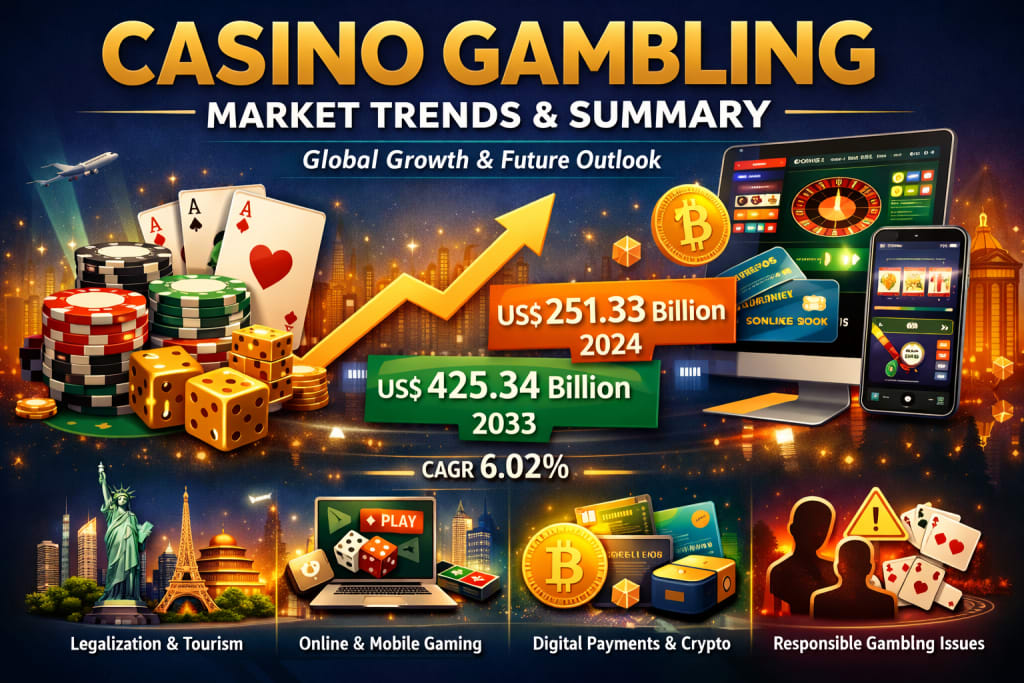
The global casino gambling market is undergoing a powerful transformation, driven by legalization, digital platforms, changing social attitudes, and a surge in tourism-led entertainment spending. According to Renub Research, the casino gambling market is expected to grow from US$ 251.33 billion in 2024 to US$ 425.34 billion by 2033, registering a CAGR of 6.02% from 2025 to 2033.
This steady expansion reflects how gambling has evolved from a niche or location-bound activity into a mainstream entertainment industry that blends hospitality, technology, and interactive digital experiences. Today’s casinos are no longer just about gaming floors. They are entertainment ecosystems—featuring luxury hotels, fine dining, concerts, shopping, and immersive digital platforms that reach players anywhere in the world.
The industry’s growth is being powered by several forces at once: wider legalization, rising disposable incomes, the boom in mobile and online platforms, innovations in payment methods, and a cultural shift that increasingly views gambling as a form of leisure rather than a taboo. Together, these trends are reshaping how, where, and why people engage with casino gaming.
A Decade of Change: How the Industry Evolved
Over the past ten years, the global casino gambling industry has expanded well beyond its traditional strongholds like Las Vegas, Macau, and Monte Carlo. While these iconic destinations remain vital, the market has diversified geographically and digitally.
Land-based casinos continue to play a central role, especially in tourism-driven regions. These venues have reinvented themselves as integrated resorts, offering luxury accommodation, world-class entertainment, shopping malls, and fine dining alongside gaming tables and slot machines. The goal is clear: turn gambling into just one part of a broader lifestyle experience.
At the same time, technology has radically altered the industry’s reach. Online casinos, mobile apps, and live-dealer platforms have made gambling more accessible than ever. Players no longer need to travel to a casino floor—they can place bets, spin slots, or join live games from their phones. This shift has been especially appealing to younger, tech-savvy audiences who value convenience and digital-first experiences.
Another major development is the rise of alternative payment methods, including e-wallets and cryptocurrencies, which promise faster, more secure, and more private transactions. These innovations are helping casinos attract a global audience and reduce friction in the gaming experience.
Strategic Moves and Industry Developments
The competitive landscape of the casino gambling market is being shaped by strategic acquisitions, platform upgrades, and content expansion. In May 2023, MGM Resorts International announced that its subsidiary LeoVegas would acquire a majority stake in Push Gaming Holding Limited, a well-known game developer. This marked LeoVegas’ first major investment since joining MGM and was aimed at strengthening its in-house content development and technological capabilities.
Similarly, Caesars Entertainment relaunched the Tropicana Online Casino in New Jersey in April 2023, offering players a more integrated digital experience and closer ties to the Caesars Rewards loyalty program. These moves highlight a broader industry trend: major casino operators are increasingly investing in digital platforms, proprietary content, and ecosystem-based loyalty models to retain customers and boost lifetime value.
Key Growth Drivers Shaping the Market
1. Legalization and Regulation
One of the strongest drivers of growth in the global casino gambling market is the ongoing legalization and regulation of gambling activities across multiple regions. As more governments recognize the economic potential of regulated gaming, they are opening doors to new operators and formalizing previously gray or restricted markets.
A landmark moment was the 2018 U.S. Supreme Court decision that allowed states to legalize sports betting individually. This move unlocked massive new revenue streams for casinos and accelerated the integration of sports betting into both online and land-based gaming ecosystems.
Regulation also benefits players and operators alike. Clear legal frameworks improve consumer protection, encourage responsible gambling practices, and create a more stable environment for long-term investment. As more countries in Europe, Asia, and other regions adopt structured regulatory systems, the global casino gambling market is likely to see further expansion.
2. Social Acceptance and Cultural Shifts
Gambling is no longer viewed solely as a risky vice. In many societies, it has become a normalized form of entertainment, often bundled with dining, travel, nightlife, and social experiences. This cultural shift is particularly noticeable among younger adults, who see casino gaming as a social and recreational activity rather than a purely financial pursuit.
The rise of destination resorts, themed casinos, and experience-driven venues has reinforced this trend. Casinos today market themselves as entertainment hubs rather than just gambling halls, which broadens their appeal and attracts a more diverse customer base.
As social acceptance continues to grow, more people are willing to try casino gaming—whether through a mobile app, an online platform, or a physical resort—fueling steady demand across multiple segments of the market.
3. Innovative Payment Methods
Payment innovation is quietly revolutionizing the casino gambling experience. The adoption of e-wallets, mobile payments, and cryptocurrencies has made transactions faster, more secure, and more convenient. For many players, especially international or tech-savvy users, these options remove traditional banking barriers and offer greater privacy and efficiency.
Cryptocurrencies like Bitcoin and Ethereum are particularly attractive for users who value anonymity and low transaction fees. Meanwhile, mobile wallets and integrated payment gateways make it easier than ever to deposit, withdraw, and play on the go.
By reducing friction in the payment process, these technologies are encouraging higher participation rates and expanding the global reach of both online and land-based casinos.
Challenges the Industry Cannot Ignore
1. Addiction and Responsible Gambling
Despite its growth, the casino gambling industry faces a serious and ongoing challenge: gambling addiction. As access to gaming becomes easier—especially through mobile and online platforms—the risk of problem gambling increases.
Operators are under growing pressure to implement responsible gambling measures, including self-exclusion programs, betting limits, awareness campaigns, and access to counseling resources. Regulators, too, are tightening oversight to ensure player protection and ethical marketing practices.
Failure to address these concerns can lead to reputational damage, legal penalties, and public backlash. For the industry to grow sustainably, responsible gaming must remain a core priority rather than an afterthought.
2. Competition from Online Gambling
While online gambling is a growth engine for the industry as a whole, it also poses a challenge to traditional brick-and-mortar casinos. Many players now prefer the convenience of gambling from home or on their smartphones, where they can access a wide range of games 24/7 along with bonuses and promotions.
To stay competitive, land-based casinos are increasingly blending physical and digital experiences—launching online platforms, offering mobile apps, and experimenting with virtual and hybrid gaming models. Still, competition remains intense, and operators must continuously invest in technology, user experience, and marketing to retain customers.
Regional Market Highlights
United States
The U.S. casino gambling market is benefiting strongly from state-level legalization, particularly in sports betting and online gaming. This has opened up new revenue streams for both traditional casinos and digital operators. Technological innovation, mobile platforms, and improved payment systems are making gaming more accessible, while sports betting has become a major growth pillar. However, regulatory complexity and responsible gambling concerns continue to shape the market’s evolution.
United Kingdom
The UK remains one of the most mature and tightly regulated gambling markets in the world. While land-based casinos still have a strong presence, online and mobile gaming dominate growth. The UK Gambling Commission enforces strict rules on transparency, fairness, and player protection, pushing operators to innovate while maintaining high compliance standards. Live dealer games and mobile-friendly platforms are especially popular among British players.
India
India’s casino gambling market is smaller but increasingly interesting due to rising disposable incomes and a growing middle class. Regions like Goa, Sikkim, and Daman—where gambling is legal—have seen growing interest in both land-based and online casinos. However, fragmented regulations and state-by-state rules create uncertainty. If clearer national policies emerge, the long-term growth potential could be significant.
United Arab Emirates
The UAE represents one of the most intriguing emerging markets. In 2024, the formation of the General Commercial Gaming Regulatory Authority (GCGRA) signaled a major policy shift. Wynn Resorts has already secured the first commercial gaming license and is developing a luxury resort in Ras Al Khaimah, expected to open in 2027. With strong tourism, premium infrastructure, and high-spending visitors, the UAE could become a major global gaming hub.
Market Segmentation Overview
By Player Type:
Recreational Gamblers
Professional Gamblers
High Rollers
Casual Gamblers
By Game Type:
Table Games
Slot Machines
Electronic Gaming Machines (EGMs)
Sports Betting
By Gaming Location:
Land-based Casinos
Online Casinos
Virtual Reality Casinos
By Payment Method:
Cash
Credit/Debit Cards
E-Wallets
Cryptocurrency
By Country (25 Markets Covered):
North America (United States, Canada), Europe (France, Germany, Italy, Spain, UK, Belgium, Netherlands, Turkey), Asia Pacific (China, Japan, India, Australia, South Korea, Thailand, Malaysia, Indonesia, New Zealand), Latin America (Brazil, Mexico, Argentina), Middle East & Africa (South Africa, Saudi Arabia, UAE).
Competitive Landscape: Key Players
Major companies shaping the global casino gambling market include:
Las Vegas Sands
MGM Resorts International
Caesars Entertainment
SJM Holdings
Wynn Resorts
Galaxy Entertainment
Hard Rock International
Palms Casino Resort
Boyd Gaming
Each of these players is analyzed across four viewpoints: Overview, Key Persons, Recent Developments, and Revenue, reflecting how scale, brand power, and digital strategy are becoming decisive competitive factors.
Final Thoughts: The Future of Casino Gambling
The global casino gambling market is no longer just about gaming—it’s about experiences, technology, and lifestyle. With the market projected to grow from US$ 251.33 billion in 2024 to US$ 425.34 billion by 2033, the industry is clearly entering a new phase of expansion and reinvention.
Legalization, digital platforms, innovative payments, and shifting cultural attitudes are opening doors to new audiences and new business models. At the same time, challenges like responsible gambling and intense digital competition will require thoughtful strategy and strong regulation.
For operators, investors, and policymakers alike, the message is clear: the future of casino gambling will be shaped not just by how people play—but by how safely, seamlessly, and responsibly the industry evolves in a rapidly changing world.
About the Creator
Sakshi Sharma
Content Writer with 7+ years of experience crafting SEO-driven blogs, web copy & research reports. Skilled in creating engaging, audience-focused content across diverse industries.
Keep reading
More stories from Sakshi Sharma and writers in Trader and other communities.
Power Equipment Market Trends & Summary: The Backbone of the Global Energy Transition
Introduction: Why Power Equipment Matters More Than Ever The global energy system is in the middle of its most dramatic transformation in a century. From the electrification of transport and industry to the rapid rise of renewable energy, the world’s dependence on reliable, efficient, and intelligent power infrastructure has never been higher. At the heart of this transformation sits the power equipment market—a vast and often underappreciated industry that supplies the hardware making modern electricity systems possible.
By Sakshi Sharmaa day ago in Trader
Lloyds Bank Closures 2026: Steps to Keep Your Banking Safe
lloyds bank closures 2026 are causing concern for customers across the UK. Many wonder if their local branch will remain open and how it will affect their daily banking. Branch closures are not just about numbers they impact communities, small businesses, and individuals who rely on in-person services. This article explains the reasons behind lloyds bank closures 2026, what areas may be affected, and practical steps you can take to protect your access to banking services.
By hamza mirza4 days ago in Trader



Comments
There are no comments for this story
Be the first to respond and start the conversation.