
China Watch Market Size and Forecast 2025
From Heritage Timepieces to Smart Wearables, China’s Watch Industry Enters a New Golden Era

Introduction: Timekeeping in a Rapidly Changing China
China’s relationship with watches has evolved far beyond simple timekeeping. Today, watches in China are symbols of status, technology, fashion, and personal identity. From Swiss luxury mechanical masterpieces to feature-rich smartwatches by domestic tech giants, the Chinese watch market reflects the country’s broader economic transformation—where tradition meets innovation, and craftsmanship meets digital intelligence.
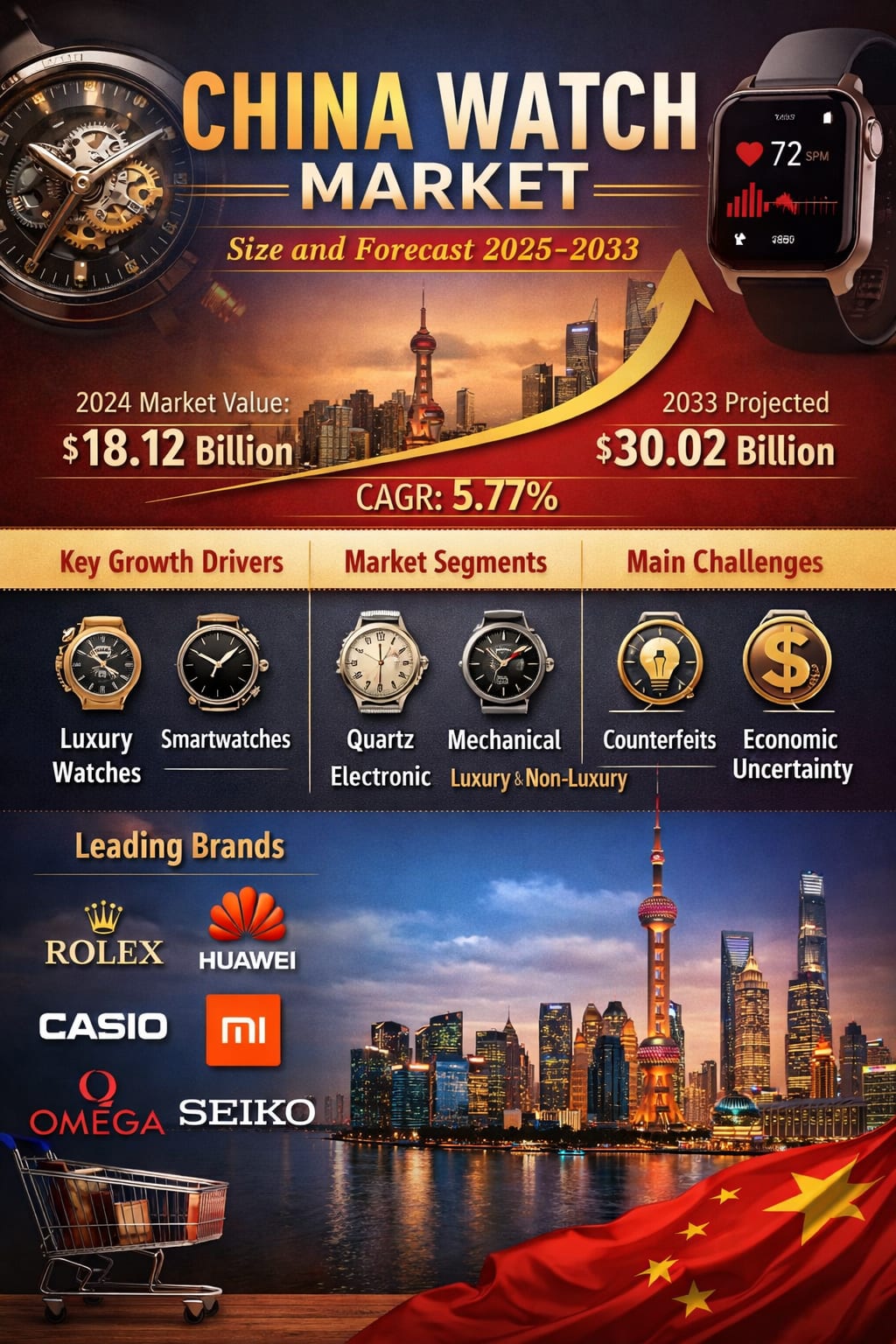
According to Renub Research, the China Watch Market was valued at US$ 18.12 billion in 2024 and is projected to reach US$ 30.02 billion by 2033, growing at a CAGR of 5.77% during 2025–2033. This solid expansion is driven by a combination of rising disposable incomes, strong demand for luxury goods, rapid adoption of smartwatches, and the explosive growth of e-commerce.
China is no longer just a manufacturing hub for global watch brands—it has become one of the most influential consumer markets shaping global watch trends. Whether it’s a young professional buying a smartwatch for fitness tracking or a collector investing in a limited-edition Swiss mechanical watch, the market today is broader, deeper, and more dynamic than ever before.
What Is Driving the China Watch Market Forward?
1. Rising Demand for Luxury Watches
China has emerged as one of the world’s largest consumers of luxury watches. For many affluent and upper-middle-class consumers, a luxury watch is not just an accessory—it is a statement of success, taste, and social status. Brands such as Rolex, Patek Philippe, Audemars Piguet, Omega, and Vacheron Constantin enjoy strong demand, particularly in major cities like Shanghai, Beijing, Shenzhen, and Guangzhou.
Luxury watches are also increasingly viewed as investment assets. Certain models, especially limited editions, tend to appreciate over time, making them attractive to collectors and high-net-worth individuals. This investment mindset, combined with China’s growing wealthy population, continues to push the premium segment forward.
In recent years, both domestic consumption and travel-related luxury purchases have contributed significantly to sales. The opening of flagship boutiques and brand-owned stores in top-tier malls further signals how seriously global luxury watchmakers are taking the Chinese market.
2. The Smartwatch Boom and Digital Lifestyles
On the other end of the spectrum, smartwatches are transforming the definition of a watch in China. Devices from Apple, Huawei, Xiaomi, and other tech players are now seen as daily digital companions, offering features such as heart-rate monitoring, sleep tracking, fitness coaching, GPS, notifications, and mobile payments.
China’s tech-savvy population, combined with a growing focus on health, fitness, and productivity, has made smartwatches one of the fastest-growing segments in the market. Affordable pricing strategies by domestic brands have also helped expand adoption beyond major cities into smaller urban centers.
Innovation remains constant. For example, Xiaomi’s launch of advanced sports-focused smartwatches highlights how brands are pushing into professional fitness and performance tracking, not just basic lifestyle features. As sensors, AI integration, and battery technology improve, smartwatches are expected to capture an even larger share of the overall watch market.
3. E-Commerce and the Rise of Digital Watch Retail
China’s world-leading e-commerce ecosystem plays a crucial role in the watch market’s expansion. Platforms such as Tmall, JD.com, and Pinduoduo offer consumers access to everything from budget quartz watches to high-end luxury timepieces.
Online retail brings price transparency, convenience, wide product selection, and customer reviews, making it especially attractive to younger buyers. Live-stream shopping, influencer marketing, and short-video platforms have further reshaped how watches are marketed and sold, turning product launches into entertainment-driven shopping events.
Even luxury brands, once cautious about online sales, are now embracing direct-to-consumer digital channels, offering exclusive collections and personalized services through official websites and flagship online stores. With China’s digital infrastructure continuing to mature, online sales will remain one of the strongest growth engines for the watch industry.
Key Challenges Facing the Market
1. Counterfeit and Imitation Watches
One of the most persistent challenges in China’s watch market is the widespread presence of counterfeit and imitation products. High-quality replicas, often sold at a fraction of the original price, can erode brand value and reduce sales for legitimate manufacturers.
While authorities and brands continue to invest in anti-counterfeiting technologies such as digital certificates, blockchain verification, and improved supply chain tracking, the issue has not disappeared. For premium brands especially, protecting brand integrity and consumer trust remains an ongoing battle.
2. Economic Uncertainty and Changing Spending Habits
Like all discretionary consumer goods, watches are sensitive to economic cycles and shifts in consumer confidence. During periods of uncertainty, consumers tend to prioritize essential spending over luxury or non-essential purchases.
Additionally, younger consumers are increasingly valuing experiences over possessions, which can influence how and when they choose to buy watches. To adapt, brands are focusing more on flexible pricing, financing options, and stronger emotional storytelling to keep watches relevant in a changing lifestyle landscape.
Market by Type: Technology and Tradition Coexist
China Electronic Watch Market
The electronic watch segment—largely driven by smartwatches—is one of the fastest-growing parts of the Chinese market. These devices have moved beyond simple timekeeping to become health monitors, fitness coaches, communication tools, and lifestyle assistants.
Apple, Huawei, and Xiaomi dominate this space, continuously releasing upgraded models with better displays, smarter software, and more advanced sensors. The combination of innovation, competitive pricing, and frequent product refresh cycles keeps consumers engaged and encourages repeat purchases.
As wearable technology becomes more integrated into daily life, electronic watches are expected to remain a core growth pillar of the overall market.
China Mechanical Watch Market
Mechanical watches continue to hold a special place in China’s high-end segment. For many consumers, these watches represent heritage, craftsmanship, and timeless value rather than just functionality.
Swiss brands remain highly desirable, but domestic manufacturers such as Seagull and FIYTA are also gaining recognition by blending traditional watchmaking techniques with modern design. Mechanical watches are often purchased for collecting, gifting, and long-term investment, making this segment more resilient to short-term fashion trends.
Despite competition from smartwatches, mechanical timepieces maintain strong appeal among affluent consumers and enthusiasts who appreciate the art of horology.
China Quartz Watch Market
Quartz watches remain popular thanks to their affordability, accuracy, and low maintenance. Brands like Casio, Citizen, and Seiko, along with numerous domestic players, continue to serve a wide base of consumers looking for reliable everyday watches.
While smartwatches have taken some share from traditional quartz models, this segment still benefits from price-sensitive buyers, students, and practical users who prefer simplicity. To stay competitive, many quartz watch makers are experimenting with new designs, eco-friendly materials, and hybrid features.
Market by Gender: A Broad and Diverse Audience
China Men’s Watch Market
The men’s segment covers everything from luxury business watches and rugged sports models to high-tech smartwatches. Executives and collectors often gravitate toward premium mechanical watches, while younger consumers show strong interest in smart and connected devices.
Brands like Patek Philippe, TAG Heuer, Huawei, Apple, and Garmin each serve different lifestyle needs—from boardrooms to gyms to outdoor adventures. As incomes rise and fashion awareness grows, the men’s watch market in China continues to expand steadily.
Market by Price Range: Luxury vs. Non-Luxury
China Luxury Watch Market
Luxury watches represent one of the most prestigious and profitable segments of the Chinese watch industry. These timepieces are frequently purchased for status display, corporate gifting, weddings, and major life milestones.
The growth of the pre-owned and certified resale market has also made luxury watches more accessible while reinforcing their image as long-term value assets. As China’s wealthy population continues to grow, the luxury watch segment is expected to remain a key driver of market value expansion.
Market by Distribution Channel: Where Consumers Buy
China Convenience Stores Watch Market
Convenience stores mainly serve budget-conscious consumers looking for simple, functional timepieces. These are typically low-cost quartz watches, often from local or unbranded manufacturers. While this segment does not compete with luxury or smartwatches, it plays an important role in mass-market accessibility and everyday utility.
China Online Watch Store Market
Online platforms have revolutionized watch retailing in China. Consumers can compare prices, read reviews, watch live demonstrations, and even interact with influencers before making a purchase.
From entry-level models to high-end luxury pieces, the internet has become one of the most influential sales channels in the industry. With continued innovation in digital retail and logistics, online channels are expected to maintain strong momentum in the coming years.
Market Segmentation Snapshot
By Type:
Quartz Watches
Electronic Watches
Mechanical Watches
By Gender:
Men
Women
Unisex
By Price Range:
Luxury
Non-Luxury
By Distribution Channel:
Hypermarket/Supermarket
Convenience Stores
Online
Competitive Landscape: Key Players in Focus
The China watch market features a mix of global giants and influential domestic brands. Key players include:
Seiko Holdings Corporation
Casio Computer Co. Ltd
Timex Group
Rolex SA
Compagnie Financière Richemont S.A
The Swatch Group Ltd
Citizen Watch Co. Ltd.
Fossil Group Inc.
Google LLC (Fitbit Inc.)
These companies compete across innovation, brand heritage, pricing strategies, distribution reach, and marketing influence, shaping the future direction of the industry.
Final Thoughts: A Market Where Time Meets Transformation
The China watch market is no longer defined by a single trend or product category. Instead, it is a multi-layered ecosystem where luxury craftsmanship, digital innovation, mass-market affordability, and e-commerce convenience coexist and reinforce each other.
With the market expected to grow from US$ 18.12 billion in 2024 to US$ 30.02 billion by 2033 at a CAGR of 5.77%, the outlook remains strong. Rising incomes, evolving lifestyles, and continuous technological advancement will keep reshaping how Chinese consumers perceive and purchase watches.
About the Creator
Australia Intravenous Solution Market: Critical Care Growth Driven by Healthcare Needs
The Australia intravenous solution market plays an essential role in the nation’s healthcare infrastructure, underpinning fluid therapy, nutritional support, medication delivery and hydration across hospitals, clinics and home care settings. According to the latest IMARC Group analysis, the market was valued at USD 326.20 million in 2025 and is projected to reach USD 479.28 million by 2034, growing at a compound annual growth rate (CAGR) of 4.37% from 2026 to 2034.
By Amélie Belleabout 22 hours ago in Trader
France Foodservice Market Size and Forecast 2025–2033
Introduction: A Market Built on Taste, Tradition, and Transformation France has long been recognized as the spiritual home of global gastronomy. From Michelin-starred fine dining restaurants to neighborhood bakeries, cafés, and bustling brasseries, food is not just a necessity in France—it is culture, identity, and daily ritual. In recent years, this deep-rooted culinary tradition has been meeting powerful new forces: digitalization, sustainability, changing lifestyles, and the revival of global tourism.
By Sakshi Sharmaabout 23 hours ago in Trader


Comments
There are no comments for this story
Be the first to respond and start the conversation.