
Cloud Services Brokerage Market Size and Forecast 2026–2034
Multi-Cloud Complexity and AI Integration Propel Global CSB Market Toward US$ 50.14 Billion by 2034

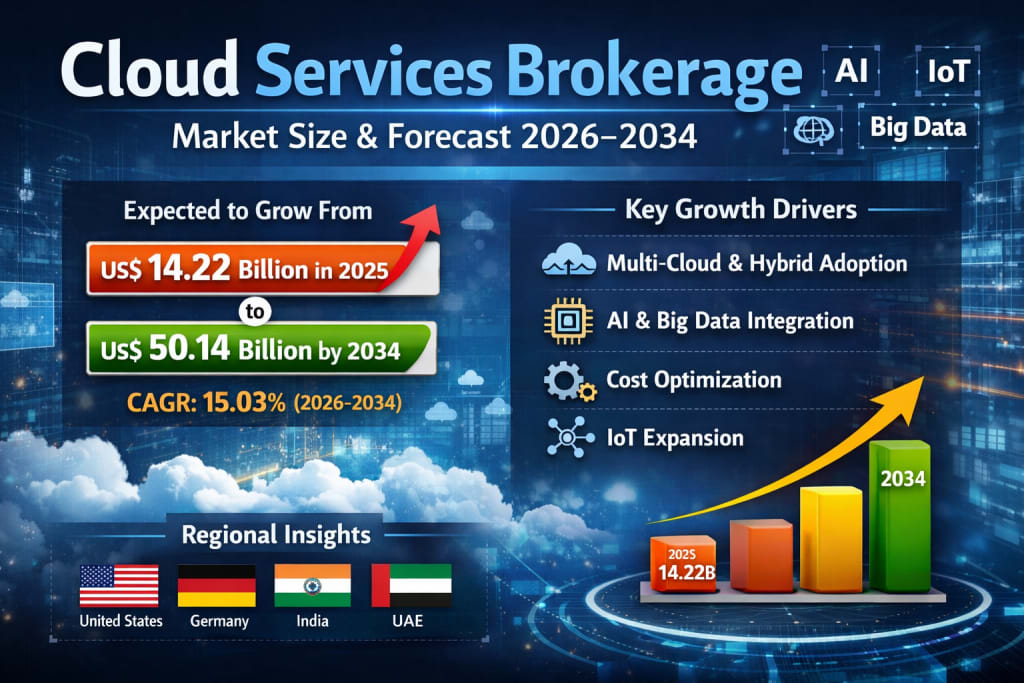
The Cloud Services Brokerage (CSB) market is entering a dynamic phase of expansion as enterprises accelerate their digital transformation initiatives. According to Renub Research, the Cloud Services Brokerage Market is expected to reach US$ 50.14 billion by 2034, up from US$ 14.22 billion in 2025, growing at a CAGR of 15.03% from 2026 to 2034.
This impressive growth trajectory reflects the increasing complexity of cloud ecosystems, the widespread adoption of AI, big data analytics, and IoT technologies, and the strategic shift toward hybrid and multi-cloud environments. As organizations seek agility, scalability, and operational efficiency, Cloud Services Brokerage is emerging as a critical enabler of enterprise cloud success.
Cloud Services Brokerage Industry Overview
Cloud Services Brokerage acts as an intermediary between enterprises and cloud service providers, helping organizations select, integrate, manage, and optimize cloud solutions. In a business environment where companies rely on multiple cloud platforms, CSBs simplify procurement, integration, governance, and cost management.
The core functions of CSBs typically include:
Aggregation: Providing unified access to multiple cloud services through a centralized platform.
Integration: Ensuring seamless interoperability between cloud platforms and on-premises systems.
Customization: Tailoring cloud solutions to specific business needs.
Governance and Compliance: Monitoring regulatory adherence and security standards.
Cost Optimization: Delivering financial transparency and resource efficiency.
As enterprises adopt Infrastructure-as-a-Service (IaaS), Platform-as-a-Service (PaaS), and Software-as-a-Service (SaaS) models, the need for orchestration across these services becomes critical. CSBs bridge that gap, enabling organizations to focus on innovation rather than infrastructure complexity.
The market landscape includes global IT service leaders such as Accenture PLC, IBM Corporation, Wipro Limited, and Cognizant Technology Solutions Corp., along with specialized brokerage firms and emerging startups. These players differentiate themselves through advanced analytics, AI-driven automation tools, and strategic alliances with hyperscale providers like Amazon Web Services, Microsoft Azure, and Google Cloud.
Growth Drivers for the Cloud Services Brokerage Market
1. Rising Adoption of Multi-Cloud and Hybrid Cloud Strategies
Organizations are increasingly adopting hybrid and multi-cloud strategies to avoid vendor lock-in, improve disaster recovery capabilities, and enhance operational resilience. However, managing multiple cloud environments introduces significant complexity in terms of integration, security, billing, and governance.
Cloud Services Brokerages address this complexity by offering centralized dashboards that allow enterprises to monitor workloads, manage costs, and enforce compliance policies across multiple cloud providers. Unified billing systems, workload portability tools, and interoperability frameworks are making CSBs indispensable to modern IT teams.
As hybrid cloud adoption becomes the norm rather than the exception, demand for brokerage services is expected to grow steadily throughout the forecast period.
2. Increasing Complexity of Enterprise IT Environments
Today’s enterprise IT landscape often combines legacy systems, private clouds, public clouds, and containerized applications. Integrating these disparate systems requires advanced technical expertise and automation capabilities.
CSBs provide middleware solutions, API management tools, and AI-powered analytics to ensure seamless communication across platforms. By consolidating operations into a single interface, brokers reduce redundancies, eliminate data silos, and enhance operational visibility.
Industries such as BFSI, healthcare, manufacturing, and retail—where compliance and performance reliability are paramount—are particularly reliant on brokerage services to streamline IT management.
3. Emphasis on Cost Optimization and Resource Efficiency
Cloud adoption offers scalability but also introduces variable cost structures. Without proper oversight, organizations may overspend due to underutilized resources, redundant subscriptions, or inefficient workloads.
CSBs offer financial governance frameworks, real-time analytics, and automated scaling capabilities to ensure cost optimization. By analyzing consumption patterns and recommending optimal service combinations, brokers help enterprises achieve measurable savings.
In an era where IT budgets are under scrutiny, CSBs provide transparency and financial control, strengthening their strategic relevance in enterprise planning.
4. Expansion of AI, Big Data, and IoT Applications
The proliferation of artificial intelligence, big data analytics, and IoT ecosystems is accelerating demand for scalable and integrated cloud environments. These technologies require flexible infrastructure capable of handling high data volumes and complex processing tasks.
CSBs support enterprises by orchestrating cloud resources optimized for AI workloads, ensuring performance consistency and compliance. As AI adoption expands across sectors, brokerage platforms equipped with automation and predictive analytics capabilities are becoming essential.
Challenges in the Cloud Services Brokerage Market
Integration Complexity Across Multi-Cloud Environments
Despite strong growth potential, integration remains a significant challenge. Each cloud provider has distinct APIs, security frameworks, and compliance requirements. Ensuring seamless interoperability across platforms demands continuous updates, technical expertise, and advanced management tools.
Smaller brokerage firms may face resource limitations in maintaining compatibility with evolving cloud ecosystems, creating competitive pressure within the market.
Data Security and Regulatory Compliance Concerns
Data privacy regulations such as GDPR and sector-specific compliance standards increase operational complexity for CSBs. Since brokers handle sensitive enterprise data, they must implement robust encryption, monitoring systems, and cybersecurity protocols.
Any breach or non-compliance can result in reputational damage and financial penalties. Consequently, ongoing investment in security infrastructure and certifications is critical for sustained growth.
Regional Insights
United States
The United States represents one of the most mature CSB markets globally. High cloud penetration across enterprises and government agencies has fueled strong demand for brokerage services.
Sectors such as finance, healthcare, retail, and IT services rely heavily on hybrid and multi-cloud strategies. Partnerships between CSBs and hyperscale providers are strengthening the competitive landscape. However, integration complexity and cybersecurity risks remain ongoing challenges.
Germany
Germany’s CSB market is expanding steadily, driven by digital transformation initiatives across manufacturing, automotive, and finance sectors. Data sovereignty and regulatory compliance play a central role in shaping brokerage services in the country.
Enterprises rely on CSBs to ensure GDPR compliance, optimize costs, and maintain secure cloud deployments. Strategic collaborations between brokers and global cloud providers are supporting market growth.
India
India’s CSB market is experiencing rapid expansion due to strong digital adoption across IT services, BFSI, e-commerce, and healthcare sectors. Government-led digital initiatives and startup ecosystem growth further accelerate cloud adoption.
Indian enterprises are increasingly implementing multi-cloud environments to enhance scalability and reduce operational costs. While awareness among SMEs is still developing, the long-term outlook remains highly positive.
United Arab Emirates
The UAE market is growing rapidly, supported by smart city initiatives and cloud-first government strategies. Enterprises across finance, logistics, and healthcare are adopting hybrid cloud solutions, increasing demand for brokerage services.
Strong partnerships with global cloud providers and regional technology vendors are enabling CSBs to deliver localized and compliant solutions tailored to the region’s regulatory landscape.
Market Segmentation
By Platform:
Internal Cloud Services Brokerage
External Cloud Services Brokerage
By Deployment Model:
Public
Private
Hybrid
By Enterprise Size:
Small and Medium Enterprises (SMEs)
Large Enterprises
By End-User Industry:
IT and Telecom
BFSI
Retail
Healthcare
Government
Manufacturing
Other Industries
By Region:
North America, Europe, Asia Pacific, Latin America, and Middle East & Africa.
Competitive Landscape
Leading companies shaping the Cloud Services Brokerage market include:
Accenture PLC
Capgemini SE
NEC Corporation
DXC Technology Company
Rightscale Inc.
Wipro Limited
IBM Corporation
NTT Data Inc.
Cognizant Technology Solutions Corp.
These organizations are leveraging AI-driven automation, analytics-based cost management tools, and strategic alliances to strengthen their market position.
Recent Developments
In February 2025, Google Cloud and Salesforce signed a USD 2.5 billion infrastructure agreement, reinforcing their strategic partnership.
Arrow Electronics launched the Cloud Amplification Program across EMEA in February 2025 to boost partner cloud sales.
In July 2024, Wipro Limited partnered with MAHLE to implement hybrid cloud solutions under Wipro FullStride Cloud.
In April 2024, Cognizant Technology Solutions Corp. announced a strategic alliance with Shopify and Google Cloud to enhance retail digital transformation capabilities.
Final Thoughts
The Cloud Services Brokerage market is positioned at the center of the evolving cloud ecosystem. With enterprises increasingly adopting multi-cloud strategies and AI-driven workloads, the demand for centralized cloud governance, cost optimization, and integration expertise continues to rise.
Projected to grow from US$ 14.22 billion in 2025 to US$ 50.14 billion by 2034, at a CAGR of 15.03%, the market reflects the strategic importance of brokerage services in modern enterprise IT frameworks.
While integration challenges and security concerns persist, the long-term outlook remains highly favorable. As organizations prioritize scalability, compliance, and digital agility, Cloud Services Brokerage will remain a foundational pillar in enabling efficient, secure, and future-ready cloud transformation.
About the Creator
Sakshi Sharma
Content Writer with 7+ years of experience crafting SEO-driven blogs, web copy & research reports. Skilled in creating engaging, audience-focused content across diverse industries.
Keep reading
More stories from Sakshi Sharma and writers in Trader and other communities.
Children’s Wear Market Size and Forecast 2026–2034
The global Children’s Wear Market is entering a new phase of structured and sustainable growth. According to Renub Research, the market is projected to expand from US$ 291.33 billion in 2025 to US$ 493.03 billion by 2034, growing at a CAGR of 6.02% from 2026 to 2034.
By Sakshi Sharmaa day ago in Trader
Australia Industrial Heat Recovery Market Set to Double by 2033 as Energy Efficiency Gains Momentum
In 2024, the Australia industrial heat recovery market reached USD 48.7 million, and it is forecast to grow to USD 95.8 million by 2033, representing a compound annual growth rate (CAGR) of 7.8% over the 2025–2033 period. This growth trajectory reflects a robust industry response to rising energy costs, expanding mining and manufacturing activities, and increasing sustainability commitments from both public and private sector stakeholders seeking to optimise energy use and reduce operational expenditure.
By Amélie Belle3 days ago in Trader
Australia Paper Packaging Market Is Riding the Green Wave — And It's Only Getting Started
There is a quiet revolution happening on supermarket shelves, inside warehouses, and along e-commerce delivery routes across Australia. It does not announce itself loudly, but its impact is unmistakable: the cardboard box that replaced your single-use plastic bag, the paper mailer that arrived in place of a bubble-wrapped polybag, the recyclable carton now holding your morning juice. This is Australia's paper packaging market in action — a USD 9 billion industry that is steadily, confidently, and quite deliberately reshaping the country's packaging economy from the inside out.
By Rashi Sharma5 days ago in Trader




Comments
There are no comments for this story
Be the first to respond and start the conversation.