
Dairy Blends Market Size and Forecast 2026–2034
Hybrid Innovation Reshapes the Global Food Ingredients Industry

Introduction
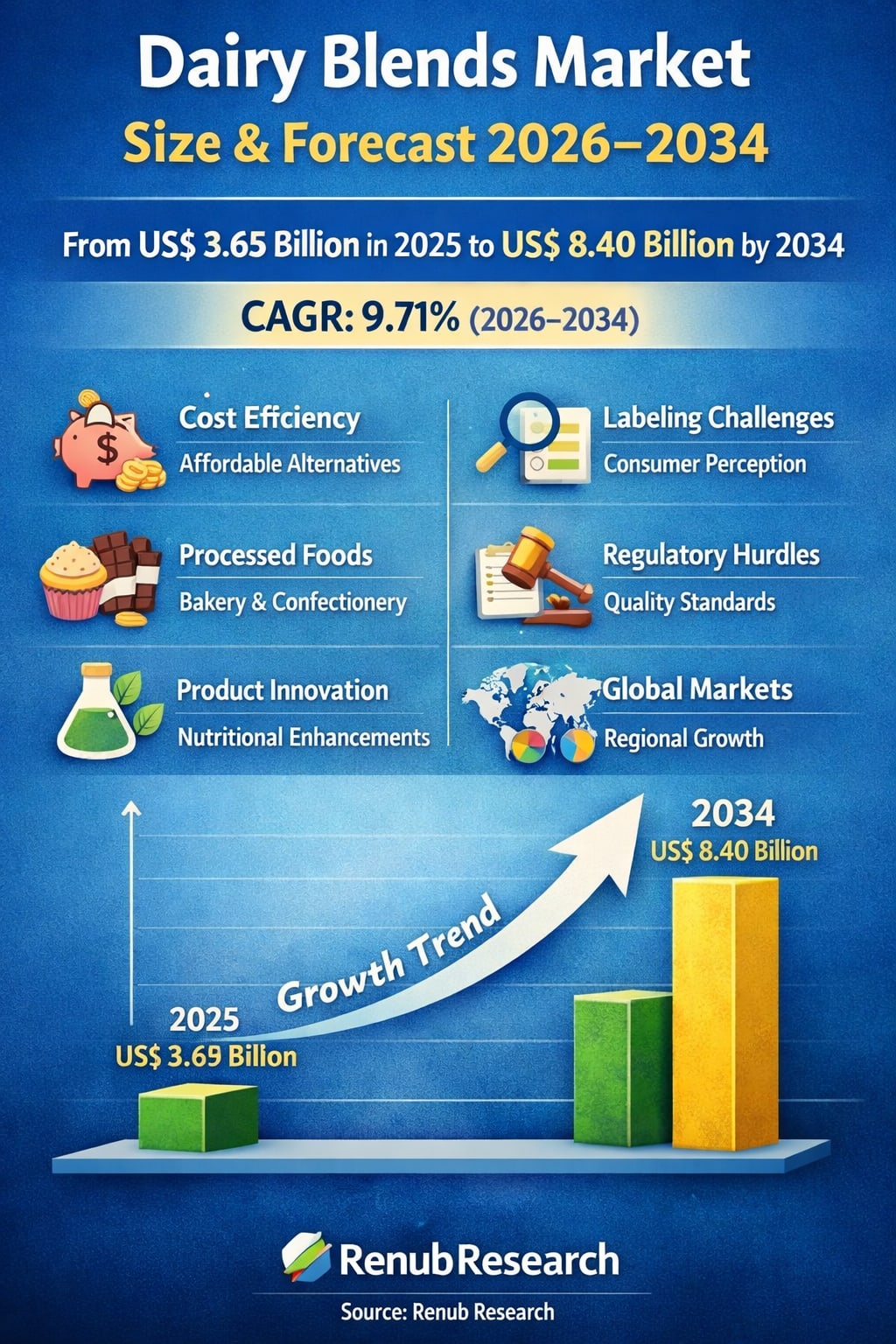
The global food industry is undergoing a structural transformation driven by cost pressures, evolving consumer preferences, and the constant push for innovation in taste, texture, and nutrition. Within this changing landscape, dairy blends have emerged as a strategic solution for manufacturers seeking performance, affordability, and formulation flexibility. According to Renub Research-based estimates, the Dairy Blends Market is projected to grow steadily from US$ 3.65 Billion in 2025 to US$ 8.40 Billion by 2034, registering a Compound Annual Growth Rate (CAGR) of 9.71% during 2026–2034.
This impressive growth trajectory reflects the increasing use of blended dairy and non-dairy ingredients across bakery, confectionery, spreads, sauces, ready meals, frozen desserts, and specialized nutrition products. Dairy blends are no longer niche industrial ingredients; they are becoming a core part of modern food formulation strategies worldwide.
At a time when manufacturers must balance rising raw material costs, regulatory complexity, and consumer demand for better nutrition and sustainability, dairy blends offer a compelling middle ground—combining the functional strengths of dairy with the cost efficiency and stability of non-dairy components.
Dairy Blends Market Outlook
Dairy blends are food products created by combining traditional dairy ingredients—such as milk solids, butter, cream, or cheese—with non-dairy components like vegetable oils, plant proteins, emulsifiers, or stabilizers. The objective is not merely substitution, but optimization: improving cost efficiency, shelf life, texture, and nutritional flexibility while maintaining the functional properties expected from conventional dairy products.
These blends are widely used in bakery items, confectionery, spreads, sauces, ready meals, beverages, and foodservice applications. In industrial food processing, where consistency, scalability, and performance under varying conditions are critical, dairy blends have proven to be highly valuable.
Globally, their adoption is rising due to changing dietary habits, urbanization, and the rapid growth of processed and convenience foods. Manufacturers favor dairy blends because they offer formulation flexibility, more predictable pricing compared to pure dairy fats, and the ability to tailor products to specific nutritional or functional requirements. Foodservice operators also appreciate their stable quality and extended shelf life, which help reduce waste and operational risks.
Key Growth Drivers in the Dairy Blends Market
1. Cost Efficiency and Price Stability
One of the strongest drivers behind the growth of the dairy blends market is their economic advantage over traditional dairy ingredients. Prices of butterfat, cream, and cheese are often volatile due to fluctuations in milk supply, feed costs, energy prices, and climatic conditions. Dairy blends allow manufacturers to partially replace expensive dairy fats with functional vegetable oils and other ingredients, helping stabilize production costs.
This cost control is particularly important for large-scale food producers operating in competitive, price-sensitive markets. By using dairy blends, companies can protect margins without compromising on product performance. The launch of innovative dairy/plant protein blends, such as FrieslandCampina Ingredients’ Biotis™ Fermentis range in 2024, highlights how the industry is combining cost efficiency with added functional and nutritional benefits.
2. Expanding Applications in Processed Foods
The global rise in processed and convenience foods is another major growth catalyst. Dairy blends are extensively used in bakery, confectionery, spreads, sauces, frozen desserts, and ready-to-cook meals due to their superior melting behavior, texture control, and storage stability. These blends perform well even under fluctuating temperature conditions, making them ideal for large-scale industrial processing and global distribution.
In 2024, Dairy Consumer Foods introduced SMUG Dairy, blending dairy and oats to create milk, butter, and cheddar alternatives with reduced saturated fat and improved nutritional profiles. Such product innovations demonstrate how dairy blends are enabling manufacturers to meet both functional and health-related goals.
3. Product Innovation and Nutritional Customization
Innovation in formulation is reshaping the dairy blends market. Food companies are increasingly developing reduced-fat, trans-fat-free, and nutrient-enriched dairy blends tailored to specific dietary needs. These blends can be fortified with proteins, vitamins, minerals, or functional ingredients, supporting claims in the nutrition and wellness space.
Advancements in emulsification and fat-structuring technologies have also improved the sensory qualities of dairy blends, making them closer than ever to traditional dairy in taste and mouthfeel. The 2025 launch of hybrid milk products combining dairy and plant-based ingredients in European markets reflects a broader trend toward hybrid nutrition—offering familiar taste with improved sustainability and nutritional positioning.
Challenges in the Dairy Blends Market
Consumer Perception and Labeling Issues
Despite their advantages, dairy blends face challenges related to consumer perception. Some consumers view blended products as overly processed or inferior to “pure” dairy, especially when vegetable oils or unfamiliar additives are involved. The growing demand for clean-label and transparent ingredient lists puts additional pressure on manufacturers to clearly communicate the benefits and safety of these products.
In certain regions, regulatory frameworks also restrict how dairy blends can be labeled or marketed, particularly if they do not meet the legal definition of traditional dairy products. This can limit branding opportunities and create confusion in the marketplace.
Regulatory Complexity and Quality Consistency
Regulatory standards for dairy blends vary widely across countries, covering aspects such as minimum dairy content, permitted additives, and labeling requirements. Compliance with these diverse rules increases operational complexity and costs, especially for companies operating across multiple markets.
Moreover, maintaining consistent product quality can be challenging due to variations in raw material sources, particularly vegetable oils and dairy components. Even small differences in ingredient properties can affect the performance of the final product in applications like baking, sauces, or frozen desserts.
Dairy Blends Mixtures Market
The dairy blends mixtures segment focuses on pre-formulated combinations of dairy and non-dairy ingredients, typically including milk solids, butterfat, vegetable oils, emulsifiers, and stabilizers in fixed ratios. These mixtures are highly attractive to food manufacturers because they simplify production processes, reduce formulation errors, and increase manufacturing efficiency.
Their reliable performance across different temperatures and processing conditions makes them especially suitable for large-scale industrial operations, where consistency and speed are critical. As food companies continue to streamline operations and reduce complexity, demand for ready-to-use dairy blend mixtures is expected to rise further.
Dairy Blends as Functional Ingredients
When used as functional ingredients, dairy blends play a crucial role in optimizing texture, stability, and mouthfeel. In bakery and confectionery products, they improve dough handling, crumb softness, and fat distribution. In sauces and spreads, they enhance smoothness, prevent separation, and improve emulsion stability. In frozen products, they contribute to better freeze-thaw stability and controlled ice crystal formation.
This functional versatility is one of the main reasons dairy blends are becoming indispensable in modern food formulation, especially in products that must perform consistently across long supply chains and varied storage conditions.
Dairy Blends in Ice Cream, Infant Formula, and Powdered Products
In the ice cream segment, dairy blends are widely used to partially replace milk fat with vegetable fats while maintaining creaminess, texture, and flavor. This allows manufacturers to produce affordable frozen desserts without sacrificing quality, particularly in price-sensitive markets with high demand for mass-produced ice cream.
In infant formula, dairy blends are designed to deliver balanced nutrition by combining dairy components with specialized lipids and micronutrients. These formulations aim to mimic the lipid structure needed for infant development and are produced under strict regulatory and quality standards.
Powdered dairy blends offer advantages such as longer shelf life, easy transportation, and versatility in use. They are widely applied in baking mixes, beverages, confectionery, and instant meals. Their stability and ease of handling make them especially attractive for export-oriented and bulk production.
Liquid Dairy Blends Market
Liquid dairy blends are preferred in applications requiring immediate functionality and easy integration into processing lines, such as sauces, soups, desserts, beverages, and ice cream. They offer consistent viscosity, better emulsification, and uniform distribution in high-volume production environments. Although they require cold-chain logistics, their convenience and performance benefits often outweigh these challenges.
Regional Market Insights
United States
The U.S. dairy blends market is mature and innovation-driven, supported by strong demand from bakery, confectionery, and foodservice industries. Manufacturers use dairy blends to manage cost volatility and ensure consistent product performance. With ongoing R&D in food technology and a growing appetite for convenient, high-performance ingredients, the market continues to expand steadily.
United Kingdom
In the UK, dairy blends are widely used to optimize food processing efficiency and manage costs in large-scale production. The focus on shelf-stable, easy-to-use ingredients and nutritional reformulation supports market growth, particularly in private-label and foodservice sectors.
China
China’s dairy blends market is growing rapidly due to urbanization, rising consumption of processed foods, and investment in modern food processing infrastructure. Dairy blends help manufacturers improve consistency, shelf life, and scalability while controlling costs in a highly competitive market.
Brazil
Brazil’s market is expanding as food processors seek cost-effective ingredients for bakery, confectionery, and spreads. Growing urban populations and changing lifestyles are driving demand for packaged and convenience foods, further supporting the adoption of dairy blends.
Saudi Arabia
In Saudi Arabia, the growth of the food and hospitality sectors is boosting demand for stable, high-performance ingredients. Dairy blends are valued for their heat stability, long shelf life, and consistent performance in baked goods, desserts, and dairy drinks.
Market Segmentation Overview
By Type:
Dairy Mixtures
Dairy/Non-Dairy Ingredients
Dairy as Functional
Dairy as Carrier
Others
By Application:
Bakery
Ice Cream
Infant Formula
Others
By Product Form:
Powder
Spreadable
Liquid
By Region:
North America, Europe, Asia Pacific, Latin America, Middle East & Africa
Competitive Landscape
Key players shaping the global dairy blends market include:
Cargill Foods, Kerry Foods, Archer Daniels Midland, Tate & Lyle, AAK AB, Dana Foods Inc., Royal FrieslandCampina N.V., and Galloway Company. These companies focus on innovation, strategic partnerships, and product customization to strengthen their market positions.
Final Thoughts
The global dairy blends market is entering a phase of accelerated growth, driven by the need for cost efficiency, functional performance, and nutritional innovation in the food industry. With the market projected to rise from US$ 3.65 Billion in 2025 to US$ 8.40 Billion by 2034, dairy blends are set to become an even more integral part of modern food manufacturing.
As consumer expectations continue to evolve and regulatory and cost pressures persist, dairy blends offer a practical, scalable, and innovative solution—bridging the gap between tradition and transformation in the global food system.
About the Creator
Mexico Cold Chain Transport Market Size, Share, Industry Trends, Growth and Forecast 2034
Why the Mexico Cold Chain Transport Market Is Expanding Rapidly: Trends & Future Outlook Temperature-controlled logistics is becoming a critical pillar of Mexico’s supply chain ecosystem. From fresh produce and seafood to pharmaceuticals and vaccines, sensitive goods require precise temperature management during transportation. The Mexico cold chain transport market is growing steadily as demand for food safety, healthcare distribution, and export quality standards continues to rise.
By Jackson Watson5 days ago in Trader
Stock Market Today: Key Updates, Trends, and Insights
The stock market today reflects ongoing volatility as investors react to a combination of domestic and global factors. Indices such as the S&P BSE Sensex continue to serve as a benchmark for India’s top 30 companies, offering insight into the overall market direction. Simultaneously, global developments and digital assets like Bitcoin USD are increasingly influencing investor sentiment and trading decisions.
By Hammad Nawaz5 days ago in Trader




Comments
There are no comments for this story
Be the first to respond and start the conversation.