
Europe Electric Vehicle Wireless Charging Market Size and Forecast 2025–2033
Europe’s shift toward cable-free EV charging is accelerating as governments, automakers, and cities invest in inductive and magnetic field technologies to power the next phase of clean mobility.

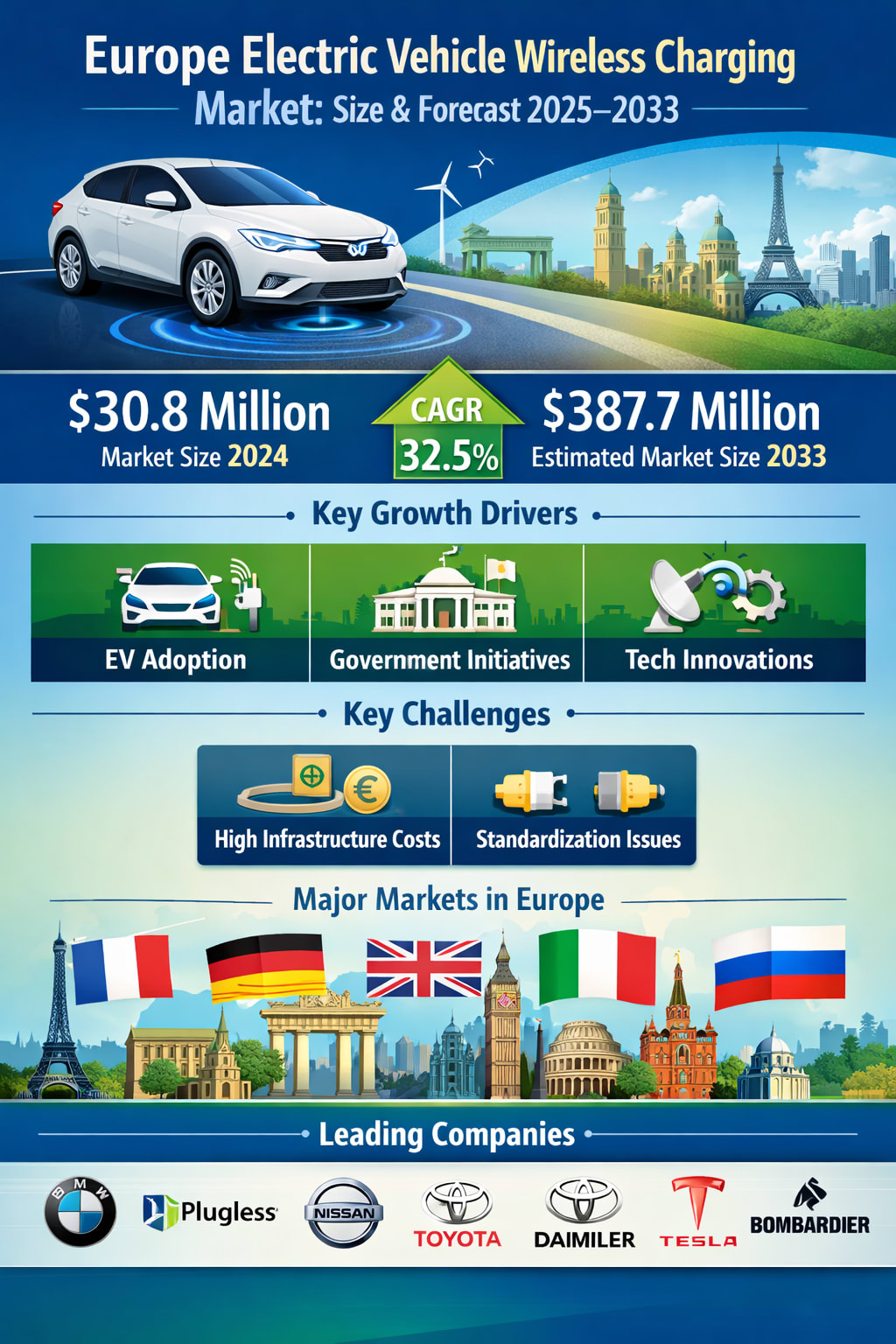
Introduction: A New Era of Effortless EV Charging
The European electric mobility landscape is entering a new phase—one where charging an electric vehicle (EV) may no longer require plugging in a cable at all. Wireless charging, based on electromagnetic induction and resonant magnetic field technologies, is steadily moving from pilot projects into real-world deployment. This innovation promises to transform how drivers, fleet operators, and cities think about charging infrastructure, convenience, and urban design.
According to Renub Research, the Europe Electric Vehicle Wireless Charging Market was valued at US$ 30.8 million in 2024 and is projected to reach US$ 387.7 million by 2033, expanding at a remarkable CAGR of 32.5% between 2025 and 2033. This rapid growth is being fueled by rising EV adoption, supportive government policies, advances in inductive charging technologies, and increasing demand for seamless, cable-free charging solutions in both residential and public spaces.
Wireless charging is no longer just a futuristic concept. Across Europe, city planners, automakers, and technology providers are testing and deploying systems that allow vehicles to charge simply by parking over a pad embedded in the ground—or, in some experimental cases, even while driving. As Europe pushes toward ambitious climate targets and smarter urban mobility, wireless EV charging is emerging as a critical piece of the infrastructure puzzle.
Understanding EV Wireless Charging Technology
Electric vehicle wireless charging works primarily through electromagnetic induction. A charging pad installed on or beneath the ground transmits energy wirelessly to a receiver coil mounted under the vehicle. When the vehicle is correctly aligned, power flows without any physical connectors, charging the battery safely and efficiently.
This approach offers several advantages over conventional plug-in charging. It is hands-free, weather-resistant, safer, and particularly attractive in high-traffic or space-constrained environments. There is no risk of cable damage, vandalism, or wear and tear from repeated plugging and unplugging. For users, the experience is simple: park and charge.
In Europe, this technology is increasingly being linked to smart city initiatives, fleet electrification programs, and future-ready transport systems such as autonomous vehicles and shared mobility services. Wireless charging is especially well-suited for taxis, buses, delivery fleets, and urban public transport, where vehicles follow predictable routes and schedules and can recharge opportunistically at designated stops.
Market Outlook: Europe’s Strong Growth Trajectory
The European market for EV wireless charging is still at an early stage, but its growth trajectory is impressive. From a relatively modest base in 2024, the market is expected to multiply many times over by 2033. This expansion reflects not only technological progress but also broader structural shifts in Europe’s transport and energy policies.
European countries are aggressively pursuing decarbonization of transport, investing in EV adoption, and modernizing charging infrastructure. Wireless charging fits neatly into this strategy by addressing one of the persistent pain points of EV ownership: convenience. As more consumers and fleet operators look for frictionless charging experiences, the appeal of cable-free systems continues to grow.
At the same time, urbanization and space constraints in European cities make traditional charging infrastructure harder to scale in some locations. Wireless systems, which can be embedded into roads, parking spaces, and depots, offer a cleaner and more visually discreet alternative—an important consideration in historic city centers and densely populated areas.
Key Growth Drivers in the Europe EV Wireless Charging Market
1. Strong Policy Support and Green Initiatives
European governments are among the most proactive in the world when it comes to promoting clean mobility. The European Union’s long-term goal of carbon neutrality by 2050 has translated into a wide range of policies supporting electric vehicles, renewable energy, and innovative charging solutions.
Subsidies, emissions regulations, and public investment in infrastructure are encouraging both consumers and businesses to transition to electric mobility. Several countries, including Germany, France, and the Netherlands, are funding pilot projects for inductive charging in public spaces and transport corridors. These initiatives reduce the financial risk for early adopters and help build confidence in the technology.
Wireless charging aligns perfectly with Europe’s vision of smart, sustainable, and connected cities, making it a natural beneficiary of green transport funding and innovation programs.
2. Rising Electric Vehicle Adoption
Europe has witnessed a sharp increase in EV adoption over the past few years, driven by environmental awareness, improving battery technology, and a growing range of electric models across all vehicle segments. In 2023, electric cars accounted for a significant share of new vehicle registrations across the region, highlighting the rapid shift away from internal combustion engines.
As the number of EVs on the road grows, so does the demand for convenient and accessible charging solutions. Wireless charging offers a compelling value proposition for both private users and fleet operators by simplifying the charging process and reducing operational friction. Home garages, office buildings, shopping centers, and public parking facilities are all potential deployment sites.
Moreover, as electricity generation becomes cleaner, the overall environmental benefits of EVs continue to improve, reinforcing the case for investing in advanced charging infrastructure that supports mass adoption.
3. Technological Innovation and Industry Partnerships
Continuous innovation is improving the efficiency, safety, and reliability of wireless charging systems. Advances in alignment technology, power transfer efficiency, and system integration are making wireless charging more practical for everyday use.
At the same time, collaborations between automakers, technology providers, utilities, and research institutions are accelerating development and standardization efforts. European automotive OEMs are actively testing both static and dynamic wireless charging solutions, while infrastructure providers are working on scalable deployment models.
These partnerships are crucial for building a robust ecosystem where vehicles and charging infrastructure can work seamlessly together, regardless of brand or location.
Challenges Facing the Market
High Infrastructure and Installation Costs
One of the main barriers to widespread adoption is the high upfront cost of wireless charging infrastructure. Installing inductive charging pads in roads, parking areas, or garages is more expensive than setting up conventional plug-in chargers. The return on investment can be uncertain, especially in the early stages of deployment.
Without continued government support, subsidies, or large-scale fleet adoption, some municipalities and private operators may hesitate to commit to large installations.
Standardization and Interoperability Issues
Another significant challenge is the lack of fully harmonized standards. Different manufacturers may use different technologies or specifications, raising concerns about compatibility between vehicles and charging systems. This fragmentation can slow investment decisions and create uncertainty for both consumers and infrastructure operators.
While Europe is actively working toward common standards, achieving full interoperability across brands and borders remains a work in progress.
Technology Segmentation: The Backbone of Wireless Charging
Inductive Charging
Inductive charging is currently the most widely used and commercially viable form of wireless EV charging in Europe. It is particularly well-suited for static charging in home garages, public parking lots, taxi ranks, and bus depots. Countries such as Norway, Sweden, and the Netherlands have already launched pilot projects demonstrating its practicality and reliability.
Given its relative maturity and scalability, inductive charging is expected to dominate the market over the forecast period.
Resonant Inductive and Magnetic Field Charging
Magnetic field-based and resonant inductive charging technologies are gaining attention, especially for dynamic or in-motion charging applications. These systems could allow vehicles to charge while driving on specially equipped roads, reducing battery size requirements and alleviating range anxiety.
Although still in the experimental stage, trials in countries like Germany and Sweden suggest strong long-term potential, particularly for freight transport and public transit corridors.
Application Segmentation: Commercial vs. Home Charging
Wireless charging systems are being deployed in two main application areas:
Commercial Charging Stations: These include public transport hubs, taxi ranks, fleet depots, and commercial parking facilities. This segment is expected to grow faster due to fleet electrification and smart city projects.
Home Charging Units: Residential wireless charging offers unmatched convenience for private EV owners, especially in regions with high EV penetration and modern housing infrastructure.
Country-Level Insights
France
France is rapidly expanding its EV ecosystem, with a strong focus on commercial wireless charging for public transport and urban fleets. Pilot projects in cities like Paris and Lyon are testing wireless pads for taxis and buses, aiming to reduce downtime and improve urban mobility efficiency.
Germany
Germany stands at the forefront of wireless EV charging innovation, supported by its powerful automotive industry and strong R&D base. Automakers such as BMW, Audi, and Mercedes-Benz are actively exploring wireless charging integration, while the government supports both static and dynamic charging trials.
United Kingdom
In the UK, wireless charging is being explored as a solution to urban infrastructure constraints and visual clutter from cables. Cities like London, Oxford, and Nottingham are experimenting with wireless systems for buses and taxis, aligning with the country’s long-term electrification goals.
Italy
Italy’s focus on sustainable tourism and smart cities is creating opportunities for discreet, space-saving charging solutions in historic and high-traffic areas. Cities such as Milan and Florence are investing in green mobility initiatives that include contactless charging options.
Russia
Although still in the early stages of EV adoption, Russia shows niche interest in wireless charging, particularly in tech-forward cities like Moscow and St. Petersburg. Harsh winter conditions make cable-free systems especially attractive, though broader adoption will depend on stronger policy support.
Competitive Landscape: Key Players Shaping the Market
The Europe EV wireless charging market features a mix of global automakers and technology specialists. Key players include:
BMW AG
Plugless
Nissan
Toyota
Daimler
Tesla Motors
Bombardier
OLEV Technologies
These companies are investing in product development, pilot projects, and strategic partnerships. Market analysis typically covers each company from four viewpoints: Overview, Key Persons, Recent Developments & Strategies, and Revenue Analysis, providing a comprehensive picture of their competitive positioning.
Market Segmentation Overview
By Technology:
Inductive Charging
Resonant Inductive Charging
Magnetic Field Charging
By Application:
Commercial Charging Station
Home Charging Unit
By Country:
France, Germany, Italy, Spain, United Kingdom, Belgium, Netherlands, Russia, Poland, Greece, Norway, Romania, Portugal, and Rest of Europe.
Final Thoughts: A Quiet Revolution in Motion
Wireless charging may not yet be visible on every European street, but its momentum is undeniable. With the market expected to grow from US$ 30.8 million in 2024 to US$ 387.7 million by 2033, Europe is clearly positioning itself at the forefront of this transformative technology.
As EV adoption accelerates, cities become smarter, and transport systems grow more automated, the demand for seamless, reliable, and user-friendly charging solutions will only intensify. While challenges around cost and standardization remain, continued innovation, policy support, and industry collaboration are likely to push wireless charging from niche to mainstream.
In the long run, wireless EV charging is not just about convenience—it represents a fundamental shift toward invisible, integrated, and intelligent infrastructure that supports Europe’s vision of a cleaner, more connected mobility future.
About the Creator
Titan Company Q3 Results: Net Profit Surges 61% YoY to ₹1,684 Crore as Jewellery Sales Jump 42%
Titan Company delivered an impressive financial performance in the third quarter, reporting a sharp 61% year-on-year jump in net profit to ₹1,684 crore. The strong earnings growth was largely driven by exceptional performance in its jewellery segment, where sales surged by 42% compared to the same period last year. The robust results reinforced Titan’s position as one of India’s strongest consumer-focused companies.
By Hammad Nawaz7 days ago in Trader
The Cave Part 6
If you have ever heard a tale about yourself that you cannot remember and doubtless think is made up, you will know how I felt when Tharkin related all that the eagle had seen of me before my memories were scattered. Of far distances and traveling companions that I did not recall, camping out under the stars and making our way to the mountains with deliberate purpose. The great bird had lost contact with my party once we entered the forests, and the seven other members were not seen again by him or his brethren since.
By Jamye Sharp3 days ago in Chapters



Comments
There are no comments for this story
Be the first to respond and start the conversation.