
Europe Halal Food Market Trends & Summary: Ethical Eating Goes Mainstream Across the Continent
Europe’s halal food industry is entering a golden growth phase, driven by changing demographics, ethical consumption trends, and expanding retail access—pushing the market toward a trillion-dollar future by 2033.

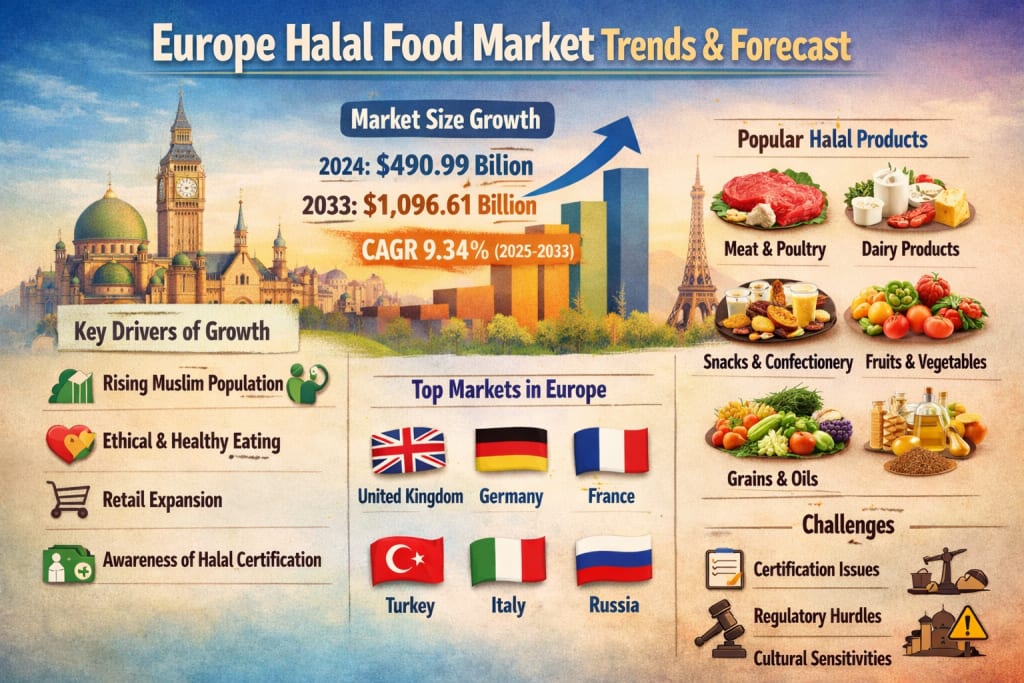
Europe Halal Food Market at a Glance
The Europe Halal Food Market is expected to reach US$ 1,096.61 billion by 2033, up from US$ 490.99 billion in 2024, growing at a strong CAGR of 9.34% from 2025 to 2033. This impressive expansion is being powered by a combination of growing Muslim populations, rising demand for ethical and transparent food, retail sector modernization, better awareness of halal certification, and a rapidly diversifying product portfolio.
The market, as covered in the Europe Halal Food Market & Forecast Report, is segmented by Product (Meat, Poultry & Seafood; Fruits & Vegetables; Dairy Products; Cereals & Grains; Oil, Fats & Waxes; Confectionery; Others), Distribution Channel (Hypermarkets & Supermarkets, Online Stores, Convenience Stores, Specialty Stores, Others), and Countries (Russia, France, Germany, Italy, United Kingdom, Turkey), along with detailed Company Analysis for the period 2025–2033.
Once considered a niche category limited to ethnic stores, halal food in Europe has now entered the mainstream. Today, halal-certified products can be found in major supermarket chains, online grocery platforms, and even premium food retailers—signaling a structural shift in how European consumers perceive and purchase halal food.
Europe Halal Food Industry Overview
The European halal food market is expanding rapidly due to a powerful mix of demographic change, evolving consumer values, and improved accessibility. The Muslim population in countries such as France, Germany, and the United Kingdom continues to grow, naturally increasing the demand for halal-certified food products. However, what makes this market especially interesting is that halal food is no longer consumed only by Muslims.
A rising number of non-Muslim European consumers are choosing halal products because they associate them with higher quality, better hygiene, ethical sourcing, and responsible animal treatment. This perception has helped halal food cross cultural boundaries and enter the everyday shopping baskets of a much wider audience.
Retailers and manufacturers have responded quickly. Today, the European halal market includes not just fresh meat and poultry, but also frozen foods, snacks, beverages, confectionery, dairy products, and ready-to-eat meals. Companies are also innovating by launching organic, vegan, and sustainably sourced halal-certified products, aligning religious compliance with modern lifestyle and environmental values.
At the same time, e-commerce and digital food platforms are playing a crucial role in expanding access—especially among younger, tech-savvy consumers who want convenience without compromising on ethical or religious principles. Improved logistics, better labeling, and stronger certification systems are also making halal food more visible and more trusted across the continent.
Still, the industry is not without its challenges. Fragmented certification standards, regulatory debates over slaughter methods, and political sensitivities in certain countries continue to shape the market landscape. Yet, despite these hurdles, the long-term outlook remains highly positive. With a growing consumer base, rising awareness, and continuous product innovation, the European halal food industry is well positioned for sustained growth.
A Demographic and Cultural Shift Driving Demand
Changes in demographics are one of the strongest forces behind the growth of the halal food market in Europe. For example, the United Kingdom had around 3.9 million Muslims in 2021, reflecting the steady expansion of the Islamic community across the region. More importantly, this population is young and economically active. According to data often cited from global demographic studies, a significant share of Muslims in Europe are under 30, making them a powerful consumer group with increasing purchasing power and strong brand awareness.
This has given rise to what many marketers call “Generation M”—Muslim millennials who are digitally connected, brand-conscious, and interested in products that combine faith, quality, convenience, and lifestyle appeal. Their preferences are pushing brands to go beyond basic compliance and offer halal products that are also modern, innovative, and aspirational.
At the same time, ethical consumption is becoming more mainstream across Europe. Concerns about food safety, sustainability, animal welfare, and transparency are influencing buying decisions for millions of consumers—Muslim and non-Muslim alike. Halal food, with its emphasis on cleanliness, traceability, and ethical handling, fits naturally into this broader shift toward more responsible consumption.
Growth Drivers for the Europe Halal Food Market
Government Support and Regulations
In response to rising demand, several European countries have strengthened their regulatory frameworks to improve consumer trust in halal labeling and certification. France, which has one of the largest Muslim populations in Western Europe, plays a particularly important role in the European halal ecosystem. The country has developed a robust halal certification environment, supported by multiple agencies that oversee inspection, auditing, and compliance.
Such regulatory structures help ensure that halal products meet both religious requirements and high quality standards, which is critical for building long-term consumer confidence. The presence of recognized bodies, such as monitoring and certification committees in the UK and other countries, also signals that halal food is no longer a fringe category—it is an institutionally acknowledged and economically significant segment of the food industry.
These frameworks not only protect consumers but also encourage investment, support exports, and help European producers compete in the global halal market.
Germany’s Increasing Need for Halal Food
Germany is emerging as one of the most dynamic halal food markets in Europe. The country’s growing Muslim population, driven by migration and higher birth rates within these communities, has significantly increased demand for halal-compliant products. Surveys conducted among Muslim consumers in Germany consistently show that halal food is considered essential, and many shoppers are willing to pay a premium for products that meet halal standards.
This has caught the attention of German food producers and retailers, who are now expanding their halal product ranges and investing in better certification and supply chain transparency. As awareness improves and distribution widens, Germany is expected to remain one of the key growth engines for the European halal food market.
Growing Market Demand and the Muslim Population
Looking at the broader European picture, demographic trends clearly point toward a steadily expanding consumer base for halal products. Over the next decades, the Muslim population in Europe is expected to continue growing, both in absolute numbers and as a share of the total population. This naturally translates into rising demand for halal food across supermarkets, restaurants, and foodservice channels.
As a result, more food manufacturers and retailers are integrating halal lines into their core offerings rather than treating them as niche products. This is diversifying food choices, increasing cultural inclusion, and normalizing halal food in everyday European diets.
Challenges in the Europe Halal Food Market
Fragmented Certification Standards
One of the biggest obstacles facing the European halal food industry is the lack of a unified certification system. Different countries—and sometimes different organizations within the same country—follow varying interpretations and standards of what qualifies as halal. This creates confusion for consumers and increases operational complexity for businesses.
For companies operating across borders, navigating these inconsistent rules can be costly, time-consuming, and risky. For consumers, it can raise doubts about whether a product truly meets halal requirements. Without greater standardization or mutual recognition of certifications, this fragmentation may continue to limit market efficiency and slow down cross-border expansion.
Regulatory and Legal Restrictions
Another sensitive issue is the regulation of slaughter methods in several European countries. Some governments require pre-slaughter stunning for animal welfare reasons, while certain Islamic authorities debate whether such practices fully comply with halal principles. This has led to legal, ethical, and political debates in multiple markets.
These regulatory constraints can reduce production flexibility, discourage new investments, and complicate supply chains for halal meat producers. The absence of a harmonized European framework further adds to the uncertainty, making long-term planning more difficult for businesses operating in multiple countries.
Country-Level Market Insights
United Kingdom Halal Food Market
The UK halal food market is one of the most developed and diverse in Europe. Halal products are widely available not only in ethnic stores but also in major supermarket chains and online platforms. Demand comes from both Muslim and non-Muslim consumers, driven by factors such as ethical sourcing, food safety, and product quality.
The market offers everything from fresh meat and poultry to processed foods, ready meals, and snacks. While challenges around certification consistency and slaughter practices remain, the overall outlook is strongly positive, supported by innovation, rising awareness, and inclusive food policies.
France Halal Food Market
France represents one of the largest halal food markets in Europe due to its sizable Muslim population and strong retail infrastructure. Halal products are increasingly visible in supermarkets, e-commerce platforms, and specialty stores, covering categories such as meat, dairy, snacks, and ready-to-eat meals.
However, the French market also faces certification complexity and regulatory debates, particularly around animal welfare laws. Despite these issues, continued product innovation and expanding distribution channels are expected to support long-term, sustainable growth.
Germany Halal Food Market
Germany’s halal food sector is growing steadily, driven by rising demand for ethical and high-quality food options. Mainstream retailers are increasingly stocking halal-certified products, and consumer interest is expanding beyond the Muslim population.
Challenges remain around fragmented certification systems and regulatory debates, but increasing awareness and stronger retail participation are helping the market move forward. Germany is likely to remain a key strategic market for halal food companies in Europe.
Market News for Halal Foods and Drinks in Europe
Recent developments highlight how dynamic the sector has become. In June 2022, The Halal Food Company launched five new ready meals in a major UK supermarket chain, offering products such as shepherd’s pie, beef lasagna, peri-peri chicken, and curry with rice—showing how halal food is blending into mainstream convenience categories.
In February 2022, Berlin-based GetHalal Group expanded its halal food delivery services across Germany, focusing on reaching Muslim households and meeting everyday grocery needs through digital platforms. Moves like these underline the growing role of convenience, e-commerce, and ready-to-eat solutions in shaping the future of the market.
Europe Halal Food Market Segmentation
By Product
Meat, Poultry & Seafood
Fruits & Vegetables
Dairy Products
Cereals & Grains
Oil, Fats & Waxes
Confectionery
Others
By Distribution Channel
Hypermarkets & Supermarkets
Online Stores
Convenience Stores
Specialty Stores
Others
By Country
Russia
France
Germany
Italy
United Kingdom
Turkey
Key Companies Covered
The competitive landscape includes both global food giants and specialized halal producers, such as:
Nestlé SA, JBS SA, BRF SA, Kawan Food Berhad, Cargill Inc., Carrefour SA, Crescent Foods Inc., VegaVites, American Halal Company Inc., American Foods Group LLC, and Al Islami Foods.
These players are focusing on product innovation, certification compliance, retail partnerships, and geographic expansion to strengthen their positions in the fast-growing European halal market.
Final Thoughts
The European halal food market is no longer a niche—it is becoming a core part of the continent’s evolving food economy. With the market projected to grow from US$ 490.99 billion in 2024 to US$ 1,096.61 billion by 2033, the scale of opportunity is enormous.
Driven by demographic change, ethical consumption trends, retail modernization, and digital transformation, halal food is steadily moving into the mainstream. While challenges around certification and regulation remain, the overall direction is clear: halal food in Europe is on a strong, sustainable growth path.
For food manufacturers, retailers, and investors, this market represents not just a business opportunity—but a chance to be part of a broader shift toward more inclusive, transparent, and values-driven food consumption across Europe.
About the Creator
Supply Chain Security Market Set to Soar USD 6.2 Billion by 2033 | CAGR 9.64%
Overview – Supply Chain Security Market Supply chain security refers to technologies, policies, and practices implemented to safeguard supply networks from vulnerabilities such as cyberattacks, counterfeit products, data breaches, and logistical disruptions. The market encompasses various solutions including threat detection software, identity management systems, and real-time monitoring tools. Growing adoption of cloud computing, IoT-enabled logistics, and digital procurement platforms has transformed supply chain operations, but also increased security risks. As global trade networks become more interconnected, organizations are prioritizing supply chain resilience, transparency, and compliance to ensure smooth business continuity and protect sensitive data.
By James Smith6 days ago in Trader
PayPal Stock Analysis: Can PayPal Sustain Growth in the Digital Payments Industry?
Introduction PayPal stock is one of the leading names in the digital payments sector. PayPal provides a global platform for online payments, money transfers, and merchant services. As e-commerce continues to expand and digital transactions become mainstream, PayPal remains central to the evolution of financial technology. Investors closely monitor whether PayPal stock can maintain growth amid competition, regulatory challenges, and technological innovation.
By Hammad Nawaz18 minutes ago in Trader
Goodbye, Mr. Duvall
It is turning out to be an interesting year. I was in the middle of teaching a class when a pop-up appeared on the screen announcing the death of Mr. Robert Seldon Duvall (yes, that was his full name). I was in the middle of a discussion on the obsession we have with winning when it comes to sports (the Winter Olympics was a theme), and I felt as though things were coming full circle. We had already lost Gene Hackman last year, and along with that titan, it feels though one particular golden age has closed off to be replaced by...?
By Kendall Defoe about 19 hours ago in Geeks



Comments
There are no comments for this story
Be the first to respond and start the conversation.