
Evcry and the audit lens on withdrawal pressure
The difference between a platform fee and a forced external top-up

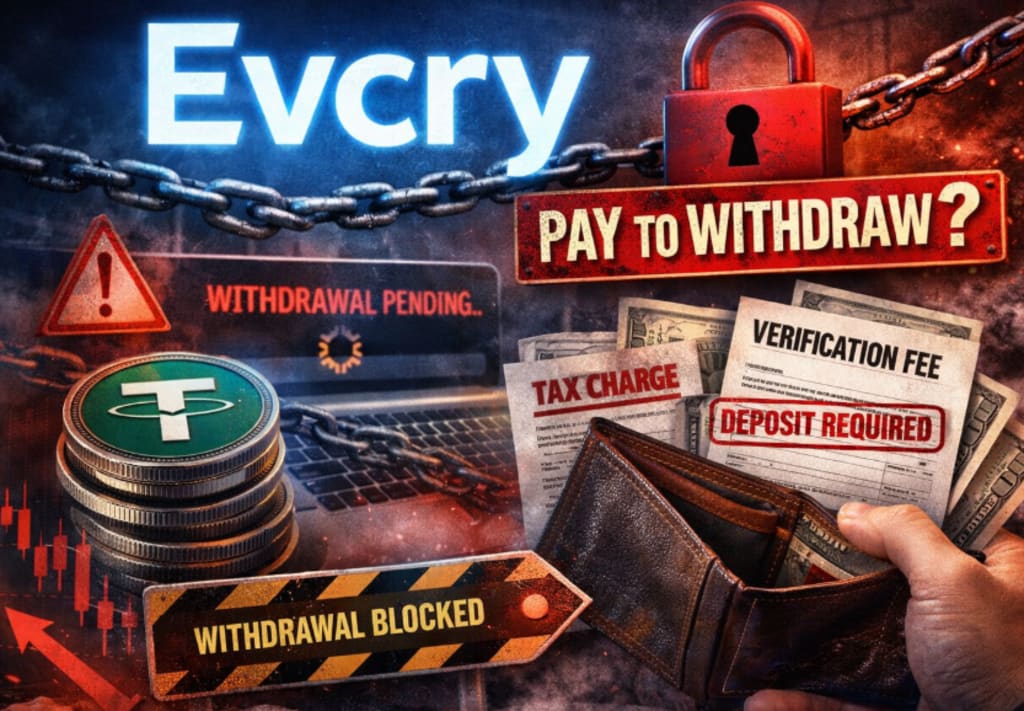
When people ask me what a high-risk trading platform looks like, I tell them to stop staring at the chart. A user interface can be polished. The layout can look “institutional.” Even the pricing can appear competitive for a while. The real test is much less glamorous: can you exit cleanly, on your terms, without negotiating your own withdrawal?
In legitimate venues, fees are part of the internal accounting system. A withdrawal fee, a maker-taker schedule, or a spread cost might be annoying, but it’s predictable. You can calculate it, compare it to peers, and see the charge deducted from your balance when the transaction is executed. What changes the risk category entirely is the moment fees stop behaving like accounting and start behaving like pressure.
The pattern I watch for is straightforward. You request a withdrawal. The system replies with a delay. The delay becomes a “review.” The review becomes “compliance.” Then the language shifts: a “tax,” a “verification fee,” or a “security deposit” is required, and it must be paid from an external wallet before your funds can be released. That is not an internal fee model. That is an external leverage model. It turns your trapped balance into a bargaining chip, and it nudges you toward the sunk-cost fallacy, where you keep paying because you’ve already paid.
With Evcry, what can we verify without touching anyone’s money? Third-party profiling describes a crypto-only flow, with deposits and withdrawals routed through USDT networks and no traditional fiat rails. It also presents a stated withdrawal handling fee of 0.3%. The same profile notes limited public disclosure, including the absence of a clearly stated office location, and indicates the platform uses a self-developed web terminal rather than widely deployed third-party clients. None of these points alone prove misconduct, but they do raise operational and counterparty risk because independent accountability is harder to establish up front.
Public reviews are never perfect evidence, yet they are still signals. On a major consumer-review site, Evcry’s visible review footprint is thin, and the available recent review content is strongly negative, calling out missing physical and legal detail and labeling the entity high-risk. One review does not establish a case, but in audit work a single credible red flag is enough to justify tighter controls and smaller exposure until clarity improves.
There’s also an operational detail that matters for verification. The official site currently presents a security verification gate that blocks routine access in a standard browser session. That can be normal anti-bot behavior, but it still raises the cost of basic due diligence because everyday users can’t easily read disclosures, confirm fee language, or cross-check legal pages. Lower transparency today often becomes higher friction tomorrow, and withdrawals are where that friction hurts most.
A cautious posture is simple, even if it’s not exciting. Keep position sizing small until you have proven the exit path. Run a withdrawal test early, even if it costs a small fee, because the objective is not profit; it is process integrity. Keep a written log of every interaction: timestamps, screenshots, wallet addresses used, and the exact wording of any requirement. If any step requires a new external transfer to “release,” “activate,” or “verify” your withdrawal, treat it as a stop sign, not a speed bump.
Risk management is mostly boring when done well. It becomes dramatic only when the exit door is locked. The goal of notes like these is to keep it boring, and to keep you in control of your own liquidity.
Disclaimer: Analysis only, not financial advice. Verify independently.
#Evcry #CryptoSafety #WithdrawalRisk #PlatformAudit #DueDiligence
#SecurityMindset #RiskEngineering #ScamAlert
About the Creator
Bittam
Bittam is a global crypto derivatives exchange where finance and code meet. From BTC and ETH to SOL and ADA perps, Bittam focuses on security, risk awareness and tools that help traders read markets with more clarity.
Gaming Market: The Rise of Digital Entertainment Worldwide
Overview The global gaming market stands as one of the largest and most dynamic entertainment industries worldwide, spanning video games on consoles, PCs, mobile devices, cloud gaming, and esports. Fueled by technological innovation, expanding internet access, and a diverse global audience, revenue continues to rise year after year. In 2025 alone, industry estimates suggest the gaming market could approach near $200 billion in annual revenue, with mobile games accounting for more than half of that total.
By James Smith6 days ago in Trader
Strategies to Grow a Small Toy Brand Successfully
You create a toy brand so that you can make children happy, and you can get constant sales. The children's toys market is dynamic. Trends change according to media, play patterns, and parents' values. In order to expand, you require distinctive planning, shrewd packing, and trustworthy marketing.
By Cristina Baker3 days ago in Trader




Comments
There are no comments for this story
Be the first to respond and start the conversation.