
France Toys Market Size and Forecast 2025–2033
How Innovation, E-Commerce, and Sustainable Play Are Reshaping the French Toy Industry

France Toys Market Overview
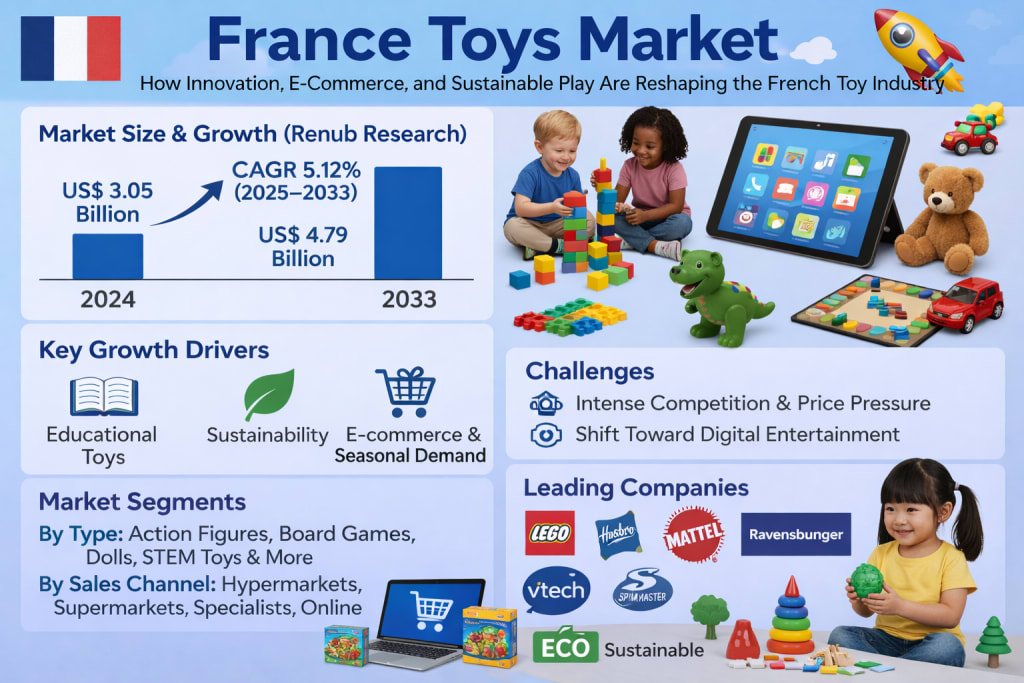
The France toys market is undergoing a steady and meaningful transformation, driven by evolving consumer preferences, digital retail expansion, and a growing focus on educational and sustainable products. According to Renub Research, the France Toys Market is expected to reach US$ 4.79 billion by 2033, up from US$ 3.05 billion in 2024, expanding at a compound annual growth rate (CAGR) of 5.12% from 2025 to 2033. This growth reflects not only rising household spending power but also a deeper shift in how French families perceive play, learning, and child development.
Traditionally, the French toy market has been known for its strong mix of classic toys such as dolls, board games, puzzles, and action figures, alongside globally popular brands. Today, that foundation is being strengthened by innovation. High-tech interactive toys, app-enabled learning tools, and STEM-focused playsets are becoming increasingly common in French households. At the same time, there is a clear consumer move toward toys that are safe, ethically produced, and environmentally responsible.
France has a strong demographic base supporting long-term toy demand. With over 723,000 births recorded in 2022 and around 17.2% of the population aged between 0 and 14 years, the country continues to represent a healthy and stable consumer base for toy manufacturers and retailers. Toys remain an essential part of childhood development, contributing to cognitive, emotional, social, and motor skills. This educational dimension of play is becoming more important than ever, shaping both product design and marketing strategies.
Another major force reshaping the French toy market is e-commerce. Online platforms now play a critical role in product discovery, price comparison, and seasonal purchasing, particularly during peak periods such as Christmas, Easter, and the back-to-school season. Consumers increasingly value convenience, wider product selection, and promotional offers, all of which online retail delivers effectively. As a result, omnichannel strategies are becoming standard for both global brands and local specialists.
In addition, licensing and brand partnerships continue to influence buying decisions. Toys based on popular movie franchises, television series, and global entertainment brands such as Disney, Marvel, and major animation studios remain highly attractive to children and collectors alike. This blend of tradition, innovation, and cultural influence positions the French toy market for sustained growth throughout the forecast period.
Market Size and Growth Outlook
Renub Research projects a strong and consistent upward trajectory for the French toy industry. From US$ 3.05 billion in 2024, the market is forecast to grow to US$ 4.79 billion by 2033, reflecting a CAGR of 5.12% between 2025 and 2033. This growth is being supported by multiple structural trends: rising disposable incomes, higher spending on children’s development, increasing digitalization of retail, and a clear shift toward value-driven and purpose-oriented products.
Unlike purely trend-driven consumer segments, toys benefit from both emotional and functional demand. Parents are not only buying toys as gifts or entertainment tools but also as learning aids that support early education and skill development. This dual role of toys—as sources of joy and as developmental tools—creates a resilient demand base even during periods of economic uncertainty.
Key Growth Drivers
1. Increasing Demand for Educational Toys
One of the most powerful drivers of growth in the France toys market is the rising demand for educational and learning-oriented toys. Modern parents are increasingly conscious of the role toys play in shaping their children’s intellectual and emotional development. As a result, products that promote creativity, logic, problem-solving, and communication skills are gaining strong traction.
STEM toys—focused on science, technology, engineering, and mathematics—are particularly popular. These toys help children develop analytical thinking, curiosity, and practical skills from an early age. Construction sets, coding kits, science experiment boxes, and logic-based puzzles are no longer niche products; they are becoming mainstream choices in French households.
This shift reflects a broader change in consumer behavior, where purchases are evaluated not just on entertainment value but also on long-term developmental benefits. As education systems and parents place greater emphasis on early learning, the demand for smart, skill-building toys is expected to remain a major growth engine throughout the forecast period.
2. Rising Popularity of Eco-Friendly and Sustainable Toys
Sustainability is no longer a side trend in France—it is becoming a central purchasing criterion. The growing awareness of environmental issues has significantly influenced consumer behavior, including in the toy market. Parents are increasingly looking for eco-friendly toys made from wood, organic fabrics, or recycled materials, as well as products manufactured using responsible and ethical processes.
This shift is encouraging manufacturers to redesign their product lines, reduce plastic usage, improve packaging sustainability, and communicate environmental values more clearly. Brands that can demonstrate genuine commitment to sustainability are gaining trust and loyalty among French consumers.
The rise of eco-friendly toys also aligns with broader European regulatory and social trends focused on reducing waste, promoting circular economy models, and encouraging responsible consumption. As a result, sustainability is not only a marketing advantage but also a long-term strategic necessity for companies operating in the French toy market.
3. Seasonal and Event-Based Demand
Seasonal peaks play a crucial role in shaping sales patterns in the French toy industry. Christmas, Easter, birthdays, and the back-to-school season consistently drive significant spikes in toy purchases. During these periods, toys remain one of the most popular gift categories, especially for younger age groups.
Retailers often support these peaks with promotional campaigns, discounts, and special editions, which further stimulate consumer spending. These high-demand windows are also key moments for launching new products, testing innovative concepts, and strengthening brand visibility.
Because of this strong seasonal rhythm, companies that manage inventory, marketing, and distribution effectively around these peak periods can significantly improve their overall performance and market share.
Challenges in the France Toys Market
1. Increasing Competition
The French toy market is highly competitive, with both domestic and international players competing for consumer attention. This intense rivalry often leads to price pressure, promotional battles, and shrinking margins, particularly in mass-market segments.
With shelves and online platforms crowded by a wide variety of products—from traditional toys to advanced tech-based solutions—differentiation has become increasingly difficult. To stay competitive, companies must continuously invest in innovation, branding, licensing agreements, and marketing strategies. Smaller players, in particular, may struggle to compete with well-established global brands that benefit from scale, strong distribution networks, and high marketing budgets.
2. Shifting Consumer Preferences Toward Digital Entertainment
Another major challenge comes from the growing popularity of digital entertainment, including video games, mobile apps, and interactive digital platforms. Older children, in particular, are spending more time on screens, which can reduce demand for certain categories of traditional toys such as action figures or classic board games.
To respond to this shift, many toy manufacturers are integrating technology into physical products, creating app-connected toys, augmented reality (AR) experiences, and interactive learning tools. While this strategy helps bridge the gap between physical and digital play, it also increases development costs and raises the bar for innovation.
France Toys Market Segmentation
By Toys Type (8 Categories):
Action Figures
Board Games
Card Games
Construction Sets & Models
Dolls & Stuffed Toys
Plastic & Other Toys
Puzzles
Toys for Toddlers & Kids
This wide segmentation highlights the diversity of the French toy market, which caters to different age groups, interests, and developmental needs.
By Sales Channel (5 Categories):
Hypermarkets
Supermarkets
Toy Specialists
Multi-Specialists
Others
While physical retail remains important, online and omnichannel strategies are becoming increasingly central to growth.
Competitive Landscape and Company Analysis
Key players in the French toy market are analyzed across four main dimensions: company overview, key persons, recent developments, and financial insights. Major companies operating in this space include:
Mattel Inc.
Hasbro, Inc.
LEGO
Ravensburger
Spin Master Corp.
VTech
Clementoni
Thames & Kosmos
Simba Dickie Group
HABA Sales GmbH & Co. KG
These companies compete through a mix of product innovation, strong branding, licensing partnerships, and expanding digital presence. Many are also investing heavily in sustainability, educational value, and technology integration to align with changing consumer expectations.
Future Outlook
Looking ahead, the France toys market is well positioned for stable and sustainable growth. The combination of favorable demographics, rising educational awareness, expanding e-commerce, and strong demand for eco-friendly products creates a solid foundation for the industry.
Innovation will remain a key differentiator, particularly in areas such as STEM toys, interactive learning tools, and sustainable product design. Companies that can successfully balance entertainment, education, and environmental responsibility are likely to emerge as long-term winners in this evolving market.
Final Thoughts
The French toy industry is no longer just about play—it is about learning, values, and experience. With the market expected to grow from US$ 3.05 billion in 2024 to US$ 4.79 billion by 2033 at a CAGR of 5.12%, the sector offers strong opportunities for brands that understand modern consumer priorities.
As parents become more conscious buyers and children’s expectations continue to evolve, the future of the France toys market will be shaped by innovation, sustainability, and meaningful play. For manufacturers, retailers, and investors alike, this makes the French toy market not only resilient, but also strategically exciting in the years ahead.
About the Creator
Keep reading
More stories from shibansh kumar and writers in Trader and other communities.
Non-Invasive Prenatal Testing Market Size and Forecast 2025–2033
Global Non-Invasive Prenatal Testing Market Overview Non-Invasive Prenatal Testing (NIPT) has rapidly emerged as one of the most transformative innovations in modern prenatal care. Designed to detect the risk of specific chromosomal abnormalities in a fetus using a simple maternal blood sample, NIPT offers a safer, more accurate alternative to traditional invasive procedures such as amniocentesis and chorionic villus sampling (CVS). By analyzing cell-free fetal DNA (cfDNA) circulating in the mother’s bloodstream, clinicians can assess the likelihood of conditions such as Down syndrome (trisomy 21), Edwards syndrome (trisomy 18), Patau syndrome (trisomy 13), Turner syndrome, and other chromosomal anomalies early in pregnancy.
By shibansh kumar4 days ago in Trader



Comments
There are no comments for this story
Be the first to respond and start the conversation.