
Global Coffee Market Size and Forecast 2026–2034
How Rising Café Culture, Premiumization, and Ready-to-Drink Trends Are Brewing a Multi-Billion-Dollar Future

Introduction: A Market That Never Sleeps
Coffee is no longer just a morning ritual—it has become a lifestyle statement, a social connector, and a global business powerhouse. From bustling cafés in New York and London to rapidly growing coffee cultures in India and Southeast Asia, coffee has firmly secured its place as one of the world’s most consumed and commercially important beverages.
The global coffee market is expected to grow steadily during the forecast period, driven by rising coffee consumption, the expansion of coffee shop culture, and increasing demand for better-quality coffee and innovative coffee products. In addition, the rapid growth of ready-to-drink (RTD) coffee and the rising focus on sustainable sourcing are contributing significantly to market expansion.
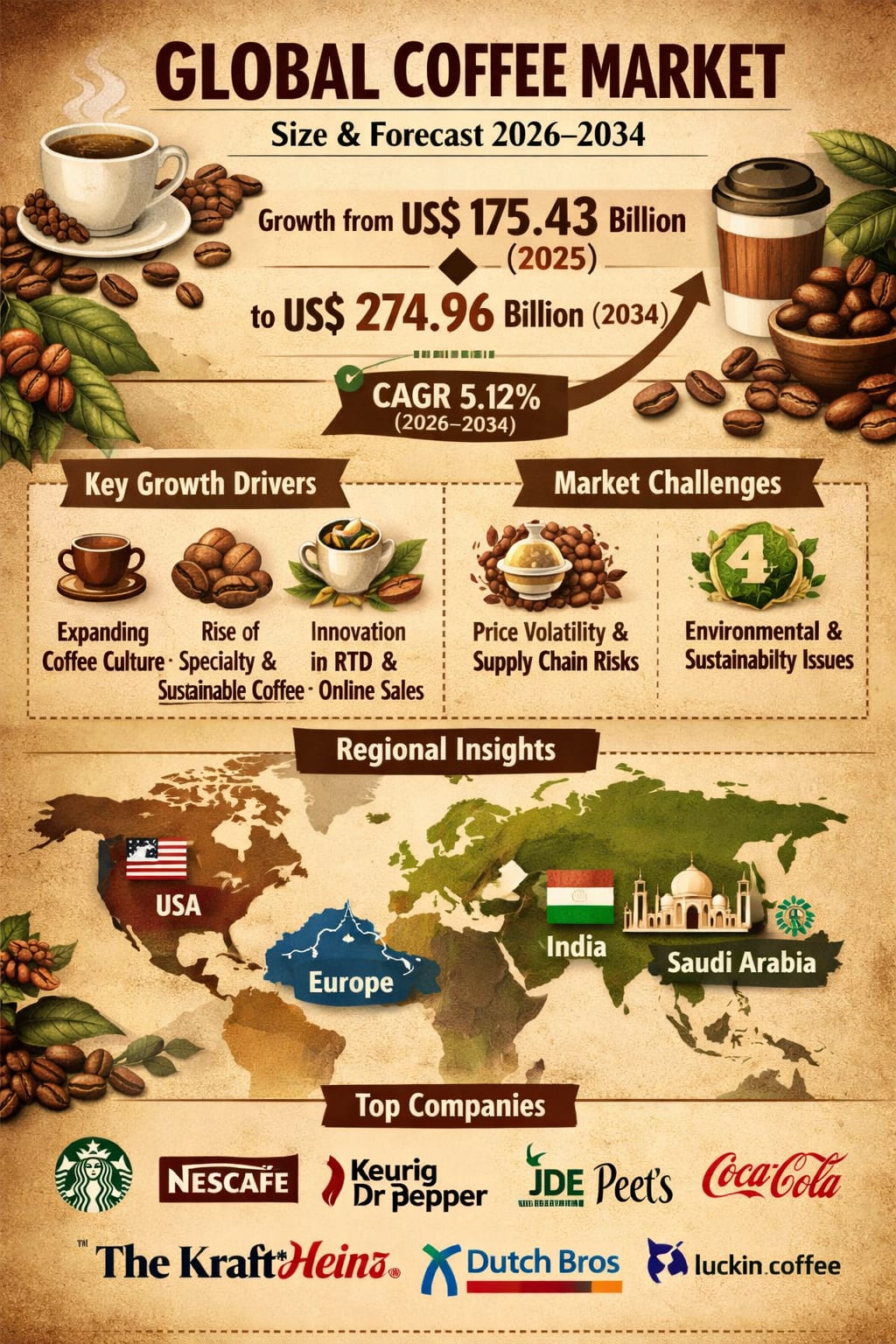
According to market estimates, the global coffee market is anticipated to grow from US$ 175.43 billion in 2025 to US$ 274.96 billion by 2034, registering a CAGR of 5.12% from 2026 to 2034. This strong growth trajectory clearly reflects the rising global demand for coffee and the continuous evolution of consumer preferences across regions.
Coffee is considered one of the most popular, accessible, and widely enjoyed caffeinated products in the world. At its core, coffee is derived from seeds found inside berries grown primarily on Arabica or Robusta plants. Once harvested, these seeds undergo multiple processing steps before becoming the familiar beverage enjoyed worldwide. The final product—simply called “coffee”—is typically prepared using hot water and is valued for its aroma, flavor, and caffeine content.
Coffee products appear in many forms, including whole beans, ground coffee, instant coffee, espresso, and ready-to-drink beverages. This versatility is one of the key reasons behind coffee’s enduring popularity and commercial success.
Globally, coffee enjoys strong cultural and social significance. In Europe and North America, coffee is deeply embedded in daily routines, workplace culture, and social interactions. Meanwhile, in the Asia-Pacific region, coffee consumption is rising rapidly, fueled by urbanization, changing lifestyles, and the growing popularity of café culture. Latin America and parts of Asia-Pacific represent especially dynamic growth markets, where consumption continues to increase alongside expanding urban populations and rising disposable incomes.
Key Growth Drivers of the Global Coffee Market
1. Rising Global Consumption and Expanding Coffee Culture
One of the strongest drivers of the global coffee market is the consistent rise in coffee consumption worldwide. Once considered a traditional beverage limited to specific regions, coffee has now become a global cultural phenomenon. People across both developed and emerging economies are increasingly adopting coffee as part of their daily routines.
It is estimated that over 2.25 billion cups of coffee are consumed every day worldwide, highlighting not only the scale of demand but also coffee’s deep integration into everyday life. From quick office breaks to social meetups in cafés, coffee has become a universal habit that transcends age groups, professions, and cultures. This cultural shift continues to fuel long-term market growth.
2. Growth of Premium, Specialty, and Sustainable Coffee
Another major force shaping the coffee market is the rising demand for premium and specialty coffee. Modern consumers are more informed and selective, seeking high-quality beans, unique flavor profiles, single-origin coffees, and artisanal roasts. Specialty coffee shops and advanced home-brewing methods are further encouraging experimentation and appreciation for premium coffee experiences.
At the same time, sustainability and ethical sourcing have become critical purchasing factors. Consumers are increasingly drawn to organic, fair-trade, and environmentally responsible coffee brands. Transparency in sourcing and eco-friendly farming practices are helping brands build trust and loyalty, while also allowing them to command premium pricing. This premiumization trend is significantly boosting the overall value of the global coffee market.
3. Innovation in Product Formats and Distribution Channels
Product innovation is another key growth engine. The rising popularity of ready-to-drink (RTD) coffee, cold brew, instant specialty coffee, and pod-based systems reflects modern consumers’ demand for convenience and consistency. These formats cater perfectly to fast-paced, on-the-go lifestyles.
On the distribution side, e-commerce and direct-to-consumer models have transformed how coffee reaches consumers. Improved accessibility, wider product variety, and subscription-based models are helping brands expand their reach while strengthening customer relationships. Together, product and distribution innovations are accelerating market growth worldwide.
Challenges Facing the Global Coffee Market
1. Price Volatility and Supply Chain Risks
Despite strong demand, the coffee industry faces notable risks related to climate conditions, crop yields, and geopolitical factors. Coffee production is highly sensitive to weather changes, pests, and natural disasters. Any disruption in supply can lead to price volatility, affecting both producers and manufacturers.
In addition, global supply chains are exposed to transportation challenges, trade policies, and regional instability. Managing these risks often requires higher operational investments, which can impact profitability across the value chain.
2. Environmental and Sustainability Pressures
Environmental concerns present another significant challenge. Climate change is gradually reducing the regions suitable for coffee cultivation, while issues such as deforestation, water usage, and chemical inputs continue to raise sustainability questions.
To address these challenges, the industry must invest in sustainable farming methods, certification programs, and farmer education. While these initiatives are essential for long-term stability, they can also increase short-term costs for producers.
Segment Insights
Instant Coffee Market
The instant coffee segment is driven by demand for convenience, affordability, and ease of preparation. Instant coffee requires no brewing equipment and offers consistent taste, making it especially popular in emerging markets. Advances in processing technologies, such as freeze-drying, have significantly improved quality, while premium instant variants and single-serve packaging are attracting younger consumers. Strong growth in Asia-Pacific and Latin America continues to support this segment.
Ground Coffee Market
Ground coffee remains popular among consumers who value freshness, aroma, and traditional brewing methods. Widely used in drip machines, French presses, and manual brewing systems, this segment is particularly strong in North America and Europe. Growing interest in specialty blends and single-origin offerings is further driving demand for high-quality ground coffee.
Coffee Convenience Store Market
Convenience stores play an increasingly important role in coffee sales, especially for ready-to-drink and on-the-go coffee products. Extended operating hours, urban lifestyles, and growing commuter populations are boosting demand through this channel, making it a vital part of the modern coffee retail ecosystem.
Online Coffee Market
Online coffee sales are expanding rapidly due to the growth of e-commerce and changing consumer shopping habits. Consumers benefit from access to a wide variety of brands and products, while direct-to-consumer models help companies build stronger customer relationships. The online channel is currently the fastest-growing distribution segment in the global coffee market.
Regional Market Highlights
United States Coffee Market
The United States is one of the largest and most mature coffee markets globally. Coffee is deeply embedded in daily routines, and café culture is well established. Premiumization, specialty coffee, cold brew, and RTD formats are driving growth, while sustainability and e-commerce are reshaping consumer preferences. According to the USDA, the U.S. imported the second-largest volume of coffee beans, with imports projected to reach 22.3 million bags, reflecting strong domestic demand.
United Kingdom Coffee Market
The UK coffee market has expanded rapidly over the past decade, driven by café culture and changing consumer preferences. Both out-of-home and at-home consumption are rising, supported by coffee machines, pods, and premium ground coffee. According to the British Coffee Association, around 95 million cups of coffee are consumed daily in the UK, highlighting the scale and resilience of demand.
India Coffee Market
India’s coffee market is growing quickly due to urbanization, lifestyle changes, and a young population. While instant coffee remains popular for affordability, premium and specialty coffee are gaining traction in cities. The expansion of café chains and e-commerce is further accelerating growth. India’s strong domestic production also supports long-term market development.
Saudi Arabia Coffee Market
Saudi Arabia’s coffee market is shaped by deep-rooted traditions and a rising appetite for premium coffee experiences. Alongside traditional Arabic coffee, demand for specialty and espresso-based beverages is increasing. Government initiatives to expand domestic coffee production and strong consumer spending power continue to support market growth.
Market Segmentation
By Product Type:
Instant Coffee
Ground Coffee
Whole Grain
Others
By Distribution Channel:
Supermarket/Hypermarket
Convenience Store
Online Platform
Others
By Region:
North America (United States, Canada)
Europe (France, Germany, Italy, Spain, UK, Belgium, Netherlands, Turkey)
Asia Pacific (China, Japan, India, Australia, South Korea, Thailand, Malaysia, Indonesia, New Zealand)
Latin America (Brazil, Mexico, Argentina)
Middle East & Africa (South Africa, Saudi Arabia, UAE)
Competitive Landscape
Key companies operating in the global coffee market include:
Starbucks
Nescafé
The Kraft Heinz Company
J.M. Smucker
Coca-Cola
Dutch Bros
Keurig Dr Pepper
JDE Peet’s N.V.
Luckin Coffee
These companies compete through product innovation, brand positioning, sustainability initiatives, and expanding distribution networks.
Final Thoughts
The global coffee market is on a strong and sustainable growth path, supported by rising consumption, premiumization, innovation, and expanding café culture worldwide. With the market projected to grow from US$ 175.43 billion in 2025 to US$ 274.96 billion by 2034 at a CAGR of 5.12%, coffee remains one of the most dynamic and resilient segments in the global beverage industry.
While challenges such as climate risks and sustainability pressures persist, continued investments in innovation, ethical sourcing, and new retail models are expected to keep the industry moving forward. For businesses, investors, and consumers alike, the future of coffee looks rich, diverse, and full of opportunity.
About the Creator
Australia Grocery Retail Market — Growth, Forecast & Strategic Outlook
The Australia grocery retail market continues to grow steadily as both traditional retail and digital channels adapt to evolving consumer needs. According to IMARC Group, the market reached USD 54.3 billion in 2025 and is forecast to expand to USD 79.2 billion by 2034, exhibiting a compound annual growth rate (CAGR) of 4.16% during 2026–2034.
By Amélie Belleabout 22 hours ago in Trader
Stanislav Kondrashov on Bitcoin, Amazon, and the New Shape of Tech Pressure
Bitcoin is falling. Amazon is drawing scrutiny. And the wider tech sector is facing questions it hasn’t had to answer in years. According to Stanislav Kondrashov, founder of TELF AG, what’s happening now isn’t about panic or collapse—it’s about a shift in how the world views technology’s role in the broader economy.
By Stanislav Kondrashov6 days ago in Trader




Comments
There are no comments for this story
Be the first to respond and start the conversation.