
Global Diagnostic Imaging Market Size and Forecast 2025–2033
How AI, Aging Populations, and Healthcare Infrastructure Are Redefining Medical Imaging Worldwide

Global Diagnostic Imaging Market Outlook
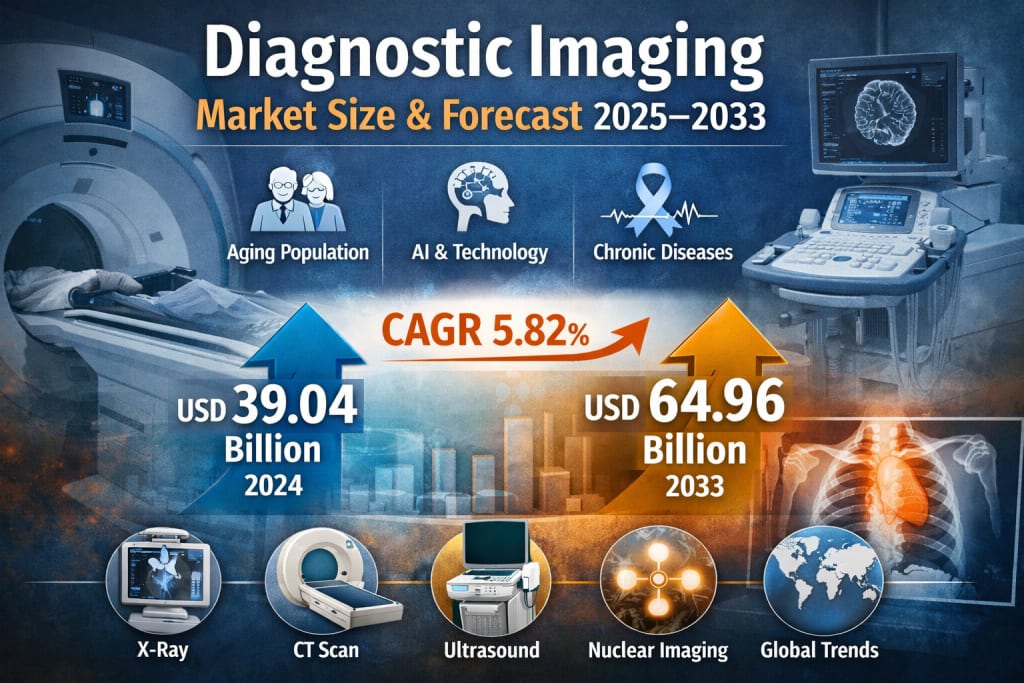
The global Diagnostic Imaging Market is entering a decisive growth phase as healthcare systems worldwide increasingly depend on fast, accurate, and non-invasive tools to detect disease and guide treatment. According to industry estimates, the Diagnostic Imaging Market is expected to reach US$ 64.96 billion in 2033, up from US$ 39.04 billion in 2024, expanding at a CAGR of 5.82% from 2025 to 2033.
This steady rise reflects more than just technological progress. It mirrors deep structural shifts in global healthcare: rapidly aging populations, a sharp increase in chronic diseases such as cancer, diabetes, cardiovascular disorders, stroke, and respiratory illnesses, and a growing emphasis on early diagnosis and preventive care. Diagnostic imaging has become a cornerstone of modern medicine, supporting everything from routine checkups to complex surgical planning and long-term disease management.
Medical imaging—often referred to as diagnostic imaging—covers a broad range of non-invasive techniques that allow physicians to visualize the internal structures of the body. These include imaging methods based on X-rays, ultrasound, nuclear imaging, computed tomography (CT), and magnetic resonance principles. Together, these technologies help clinicians detect diseases at earlier stages, monitor treatment response, plan interventions, and reduce the risks associated with invasive diagnostic procedures.
Beyond clinical value, imaging is also becoming more efficient and interconnected. Advances in radiology software and digital platforms now allow images from multiple modalities to be stored, retrieved, and analyzed seamlessly. This reduces the need for manual film handling, saves physical storage space, and improves workflow efficiency across hospitals and diagnostic centers. In parallel, governments across the world are investing heavily in healthcare infrastructure, further strengthening the foundation for sustained market growth.
Key Growth Drivers Shaping the Market
1. Expansion of Healthcare Infrastructure
One of the most powerful engines behind the growth of the diagnostic imaging market is the continuous expansion and modernization of healthcare infrastructure. Across both developed and emerging economies, new hospitals, specialty clinics, and diagnostic centers are being built or upgraded with advanced imaging departments.
Public and private investments are accelerating the deployment of modern healthcare facilities, making imaging services more accessible to a broader population. This expansion not only increases the installed base of imaging equipment but also raises awareness among patients and physicians about the importance of early and accurate diagnosis.
At the same time, the rise of digital health platforms and telemedicine is supporting remote diagnostics and image sharing, especially in underserved or rural areas. As healthcare delivery becomes more decentralized and technology-driven, the demand for reliable and connected imaging systems continues to grow.
2. AI-Powered Medical Imaging Devices Driving Demand
Artificial intelligence is rapidly transforming diagnostic imaging from a purely visual tool into a powerful decision-support system. AI-enabled imaging solutions can now assist radiologists in detecting abnormalities, prioritizing urgent cases, and improving diagnostic accuracy while reducing interpretation time.
This technological shift is already visible in regulatory approvals and commercial launches. According to a January 2024 update from the U.S. FDA, as of July 2023, 692 AI-enabled medical devices had been authorized, with over 75% of them used in radiology. This highlights how central imaging has become to the broader AI revolution in healthcare.
Major industry players are also accelerating innovation. For example, GE HealthCare launched the MyBreastAI suite in November 2023, a platform of AI applications designed to support imaging workflows and improve breast cancer diagnosis. Similarly, Google Cloud introduced its Medical Imaging Suite in October 2022, focusing on improving accessibility and interoperability of radiology and imaging data.
Although only a limited number of companies currently offer advanced AI-enabled imaging solutions at scale, adoption is expected to rise quickly as healthcare providers seek faster, more accurate, and more cost-effective diagnostic pathways.
3. Introduction of Cutting-Edge Imaging Systems
Another critical growth driver is the strong focus on research and development by leading manufacturers. Companies are racing to introduce next-generation imaging systems that combine higher image quality, faster scan times, and smarter software capabilities.
In January 2024, Hyperfine, Inc. introduced the Swoop system, an AI-powered brain imaging platform. The latest software upgrade improved image quality and added user-friendly features such as real-time guidance for accurate patient loading and positioning, making advanced imaging more accessible even outside traditional radiology suites.
Earlier, in December 2022, Fujifilm Healthcare Americas Corporation launched the SCENARIA View Focus Edition CT system, featuring Cardio StillShot, a sophisticated cardiac motion correction technology. This innovation allows clinicians to capture clearer images of the heart using advanced 4D motion estimation, significantly improving diagnostic confidence in cardiac imaging.
As more such products reach the market, demand is expected to rise not only from large hospitals but also from smaller facilities looking to upgrade their diagnostic capabilities.
Challenges Facing the Diagnostic Imaging Market
1. Product Recalls and the Refurbished Equipment Market
Despite strong growth prospects, the industry faces notable challenges. One of the key concerns is the frequency of product recalls, which can disrupt market confidence and slow down new equipment adoption. For instance, Koninklijke Philips N.V. recalled 109 Incisive CT scanner systems in February 2021 to implement urgent modifications.
In parallel, a large and well-regulated market for refurbished imaging equipment has emerged, especially in price-sensitive regions such as China and India. Many healthcare facilities, particularly small and medium-sized ones, prefer refurbished systems because they offer a better cost-benefit ratio. While this improves access to imaging, it also reduces the pace at which brand-new, cutting-edge systems are adopted.
2. High Cost of Equipment and Maintenance
Advanced imaging systems such as MRI, CT, and PET scanners require significant upfront investment. Beyond purchase costs, healthcare providers must also account for ongoing expenses related to maintenance, calibration, software upgrades, and staff training.
These high costs can limit access in low-resource settings and place financial pressure on smaller healthcare providers. In some regions, patients may also face higher out-of-pocket expenses for imaging procedures, which can restrict utilization and slow market expansion.
Regional Overview: A Market with Uneven Growth
The diagnostic imaging market shows strong regional variation:
North America leads the global market, supported by advanced healthcare infrastructure, high adoption of new technologies, and strong demand for imaging services.
Europe follows closely, driven by an aging population and well-established healthcare systems.
Asia Pacific is the fastest-growing region, fueled by improving healthcare access, rising chronic disease burden, and expanding medical infrastructure.
Latin America and the Middle East & Africa are growing more slowly, mainly due to budget constraints and uneven healthcare development, although targeted investments are beginning to change this landscape.
Country-Level Market Highlights
United States Diagnostic Imaging Market
The United States represents one of the largest and most technologically advanced diagnostic imaging markets in the world. Growth is being driven by an aging population, a rising prevalence of chronic diseases, and increasing adoption of minimally invasive procedures.
Technological innovation remains a defining feature of the U.S. market. At the European Congress of Radiology (ECR) in March 2023, Canon Medical introduced the Aquilion Serve, an advanced 80/160-slice CT scanner that improves diagnostic efficiency through simultaneous multi-view previews. Earlier, in November 2022, Siemens Healthcare launched the Magnetom Viato, a portable MRI scanner designed for use in diverse healthcare settings, expanding access to advanced imaging in areas with limited traditional MRI infrastructure.
These developments reflect a broader trend in the U.S. toward more flexible, efficient, and patient-centered imaging solutions.
Germany Diagnostic Imaging Market
Germany’s diagnostic imaging market is characterized by strong demand for premium technologies and a robust healthcare system. As the population ages and chronic diseases become more common, the need for high-quality imaging continues to rise.
In July 2022, GE Healthcare introduced the Voluson Expert 22, a high-end ultrasound system featuring advanced graphics-based beamforming technology for improved image quality and diagnostic precision. In May 2021, Neoscan Solutions launched a compact MRI scanner designed specifically for infants, enabling high-quality imaging directly within children’s wards. The successful deployment of these systems in German hospitals highlights the country’s role as a leader in medical imaging innovation.
India Diagnostic Imaging Market
India’s diagnostic imaging market is expanding rapidly due to population growth, rising healthcare awareness, and increasing prevalence of chronic diseases such as cancer, cardiovascular conditions, and neurological disorders. Government initiatives to strengthen healthcare infrastructure, along with the growth of medical tourism, are further supporting market expansion.
Cost-effective imaging solutions and mobile imaging units are gaining traction, particularly in rural and underserved regions. At the same time, AI-based imaging technologies are improving diagnostic accuracy and workflow efficiency, helping bridge the gap between demand and limited specialist availability.
Saudi Arabia Diagnostic Imaging Market
Saudi Arabia is witnessing steady growth in diagnostic imaging, supported by rising healthcare demand and strong government focus on modernization under Vision 2030. Investments in MRI, CT, and ultrasound systems are increasing as the Kingdom works to enhance healthcare quality and accessibility.
In October 2022, Saudi company AZDEF, in collaboration with the Dubai Health Authority, launched an MRI safety awareness campaign to improve patient safety and professional standards. Earlier, in January 2022, the Sanad Charitable Association initiated a campaign to raise awareness of childhood cancer, emphasizing early diagnosis and screening. Such initiatives are not only improving public health outcomes but also driving demand for imaging services across the country.
Market Segmentation Snapshot
By Product:
X-Ray
CT
Ultrasound
Nuclear Imaging
Others
By Application:
Orthopedics
Cardiovascular
Neurology
Pelvic & Abdomen
Oncology
By End User:
Hospital
Diagnostic Center
Others
By Region and Country:
North America: United States, Canada
Europe: France, Germany, Italy, Spain, United Kingdom, Belgium, Netherlands, Turkey
Asia Pacific: China, Japan, India, South Korea, Thailand, Malaysia, Indonesia, Australia, New Zealand
Latin America: Brazil, Mexico, Argentina
Middle East & Africa: Saudi Arabia, UAE, South Africa
Competitive Landscape and Key Players
The global diagnostic imaging market is highly competitive, with leading companies focusing on innovation, strategic partnerships, and portfolio expansion. Key players include:
FUJIFILM VisualSonics Inc.
Canon Medical Systems Corporation
Bruker Corporation
PerkinElmer Inc.
Hitachi
Hologic
RadNet
Koninklijke Philips
These companies are typically analyzed across five key dimensions: Overview, Key Persons, Product Portfolio, Recent Developments & Strategies, and Financial Insights, reflecting the strategic depth and technological intensity of the sector.
Final Thoughts
The global diagnostic imaging market is on a clear upward trajectory, supported by powerful long-term trends: aging populations, the rising burden of chronic diseases, rapid technological innovation, and expanding healthcare infrastructure worldwide. With the market projected to grow from US$ 39.04 billion in 2024 to US$ 64.96 billion by 2033 at a CAGR of 5.82%, imaging will remain one of the most critical pillars of modern healthcare.
While challenges such as high costs and product recalls persist, the integration of AI, the introduction of cutting-edge systems, and increased government and private investment are steadily reshaping the industry. In the coming decade, diagnostic imaging is set to become not only more powerful and precise, but also more accessible—playing a central role in improving patient outcomes and transforming global healthcare delivery.
About the Creator
Keep reading
More stories from shibansh kumar and writers in Trader and other communities.
Global Ready to Drink Tea and Coffee Market Size and Forecast 2025–2033
The Rise of Ready-to-Drink Beverages in a Fast-Moving World The global beverage industry is in the middle of a quiet but powerful transformation. Consumers no longer want to wait in line for a coffee or brew a cup of tea at home when life is moving faster than ever. Instead, they are reaching for bottles, cans, and cartons that deliver the same experience instantly. This shift has propelled the Ready to Drink (RTD) Tea and Coffee Market into one of the most dynamic segments of the global drinks industry.
By shibansh kumarabout 10 hours ago in Trader
The Future of Gold: Why This Ancient Metal Still Rules the Modern World
Gold has fascinated humanity for thousands of years. From ancient Egyptian tombs to modern financial markets, this glowing metal has never lost its symbolic and economic power. While the world has changed dramatically — cryptocurrencies have emerged, economies have gone digital, and global finance is evolving faster than ever — gold continues to hold a unique place.
By Ghalib Khan3 days ago in Trader
Faster Growth with Intraday Trading or More Loss?
You've seen the posts. The sleek laptops, the exotic backdrops, the claims of "unlimited income" from "just a few clicks a day." It's the day trading dream: the ultimate shortcut to wealth, freedom, and endless financial swagger.
By Daniel Reid6 days ago in Trader


Comments
There are no comments for this story
Be the first to respond and start the conversation.