
Global Dishwasher Market Size and Forecast 2025–2033
From Convenience to Necessity: How Dishwashers Are Reshaping Modern Kitchens Worldwide

Introduction
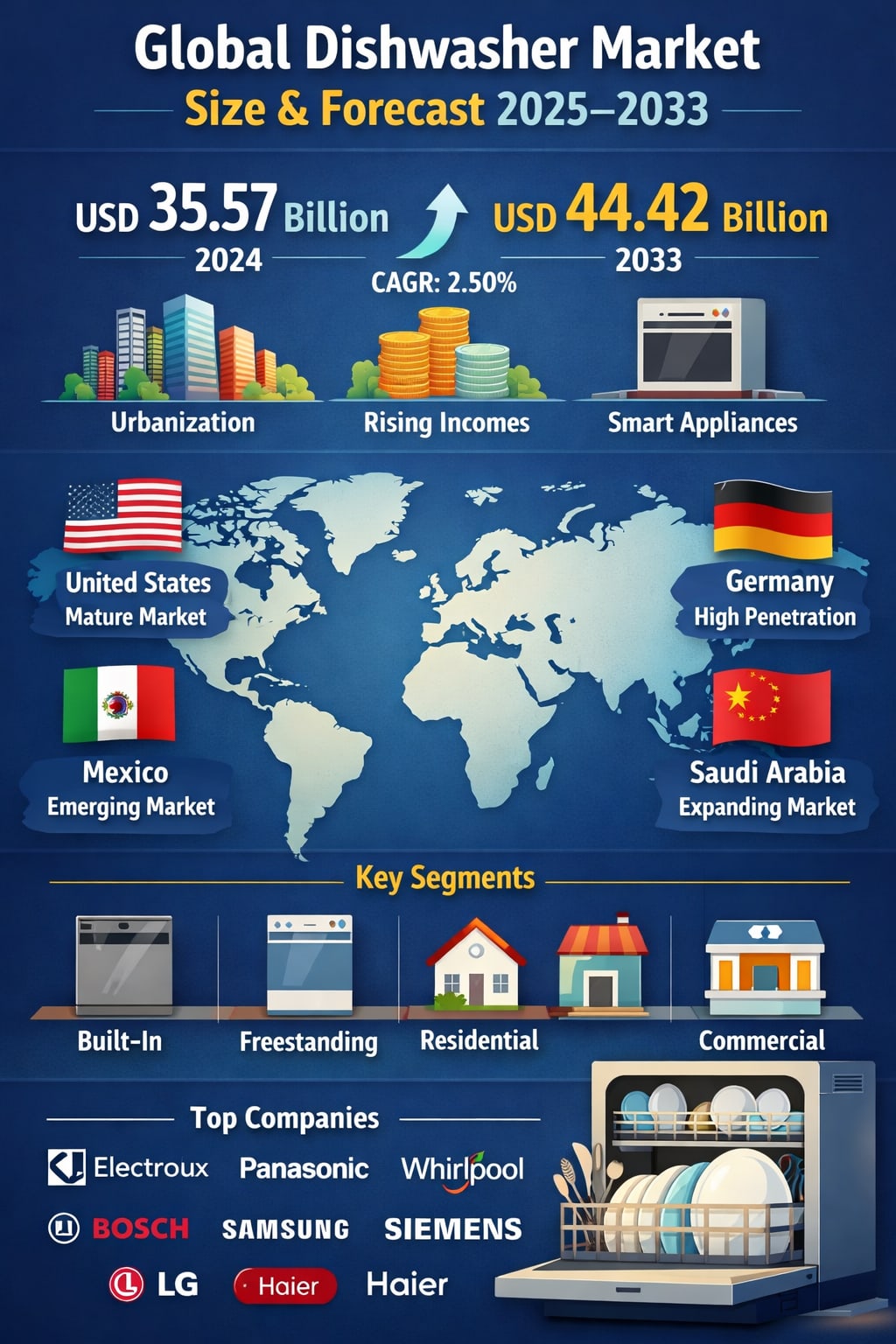
The global dishwasher market is steadily transforming from a convenience-driven niche into a mainstream household essential. Valued at USD 35.57 billion in 2024, the market is projected to reach USD 44.42 billion by 2033, growing at a compound annual growth rate (CAGR) of 2.50% during 2025–2033. This growth is being fueled by rising urbanization, increasing disposable incomes, and the growing preference for automated and time-saving kitchen appliances.
Once considered a luxury item in many parts of the world, dishwashers are now becoming a standard fixture in modern homes and commercial kitchens alike. The shift toward busy lifestyles, dual-income households, and heightened awareness of hygiene has significantly changed consumer attitudes toward kitchen automation. In developed markets such as North America and Europe, dishwashers are already deeply embedded in everyday life. Meanwhile, emerging economies in Asia-Pacific and Latin America are witnessing rising adoption as middle-class populations expand and urban living becomes more prevalent.
Beyond convenience, technological innovation is redefining what a dishwasher can do. Smart connectivity, energy-efficient systems, advanced cleaning sensors, and eco-friendly water usage are turning these appliances into intelligent kitchen companions. As sustainability and smart home integration gain importance, the dishwasher market is well-positioned to remain on a steady growth path over the next decade.
Global Dishwasher Market Overview
A dishwasher is an automated kitchen appliance designed to clean and sanitize dishes, utensils, pots, and pans using hot water, detergent, and high-pressure spray jets. Modern dishwashers offer multiple wash cycles, energy-saving modes, and smart features that allow users to customize cleaning based on load size and soil level.
Globally, the adoption of dishwashers has been driven by lifestyle changes and rising hygiene awareness. In many developed countries, dishwashers are no longer optional appliances but standard kitchen equipment. In contrast, emerging markets are now entering a phase of accelerated adoption, supported by urbanization, growing disposable incomes, and the desire for modern living standards.
Manufacturers are focusing on water conservation, energy efficiency, noise reduction, and compact designs to address long-standing consumer concerns. These improvements are not only enhancing performance but also expanding the potential customer base, especially in space-constrained urban homes and environmentally conscious households.
Key Growth Drivers in the Global Dishwasher Market
Increasing Urbanization and Shifting Lifestyles
Urbanization is one of the most powerful forces shaping the global appliance market, and dishwashers are no exception. With more people moving to cities and adopting fast-paced lifestyles, the demand for time-saving home solutions continues to rise. Dishwashers are particularly attractive to dual-income households, working professionals, and small families who want to reduce daily household chores.
The growth of nuclear families and the spread of modular kitchens in urban apartments have further boosted dishwasher adoption. Rising disposable incomes among middle-class consumers in emerging economies are also making appliances more affordable and accessible. Alongside this, growing awareness of hygiene and cleanliness in food preparation is reinforcing the appeal of automated dishwashing solutions.
Currently, around 55% of the global population lives in urban areas, and this figure is projected to increase to 68% by 2050, with nearly 90% of this growth expected in Asia and Africa. This massive demographic shift is likely to continue driving demand for modern kitchen appliances, including dishwashers, across both developed and developing regions.
Smart Features and Technological Advancements
Technology is playing a central role in reshaping the dishwasher market. Today’s dishwashers come equipped with advanced features such as soil sensors, auto-dosing systems, steam cleaning, and AI-powered wash cycles that optimize performance while reducing water and energy consumption. Many models now offer IoT connectivity, allowing users to monitor and control their appliances through smartphone apps.
The integration of dishwashers into smart home ecosystems has further increased their appeal, especially among tech-savvy consumers. Sustainability is also a major focus, with manufacturers developing models that use less water and electricity without compromising cleaning efficiency. These innovations address traditional concerns related to resource consumption, noise levels, and cleaning performance.
In July 2022, Samsung Electronics Singapore introduced a new generation of dishwashers designed to enhance kitchen hygiene and convenience. These models feature smart technologies aimed at faster, more personalized cleaning, reflecting the industry’s broader shift toward intelligent and user-centric appliances.
Expansion of the Hospitality and Foodservice Industry
The rapid growth of the global hospitality and foodservice sector is another major driver of dishwasher demand, particularly in the commercial segment. Restaurants, hotels, cafes, hospitals, and catering services require high-capacity, hygienic, and efficient dishwashing solutions to meet strict food safety standards and customer expectations.
As global tourism rebounds and the number of quick-service restaurants and catering businesses increases, investments in commercial kitchen equipment are also rising. Dishwashers designed for commercial use emphasize durability, speed, and compliance with hygiene regulations.
In March 2024, Miele Professional introduced MasterLine, a new range of dishwashers suitable for both residential and commercial use. The product line focuses on high hygiene standards, efficiency, and convenience, highlighting how manufacturers are catering to the evolving needs of professional kitchens.
Challenges Facing the Global Dishwasher Market
High Initial Costs and Installation Barriers
Despite their long-term benefits, dishwashers still represent a relatively high upfront investment, especially in developing economies. The cost of the appliance itself, combined with plumbing and electrical installation requirements, can discourage price-sensitive consumers. In many markets, dishwashers are still perceived as luxury items rather than essential kitchen appliances.
Installation challenges in older homes, limited kitchen space, and the need for cabinetry modifications further add to the total cost. Compatibility issues with local dishware sizes and materials can also influence purchasing decisions. To overcome these barriers, manufacturers are increasingly focusing on compact designs, more affordable models, and easier installation options that can support wider adoption.
Low Penetration in Developing Countries
In many developing regions, dishwasher penetration remains low due to cultural habits, economic constraints, and infrastructure limitations. In parts of Asia-Pacific, Africa, and Latin America, manual dishwashing is still deeply rooted in daily routines, often supported by domestic help. Limited awareness of the time-saving and water-efficient benefits of dishwashers also slows adoption.
In rural and semi-urban areas, inconsistent water supply and electricity access further restrict market growth. Even in urban centers, some consumers remain hesitant due to misconceptions about water usage and cleaning effectiveness. Addressing these challenges will require targeted awareness campaigns, affordable and compact models, and products designed specifically for local needs.
Market Segmentation Insights
Global Built-in Dishwasher Market
Built-in dishwashers are gaining strong traction, particularly in developed markets and urban areas with modern kitchen designs. These models integrate seamlessly into cabinetry, offering a sleek, space-efficient appearance that appeals to consumers who prioritize aesthetics and functionality.
Built-in dishwashers are often preferred for their quieter operation, advanced features, and energy efficiency. Real estate developers and interior designers are increasingly including them in high-end residential projects, further supporting demand. As smart home adoption grows, built-in dishwashers are becoming a popular choice for homeowners seeking both performance and design harmony.
Global Residential Dishwasher Market
The residential segment accounts for the largest share of the global dishwasher market. Growth in this segment is driven by rising consumer awareness, the increasing number of dual-income households, and the desire for convenience in daily life.
Compact and countertop models are becoming more popular, especially in urban apartments with limited space. In emerging economies, rising living standards and disposable incomes are encouraging first-time buyers to invest in home appliances. Marketing campaigns and promotional offers are also helping reposition dishwashers as practical, hygienic, and time-saving solutions rather than luxury items.
Global Commercial Dishwasher Market
Commercial dishwashers serve restaurants, hotels, hospitals, and institutional kitchens that require high-volume, fast, and hygienic cleaning solutions. These machines are built for durability, speed, and compliance with food safety standards.
The post-pandemic focus on sanitation and hygiene has further strengthened demand for commercial dishwashers. As the global foodservice and hospitality industry continues to expand—especially in Asia-Pacific and the Middle East—the commercial segment is expected to maintain steady growth over the forecast period.
Global Online Dishwasher Market
Online sales channels are playing an increasingly important role in the dishwasher market. E-commerce platforms such as Amazon, Flipkart, and Alibaba offer consumers convenience, wider product choices, competitive pricing, and access to reviews and comparisons.
The pandemic accelerated the shift toward online shopping, and many appliance brands have since invested heavily in direct-to-consumer platforms and omnichannel strategies. Features such as home delivery, easy returns, and flexible payment options have further boosted online adoption. With rising internet penetration and digital literacy, online distribution is expected to remain a key growth channel for dishwasher sales worldwide.
Regional Market Highlights
United States
The United States is one of the largest and most mature dishwasher markets globally. High appliance penetration, advanced kitchen infrastructure, and strong consumer preference for convenience support steady demand. Smart and energy-efficient dishwashers are particularly popular, driven by sustainability trends and Energy Star ratings.
Competition among major brands such as Whirlpool, GE Appliances, and Bosch encourages continuous innovation. Replacement demand from home renovations and remodeling projects also contributes to market stability. In February 2024, GE Appliances introduced a new line of stainless tub dishwashers focused on improved design and cleaning performance, reinforcing its strong position in the U.S. market.
Germany
Germany has one of the highest dishwasher penetration rates in Europe, reflecting its advanced appliance market and strong focus on sustainability. Built-in models dominate, supported by widespread adoption of modular kitchens. German consumers place high value on energy efficiency, water conservation, quiet operation, and long product life.
Leading brands such as Bosch, Miele, and Siemens continue to introduce smart and eco-friendly models. Government energy-labeling policies and environmental awareness further encourage appliance upgrades. With growing interest in smart homes, AI-enabled and connected dishwashers are becoming increasingly popular across the country.
China
China’s dishwasher market is expanding rapidly due to urbanization, rising incomes, and changing household preferences. Once seen as a luxury, dishwashers are now increasingly viewed as essential appliances in middle-class homes, particularly in major cities.
Manufacturers are introducing compact and countertop models to suit smaller kitchens and family sizes. Domestic brands such as Haier and Midea are investing heavily in smart, locally tailored designs, while international brands are also gaining ground. In April 2024, ROBAM introduced a high-end sterilizing dishwasher, highlighting how Chinese brands are pushing innovation and competing strongly on a global scale.
Mexico
Mexico’s dishwasher market is gradually growing as appliances become more affordable for middle-class consumers. Urban development and the spread of modular kitchens are supporting adoption, especially in major cities. While price sensitivity and cultural habits still limit growth, increasing awareness of hygiene and water-saving benefits is improving consumer acceptance. Both retail and online channels are playing an important role in expanding product visibility.
Saudi Arabia
In Saudi Arabia, the dishwasher market is benefiting from changing lifestyles, rising disposable incomes, and strong demand for modern kitchen appliances. Urbanization, new housing projects, and smart home integration are driving adoption, particularly for built-in models.
Global brands dominate the market, supported by expanding retail and e-commerce platforms. In February 2024, Samsung introduced a next-generation dishwasher with smart connectivity features, reflecting the growing demand for technologically advanced appliances in the region.
Competitive Landscape and Key Players
The global dishwasher market is highly competitive, with major players focusing on innovation, energy efficiency, and smart features to differentiate their offerings. Key companies operating in the market include:
Electrolux AB
Panasonic
Whirlpool
Robert Bosch GmbH
Samsung
Siemens
LG Electronics
Haier
These companies compete across product portfolios, technological capabilities, regional presence, and brand reputation. Continuous investment in research and development, along with strategic product launches, remains central to maintaining market share.
Market Segmentation
By Product:
Freestanding
Built-in
By Application:
Residential
Commercial
By Distribution Channel:
Offline
Online
By Region:
North America (United States, Canada)
Europe (France, Germany, Italy, Spain, UK, Belgium, Netherlands, Turkey)
Asia-Pacific (China, Japan, India, Australia, South Korea, Thailand, Malaysia, Indonesia, New Zealand)
Latin America (Brazil, Mexico, Argentina)
Middle East & Africa (South Africa, Saudi Arabia, UAE)
Final Thoughts
The global dishwasher market is on a steady and sustainable growth path, driven by urbanization, lifestyle changes, technological innovation, and the expanding hospitality sector. With the market expected to grow from USD 35.57 billion in 2024 to USD 44.42 billion by 2033 at a CAGR of 2.50%, dishwashers are clearly transitioning from optional conveniences to essential components of modern kitchens.
While challenges such as high upfront costs and low penetration in developing regions remain, ongoing innovation, affordability improvements, and rising awareness are steadily addressing these barriers. As smart homes, sustainability, and convenience continue to shape consumer choices, the dishwasher industry is well-positioned to remain an important and evolving segment of the global home appliance market over the coming decade.
About the Creator
United States Diabetes Market Size, Trends, Growth & Forecast 2034: A Transforming Healthcare Landscape
The United States diabetes market is entering a new era of transformation. With millions of Americans living with diabetes and prediabetes, the condition remains one of the most pressing public health challenges in the country. However, alongside rising prevalence comes rapid innovation — from advanced insulin therapies to AI-powered glucose monitoring systems.
By Adil Ali Khan4 days ago in Trader
Private Equity Market Transforming Through AI Integration and Strategic Investments
Private Equity Market Overview The Private Equity Market involves investment funds that acquire, manage, and restructure private companies or public companies taken private, with the goal of improving performance and generating strong returns. Private equity firms typically invest in sectors such as technology, healthcare, manufacturing, consumer goods, and financial services. The market has witnessed steady growth due to increasing institutional investor participation, favorable economic conditions, and expanding opportunities in emerging industries. Additionally, private equity firms are focusing on operational improvements, digital transformation, and strategic acquisitions to maximize portfolio company value. The integration of advanced technologies, particularly artificial intelligence, is playing a crucial role in reshaping investment decision-making and portfolio management strategies.
By James Smith6 days ago in Trader



Comments
There are no comments for this story
Be the first to respond and start the conversation.