
Global Li-Fi Market Size & Forecast 2026–2034
How Light-Based Wireless Technology Is Set to Transform the Future of High-Speed, Secure Connectivity

Introduction
The world is witnessing an unprecedented surge in data consumption. From high-definition video streaming and cloud computing to smart cities and connected vehicles, the demand for faster, more secure, and more reliable wireless communication is growing at an extraordinary pace. While Wi-Fi and cellular technologies have powered the digital revolution for decades, they are now facing increasing challenges such as spectrum congestion, interference, and security vulnerabilities.
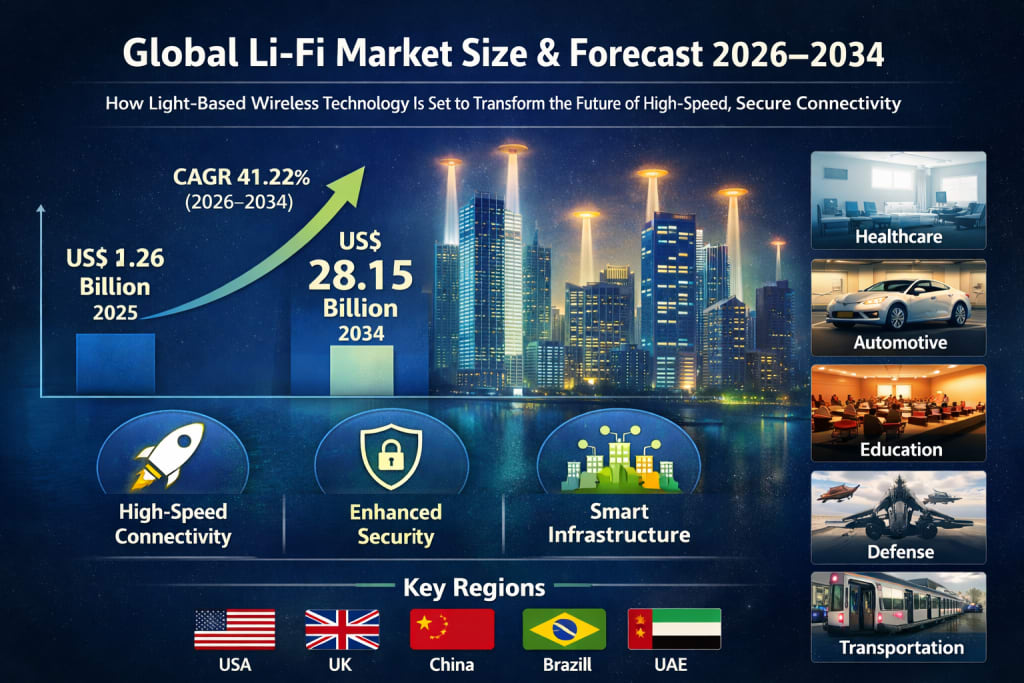
Against this backdrop, Li-Fi (Light Fidelity) is emerging as a powerful complementary wireless technology that uses light instead of radio waves to transmit data. According to Renub Research, the global Li-Fi market is projected to grow from US$ 1.26 billion in 2025 to US$ 28.15 billion by 2034, registering a remarkable CAGR of 41.22% from 2026 to 2034. This rapid expansion reflects the rising demand for high-speed wireless communication, growing data traffic, enhanced security requirements, and increasing adoption of Li-Fi across sectors such as smart buildings, healthcare, defense, and industrial automation.
As industries and governments look for next-generation connectivity solutions, Li-Fi is no longer just a laboratory concept—it is steadily moving toward real-world commercialization.
Global Li-Fi Market Outlook
Li-Fi, short for Light Fidelity, is an advanced wireless communication technology that uses visible light, infrared, or ultraviolet light to transmit data at extremely high speeds. Unlike traditional Wi-Fi, which relies on radio frequency signals, Li-Fi works through LED light sources that rapidly modulate light intensity to encode and transmit information. This modulation happens at speeds invisible to the human eye, enabling high-bandwidth, low-latency, and secure data transmission.
One of Li-Fi’s most compelling advantages is security. Since light does not pass through walls, Li-Fi signals remain confined within physical spaces, significantly reducing the risk of unauthorized access or data interception. This makes Li-Fi particularly suitable for hospitals, aircraft cabins, industrial facilities, research labs, and defense environments, where both reliability and security are critical.
Globally, interest in Li-Fi is rising as smart cities, Internet of Things (IoT) networks, and data-intensive applications continue to expand. Countries across North America, Europe, and Asia-Pacific are investing in research, pilot projects, and early commercial deployments. While Li-Fi is still an emerging technology compared to Wi-Fi, its speed, spectrum efficiency, and security benefits position it as a powerful complementary solution for the future of wireless communication.
Growth Drivers in the Global Li-Fi Market
1. Demand for High-Speed and Low-Latency Wireless Connectivity
One of the strongest drivers of the global Li-Fi market is the growing need for ultra-fast, low-latency wireless communication. With the rapid rise of cloud services, video conferencing, AR/VR applications, and real-time industrial systems, traditional radio-frequency networks are increasingly facing congestion and performance limitations.
Li-Fi uses the vast, unlicensed visible light spectrum, offering significantly higher bandwidth potential and reduced interference. This makes it highly attractive for environments such as offices, hospitals, factories, and research centers, where reliable and high-capacity connectivity is essential. Li-Fi also supports high device density without major performance drops, a critical requirement in smart buildings and connected workplaces.
As enterprises and institutions search for alternatives or complements to Wi-Fi to manage exploding data traffic, Li-Fi’s speed, stability, and responsiveness are positioning it as a next-generation wireless solution.
2. Rising Adoption in Secure and Sensitive Environments
Security concerns are playing a major role in accelerating Li-Fi adoption. Unlike radio waves, light does not penetrate walls, making Li-Fi inherently more secure against external hacking or eavesdropping. This feature is particularly valuable in government facilities, defense operations, financial institutions, and healthcare environments.
In hospitals, Li-Fi also avoids electromagnetic interference with sensitive medical equipment, ensuring safe and reliable wireless communication. In research labs and industrial settings, it provides secure, localized data transmission. As cyber threats and data breaches continue to rise globally, organizations are increasingly prioritizing physically secure communication technologies, giving Li-Fi a strong competitive advantage.
3. Expansion of Smart Lighting and IoT Infrastructure
The rapid global shift toward LED lighting and smart infrastructure is another powerful growth driver for the Li-Fi market. Since Li-Fi operates through LED lights, the widespread replacement of traditional lighting with energy-efficient LEDs creates a ready-made foundation for Li-Fi deployment.
Smart buildings, smart cities, and connected factories are increasingly integrating lighting with sensors, networks, and control systems. Li-Fi allows these lighting systems to serve a dual purpose: providing illumination and high-speed data connectivity. This convergence reduces infrastructure costs and improves space efficiency. Moreover, Li-Fi supports precise indoor positioning and location-based services, which are valuable for retail, logistics, and manufacturing applications.
As global investment in smart infrastructure continues to grow, Li-Fi stands to benefit directly from this technological convergence.
Challenges in the Global Li-Fi Market
1. Limited Range and Line-of-Sight Dependency
Despite its advantages, Li-Fi faces technical limitations. The technology relies on line-of-sight or reflected light, meaning obstacles such as walls, furniture, or even human movement can disrupt connectivity. Coverage is typically limited to illuminated areas, which makes Li-Fi less suitable for wide-area or outdoor communication compared to Wi-Fi.
To ensure seamless connectivity, Li-Fi requires dense deployment of LED access points, which can increase installation complexity and costs. While hybrid Li-Fi and Wi-Fi systems can address some of these issues, managing smooth handovers between networks remains a technical challenge.
2. High Initial Deployment Cost and Limited Awareness
Another major barrier is the high initial cost of Li-Fi infrastructure. Specialized LED drivers, receivers, and network integration systems are often more expensive than conventional Wi-Fi equipment. Many organizations remain cautious due to uncertain return on investment and limited standardization.
Additionally, Li-Fi is still relatively unknown outside of tech-savvy circles. Limited availability of compatible devices and low market awareness continue to slow adoption. Wider commercialization, better standardization, and economies of scale will be essential to reduce costs and build market confidence.
Key Market Segments
Global LED Li-Fi Market
The LED Li-Fi segment forms the backbone of the entire ecosystem. LEDs serve both as light sources and data transmitters, enabling high-speed communication while maintaining energy efficiency. The global push toward LED lighting in offices, factories, and public infrastructure has created a strong foundation for Li-Fi integration. Advances in LED chip design and optical components are further improving data rates and reliability, strengthening this segment’s growth potential.
Microcontrollers Li-Fi Market
Microcontrollers play a critical role in managing signal processing, modulation, and data control in Li-Fi systems. As semiconductor technology advances, microcontrollers are becoming more powerful, energy-efficient, and compact. This supports Li-Fi deployment in IoT devices, smart lighting systems, and embedded applications, driving steady growth in this segment.
Application Outlook
Li-Fi in Healthcare
Healthcare is one of the most promising sectors for Li-Fi adoption. Hospitals often restrict radio-frequency signals due to interference risks with medical equipment. Li-Fi provides a safe, secure, and interference-free alternative for patient data transfer, real-time monitoring, medical imaging, and indoor navigation. With increasing digitalization and a strong focus on data security, Li-Fi is expected to play a growing role in modern healthcare networks.
Li-Fi in Education
Educational institutions are rapidly adopting digital learning platforms, virtual classrooms, and cloud-based collaboration tools. Li-Fi offers high-speed, low-latency connectivity while reducing network congestion in classrooms and campuses. Its enhanced security also helps protect student and institutional data, making it an attractive option for smart classrooms and smart campuses.
Li-Fi in Automotive and Transportation
In the automotive sector, Li-Fi can enable high-speed communication using LED headlights, taillights, and interior lighting. Applications include infotainment systems, navigation updates, and vehicle-to-vehicle communication. In transportation hubs such as airports and railways, Li-Fi supports passenger connectivity, asset tracking, and secure operations, especially in environments sensitive to electromagnetic interference.
Regional Market Insights
United States
The United States is a leading market for Li-Fi adoption, driven by strong research activity, early commercialization, and rising demand for secure, high-speed connectivity. Applications in defense, healthcare, data centers, and smart buildings are gaining traction. The rapid expansion of LED lighting and smart infrastructure further supports Li-Fi integration, positioning the U.S. as a key driver of global commercialization.
United Kingdom
The UK is widely recognized as a pioneer in Li-Fi technology, supported by strong academic research and early innovation in optical wireless communication. With growing interest in cybersecurity, smart cities, and digital infrastructure, Li-Fi is gaining attention across offices, universities, and public buildings. The UK is expected to remain a major hub for Li-Fi research and early adoption.
China
China represents a high-potential market due to rapid urbanization, massive smart city projects, and strong government investment in advanced technologies. Widespread LED adoption and growing demand for high-speed data connectivity make Li-Fi an attractive complementary solution for industrial automation, transportation, and secure indoor communication.
Brazil and UAE
Brazil is an emerging market where smart city initiatives and digital connectivity programs are gradually creating opportunities for Li-Fi. The UAE, on the other hand, is moving faster, driven by strong government support for smart cities, digital transformation, and advanced infrastructure, making it one of the most promising markets in the Middle East.
Market Segmentation
By Component:
LED
Photodetector
Microcontrollers
Others
By End User:
Healthcare
Retail
Education
Aerospace & Defense
Automotive
Transportation
Government
Others
By Region:
North America (United States, Canada)
Europe (France, Germany, Italy, Spain, United Kingdom, Belgium, Netherlands, Turkey)
Asia Pacific (China, Japan, India, South Korea, Thailand, Malaysia, Indonesia, Australia, New Zealand)
Latin America (Brazil, Mexico, Argentina)
Middle East & Africa (Saudi Arabia, UAE, South Africa)
Competitive Landscape
The global Li-Fi market features a mix of lighting giants, semiconductor companies, and specialized technology firms. Key players include:
Signify N.V.
Panasonic Corporation
Renesas Electronics Corporation
General Electric Co.
LG Innotek Co. Ltd
Lucibel SA
LVX System
Lightbee Corp
These companies are focusing on product innovation, partnerships, pilot projects, and sector-specific solutions to strengthen their market positions.
Final Thoughts
The global Li-Fi market is entering a phase of rapid transformation. With the market expected to surge from US$ 1.26 billion in 2025 to US$ 28.15 billion by 2034 at a CAGR of 41.22%, Li-Fi is no longer a futuristic concept—it is becoming a practical, high-impact solution for next-generation wireless communication.
Driven by the need for speed, security, and spectrum efficiency, Li-Fi is set to complement existing wireless technologies across smart buildings, healthcare, education, transportation, and industrial environments. While challenges such as cost, awareness, and technical limitations remain, ongoing innovation and growing smart infrastructure investments are likely to overcome these barriers.
As the world moves deeper into the era of hyper-connectivity, Li-Fi’s ability to turn light into data highways could redefine how we think about wireless communication in the years ahead.
About the Creator
Philippines Cosmetics Market 2026: Beauty Consciousness, Digital Influence and the Rise of Inclusive Glam
Philippines Cosmetics Market Overview The Philippines cosmetics market is experiencing steady expansion as rising beauty awareness, digital engagement and evolving consumer lifestyles reshape product demand across the country. Cosmetics — including facial makeup, lip products, eye cosmetics and complexion solutions — have become integral to self-expression and daily grooming routines among Filipino consumers. The category continues to diversify with the influence of global beauty trends, local brand innovation and increasing accessibility through omnichannel retail.
By Manisha Dixit4 days ago in Trader



Comments
There are no comments for this story
Be the first to respond and start the conversation.