
Global Microcarrier Market Trends & Summary (2025–2033)
How Cell-Based Therapies, Biologics, and Scalable Biomanufacturing Are Reshaping the Future of Cell Culture

Introduction: Why Microcarriers Are Stealing the Spotlight in Biotech
The global life sciences industry is undergoing a profound transformation. From the rapid rise of biologics and gene therapies to the accelerating adoption of personalized medicine, the way cells are grown, expanded, and processed has become a strategic priority for pharmaceutical and biotechnology companies. At the center of this shift lies a quietly powerful technology: microcarriers.
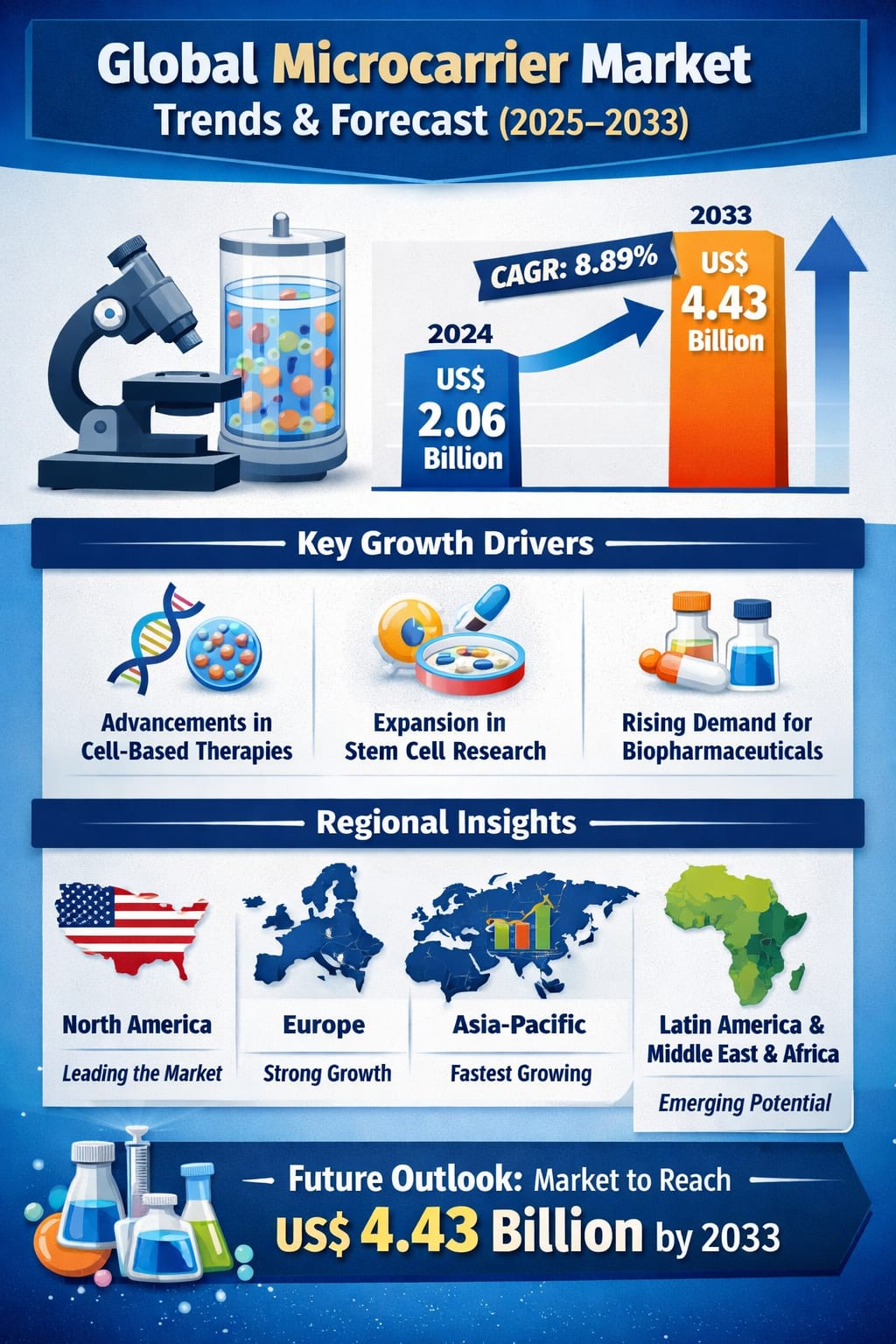
According to Renub Research, the Microcarrier Market is expected to reach US$ 4.43 billion in 2033 from US$ 2.06 billion in 2024, growing at a CAGR of 8.89% from 2025 to 2033. This strong growth trajectory reflects not only the expanding demand for biologics and cell-based therapies, but also the urgent need for scalable, efficient, and reproducible cell culture systems in modern biomanufacturing.
Microcarriers, which serve as a support matrix for adherent cell growth inside bioreactors, are increasingly becoming indispensable tools across research labs, biopharmaceutical production facilities, and advanced therapy manufacturing sites. As the global burden of chronic diseases rises and the pipeline of cell and gene therapies expands, the role of microcarriers is moving from niche technology to core bioprocessing infrastructure.
Microcarrier Market at a Glance (Renub Research)
Base Year: 2024
Forecast Period: 2025–2033
Market Size in 2024: US$ 2.06 Billion
Market Forecast in 2033: US$ 4.43 Billion
Growth Rate (2025–2033): 8.89% CAGR
Historical Years: 2021–2024
This steady and resilient growth highlights how microcarriers are benefiting from multiple overlapping trends: rising R&D investments, the shift toward biologics, and the industrialization of cell-based therapies.
Microcarrier Industry Overview: Building the Foundation of Cell-Based Innovation
Microcarriers are small beads or particles designed to provide a surface for adherent cells to grow while being suspended in a bioreactor. This approach allows scientists and manufacturers to scale up cell cultures efficiently without relying on traditional flat surfaces such as flasks or plates.
Pharmaceutical companies and research institutes are increasingly demanding microcarrier dry powder, ready-to-use beads, and associated equipment to support intensive R&D and commercial-scale manufacturing. This demand is closely tied to the global push for more effective therapeutics, including vaccines, monoclonal antibodies, and advanced cell therapies.
The growing prevalence of chronic diseases, cancer, and genetic disorders has accelerated research into novel treatment modalities. As a result, cell culture systems that offer scalability, consistency, and reproducibility are no longer optional—they are essential. Microcarriers fit perfectly into this evolving landscape, making them a critical component of modern bioprocessing workflows.
In parallel, advances in bioprocessing technologies and the expanding adoption of personalized medicine are further strengthening the market outlook. Regulatory support for cell-based treatments and increased funding for life sciences research are also reinforcing long-term growth prospects.
Key Growth Drivers Shaping the Microcarrier Market
1. Rapid Developments in Cell-Based Medicine
One of the strongest growth engines for the microcarrier market is the fast-paced evolution of cell-based therapies, particularly in immunotherapy and regenerative medicine. These therapies rely on the cultivation and expansion of immune cells or patient-derived cells, processes that require a reliable and scalable support matrix.
Microcarriers provide exactly that: a controlled environment that supports high-density cell growth while maintaining cell quality. As personalized medicine gains momentum and new treatments for cancer, autoimmune disorders, and tissue regeneration move closer to commercialization, the demand for robust cell culture platforms continues to rise.
Moreover, the adaptability and scalability of microcarrier-based systems make them highly attractive for both clinical development and commercial manufacturing, strengthening their role across the therapy development lifecycle.
2. Expanding Stem Cell Research
Stem cell research remains one of the most dynamic and promising fields in modern biomedical science. From understanding developmental biology to creating breakthrough regenerative therapies, stem cells are at the heart of numerous research and clinical programs.
Microcarriers are widely used to expand stem cells efficiently and consistently, providing researchers and biotech companies with a controlled environment for cell proliferation and differentiation. Rising global investments in stem cell research and regenerative medicine are therefore directly translating into higher demand for microcarrier-based culture systems.
As tissue engineering and cell-based therapeutics move closer to mainstream clinical use, microcarriers are expected to remain a cornerstone technology for scalable stem cell production.
3. Growing Focus on Biopharmaceuticals
Biopharmaceuticals have transformed the treatment landscape for many complex diseases, including cancer, autoimmune disorders, and rare genetic conditions. Their success has pushed the pharmaceutical industry further toward biologics and advanced therapies, increasing the need for sophisticated cell culture technologies.
Microcarriers play a crucial role in bioprocessing by enabling large-scale expansion of adherent cells, which are often required for producing therapeutic proteins, vaccines, and viral vectors. The ongoing expansion of biomanufacturing facilities, combined with sustained R&D investments, continues to fuel market growth.
The COVID-19 pandemic further highlighted the importance of scalable and flexible bioproduction platforms, reinforcing the strategic value of microcarrier-based systems in global healthcare preparedness.
Challenges Facing the Microcarrier Market
High Development Costs
Despite its strong growth outlook, the microcarrier market faces notable cost-related challenges. Developing new microcarrier technologies requires extensive research, testing, and optimization, all of which demand significant financial investment.
In addition, manufacturers must invest in specialized equipment, high-quality raw materials, and strict quality control processes. These factors increase overall production costs and can limit access for smaller companies, potentially slowing innovation and market entry for new players.
Regulatory Hurdles
Regulatory complexity is another key challenge. Microcarriers used in clinical and commercial manufacturing must meet stringent standards for safety, quality, and biocompatibility. Navigating these regulatory requirements can be time-consuming and expensive, often extending development timelines.
For smaller companies and startups, these hurdles can be particularly difficult to overcome, creating barriers to entry and increasing the cost of compliance across the industry.
Regional Outlook: Where Growth Is Coming From
North America: The Market Leader
North America remains at the forefront of the global microcarrier market, driven by a strong biopharmaceutical sector, advanced R&D infrastructure, and supportive regulatory frameworks. The United States, in particular, plays a central role due to its leadership in biologics, gene therapies, and cell-based treatments.
The region’s focus on innovation and large-scale manufacturing continues to accelerate the adoption of microcarrier-based systems across both research and commercial production.
Europe: Strong Demand for Advanced Therapies
Europe is witnessing steady growth, supported by increasing demand for cell-based therapeutics, robust pharmaceutical industries, and strong regulatory support for advanced therapies. Countries such as Germany, France, and the United Kingdom are actively investing in scalable biomanufacturing solutions, further strengthening the regional market.
Asia Pacific: The Fastest-Growing Region
The Asia Pacific region is emerging as a high-growth market for microcarriers, fueled by rising healthcare investments, expanding biotechnology sectors, and improving research infrastructure. Countries like China, Japan, India, and South Korea are rapidly scaling up their biomanufacturing capabilities, making the region a key growth engine for the global market.
Latin America & Middle East and Africa: Untapped Potential
Although still developing, Latin America and the Middle East & Africa show promising potential due to increasing biotechnology projects, rising healthcare needs, and growing government support for life sciences research.
Country Spotlight
United States Microcarrier Market
The US microcarrier market is expanding rapidly due to strong demand for biopharmaceuticals, cell-based therapies, and advanced bioprocessing technologies. Microcarriers are increasingly used in large-scale cell culture systems because they support high-density cell growth, a critical requirement for producing biologics and gene therapies.
In January 2024, Thermo Fisher Scientific Inc. introduced the PangenomiX Array, a major innovation in genomic research. By integrating multiple assays on a single platform, this technology supports advances in pharmacogenomics and disease research, indirectly strengthening the ecosystem that drives microcarrier adoption in therapeutic and research applications.
Germany Microcarrier Market
Germany’s strong biotechnology industry, advanced healthcare system, and commitment to R&D investment are driving steady growth in its microcarrier market. The country’s focus on scalable biomanufacturing, gene therapy, and personalized medicine continues to increase demand for efficient cell culture technologies.
India Microcarrier Market
India is rapidly emerging as a key market in the Asia Pacific region, supported by rising investments in biotechnology, expanding healthcare infrastructure, and a growing focus on cell-based therapies and biologics. Government initiatives, cost-effective manufacturing capabilities, and a skilled workforce are positioning India as an important hub for biomanufacturing and research-driven innovation.
Saudi Arabia Microcarrier Market
Saudi Arabia’s microcarrier market is gaining momentum as the country invests heavily in healthcare, biotechnology, and life sciences under its economic diversification strategy. Government support for medical research and personalized medicine is accelerating the adoption of advanced biomanufacturing technologies, including microcarriers.
Market Segmentation Snapshot
By Product Type
Consumables
Microcarrier Beads
Media & Reagents
Equipment
By Application
Cell Therapy
Vaccine Manufacturing
Others
By End User
Pharmaceutical & Biotechnology Companies
Contract Research Organizations (CROs) & Contract Manufacturing Organizations (CMOs)
Academic & Research Institutes
By Region and Countries
North America: United States, Canada
Europe: France, Germany, Italy, Spain, United Kingdom, Belgium, Netherlands, Turkey
Asia Pacific: China, Japan, India, South Korea, Thailand, Malaysia, Indonesia, Australia, New Zealand
Latin America: Brazil, Mexico, Argentina
Middle East & Africa: Saudi Arabia, UAE, South Africa
Rest of the World
Competitive Landscape: Key Players to Watch
Leading companies shaping the global microcarrier market include:
Thermo Fisher Scientific
Merck KGaA
Eppendorf AG
Danaher Corporation
Sartorius AG
Bio-Rad Laboratories, Inc.
Corning Inc.
Lonza Group
Getinge
Becton, Dickinson and Company
These players are actively investing in product innovation, strategic partnerships, and capacity expansion to strengthen their market positions and meet the growing demand for scalable cell culture solutions.
Final Thoughts: A Market Built for the Future of Medicine
The global microcarrier market is no longer just a supporting segment of bioprocessing—it is becoming a strategic enabler of next-generation healthcare. With the market projected to grow from US$ 2.06 billion in 2024 to US$ 4.43 billion by 2033, the outlook reflects a decade defined by biologics, cell therapies, gene therapies, and personalized medicine.
While challenges such as high development costs and regulatory complexity remain, the long-term fundamentals are strong. As biopharmaceutical pipelines expand and the demand for scalable, efficient cell culture systems intensifies, microcarriers are set to play an even more critical role in shaping the future of global healthcare.
About the Creator
Bitcoin’s Sudden Crash After the Epstein File Release
Bitcoin’s Sudden Crash After the Epstein File Release: Coincidence or Market Psychology? When the long-anticipated Epstein-related documents were released to the public, the world’s attention was captured almost instantly. Media outlets, social platforms, and political commentators erupted with reactions, debates, and speculation. Around the same time, Bitcoin and the broader cryptocurrency market experienced a noticeable decline. This timing led many observers to ask a pressing question: Did the Epstein file release cause Bitcoin to crash?
By Wings of Time 3 days ago in Trader
📢 Raise Your Voice Thread: 02/05/2026
Our “Raise Your Voice Threads” are hosted most alternating Thursdays at 12PM ET to offer creators more avenues to uncover exceptional stories on Vocal. As we are continuously searching for fresh creators and inspiring stories, this thread provides an opportunity to exchange and discuss the stories that have moved and motivated us on Vocal.
By Raise Your Voice by Vocal6 days ago in Resources




Comments
There are no comments for this story
Be the first to respond and start the conversation.