
Global Pork Meat Market Trends & Summary
Rising Protein Demand, Technological Innovation, and Trade Expansion Reshape the Global Pork Industry Through 2033

Introduction: A Market on a Steady Growth Path
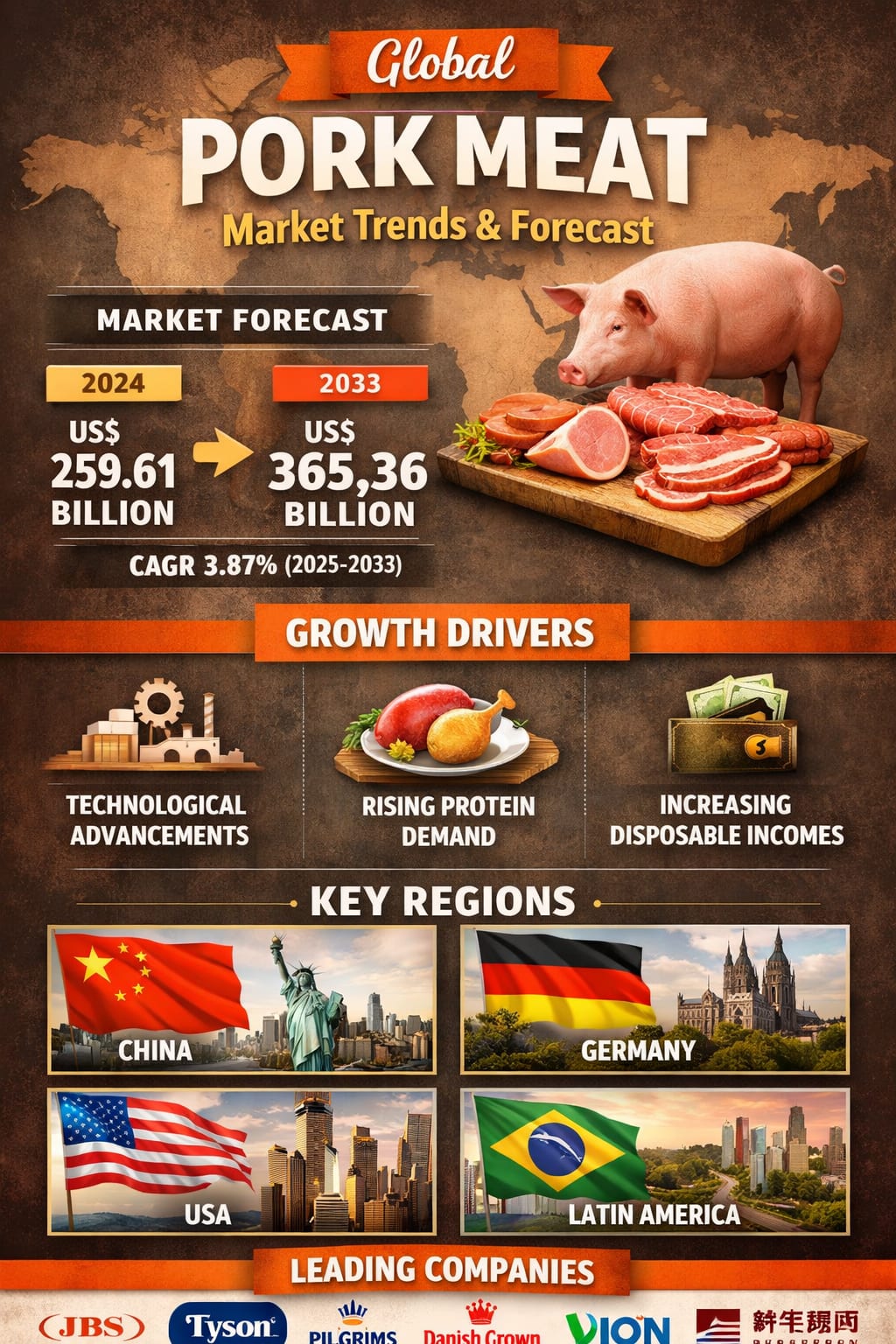
The global pork meat market continues to hold a vital position in the international food and agriculture economy, supported by rising protein demand, expanding middle-class populations, and continuous improvements in production and processing technologies. According to Renub Research, the Pork Meat Market is expected to reach US$ 365.36 billion by 2033, growing from US$ 259.61 billion in 2024, registering a compound annual growth rate (CAGR) of 3.87% from 2025 to 2033.
This steady expansion reflects more than just population growth. It signals changing dietary preferences, higher disposable incomes in emerging economies, and the modernization of global meat supply chains. Pork remains one of the most widely consumed meats worldwide due to its affordability, versatility, and high nutritional value. From traditional household meals to large-scale commercial foodservice operations, pork continues to be a core protein source across many cultures and cuisines.
At the same time, the industry is navigating complex challenges, including price volatility, ethical and animal welfare concerns, and regional consumption differences driven by cultural and religious factors. Together, these forces are shaping a market that is both resilient and rapidly evolving.
Pork Meat Industry Overview
Pork, derived from domesticated pigs, is one of the most consumed meats globally, valued for its rich nutritional profile and culinary adaptability. It is a significant source of high-quality protein, essential amino acids, and vital micronutrients such as iron and vitamin B12. Popular cuts include bacon, ham, ribs, pork belly, and tenderloin, each used in a wide variety of cooking methods ranging from grilling and roasting to frying and slow cooking.
Beyond its role in everyday diets, pork plays an important part in international trade and agricultural economies. Many countries rely on pork production as a major contributor to their livestock and food processing sectors. However, consumption patterns vary widely across regions. While pork is a dietary staple in large parts of Asia and Europe, it is less consumed in regions with sizable Muslim and Jewish populations due to religious dietary restrictions.
The global pork industry has also benefited from advances in breeding, farming, and processing technologies. These innovations have improved productivity, enhanced animal health, and helped ensure a more stable supply of pork products. At the same time, expanding urban populations and improving distribution networks have made pork more accessible to consumers across both developed and developing markets.
Key Growth Drivers for the Pork Meat Market
1. Technological Advancements in Production and Processing
Technology is playing a central role in transforming the pork industry. Improvements in feed formulations, genetic selection, and breeding techniques have led to healthier pigs, faster growth rates, and higher feed efficiency. Modern farm management systems, supported by data analytics and automation, are helping producers optimize operations, reduce waste, and improve overall productivity.
On the processing side, innovations in refrigeration, packaging, and preservation technologies have extended shelf life and improved product quality. These advancements not only reduce losses across the supply chain but also enable producers to reach distant export markets more effectively. By lowering costs and increasing efficiency, technology continues to strengthen the competitiveness of pork in both domestic and international markets.
2. Rising Global Demand for Protein
One of the most powerful forces behind the growth of the pork meat market is the rising global demand for protein. As the world’s population grows and urbanization accelerates, consumers—particularly in emerging economies—are seeking affordable and accessible sources of animal protein. Pork, often priced lower than beef or lamb, has become a preferred choice for many households.
In addition to affordability, pork is valued for its taste, versatility, and nutritional benefits. It fits easily into a wide range of cuisines and meal formats, from traditional dishes to processed and ready-to-eat foods. As dietary preferences in many regions continue to shift toward higher protein intake, pork consumption is expected to remain on a steady upward trajectory.
3. Increasing Disposable Incomes in Emerging Economies
Rising disposable incomes, especially in Asia and Latin America, are another major driver of market growth. As consumers gain greater purchasing power, they tend to diversify their diets and increase their intake of animal-based proteins. Pork, being relatively economical compared to other meats, often becomes one of the first beneficiaries of this shift.
Improving living standards also fuel demand for value-added and processed pork products, such as sausages, bacon, and ready-to-cook meals. This trend is particularly visible in urban areas, where busy lifestyles and changing consumption habits are boosting demand for convenient and protein-rich food options.
Challenges Facing the Pork Meat Market
1. Ethical and Animal Welfare Concerns
Ethical considerations and animal welfare issues are becoming increasingly important in the global pork industry. Consumers are more aware of how their food is produced and are raising concerns about intensive farming practices, animal confinement, and slaughter methods. This has led to growing pressure on producers to adopt more humane, transparent, and sustainable farming practices.
While these changes can improve brand reputation and consumer trust, they also often involve higher production costs. Balancing ethical responsibility with economic competitiveness remains a key challenge for pork producers worldwide.
2. Price Volatility and Supply Chain Risks
Price volatility is another significant concern for the pork market. Fluctuations in feed prices, labor costs, and energy expenses can directly impact production costs and, ultimately, consumer prices. In addition, supply disruptions caused by disease outbreaks or climate-related events can lead to sudden shortages, further increasing price instability.
This volatility affects both producers and consumers, making it harder to plan investments, manage costs, and maintain stable demand. In the long run, managing these risks through better supply chain planning and diversification will be crucial for the industry’s stability.
Regional Overview: A Market of Contrasts
The global pork meat market shows strong regional variations in both production and consumption. Asia, particularly China, remains the world’s largest consumer of pork, where it is a dietary staple and a central part of many traditional dishes. Europe also records high consumption levels, with countries such as Germany and Spain leading the market.
In North America, especially the United States, pork plays a major role in both domestic consumption and exports. Latin America is witnessing rising pork consumption due to urbanization and income growth, while the Middle East and parts of Africa show limited demand because of cultural and religious factors.
United States Pork Meat Market
The United States is one of the largest and most dynamic pork markets in the world. Pork is widely consumed domestically, with products such as bacon, ham, sausages, and ribs being particularly popular. At the same time, the U.S. is a major exporter, supplying pork to numerous international markets.
Technological advancements in farming and processing have helped U.S. producers increase productivity while maintaining high quality standards. The market has also seen notable mergers and acquisitions, highlighting the importance of scale, efficiency, and supply chain control. For instance, JBS SA’s acquisition of TriOak Foods in December 2022 strengthened its access to a consistent supply of high-quality pigs, while Benestar Brands’ purchase of 4505 Meats in February 2022 expanded its presence in protein-based snacks and pork rind products.
These strategic moves underline how companies are positioning themselves to meet evolving consumer demand and remain competitive in a changing market environment.
Germany Pork Meat Market
Germany is one of Europe’s largest pork markets, where pork remains the most popular meat among consumers. Traditional products such as sausages, schnitzels, and ham are deeply rooted in German food culture. The country’s pork industry is known for its advanced farming practices and strict quality standards, which support consistent and efficient production.
Germany is also a major exporter within Europe, supplying pork products to neighboring countries. However, sustainability and animal welfare concerns are becoming increasingly influential in shaping the market. As consumers demand more ethically produced meat, producers are investing more in sustainable farming methods and transparent supply chains.
China Pork Meat Market
China is the world’s largest consumer and producer of pork, making it a central player in the global market. Pork is a staple in Chinese cuisine and is used in a wide variety of traditional dishes, from dumplings to stews and stir-fries. The country’s large population, rising incomes, and rapid urbanization continue to drive strong demand.
Despite being a major producer, China also relies on imports to balance supply and demand, especially during periods of production disruption. The pork industry in China has deep historical roots and remains a critical part of the nation’s food security and agricultural economy.
Market Segmentation
By Product
Chilled
Frozen
By Application
Household
Commercial
By Distribution Channel
Supermarkets & Hypermarkets
Specialty Stores
Online
Others
By Countries
North America:
United States, Canada
Europe:
France, Germany, Italy, Spain, United Kingdom, Belgium, Netherlands, Turkey
Asia Pacific:
China, Japan, India, South Korea, Thailand, Malaysia, Indonesia, Australia, New Zealand
Latin America:
Brazil, Mexico, Argentina
Middle East & Africa:
Saudi Arabia, UAE, South Africa
Competitive Landscape and Company Analysis
The global pork meat market is highly competitive, with major players focusing on scale, efficiency, product diversification, and geographic expansion. Leading companies covered in the market include:
JBS S.A
Tyson Foods
Pilgrim’s Pride Corporation
Danish Crown Group
Vion Food Group
WH Group
Hormel Foods Corporation
Muyuan Foods
All key players are analyzed from four viewpoints: Overview, Key Persons, Recent Developments & Strategies, and Financial Insight. These companies continue to invest in processing capabilities, supply chain integration, and product innovation to strengthen their positions in both domestic and international markets.
Final Thoughts
The global pork meat market is on a stable and sustainable growth path, supported by rising protein demand, technological progress, and expanding consumer markets in emerging economies. With the market projected to grow from US$ 259.61 billion in 2024 to US$ 365.36 billion by 2033 at a CAGR of 3.87%, pork will remain a cornerstone of the global meat industry.
While challenges such as ethical concerns and price volatility persist, the industry’s ability to adapt through innovation, improved farming practices, and stronger supply chains will be key to long-term success. For producers, investors, and policymakers alike, the coming decade will be defined by a balance between growth, sustainability, and changing consumer expectations in the global pork meat market.
About the Creator
Keep reading
More stories from shibansh kumar and writers in Trader and other communities.
Antacids Market Trends & Summary: How Everyday Digestive Relief Is Becoming a Big Business
Introduction: Small Tablets, Big Market Impact In an age defined by fast food, stressful schedules, and increasingly sedentary lifestyles, digestive discomfort has become an almost universal complaint. Heartburn, acid reflux, indigestion, and related gastric issues are no longer occasional inconveniences—they are routine health concerns for millions of people worldwide. This everyday reality has quietly but steadily turned antacids into one of the most consistently demanded categories in over-the-counter (OTC) healthcare.
By shibansh kumar3 days ago in Trader
Allied Properties Stock Plunges 27% After Announcing $500 Million Equity Raise
Introduction Allied Properties Real Estate Investment Trust saw its shares tumble sharply after announcing plans to raise $500 million through an equity issuance. The stock dropped as much as 27% in a single session, reflecting investor concerns over dilution, balance sheet pressure, and the broader outlook for the commercial real estate sector. The steep sell-off highlights how sensitive markets remain to capital-raising announcements, particularly in an environment of higher interest rates and cautious sentiment toward property-related stocks.
By Hammad Nawaza day ago in Trader
Bartender
On the heels of grief, pain bears down hard. On the heels of death, pain awakens the quiet place between the end of our own life and now. Feeling anything is like seeing a film and in black and white, slow motion, all sound turned off. Just watching. Gritting teeth, awkward smiles and bloody red eyes move around, scanning the others who are feeling something I don't want to feel, but I do. Escapism is all I have ever known. ~
By ROCK aka Andrea Polla (Simmons)3 days ago in Poets




Comments
There are no comments for this story
Be the first to respond and start the conversation.