
Hair Care Products Market Trends & Summary
From Clean Beauty to Personalized Solutions: How the Global Hair Care Industry Is Reinventing Itself

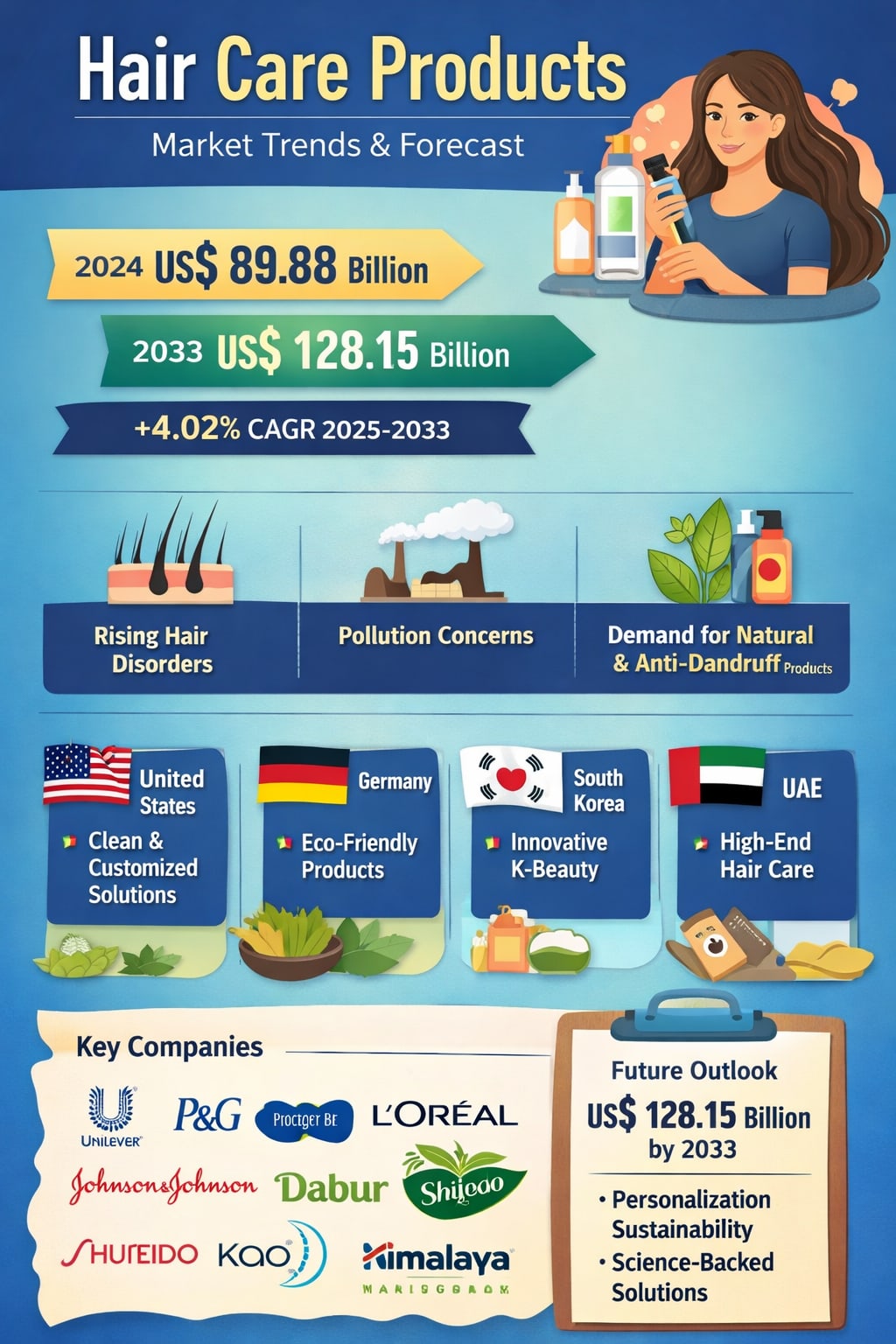
Global Hair Care Products Market Outlook
The Hair Care Products Market is on a steady growth trajectory, reflecting the world’s rising focus on personal grooming, wellness, and appearance. According to Renub Research, the market is expected to reach US$ 128.15 billion by 2033, up from US$ 89.88 billion in 2024, expanding at a CAGR of 4.02% from 2025 to 2033.
This growth is being driven by several converging forces: the rising prevalence of hair and scalp disorders, increasing awareness about the harmful effects of pollution, and a growing demand for anti-dandruff, natural, and ingredient-conscious formulations. In both developed and emerging economies, hair care has evolved from a basic hygiene routine into a lifestyle-driven, identity-focused, and results-oriented category.
Consumers today are no longer satisfied with one-size-fits-all solutions. They are actively seeking products that promise hydration, nourishment, scalp health, damage repair, and long-term hair vitality. This shift is reshaping product development, marketing strategies, and even the way brands communicate with their audiences.
Global Hair Care Products Industry Overview
The modern hair care industry sits at the intersection of beauty, wellness, and self-expression. Across the globe, consumers are becoming more conscious of how hair health connects with overall well-being. This has fueled demand for products that go beyond surface-level benefits and focus on scalp care, hair strength, and long-term nourishment.
One of the most powerful trends shaping the market is the rise of natural and organic ingredients. Shoppers are increasingly reading labels, avoiding harsh chemicals, and opting for products free from sulfates, parabens, and silicones. Clean beauty is no longer a niche—it has become a mainstream expectation.
Digital platforms are also playing a massive role. Beauty blogs, influencer reviews, and social media tutorials are influencing how consumers discover products and build personalized hair care routines. This has accelerated the demand for premium, customized, and problem-specific solutions, from anti-frizz serums to color-protection shampoos and scalp-soothing treatments.
In the United States, for example, the hair care sector continues to expand alongside growing interest in wellness and ingredient transparency. Consumers are increasingly prioritizing scalp health and long-term hair quality, pushing brands toward cleaner, more sustainable formulations. The scale of the industry is also reflected in employment: as of May 2023, around 294,840 professionals were working as cosmetologists, hairdressers, and hairstylists, underlining the strong service-oriented backbone of the market.
Another notable shift is the growing interest in sustainable formats, such as shampoo bars and water-activated concentrates, which reduce plastic waste and environmental impact. At the same time, brands are paying closer attention to diverse hair textures. With an estimated 65% to 75% of women globally having textured hair, there is rising demand for specialized products for curly, coily, wavy, and fine hair—often formulated with clean-label and naturally derived ingredients.
Growth Drivers for the Hair Care Products Market
Easy Access to Personalized Hair Care Items
No two people have the same hair. Differences in texture, thickness, scalp condition, and exposure to heat or chemicals mean that consumers increasingly look for solutions tailored to their specific needs. Whether it’s a moisturizing shampoo for dry hair, a serum for frizz control, or treatments for color-treated hair, personalization has become a key growth engine.
This trend is especially strong among consumers embracing their natural hair textures. For instance, data cited by the National Institutes of Health (NIH) shows that 94.9% of Africans have curly hair, while the percentage among Asians is significantly lower at around 12%. As awareness and acceptance of diverse hair types grow, so does the demand for texture-specific formulations, expanding the product landscape and encouraging innovation across brands.
Growing Concerns with Hair Health
Hair health has moved to the center of the beauty conversation. Today’s consumers are not just focused on how their hair looks, but also on how healthy it is from the root to the tip. This has increased demand for products that address scalp issues, hair fall, dandruff, and damage caused by pollution, stress, or styling practices.
The market is responding with more science-backed and clinically tested solutions. For example, Indian skincare brand Minimalist recently introduced a 3.5% anti-dandruff shampoo designed to tackle the root causes of dandruff while supporting long-term scalp health. Such launches reflect a broader industry shift toward problem-solving, treatment-oriented hair care, rather than purely cosmetic benefits.
Grooming Trends Driven by Celebrity and Influencer Culture
The global obsession with grooming, self-presentation, and personal branding has significantly boosted spending on hair care products. Social media platforms, beauty influencers, and celebrity culture constantly introduce new styles, routines, and product recommendations, shaping consumer preferences in real time.
Studies indicate that influencer branding has a strong correlation with purchase intent, increasing the likelihood of buying a product by nearly 90%. This influence-driven ecosystem encourages consumers to experiment with new products and routines, further accelerating market growth and intensifying competition among brands.
Challenges in the Hair Care Products Market
Ingredient Safety Concerns
As consumers become more informed, ingredient safety has emerged as a major challenge for the industry. Components like sulfates, parabens, and certain silicones—once widely used—are now under scrutiny for their potential links to scalp irritation, hair damage, and broader health or environmental concerns.
This shift has forced companies to reformulate products, invest in research and development, and adopt transparent labeling practices. While this transition builds consumer trust, it also increases costs and complexity for manufacturers, especially in highly regulated markets.
Intense Market Competition
The hair care sector is one of the most competitive segments within the beauty and personal care industry. Global giants, regional players, indie brands, and salon-exclusive labels are all competing for consumer attention. With new trends and products launching constantly, building long-term brand loyalty has become increasingly difficult.
To stand out, brands must offer more than just basic functionality. Sustainability, personalization, storytelling, and innovation are now critical differentiators. However, staying relevant in such a fast-moving market requires continuous adaptation and a deep understanding of evolving consumer expectations.
Regional Market Insights
United States Hair Care Products Market
The U.S. market is dynamic and trend-driven, shaped by strong demand for clean-label, natural, and customized solutions. Consumers are increasingly focused on ingredient transparency, scalp health, and long-term hair quality. Digital platforms and influencer marketing play a major role in shaping buying decisions, making branding and innovation essential for success.
Both established corporations and emerging indie brands are investing heavily in sustainability, ethical sourcing, and inclusive product lines to appeal to a diverse and values-driven consumer base.
Germany Hair Care Products Market
Germany’s hair care market is growing steadily, supported by rising health consciousness and a strong preference for eco-friendly and chemical-free products. Consumers are paying closer attention to packaging sustainability and ingredient safety, pushing brands toward greener alternatives.
E-commerce is also transforming the competitive landscape, allowing consumers to easily compare products and access a wider range of options. Brands that combine digital strategy, innovation, and sustainability are best positioned to thrive in this evolving market.
South Korea Hair Care Products Market
South Korea remains a global trendsetter in beauty and personal care. The hair care segment is expanding rapidly, driven by demand for multi-functional, high-performance products that address scalp health, hair loss, and nourishment in one routine.
Ingredients like ginseng, green tea, and herbal extracts are commonly used, reflecting a blend of traditional knowledge and modern science. With K-beauty continuing to influence global standards, South Korean brands are leading innovation while leveraging digital platforms and e-commerce to reach a sophisticated, health-conscious audience.
United Arab Emirates Hair Care Products Market
In the UAE, market growth is fueled by urbanization, rising disposable incomes, and increasing awareness of personal grooming. Consumers show strong interest in premium and specialized hair care products that enhance appearance and address specific concerns such as dryness, damage, and scalp health.
Social media platforms like Instagram and TikTok play a significant role in shaping trends and purchase decisions, making influencer-driven marketing a powerful force in this market.
Hair Care Products Market Segmentation
By Product Type (6 Categories):
Hair Oil
Shampoo
Conditioner
Hair Colorants
Hair Styling Products
Other
By Distribution Channel (5 Categories):
Supermarkets/Hypermarkets
Specialty Stores
Drug Stores
Online Stores
Other Distribution Channels
By Country (25 Markets Covered):
North America:
United States
Canada
Europe:
France
Germany
Italy
Spain
United Kingdom
Norway
Netherlands
Turkey
Sweden
Switzerland
Russia
Asia Pacific:
China
Japan
India
Australia
Korea
Israel
Latin America:
Brazil
Mexico
Argentina
Middle East & Africa:
South Africa
Saudi Arabia
UAE
Competitive Landscape and Company Analysis
All key players are analyzed across four perspectives:
Overview
Key Persons
Product Portfolio
Financial Insight
Major Companies Covered:
Unilever PLC
Procter & Gamble Company
L’Oréal S.A.
Johnson & Johnson
Dabur India Ltd
Natura & Co.
Shiseido Company, Limited
Oriflame Holding AG
Kao Corporation
Himalaya Global Holdings Ltd.
These companies are investing heavily in product innovation, clean formulations, sustainable packaging, and digital-first marketing strategies to strengthen their global presence and capture evolving consumer demand.
About the Creator
Tom Shane
Tom Shane is a content writer specializing in SEO-driven blogs, product descriptions, and thought leadership. He crafts engaging, research-backed content that connects with audiences and drives results.
India Wires and Cables Market Size and Forecast 2025–2033
India Wires and Cables Market Overview The India Wires and Cables Market is emerging as one of the most critical pillars supporting the country’s infrastructure, industrial, and digital transformation. According to Renub Research, the market is expected to reach US$ 15.41 billion by 2033, rising from US$ 8.97 billion in 2024, registering a CAGR of 6.20% from 2025 to 2033. This steady growth reflects India’s massive push toward urbanization, renewable energy integration, industrial expansion, and modernization of power and communication networks.
By Sakshi Sharma3 days ago in Trader



Comments
There are no comments for this story
Be the first to respond and start the conversation.