
Heart Pump Device Market Size and Forecast 2025–2033
Rising Cardiovascular Burden and Technological Innovation Propel a Double-Digit Growth Trajectory

The global healthcare landscape is undergoing a transformative shift as cardiovascular diseases (CVDs) continue to pose a formidable challenge. Against this backdrop, the Heart Pump Device Market is emerging as a critical lifeline for millions of patients worldwide.
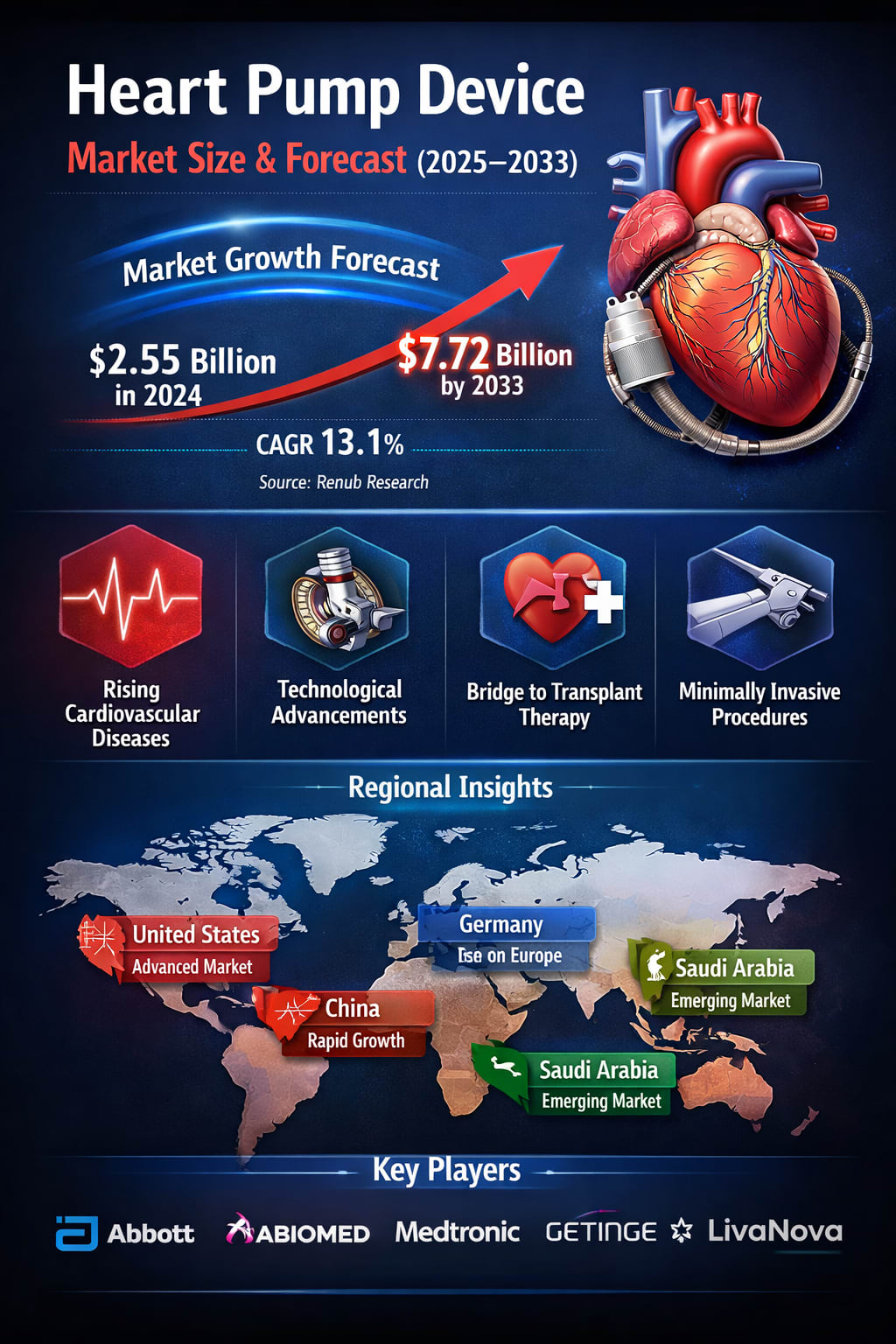
According to Renub Research, the Heart Pump Device Market is expected to reach US$ 7.72 billion by 2033 from US$ 2.55 billion in 2024, expanding at a CAGR of 13.1% from 2025 to 2033. This remarkable growth reflects not only the rising prevalence of heart failure but also continuous technological innovation, increasing awareness, and the expanding need for advanced cardiac support systems.
From life-saving ventricular assist devices (VADs) to total artificial hearts (TAHs), heart pump technologies are redefining cardiac care and improving survival rates globally.
Global Heart Pump Device Industry Overview
Heart pump devices are advanced mechanical systems designed to support or replace the pumping function of a failing heart. These devices include:
Ventricular Assist Devices (VADs)
Intra-aortic Balloon Pumps (IABPs)
Extracorporeal Membrane Oxygenation (ECMO) systems
Total Artificial Hearts (TAHs)
The rising burden of cardiovascular diseases is a primary growth catalyst. According to the British Heart Foundation (2024), approximately 620 million people worldwide — roughly 1 in 13 individuals — live with heart and circulatory disorders.
Regionally:
340 million people in Asia and Australia
100 million people in Europe
Additionally, around 200 million individuals globally suffer from coronary (ischemic) heart disease, making it the most common cardiovascular diagnosis. The report further highlights:
110 million affected men
80 million affected women
45 million men and 56 million women have survived stroke
13 million people live with congenital heart disease
Such staggering numbers underscore the urgent need for effective cardiac intervention technologies. Heart pump devices are increasingly being deployed not only for end-stage heart failure but also as monitoring and support tools to improve long-term prognosis.
Key Drivers Fueling Market Growth
1. Increasing Adoption of Mechanical Circulatory Support (MCS)
Mechanical circulatory support systems, particularly VADs, are gaining widespread acceptance. The shortage of donor hearts for transplantation has made these devices essential.
Data from the Scientific Registry of Transplant Recipients (SRTR) indicates that among adult patients listed for heart transplants (2016–2018):
56.2% received a transplant within one year
27.8% remained waiting
5.0% died
11.0% were removed from the list
After three years:
66.7% had received a transplant
7.8% were still waiting
6.3% had passed away
19.2% were removed
These statistics highlight the importance of bridge-to-transplant and destination therapy solutions. Mechanical heart pumps extend survival and significantly enhance quality of life.
2. Destination Therapy and Bridge-to-Transplant
Heart pump devices are increasingly used as:
Bridge-to-transplant (BTT) solutions
Destination therapy (DT) for non-transplant candidates
Over 6.5 million Americans aged 20+ suffer from heart failure, and approximately 960,000 new cases are diagnosed annually. This rising patient pool directly fuels demand for advanced cardiac support systems.
3. Technological Advancements and Miniaturization
Continuous innovation is reshaping the market. Modern devices are:
Smaller and more portable
Biocompatible and durable
Equipped with real-time monitoring systems
Integrated with remote data analytics
Companies such as Abbott Inc., ABIOMED, and JARVIK HEART, INC. are investing heavily in next-generation cardiac technologies.
Innovation in artificial heart systems and minimally invasive implantation techniques is expanding adoption across global healthcare systems.
Market Challenges
High Device and Procedure Costs
Heart pump devices are among the most sophisticated medical technologies available today. Their high cost stems from:
Advanced engineering and materials
Strict manufacturing standards
Complex surgical implantation
Long-term follow-up care
In low- and middle-income countries, affordability remains a significant barrier. Limited reimbursement policies and inadequate insurance coverage further restrict access.
Complex Surgical Requirements
Implantation procedures require:
Highly skilled cardiac surgeons
Advanced hospital infrastructure
Intensive postoperative monitoring
Rural and underdeveloped regions often lack such capabilities. Furthermore, complications such as infection, bleeding, and mechanical malfunction necessitate specialized training, slowing broader adoption.
Regional Insights
United States
The United States represents one of the most advanced and mature heart pump device markets globally. Factors supporting growth include:
High heart disease prevalence
Advanced surgical infrastructure
Favorable reimbursement frameworks
Strong R&D ecosystem
Major players such as Teleflex Incorporated and Fresenius SE & Co. KGaA contribute significantly to technological advancement.
An aging population and growing awareness of advanced cardiac therapies further strengthen market leadership.
Germany
Germany leads the European market, supported by a strong healthcare system and high CVD prevalence. According to the Deutscher Herzbericht 2022:
Coronary heart disease caused 121,172 deaths in 2021
Acute heart attacks accounted for 45,181 deaths
Germany’s commitment to medical research and innovation, alongside established cardiac care centers, ensures strong adoption of heart pump technologies.
China
China’s market is expanding rapidly due to:
Rising cardiovascular burden
Expanding healthcare infrastructure
Government-backed healthcare reforms
Local manufacturing initiatives
The Annual Report on Cardiovascular Health and Diseases in China (2021) estimates 8.9 million heart failure patients.
In March 2023, Yongrenxin Medical Instrument Co. Ltd. secured approximately US$ 100 million in Series A funding to develop advanced heart failure treatment platforms. This reflects growing domestic innovation and investor confidence.
Saudi Arabia
Saudi Arabia is witnessing notable growth in heart pump device adoption due to:
Increasing CVD prevalence
Government healthcare modernization initiatives
Collaborations between international and local medical device companies
As part of broader healthcare reforms under Vision 2030, access to advanced cardiac care technologies is expanding steadily.
Market Segmentation
By Product
Ventricular Assist Devices (VADs)
Intra-aortic Balloon Pumps (IABPs)
Extracorporeal Membrane Oxygenation (ECMO)
Total Artificial Hearts (TAHs)
VADs dominate the segment due to their widespread use in bridge-to-transplant and destination therapy applications.
By Type
Implanted Heart Pump Devices
Extracorporeal Heart Pump Devices
Implanted devices are witnessing stronger growth due to improvements in device longevity and patient mobility.
By End Use
Hospitals
Cardiac Centers
Research Institutes
Hospitals account for the largest market share owing to procedural complexity and need for intensive monitoring.
Competitive Landscape
The global heart pump device market is highly competitive and innovation-driven. Key companies include:
Abbott Inc.
Getinge AB
Teleflex Incorporated
Fresenius SE & Co. KGaA
LivaNova PLC
CorWave SA
JARVIK HEART, INC.
ABIOMED
These companies focus on:
Product innovation
Strategic partnerships
Regulatory approvals
Geographic expansion
AI-enabled monitoring systems
Ongoing R&D investments are shaping the next era of heart pump technologies, making devices more efficient, durable, and patient-friendly.
Future Outlook: A Decade of Transformative Growth
Between 2025 and 2033, the heart pump device market is poised for transformative expansion. Key growth themes include:
Expansion of minimally invasive surgical techniques
AI-driven remote cardiac monitoring
Development of fully implantable artificial hearts
Broader insurance coverage in emerging economies
Growth in Asia-Pacific healthcare infrastructure
As cardiovascular diseases continue to dominate global mortality statistics, heart pump technologies will remain central to life-saving interventions.
Final Thoughts
The Heart Pump Device Market represents more than just a rapidly expanding industry — it embodies hope for millions battling advanced heart failure.
With a projected surge from US$ 2.55 billion in 2024 to US$ 7.72 billion by 2033, growing at a robust 13.1% CAGR, the market reflects a confluence of urgent medical need, technological innovation, and healthcare modernization worldwide.
While challenges such as cost and procedural complexity persist, continuous advancements and global investment in cardiac care are narrowing accessibility gaps.
About the Creator
Keep reading
More stories from shibansh kumar and writers in Trader and other communities.
Global Vitamin K2 Market Size and Forecast (2025–2033)
Introduction: A Quiet Vitamin with a Powerful Market Story The global health and wellness industry is undergoing a profound transformation. Consumers today are no longer satisfied with reactive healthcare alone; instead, they are increasingly investing in preventive solutions that promise long-term vitality, better quality of life, and reduced risk of chronic disease. Within this shifting landscape, vitamin K2 has emerged as one of the most promising yet previously underappreciated nutrients.
By shibansh kumara day ago in Trader
Asia Pacific Non-Lethal Weapons Market Trends & Summary
Introduction: A Region Rethinking the Use of Force Across the Asia Pacific region, the conversation around public safety, law enforcement, and internal security is changing. Governments are under growing pressure to manage civil unrest, protests, and large public gatherings while minimizing casualties and long-term harm. This shift has brought non-lethal weapons into sharper focus as a practical and politically acceptable alternative to conventional firearms.
By Sakshi Sharma2 days ago in Trader



Comments
There are no comments for this story
Be the first to respond and start the conversation.