
How to Build Fintech Apps in Charlotte That Meet 2026 Banking Regulations?
Banking Apps Are No Longer Just Software — They Are Financial Infrastructure Operating Under Constant Scrutiny

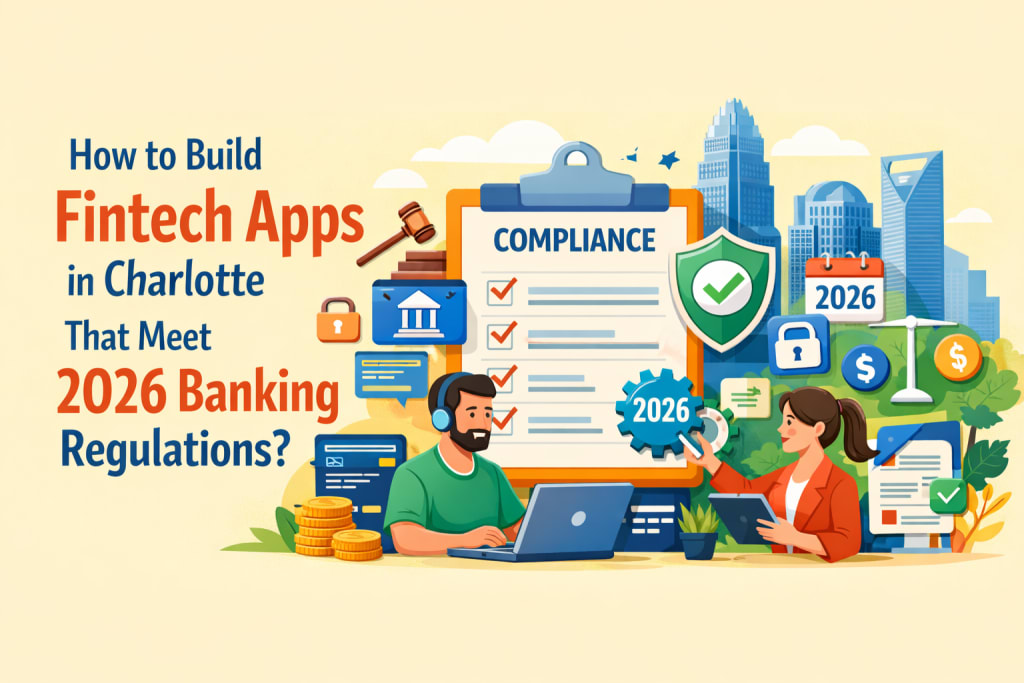
Open a modern fintech app and the experience feels almost effortless: instant payments, identity verification within seconds, automated budgeting tools that appear almost predictive. Behind that simplicity lies an environment shaped by intense regulatory attention. Financial technology no longer exists at the edges of banking; it sits at the center of economic activity, drawing interest from lawmakers, auditors, and financial institutions at an unprecedented level.
Charlotte, long known as one of the United States’ major banking hubs, has become a key arena where fintech innovation meets regulatory expectations. For startups building financial apps in 2026, success depends not only on strong engineering but on understanding how policy frameworks influence design decisions from the earliest planning stages.
The real challenge is not simply following rules. It involves designing products that align with compliance requirements while still delivering smooth, user-friendly experiences.
Why Charlotte’s Banking Environment Creates Unique Conditions for Fintech Builders
Charlotte hosts major financial institutions, regional banks, and an expanding fintech ecosystem. This concentration produces both opportunity and pressure. Access to banking partners and industry talent accelerates development timelines. At the same time, proximity to established financial players raises expectations around compliance and risk management.
Startups entering this environment often face closer scrutiny compared with companies operating in less regulated sectors. Banking partners may require detailed documentation covering security practices, customer identity verification, and transaction monitoring systems before integration even begins.
Reports from the Federal Reserve and industry analysts suggest that financial institutions increasingly rely on fintech collaborations to expand digital capabilities. That relationship pushes startups toward professional-grade compliance practices earlier than many founders anticipate.
The Shift Toward Embedded Compliance Within Product Architecture
In earlier years, regulatory planning often occurred late in development. Teams built core features first, then added compliance layers afterward. That sequence has largely disappeared.
Fintech builders now design compliance directly into system architecture. This includes:
- Automated identity verification workflows.
- Transaction monitoring mechanisms.
- Data audit trails that track system activity.
A Deloitte financial services study indicates that early compliance planning reduces delays during approval processes by a notable margin. Building compliance into initial architecture allows teams to move faster once regulatory reviews begin.
Charlotte’s banking environment reinforces this approach since partnerships with established institutions require clear evidence of regulatory readiness.
Identity Verification and KYC Requirements Shape User Experience
Know Your Customer (KYC) regulations form a central part of fintech development. These rules require platforms to verify user identity to prevent fraud and money laundering.
From a technical standpoint, KYC systems often involve:
- Document scanning using mobile cameras.
- Biometric checks such as facial recognition.
- Database verification against financial watchlists.
Designing these flows requires balancing security with user convenience. Research from Jumio shows that overly complicated verification steps can reduce onboarding completion rates by more than 20%.
The challenge involves creating identity checks that feel smooth while meeting regulatory expectations. Clear instructions, progress indicators, and transparent explanations help maintain user trust during verification processes.
Anti-Money Laundering Rules and Real-Time Transaction Monitoring
Anti-money laundering (AML) regulations require fintech platforms to monitor financial activity continuously. Algorithms analyze transaction patterns to detect suspicious behavior.
Developers must create systems capable of:
- Tracking transactions in real time.
- Flagging unusual patterns for review.
- Maintaining audit logs accessible for regulatory examination.
Charlotte’s strong banking presence means fintech startups often collaborate directly with institutions experienced in AML oversight. These partnerships influence how systems are structured, since integration with bank-level monitoring standards becomes essential.
Industry data suggests that financial institutions spend billions annually on compliance systems, reflecting the scale of responsibility placed on fintech platforms entering this space.
Data Security Expectations and the Rise of Zero-Trust Architecture
Financial apps manage sensitive information, making cybersecurity a central focus. Regulators expect platforms to maintain strong encryption practices, secure authentication methods, and detailed incident response plans.
Zero-trust security models have gained popularity, based on the principle that no user or device receives automatic trust without verification. This approach requires:
- Continuous authentication checks.
- Segmented system access.
- Monitoring user activity across platforms.
IBM security reports show that financial services remain among the most targeted industries for cyberattacks. Strong security architecture becomes both a regulatory requirement and a business necessity.
Designing secure systems early reduces the risk of costly redesigns later.
Open Banking and API Standards Influence Technical Decisions
Open banking frameworks encourage financial institutions to share data through secure APIs. This trend creates new opportunities for fintech innovation while introducing additional compliance considerations.
Developers building fintech apps must ensure API interactions follow:
- Authentication standards such as OAuth.
- Data encryption during transmission.
- Permission management allowing users to control data access.
Charlotte’s banking ecosystem encourages collaboration through structured API environments. Startups integrating with established banks must meet technical standards aligned with financial regulations.
Open banking also raises questions about data ownership and user consent, making transparency a core part of product design.
The Role of User Trust in Regulatory Alignment
Compliance does not exist solely for regulators; it also shapes user perception. Financial decisions involve risk, making trust a critical factor in adoption.
Design elements supporting trust include:
- Clear explanations of fees and transaction processes.
- Visible security indicators.
- Accessible customer support options.
Surveys from PwC indicate that consumers often choose financial apps based on perceived security rather than feature lists alone.
Building trust requires combining strong technical safeguards with communication strategies that help users understand how their data and funds remain protected.
Collaboration With Legal Teams and Compliance Officers
Fintech startups increasingly integrate legal and compliance professionals directly into product teams. Rather than reviewing products after development, these specialists participate during planning phases.
Their role includes:
- Interpreting regulatory updates.
- Evaluating risk exposure.
- Ensuring onboarding flows meet legal standards.
This collaborative approach reduces surprises during regulatory audits and helps teams anticipate future policy changes.
Charlotte’s financial community offers access to experienced compliance professionals familiar with banking regulations, giving startups a strategic advantage when building locally.
Designing for Scalability Under Regulatory Oversight
Growth introduces new regulatory challenges. A fintech app handling thousands of transactions daily must maintain monitoring systems capable of scaling alongside user growth.
Cloud infrastructure supports scalability, though teams must maintain compliance controls during expansion. Logging systems, audit trails, and reporting tools must remain consistent regardless of user volume.
Failure to plan for scalable compliance can lead to operational bottlenecks once growth accelerates.
Discussions around mobile app development Charlotte often highlight this balance between rapid expansion and regulatory responsibility.
Emerging Trends Influencing Fintech Regulation in 2026
Several developments shape how fintech platforms approach compliance today:
AI-Assisted Risk Analysis
Machine learning systems analyze transaction data to detect unusual behavior faster.
Digital Identity Frameworks
Governments and financial institutions explore standardized identity verification methods.
Consumer Data Rights Expansion
Users gain greater control over how financial data is shared across platforms.
Cross-Border Payment Standards
International transfers require coordination with multiple regulatory bodies.
Each trend influences how developers design both backend infrastructure and user-facing interfaces.
Balancing Innovation With Stability
Fintech thrives on experimentation. New payment models, lending tools, and financial planning features appear regularly. Regulatory frameworks aim to maintain stability while allowing innovation to continue.
Startups building in Charlotte must consider long-term sustainability alongside rapid growth. Aligning with regulatory expectations early can reduce friction during partnerships, funding rounds, and market expansion.
This balance between creativity and responsibility defines modern fintech development.
Final Reflection: Compliance as a Design Principle Rather Than an Obstacle
Building fintech apps under modern banking regulations requires a shift in mindset. Compliance should not appear as a final checklist applied after development. Instead, it functions as a guiding principle shaping architecture, workflows, and user experience.
Charlotte’s position as a major financial hub creates both opportunity and accountability. Startups operating within this environment gain access to industry knowledge while facing high standards for security and transparency.
The most successful fintech platforms treat regulation not as a barrier but as a framework guiding thoughtful design. When compliance aligns with usability and trust, financial apps become more than digital tools — they become reliable systems users depend on for daily financial decisions.
About the Creator
Australia MedTech Market Expected to Reach USD 13.9 Billion by 2033 on the Back of Demographic Shifts and Tech Innovation
The Australia MedTech market — encompassing a wide range of medical technologies, digital health solutions, diagnostic tools, and healthcare software — is poised for substantial expansion in the coming years. According to the IMARC Group, the market was valued at USD 8.48 billion in 2024 and is projected to grow to USD 13.90 billion by 2033, representing a compound annual growth rate (CAGR) of 5.10% from 2025 to 2033.
By Rashi Sharmaabout 17 hours ago in Trader
Google Stock Analysis: Is Alphabet Still a Dominant Force in the Digital Economy?
Introduction Google stock has long been considered a pillar of the technology sector, driven by its dominance in online search, digital advertising, and data-driven innovation. Operated under its parent company Alphabet Inc., Google has built a vast ecosystem that touches billions of users daily. For investors, Google stock represents exposure to the backbone of the modern digital economy, but questions remain about how future growth will evolve in an increasingly competitive and regulated environment.
By Hammad Nawaza day ago in Trader
The Tango Connection
I suppose I've become a writer so I wouldn't bore everyone to death telling them my stories. Reading them is reading. Not the same. There's rhythm. And timing and, most importantly, drama and suspense. Unless you have tremendous magnetism and an undeniable stage presence, there's no way you can engage an audience the way you can by writing your story. That's my opinion.
By Rene Volpi 4 days ago in Beat




Comments
There are no comments for this story
Be the first to respond and start the conversation.