
India Low Voltage Switchgear Market Size and Forecast 2025–2033
Rising Power Demand, Infrastructure Boom, and Smart Grid Adoption Set to Transform India’s Electrical Distribution Landscape

Introduction
India’s power and electrical infrastructure is going through a once-in-a-generation transformation. From rapid urbanization and industrial expansion to the government’s ambitious electrification and smart city programs, the demand for reliable, safe, and efficient electrical distribution systems is rising faster than ever. At the heart of this transformation lies a crucial but often overlooked component: Low Voltage (LV) switchgear.
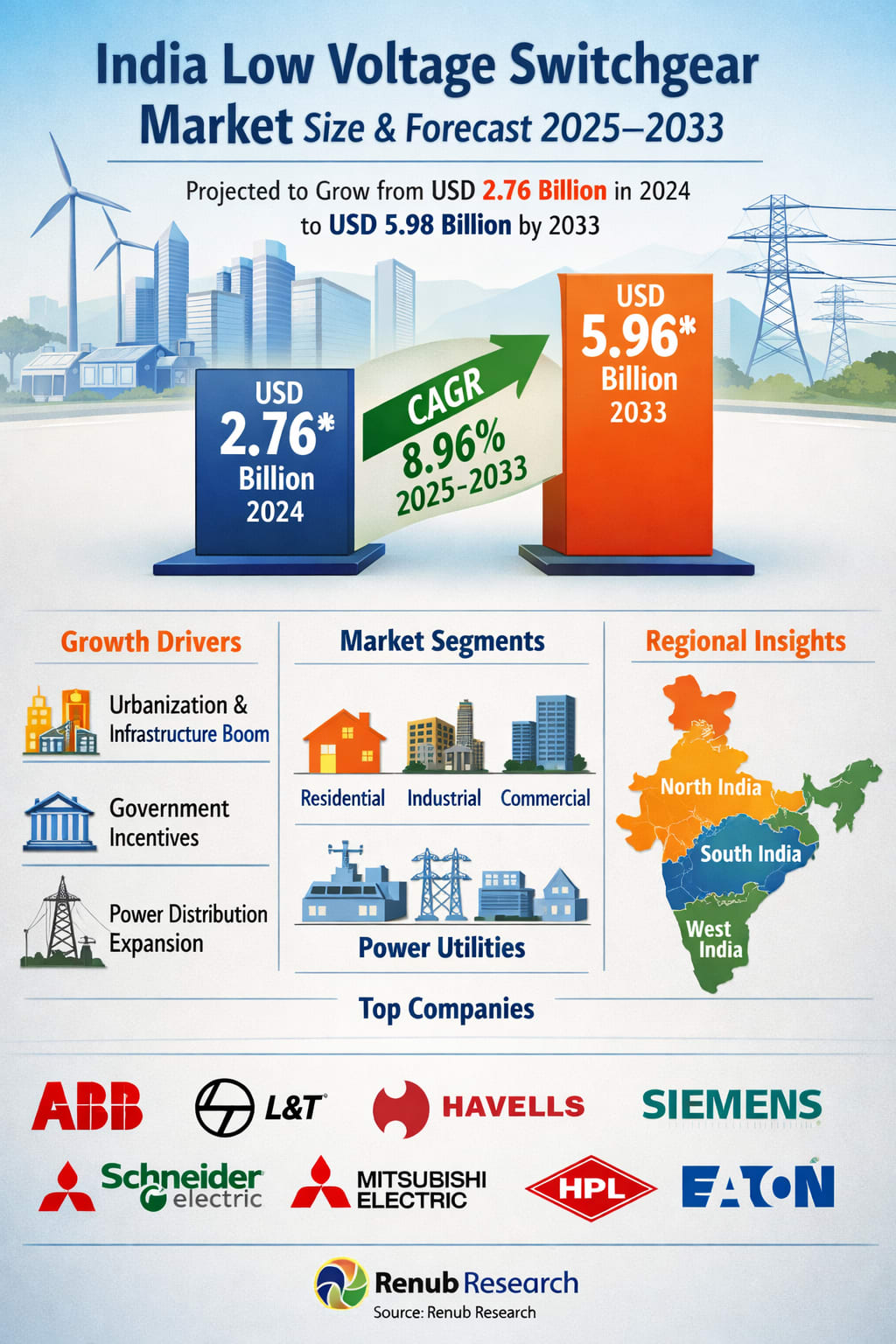
According to Renub Research, the India Low Voltage Switchgear Market is expected to reach US$ 5.98 billion by 2033, growing from US$ 2.76 billion in 2024, at a strong CAGR of 8.96% during 2025–2033. This impressive growth reflects the country’s accelerating investments in power distribution, infrastructure development, industrial automation, and renewable energy integration.
Low voltage switchgear—covering products such as circuit breakers, switches, distribution boards, and protection devices—plays a critical role in ensuring electrical safety, operational reliability, and efficient energy management across residential, commercial, industrial, and utility applications. As India’s electricity consumption continues to rise and its grid becomes more complex, the importance of modern, intelligent, and standards-compliant LV switchgear is only increasing.
India Low Voltage Switchgear Market Overview
Low voltage switchgear refers to electrical devices used to control, protect, and isolate electrical equipment operating at voltages below 1,000V. These systems include essential components such as MCBs (Miniature Circuit Breakers), MCCBs (Molded Case Circuit Breakers), ACBs (Air Circuit Breakers), RCDs (Residual Current Devices), distribution boards, switch disconnectors, and contactors & relays.
In India, LV switchgear is a backbone of the power distribution ecosystem. It is widely used across residential buildings, commercial complexes, industrial facilities, infrastructure projects, and power utilities. The sector’s growth is closely tied to the expansion of construction activity, industrial capacity, urban infrastructure, and electrification programs.
Several structural trends are reshaping the market. Rapid urbanization is increasing the demand for safe and reliable electrical installations in homes, offices, malls, data centers, and hospitals. Industrial growth is driving the adoption of more advanced switchgear systems to support automation, improve energy efficiency, and ensure operational safety. At the same time, the integration of renewable energy sources such as solar and wind into the grid is creating new requirements for flexible and responsive switchgear solutions.
Government-led initiatives such as “Power for All,” the Smart Cities Mission, AMRUT, and rural electrification programs are further accelerating demand. These programs require large-scale deployment of modern electrical distribution systems, where LV switchgear plays a central role.
Despite strong growth prospects, the market also faces challenges, including price competition from the unorganized sector, dependence on imported components, and a shortage of skilled installation and maintenance professionals. However, ongoing technological innovation, stricter safety standards, and rising awareness about electrical safety are expected to gradually shift demand toward higher-quality, branded, and technologically advanced switchgear solutions.
Key Growth Drivers of the India Low Voltage Switchgear Market
1. Urbanization and Infrastructure Development
One of the strongest growth engines for the LV switchgear market in India is the country’s rapid urbanization and massive infrastructure push. As cities expand and new urban centers emerge, the demand for reliable and efficient power distribution systems is increasing across residential, commercial, and industrial segments.
Government initiatives such as the Smart Cities Mission, AMRUT, and large-scale housing and infrastructure projects are accelerating the construction of smart buildings, metro rail systems, airports, industrial parks, and commercial hubs. All of these developments require modern electrical networks that prioritize safety, reliability, and energy efficiency.
Low voltage switchgear is a critical component in these systems, ensuring protection against overloads, short circuits, and electrical faults. As urban infrastructure becomes more technologically advanced and interconnected, the need for intelligent and compact switchgear solutions with monitoring and automation features is also growing.
2. Rising Government Incentives and Electrification Programs
Government policy support is playing a major role in expanding the LV switchgear market. Programs such as “Power for All,” rural electrification schemes, and the Smart Cities Mission are focused on improving access to reliable electricity and modernizing power distribution networks across the country.
The “Power for All” initiative aims to provide round-the-clock electricity to every household, which requires robust and safe electrical distribution infrastructure. Similarly, rural electrification programs are driving the installation of new distribution systems in underserved and remote areas, directly boosting demand for LV switchgear products.
In smart city projects, the emphasis on digital infrastructure, energy efficiency, and smart grid technologies is encouraging the adoption of advanced switchgear with features such as remote monitoring, automation, and predictive maintenance. Together, these policy-driven initiatives are creating sustained, long-term demand across residential, commercial, and industrial sectors.
3. Expansion and Modernization of Power Distribution Networks
India is investing heavily in upgrading and expanding its power transmission and distribution (T&D) infrastructure to reduce losses, improve reliability, and support growing electricity demand. Programs like the Integrated Power Development Scheme (IPDS) and Deendayal Upadhyaya Gram Jyoti Yojana (DDUGJY) are focused on strengthening both urban and rural power networks.
These upgrades require modern LV switchgear systems that offer higher safety standards, better performance, compact designs, and improved reliability. In addition, the increasing integration of distributed energy resources—such as rooftop solar systems—into the grid is creating a need for flexible and adaptive switchgear solutions that can handle variable loads and improve system resilience.
As India’s grid becomes more complex and decentralized, the role of intelligent and high-quality LV switchgear will become even more critical.
Challenges in the India Low Voltage Switchgear Market
1. Presence of the Unorganized Sector
One of the biggest challenges facing the Indian LV switchgear market is the strong presence of unorganized and small-scale manufacturers. These players often offer low-cost products that may not fully comply with established safety and quality standards.
While such products appeal to price-sensitive customers—especially in residential and rural markets—they can pose serious risks in terms of safety, reliability, and long-term performance. The widespread availability of cheaper, lower-quality products increases price competition and puts pressure on organized players to maintain margins without compromising on quality.
Over time, stricter regulations, greater awareness of electrical safety, and the growing complexity of electrical systems are expected to shift demand toward certified, branded, and technologically advanced products. However, in the short term, the unorganized sector remains a significant challenge.
2. Installation and Maintenance Challenges
Proper installation and regular maintenance are essential for the safe and efficient operation of LV switchgear systems. In India, a shortage of skilled technicians—particularly in tier 2 and tier 3 cities—often leads to improper installation, inadequate maintenance, and higher risks of system failures or electrical hazards.
Many installations are carried out by semi-skilled or untrained workers, increasing the likelihood of faults, downtime, and safety issues. In addition, limited awareness about the importance of preventive maintenance further reduces the lifespan and performance of switchgear equipment.
This skills gap not only affects operational reliability but also discourages some customers from investing in more advanced or higher-quality systems. Addressing this challenge will require greater focus on training, certification, and service network expansion by manufacturers and industry stakeholders.
Regional Market Insights
North India Low Voltage Switchgear Market
North India, including states such as Delhi, Haryana, Punjab, Uttar Pradesh, and Uttarakhand, represents a significant and fast-growing market for LV switchgear. Rapid urbanization, infrastructure development, and rising industrial activity are the primary drivers in this region.
The residential sector plays a major role, with strong demand for MCBs and distribution boards for safety and circuit protection. At the same time, commercial and industrial users are increasingly adopting advanced switchgear solutions to improve efficiency and comply with safety regulations.
With ongoing investments in infrastructure and real estate, demand for high-quality LV switchgear in North India is expected to remain strong over the forecast period.
South India Low Voltage Switchgear Market
South India, covering Tamil Nadu, Karnataka, Telangana, Andhra Pradesh, and Kerala, is one of the most dynamic markets for LV switchgear in the country. The region’s strong industrial base, thriving IT and manufacturing sectors, and rapid infrastructure growth are key growth drivers.
Residential demand remains strong, particularly for MCBs and distribution boards, while commercial and industrial users are increasingly shifting toward more sophisticated switchgear systems. The presence of major industrial hubs and technology parks further supports sustained demand.
As South India continues to attract investments in manufacturing, data centers, and infrastructure, the need for reliable and advanced LV switchgear solutions is set to rise steadily.
East India Low Voltage Switchgear Market
East India, including West Bengal, Odisha, Bihar, Jharkhand, and the northeastern states, is witnessing gradual but steady growth in the LV switchgear market. The region’s expanding industrial base—covering sectors such as steel, cement, food processing, and textiles—is a key growth driver.
Large infrastructure initiatives like the East Coast Economic Corridor (ECEC) and the development of major ports are further supporting industrial and energy infrastructure expansion. However, challenges such as higher upfront costs, lower awareness, and limited availability of skilled professionals in smaller cities continue to slow adoption.
Despite these constraints, government support for industrial development and energy efficiency is expected to drive wider adoption of LV switchgear across the region over time.
Market Segmentation Overview
By Product Type:
MCB
MCCB
C&R (Contactors & Relays)
ACB
DB (Distribution Boards)
RCD
SD (Switch Disconnectors)
Others (MPCB, COS)
By Application:
Residential
Commercial
Industrial
Power Utilities
Infrastructure & Transportation
By Region:
East India
West India
North India
South India
Competitive Landscape and Company Analysis
The India LV switchgear market features a mix of global giants and strong domestic players. Leading companies are focusing on product innovation, localization, service network expansion, and digital solutions to strengthen their market positions.
Key players covered include:
ABB India Ltd
Larsen & Toubro
Havells India
Siemens Limited
Schneider Electric SE
Mitsubishi Electric India
HPL Electric & Power Ltd
C & S Electric Ltd
Eaton Corporation Plc
These companies compete across multiple dimensions, including product quality, technology, pricing, distribution reach, and after-sales service. Increasingly, digitalization, energy efficiency, and smart switchgear solutions are becoming key differentiators in the market.
Final Thoughts
The India Low Voltage Switchgear Market is entering a high-growth phase, supported by strong fundamentals such as urbanization, infrastructure development, power sector modernization, and supportive government policies. With the market expected to grow from US$ 2.76 billion in 2024 to US$ 5.98 billion by 2033 at a CAGR of 8.96%, opportunities abound across residential, commercial, industrial, and utility segments.
While challenges such as the unorganized sector and skills shortages remain, the long-term outlook is clearly positive. As India’s electrical infrastructure becomes more advanced, interconnected, and safety-focused, demand for reliable, efficient, and intelligent LV switchgear solutions will continue to rise—making this market a vital pillar of the country’s energy and infrastructure future.
About the Creator
United States Luxury Handbag Market Size and Forecast 2025
United States Luxury Handbag Market Overview The United States luxury handbag market stood at US$ 10.77 billion in 2024 and is anticipated to grow to US$ 16.94 billion by 2033, expanding at a compound annual growth rate (CAGR) of 5.17% from 2025 to 2033. This steady rise reflects more than just a love for fashion—it highlights a deeper shift in how American consumers perceive luxury accessories: not only as style statements, but also as lifestyle markers and, in many cases, long-term investments.
By shibansh kumar4 days ago in Trader




Comments
There are no comments for this story
Be the first to respond and start the conversation.