
Japan Transmission Fluids Market Size and Forecast 2025–2033
How Hybridization, Advanced Transmissions, and Sustainability Goals Are Reshaping Japan’s Lubricants Landscape

Japan Transmission Fluids Market Overview
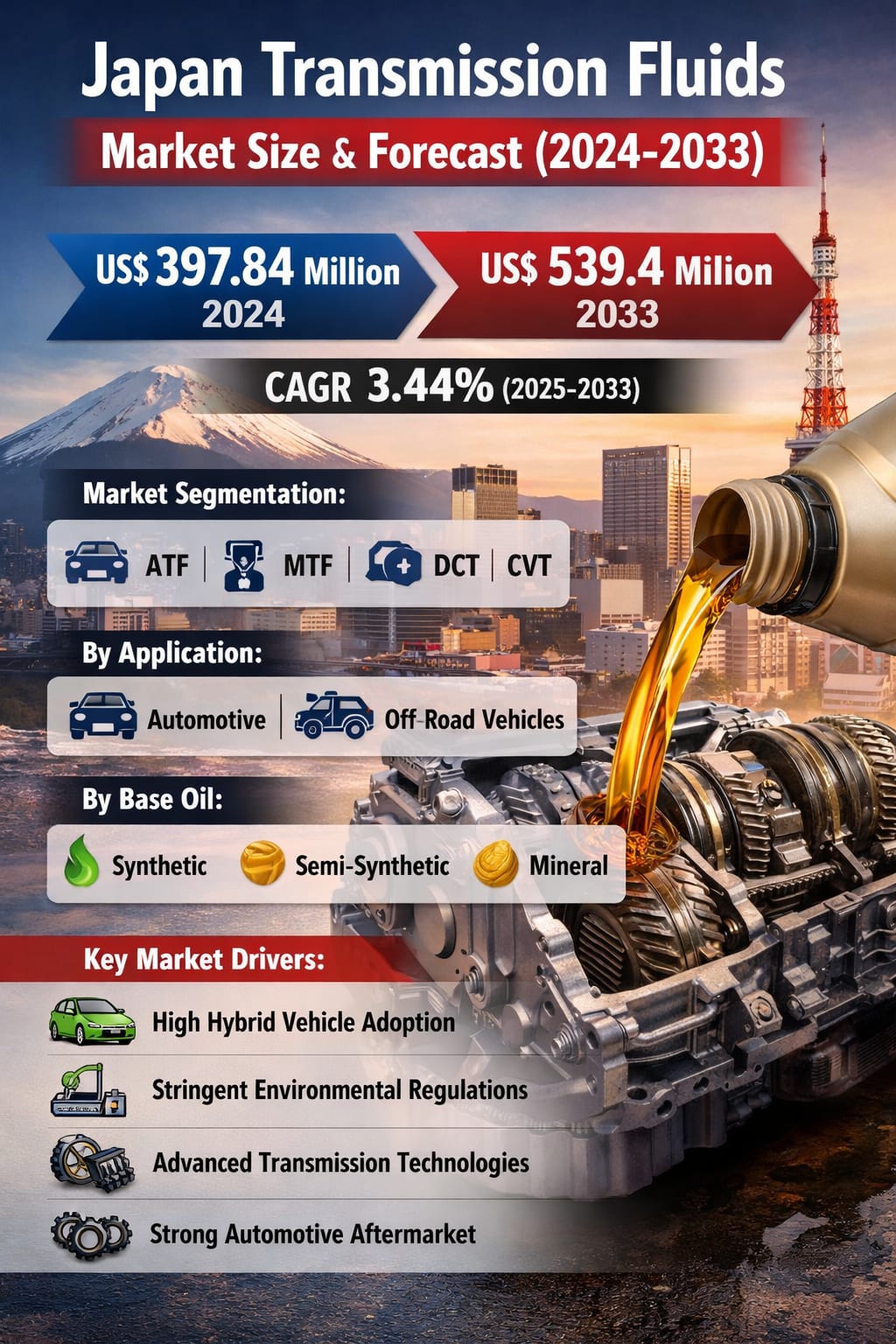
The Japan Transmission Fluids Market is projected to grow steadily, reaching US$ 539.4 million by 2033, up from US$ 397.84 million in 2024, expanding at a compound annual growth rate (CAGR) of 3.44% from 2025 to 2033. This growth reflects Japan’s continued leadership in automotive engineering, its high penetration of hybrid vehicles, and the increasing sophistication of modern transmission systems.
Transmission fluid is a critical lubricant that enables smooth power transfer from the engine to the wheels while protecting internal components from wear, corrosion, and overheating. Whether in automatic transmissions, manual gearboxes, continuously variable transmissions (CVTs), or dual-clutch transmissions (DCTs), the quality and performance of transmission fluid directly influence vehicle efficiency, durability, and driving comfort.
In Japan, where automotive manufacturing standards are among the highest in the world, the role of transmission fluids has evolved far beyond basic lubrication. Today’s fluids are engineered to deliver high thermal stability, low friction, oxidation resistance, and long service life, supporting both performance and environmental objectives.
The country’s strong focus on fuel efficiency, emission reduction, and vehicle reliability has created sustained demand for advanced transmission fluids, particularly synthetic and semi-synthetic formulations. At the same time, Japan’s large vehicle parc, combined with regular maintenance culture, ensures a stable aftermarket for transmission fluids across passenger cars, commercial vehicles, and off-road machinery.
Understanding Transmission Fluids in Modern Vehicles
Transmission fluids serve multiple functions within a vehicle’s drivetrain. They lubricate gears and bearings, cool internal components, clean and protect metal surfaces, and in automatic systems, they also act as a hydraulic medium to enable smooth gear shifts.
There are several major categories of transmission fluids used in Japan:
Automatic Transmission Fluids (ATF): Designed for traditional automatic gearboxes, offering precise friction control and thermal stability.
Manual Transmission Fluids (MTF): Used in manual gear systems, focusing on gear protection and smooth shifting.
Dual Clutch Transmission Fluids (DCT): Engineered for high-performance dual-clutch systems that operate under high temperature and pressure.
Continuously Variable Transmission Fluids (CVT): Specialized fluids required for CVTs, which are extremely common in Japanese vehicles.
With the increasing complexity of modern drivetrains, especially in hybrid and fuel-efficient vehicles, transmission fluids have become a strategic component rather than a simple consumable.
Japan Transmission Fluids Industry Landscape
Japan is home to some of the world’s most influential automotive manufacturers, including Toyota, Honda, Nissan, Subaru, and Mazda. These companies have played a major role in popularizing CVT and hybrid powertrains, both domestically and globally.
This technological leadership has a direct impact on the transmission fluids market. CVTs and advanced automatic systems require highly specialized, low-viscosity fluids that can withstand continuous stress while minimizing energy losses. As a result, lubricant producers operating in Japan are under constant pressure to innovate and refine formulations.
At the same time, Japan’s strong industrial base—covering construction equipment, agricultural machinery, and manufacturing systems—also contributes to steady demand for transmission fluids in off-road and industrial applications.
Leading lubricant companies such as Eneos, Idemitsu Kosan, Castrol, Shell, ExxonMobil, and others continue to invest in research and development to meet the evolving needs of Japanese automakers and equipment manufacturers. Their focus is not only on performance, but also on longer drain intervals, improved fuel economy, and lower environmental impact.
Key Factors Driving the Japan Transmission Fluids Market
1. High Penetration of Hybrid and Fuel-Efficient Vehicles
Japan is widely recognized as a global leader in hybrid vehicle adoption, with models like the Toyota Prius and Honda hybrid series becoming mainstream long before many other markets. Hybrid and fuel-efficient vehicles often rely heavily on CVT and advanced automatic transmissions, which demand precisely engineered fluids.
These systems require transmission fluids that offer low friction, high thermal stability, and consistent performance under variable loads. As hybrid vehicles continue to account for a significant portion of new vehicle sales in Japan, the demand for specialized transmission fluids remains strong and structurally supported.
2. Stringent Environmental and Fuel Economy Regulations
Japan’s environmental policies are among the strictest in the world, with a strong emphasis on reducing carbon emissions and improving fuel efficiency. Automakers are continuously optimizing powertrains to meet these targets, and transmission fluids play a crucial supporting role in this effort.
Low-viscosity and synthetic transmission fluids help reduce internal friction losses, contributing to better fuel economy and lower emissions. In response, lubricant manufacturers are increasingly focusing on eco-friendly, high-efficiency formulations that align with regulatory requirements and sustainability goals.
This regulatory environment not only sustains demand but also accelerates innovation within the transmission fluids market.
3. Technological Advancements in Transmission Systems
The widespread adoption of CVTs and DCTs in Japan has significantly changed the performance requirements for transmission fluids. These modern systems operate under higher temperatures, tighter tolerances, and more demanding conditions compared to older gearbox designs.
As a result, transmission fluids must deliver:
Superior wear protection
Excellent thermal and oxidation stability
Precise friction control
Long service life and reliability
The continuous evolution of transmission technology ensures that fluid innovation remains a priority, driving steady investment in research and development across the industry.
4. Strong Automotive Aftermarket and Maintenance Culture
Japanese consumers are known for their emphasis on regular vehicle maintenance and long-term reliability. This cultural factor supports a stable and recurring demand for transmission fluids in the aftermarket segment.
Even as new vehicle sales fluctuate, the large installed base of vehicles on Japanese roads ensures consistent replacement and servicing needs, providing a reliable foundation for market growth over the forecast period.
Challenges in the Japan Transmission Fluids Market
Intense Competition and Market Saturation
Japan’s transmission fluids market is highly competitive, with numerous well-established domestic and international brands competing for market share. This intense rivalry puts pressure on pricing and margins, while also raising the bar for product quality and differentiation.
For new entrants, breaking into the market is particularly challenging due to strong brand loyalty and long-standing relationships between automakers, service networks, and lubricant suppliers.
Regulatory Compliance and Cost Pressures
While strict environmental regulations support long-term sustainability, they also increase production and development costs. Creating compliant, high-performance formulations requires extensive testing, certification, and ongoing reformulation as standards evolve.
These cost pressures can be especially challenging for smaller manufacturers, making it difficult to compete with large, well-funded multinational players.
Market Segmentation Analysis
By Product Type
Automatic Transmission Fluids (ATF): Continue to hold a significant share due to the large number of automatic vehicles in operation.
Manual Transmission Fluids (MTF): Maintain steady demand, particularly in specific vehicle segments and industrial applications.
Dual Clutch Transmission Fluids (DCT): Growing in importance with the adoption of high-performance and efficiency-focused drivetrains.
Continuously Variable Transmission Fluids (CVT): A key growth segment, driven by Japan’s strong preference for CVT-equipped vehicles.
By Application
Automotive: The dominant segment, covering passenger cars, light commercial vehicles, and performance vehicles.
Off-Road Vehicles: Includes construction, agricultural, and industrial machinery, providing stable supplemental demand.
By Base Oil
Synthetic: The fastest-growing segment due to superior performance, longer service life, and compatibility with advanced transmissions.
Semi-Synthetic: Balances performance and cost, widely used across multiple vehicle categories.
Mineral: Still present, mainly in older vehicles and cost-sensitive applications, but gradually losing share to higher-performance alternatives.
Competitive Landscape and Company Analysis
The Japan transmission fluids market features a mix of global energy giants and specialized lubricant producers. Key companies covered in the market include:
BASF SE
BP P.L.C.
Chevron Corporation
Exxon Mobil Corporation
Fuchs Petrolub SE
Lukoil
PetroChina Company Limited (China National Petroleum Corporation)
Royal Dutch Shell Plc
Total SE
These companies compete on the basis of product performance, technological innovation, brand reputation, and strategic partnerships with automakers and service networks. Continuous investment in R&D, advanced additive technologies, and sustainable formulations remains a central theme across the competitive landscape.
Future Outlook: Where the Market Is Headed
Looking ahead to 2033, the Japan transmission fluids market is expected to maintain steady, resilient growth rather than explosive expansion. This reflects the market’s mature nature, but also its strong structural foundations in automotive innovation and maintenance demand.
Key trends likely to shape the future include:
Greater adoption of high-performance synthetic fluids
Continued dominance of CVT and advanced automatic transmissions
Increasing focus on fuel efficiency and emission reduction
Ongoing innovation in fluid chemistry to support next-generation drivetrains
Even as electric vehicles gradually gain share, hybrid vehicles and advanced internal combustion platforms will continue to play a major role in Japan’s mobility landscape throughout the forecast period, sustaining meaningful demand for specialized transmission fluids.
Final Thoughts
The Japan Transmission Fluids Market stands as a clear example of how engineering excellence, environmental policy, and automotive innovation intersect to shape an industrial segment. With the market projected to grow from US$ 397.84 million in 2024 to US$ 539.4 million by 2033, the outlook remains positive and stable.
Driven by hybridization, advanced transmission technologies, and a strong maintenance culture, transmission fluids in Japan are no longer just a supporting product—they are a critical performance enabler in the country’s automotive ecosystem. Companies that can balance performance, sustainability, and cost-efficiency will be best positioned to succeed in this competitive and technically demanding market over the coming decade.
About the Creator
Tom Shane
Tom Shane is a content writer specializing in SEO-driven blogs, product descriptions, and thought leadership. He crafts engaging, research-backed content that connects with audiences and drives results.
Chainlink (LINK) Market Dynamics, Oracle Technology, and Long-Term Investment Outlook
Introduction Chainlink is widely recognized as the leading decentralized oracle network in the cryptocurrency ecosystem. While many blockchain projects focus solely on smart contracts and decentralized applications, Chainlink addresses one of the most critical challenges in blockchain technology: secure and reliable data feeds from the outside world. This makes Chainlink an essential infrastructure project rather than a mere token for speculation. From an investment perspective, LINK offers exposure to an asset that is fundamental to the operation of a large portion of DeFi, NFT, and blockchain applications. Understanding its market dynamics, adoption, and risks is crucial before considering an allocation in a diversified crypto portfolio.
By Hammad Nawazabout 15 hours ago in Trader



Comments
There are no comments for this story
Be the first to respond and start the conversation.