
Mexico Microgrid Market Size and Forecast 2025–2033
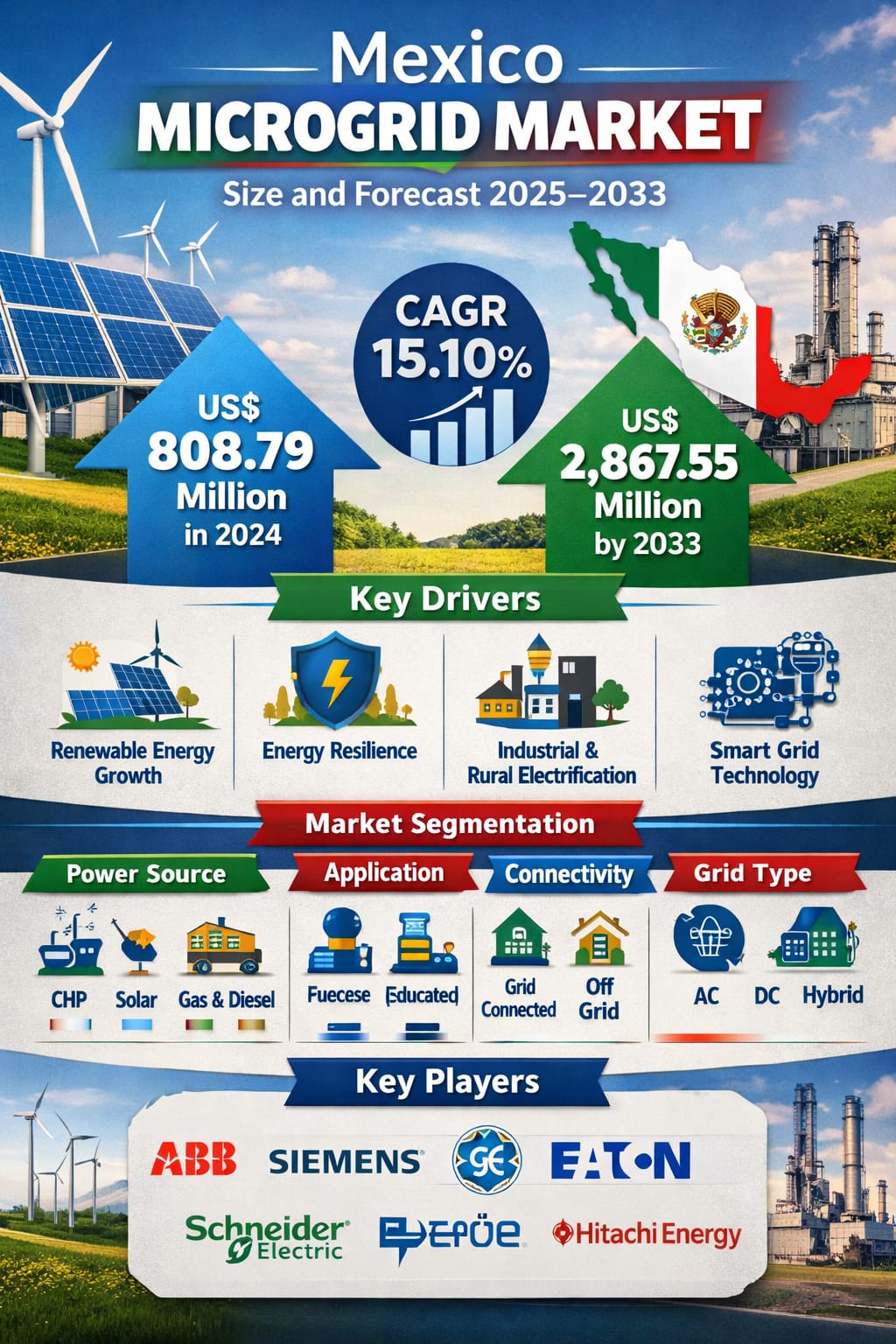
Mexico’s microgrid industry is entering a high-growth phase, driven by energy security needs, renewable integration, and grid modernization efforts, with the market projected to surge from US$ 808.79 million in 2024 to US$ 2,867.55 million by 2033.

Mexico Microgrid Market Overview
Mexico’s energy sector is undergoing a structural transformation, and microgrids are rapidly becoming one of its most strategic building blocks. According to Renub Research, the Mexico Microgrid Market is expected to reach US$ 2,867.55 million by 2033 from US$ 808.79 million in 2024, expanding at a robust CAGR of 15.10% from 2025 to 2033. This strong growth trajectory reflects a broader shift toward decentralized, resilient, and cleaner power systems across the country.
A microgrid refers to a localized energy system that can operate either independently or in coordination with the main power grid. It typically integrates multiple energy sources—such as solar photovoltaic (PV), wind turbines, natural gas generators, diesel backup systems, combined heat and power (CHP), and energy storage—along with advanced control systems. Microgrids are designed to serve a specific area such as a campus, industrial site, hospital, military base, or remote community, providing reliable and efficient electricity supply.
What makes microgrids especially valuable in Mexico is their ability to enhance energy resilience. The country has faced increasing pressure on its power infrastructure due to rapid urbanization, industrial growth, extreme weather events, and rising electricity demand. In this context, microgrids offer a practical solution by reducing dependence on centralized grids, lowering transmission losses, and ensuring continuity of operations during outages or emergencies.
Beyond reliability, microgrids also support Mexico’s long-term sustainability goals. With abundant solar and wind resources, the country is well positioned to expand renewable energy adoption. Microgrids make it easier to integrate these variable energy sources at a local level while improving efficiency through smart controls and storage technologies. As a result, microgrids are emerging as a cornerstone of Mexico’s transition toward a more decentralized, low-carbon, and digitally managed energy system.
Mexico Microgrid Industry Landscape
Mexico’s microgrid industry is being shaped by a combination of policy direction, technological progress, and real-world energy challenges. Government initiatives such as the National Energy Strategy and the Energy Transition Law have emphasized cleaner energy, grid modernization, and improved energy access—especially in rural and remote regions. These policy signals, even amid regulatory complexities, have helped create a long-term case for decentralized energy solutions.
The country’s geography and socio-economic structure further strengthen the case for microgrids. Mexico has vast rural and semi-remote areas where extending traditional grid infrastructure is expensive and slow. For these regions, off-grid or hybrid microgrids provide a cost-effective and reliable alternative for electrification. At the same time, urban and industrial centers are increasingly turning to grid-connected microgrids to improve reliability, manage peak loads, and reduce energy costs.
Another defining feature of Mexico’s microgrid market is the growing role of digitalization. Smart grid technologies, advanced metering infrastructure, real-time monitoring, and automated control systems are making microgrids more efficient, flexible, and easier to manage. These tools allow operators to balance supply and demand, optimize the use of renewable energy, and respond quickly to grid disturbances.
Together, these factors are creating a favorable environment for sustained growth in the microgrid sector, positioning Mexico as one of the more dynamic microgrid markets in Latin America over the coming decade.
Key Growth Drivers for the Mexico Microgrid Market
1. Rising Demand for Energy Resilience in Industrial and Commercial Sectors
One of the most powerful drivers of microgrid adoption in Mexico is the growing need for energy reliability in industrial and commercial operations. Sectors such as manufacturing, mining, data centers, healthcare, and large commercial facilities are highly sensitive to power interruptions. Even short outages can lead to significant financial losses, operational disruptions, and safety risks.
Mexico’s power system has faced increasing stress in recent years due to aging infrastructure, extreme heat waves, and surging electricity demand. In 2024, peak electricity demand in the country came very close to available generation capacity, and several states experienced power disruptions during periods of extreme heat. Such events have highlighted the vulnerability of centralized grids and strengthened the business case for decentralized energy solutions like microgrids.
Microgrids allow industrial and commercial users to maintain operations even when the main grid is unstable or unavailable. By combining on-site generation, energy storage, and intelligent controls, these systems can isolate from the grid and continue supplying critical loads. In addition, microgrids help optimize energy use, reduce peak demand charges, and improve overall energy efficiency.
As companies in Mexico place greater emphasis on business continuity, cost control, and operational resilience, investment in microgrids is expected to rise steadily across industrial parks, commercial campuses, and critical infrastructure facilities.
2. Growing Integration of Renewable Energy
Mexico’s rich solar and wind resources are another major force shaping the microgrid market. While renewable energy’s share in the national power mix has been growing, it still lags behind global averages, and the country faces the challenge of meeting its long-term clean energy targets while electricity demand continues to rise.
Microgrids provide an effective platform for integrating renewable energy at the local level. Solar PV, in particular, is becoming increasingly common in both urban and rural microgrid projects due to declining technology costs and favorable resource availability. When combined with battery storage and backup generation, renewable-based microgrids can deliver reliable, low-emission power around the clock.
Government policies such as the Energy Transition Law and net metering frameworks have further improved the economics of renewable-based microgrids. For commercial, agricultural, and community users, these systems offer a way to reduce energy bills, lower carbon footprints, and gain greater control over energy supply.
As technology costs continue to fall and energy storage performance improves, hybrid microgrids—combining solar, wind, storage, and conventional generation—are expected to become increasingly common across Mexico.
3. Technological Advancements in Storage and Smart Grids
Technological progress is playing a central role in accelerating microgrid deployment. One of the most important developments is the rapid improvement in energy storage technologies, especially lithium-ion batteries. These systems make it possible to store excess renewable energy and use it when generation is low or demand is high, addressing the intermittency challenge of solar and wind power.
At the same time, smart grid technologies—including advanced sensors, communication systems, and real-time control software—are transforming how microgrids are designed and operated. These tools enable precise load management, predictive maintenance, and automated responses to grid disturbances, significantly improving system reliability and efficiency.
Hybrid microgrid architectures, which combine renewable energy sources with conventional generators and storage, are also becoming more sophisticated. This flexibility allows system operators to optimize performance based on fuel prices, weather conditions, and demand patterns, making microgrids more economically attractive and technically robust.
Together, these innovations are reducing operational risks, improving return on investment, and making microgrids a more mainstream solution in Mexico’s energy landscape.
Challenges Facing the Mexico Microgrid Market
High Initial Capital Costs
Despite their long-term benefits, microgrids require significant upfront investment. Costs associated with solar panels, wind turbines, energy storage systems, control software, and grid integration infrastructure can be substantial. For many potential users—especially in rural or economically disadvantaged areas—access to affordable financing remains a major barrier.
While microgrids can deliver savings over time through reduced fuel costs, lower outage-related losses, and improved efficiency, the initial capital burden can delay or limit project development. The lack of widely available financial incentives and tailored financing mechanisms further slows adoption in some segments of the market.
Regulatory and Policy Uncertainty
Another challenge is regulatory and policy uncertainty. Changes in energy policy, permitting procedures, and market rules can affect investor confidence and project timelines. Clear, stable, and supportive regulatory frameworks are essential for encouraging long-term investment in microgrid infrastructure.
Uncertainty around grid interconnection rules, tariff structures, and the role of private investment in the power sector can create additional complexity for developers and end users. Addressing these issues through transparent and consistent policies will be critical for unlocking the full potential of Mexico’s microgrid market.
Mexico Microgrid Market Segmentation
According to Renub Research, the Mexico Microgrid Market is segmented across several key dimensions:
By Power Source
CHP
Natural Gas
Solar PV
Diesel
Fuel Cell
Others
Solar PV and hybrid configurations are expected to see strong growth due to declining costs and sustainability goals, while natural gas, diesel, and CHP continue to play important roles in ensuring reliability and backup power.
By Application
Education
Government
Commercial
Utility
Defense
Others
Commercial and industrial applications are among the fastest-growing segments, driven by the need for reliability, cost optimization, and sustainability compliance.
By Connectivity
Grid Connected
Off Grid
Grid-connected microgrids are gaining traction in urban and industrial areas, while off-grid systems remain crucial for remote and rural electrification.
By Grid Type
AC Microgrid
DC Microgrid
Hybrid
Hybrid microgrids are increasingly popular due to their flexibility and ability to integrate multiple energy sources and loads efficiently.
Competitive Landscape and Key Players
The Mexico microgrid market features a mix of global technology leaders and energy solution providers focusing on system integration, automation, and digital energy management. Key players analyzed in the market include:
ABB
Siemens AG
General Electric
Eaton Corporation
Exelon Corp.
Honeywell International Inc.
Schneider Electric SE
Hitachi Energy Ltd
These companies are competing on the basis of technology innovation, system reliability, digital capabilities, and end-to-end energy solutions. Their strategies typically focus on expanding microgrid portfolios, investing in smart grid and storage technologies, forming partnerships, and supporting customers with integrated energy management platforms.
Renub Research evaluates these companies across four main perspectives:
Company Overview
Key Persons
Recent Developments & Strategies
Sales Analysis
This competitive activity is helping to accelerate technology adoption and improve the overall maturity of the microgrid ecosystem in Mexico.
Outlook: The Road to 2033
With the market projected to grow from US$ 808.79 million in 2024 to US$ 2,867.55 million by 2033, Mexico’s microgrid sector is clearly entering a phase of rapid expansion. The combination of rising energy demand, increasing focus on resilience, strong renewable energy potential, and continuous technological progress creates a solid foundation for long-term growth.
While challenges related to capital costs and regulatory clarity remain, the overall direction is clear: microgrids will play an increasingly central role in Mexico’s energy transition. They offer a practical way to modernize infrastructure, improve reliability, support sustainability goals, and extend energy access to underserved regions.
Final Thoughts
The Mexico Microgrid Market stands at the intersection of energy security, sustainability, and digital transformation. As the country navigates the pressures of economic growth, climate change, and infrastructure modernization, microgrids provide a flexible and forward-looking solution. With strong growth forecasts from Renub Research and increasing interest from both public and private sectors, microgrids are set to become a defining feature of Mexico’s power landscape through 2033 and beyond.
About the Creator
infosys share price today: should investors buy or wait?
The infosys share price is grabbing attention today. After recent ups and downs, investors are asking whether it is the right time to buy or hold. Understanding the reasons behind its movement is key for making informed decisions. This article examines the current infosys share price trend, expert opinions, key factors influencing the stock, and strategies for investors. By reading this, you can get a clear view of the market situation.
By John.doe7984 days ago in Trader
Australia Hormone Replacement Therapy Market Size and Forecast 2025–2033
Australia Hormone Replacement Therapy Market Outlook The Australia Hormone Replacement Therapy (HRT) Market is entering a phase of steady and meaningful expansion, reflecting broader shifts in healthcare awareness, demographic change, and therapeutic innovation. According to Renub Research, the market is expected to reach US$ 725.13 million by 2033, up from US$ 417.36 million in 2024, growing at a compound annual growth rate (CAGR) of 6.33% from 2025 to 2033.
By shibansh kumarabout 24 hours ago in Trader
Goodbye, Mr. Duvall
It is turning out to be an interesting year. I was in the middle of teaching a class when a pop-up appeared on the screen announcing the death of Mr. Robert Seldon Duvall (yes, that was his full name). I was in the middle of a discussion on the obsession we have with winning when it comes to sports (the Winter Olympics was a theme), and I felt as though things were coming full circle. We had already lost Gene Hackman last year, and along with that titan, it feels though one particular golden age has closed off to be replaced by...?
By Kendall Defoe 4 days ago in Geeks



Comments (1)
Really nice