
Mexico UPS Market Size and Forecast 2025–2033: Powering a Digitally Resilient Economy
Rising data centers, digital transformation, and critical infrastructure investments are driving steady demand for uninterruptible power supply systems across Mexico.

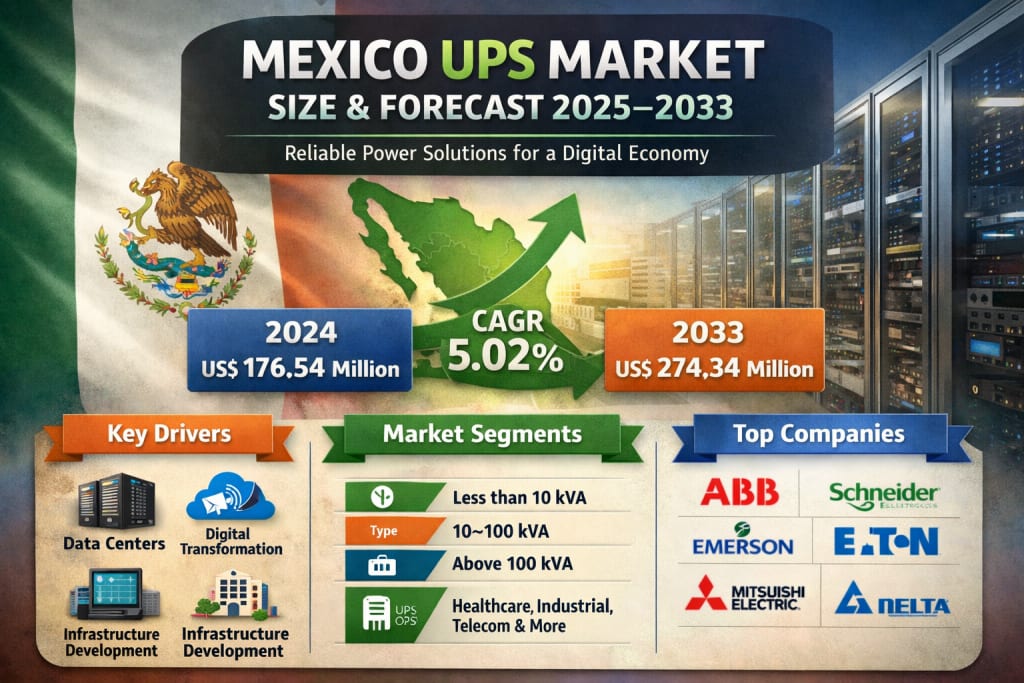
Mexico UPS Market Overview
Mexico’s Uninterruptible Power Supply (UPS) market is entering a phase of steady and strategic growth, supported by the country’s accelerating digital transformation, expanding industrial base, and rising dependence on mission-critical infrastructure. According to Renub Research, the Mexico UPS Market is expected to reach US$ 274.34 million by 2033, up from US$ 176.54 million in 2024, growing at a CAGR of 5.02% from 2025 to 2033. This trajectory reflects a broader structural shift in the Mexican economy, where uninterrupted power is no longer a luxury but a necessity.
UPS systems play a crucial role in protecting sensitive equipment and ensuring operational continuity during power outages, voltage fluctuations, and grid instability. In a country where digital services, manufacturing automation, healthcare systems, and telecommunications networks are becoming increasingly sophisticated, the importance of reliable power backup solutions continues to rise.
The Mexican market is being shaped by several long-term trends. The rapid expansion of data centers, growth in cloud computing and e-commerce, modernization of healthcare facilities, and adoption of Industry 4.0 technologies in manufacturing are all fueling demand for dependable power protection systems. At the same time, government initiatives aimed at improving digital connectivity and infrastructure resilience are reinforcing the strategic relevance of UPS systems across both public and private sectors.
While challenges such as high upfront costs, supply chain dependencies, and environmental compliance requirements persist, technological innovation in battery systems, energy efficiency, and remote monitoring is making modern UPS solutions more attractive and accessible. As Mexico continues its journey toward a more digital and industrially advanced economy, the UPS market is set to remain a critical enabler of stability, productivity, and business continuity.
The Strategic Importance of UPS in Mexico’s Evolving Economy
Mexico’s economic landscape is undergoing a fundamental transformation. Traditional manufacturing is increasingly being complemented by advanced automation, digital platforms, and data-driven operations. In this environment, even short power interruptions can lead to significant financial losses, operational disruptions, and reputational damage.
UPS systems serve as a critical insurance policy against such risks. They ensure seamless power supply to servers, medical equipment, telecommunications networks, and industrial control systems, allowing organizations to continue operations or safely shut down systems during outages. For sectors like healthcare and data centers, where reliability can be a matter of life, safety, or massive financial exposure, UPS solutions are not optional—they are essential infrastructure.
Moreover, Mexico’s growing integration into global supply chains has increased the importance of operational reliability. Multinational corporations operating in the country expect international standards of uptime and power quality, further driving demand for high-performance UPS systems across commercial and industrial facilities.
Expansion of Data Centers: A Core Growth Engine
One of the most powerful drivers of the Mexico UPS market is the rapid expansion of data centers. Mexico is increasingly being positioned as a strategic hub for data infrastructure in Latin America, thanks to its proximity to the United States, improving connectivity, and growing domestic demand for digital services.
Major global technology companies and colocation providers are investing heavily in new data center facilities, particularly in regions such as Querétaro, which is fast emerging as a technology and data hub. These facilities require highly reliable and scalable power protection systems to ensure uninterrupted service delivery, protect critical data, and meet strict uptime requirements.
High-capacity UPS systems, often combined with advanced battery storage and energy management solutions, are becoming standard components of modern data centers. As cloud computing, streaming services, financial technology platforms, and enterprise IT outsourcing continue to grow, the demand for robust power backup infrastructure is expected to rise in parallel.
This trend alone is creating long-term, stable demand for UPS systems across multiple capacity ranges, from medium-scale installations to large, mission-critical power protection setups.
Digital Transformation and Cloud Adoption
Mexico’s digital transformation is no longer limited to large corporations. Small and medium-sized enterprises, government agencies, educational institutions, and healthcare providers are increasingly adopting cloud-based platforms, digital payment systems, and online service delivery models.
This shift is significantly increasing the number of servers, networking devices, and digital endpoints that require reliable power protection. Even brief voltage fluctuations or outages can disrupt operations, compromise data integrity, and damage sensitive hardware.
UPS systems are therefore becoming a foundational element of modern IT infrastructure. Businesses are not only investing in basic backup power solutions but also in smarter UPS systems with features such as remote monitoring, predictive maintenance, and energy optimization.
The rise of smart cities, Internet of Things (IoT) applications, and digital public services further reinforces this trend. As more critical services move online, the tolerance for downtime continues to shrink, making UPS adoption a strategic priority rather than a reactive purchase.
Government Initiatives and Infrastructure Development
The Mexican government’s focus on infrastructure modernization is another important factor supporting the UPS market. Investments in telecommunications, including 5G rollout, broadband expansion, and smart grid projects, are increasing the number of facilities that depend on stable and high-quality power supply.
Public sector institutions such as hospitals, universities, administrative centers, and transportation systems are also upgrading their digital capabilities. These upgrades require reliable power backup systems to ensure continuity of essential services, particularly during emergencies or grid disturbances.
In addition, Mexico’s broader push toward industrial competitiveness and nearshoring is encouraging the development of advanced manufacturing facilities. These facilities rely heavily on automated systems, robotics, and digital controls, all of which are highly sensitive to power quality issues. UPS systems are therefore becoming a standard component of new industrial projects and infrastructure upgrades.
Challenges Facing the Mexico UPS Market
Supply Chain Disruptions and Import Dependence
Despite its positive outlook, the Mexico UPS market faces notable challenges, particularly related to supply chains. The industry remains heavily dependent on imported components such as batteries, semiconductors, and electronic control systems. Global supply chain disruptions, geopolitical tensions, and logistics bottlenecks can directly impact product availability, delivery timelines, and pricing.
Currency fluctuations also play a role, as changes in exchange rates can increase the cost of imported components, putting pressure on manufacturers and distributors. Regulatory procedures and customs clearance processes can further add to delays and uncertainty.
To ensure long-term stability, there is a growing need for greater localization of supply chains and stronger regional manufacturing capabilities. However, building such capacity requires time, investment, and supportive industrial policies.
Energy Efficiency and Environmental Compliance
Another important challenge is the increasing emphasis on energy efficiency and environmental sustainability. Regulatory standards are becoming stricter, pushing manufacturers to develop greener and more efficient UPS systems.
While this trend is positive from a long-term sustainability perspective, it also increases research and development costs and may require redesigning existing product lines. For companies operating in the low-cost segment, meeting these standards without significantly increasing prices can be particularly challenging.
Certification processes, compliance testing, and the use of more advanced materials can also add to production costs. Nevertheless, in a market that is increasingly focused on total cost of ownership and environmental impact, energy-efficient UPS systems are likely to gain a competitive advantage over time.
Market Segmentation: Understanding Demand Patterns
By Capacity
The Mexico UPS market is segmented by capacity into:
Less than 10 kVA
10–100 kVA
Above 100 kVA
Smaller capacity systems (less than 10 kVA) are widely used by small offices, retail outlets, and individual IT setups. The 10–100 kVA segment serves medium-sized businesses, healthcare facilities, and regional data centers. The above 100 kVA segment is primarily driven by large data centers, industrial facilities, and critical infrastructure projects, where high power loads and maximum reliability are essential.
By Type
By type, the market includes:
Standby UPS Systems
Online UPS Systems
Line-interactive UPS Systems
Others
Online UPS systems are gaining strong traction in mission-critical environments due to their superior power quality and zero transfer time. Line-interactive systems remain popular in commercial applications where a balance between cost and performance is required, while standby systems continue to serve basic backup needs in less demanding environments.
By Application
Key application areas include:
Data Centers
Telecommunications
Healthcare (Hospitals, Clinics, etc.)
Industrial
Other Applications
Among these, data centers and telecommunications represent the most dynamic growth segments, driven by digitalization and connectivity demands. Healthcare and industrial applications also contribute significantly, given their critical need for uninterrupted power.
Competitive Landscape and Company Analysis
The Mexico UPS market features a mix of global technology leaders and established power management companies. Key players operating in this space include:
Hitachi Ltd
ABB Ltd
General Electric Company
Emerson Electric Co.
Mitsubishi Electric Corporation
Toshiba Corporation
Delta Electronics Inc.
Schneider Electric SE
These companies compete on factors such as product reliability, energy efficiency, technological innovation, service networks, and total cost of ownership. Many are expanding their offerings to include smart monitoring, predictive maintenance, and integrated energy management solutions, reflecting the market’s shift toward more intelligent and connected power infrastructure.
Recent developments across the industry have focused on improving battery technologies, enhancing system efficiency, and integrating digital features that allow real-time performance tracking and remote management. Revenue growth in this sector is increasingly linked not only to hardware sales but also to services, maintenance contracts, and lifecycle management solutions.
Long-Term Outlook: A Market Built on Reliability
Looking ahead, the Mexico UPS market is well-positioned for sustained growth. The forecast growth from US$ 176.54 million in 2024 to US$ 274.34 million by 2033, at a CAGR of 5.02%, reflects steady, structurally driven demand rather than short-term fluctuations.
As Mexico continues to strengthen its digital economy, expand its data infrastructure, and modernize its industrial base, the need for reliable power protection will only become more critical. UPS systems will remain a silent but essential backbone of this transformation, supporting everything from online transactions and cloud services to hospital operations and smart manufacturing lines.
While challenges related to supply chains and environmental compliance will require strategic responses, they also present opportunities for innovation, localization, and differentiation. Companies that invest in efficiency, sustainability, and smart technologies are likely to emerge as long-term winners in this evolving market.
Final Thoughts
The Mexico UPS market is not just about backup power—it is about enabling confidence in a digitally driven economy. In a world where downtime can translate into lost revenue, compromised safety, or disrupted services, UPS systems play a foundational role in ensuring stability and continuity.
With strong growth drivers such as data center expansion, digital transformation, and infrastructure development, the market’s outlook remains positive through 2033. As Renub Research’s forecast highlights, this steady growth reflects Mexico’s broader economic and technological evolution—one that increasingly depends on reliable, intelligent, and efficient power protection solutions.
For businesses, policymakers, and technology providers alike, the message is clear: in Mexico’s future economy, power reliability will not be optional—it will be strategic.
About the Creator
Keep reading
More stories from shibansh kumar and writers in Trader and other communities.
Japan Flexible Packaging Market Size and Forecast 2025–2033
Introduction Japan’s packaging industry is undergoing a quiet but powerful transformation. Once dominated by rigid formats such as glass, metal, and hard plastics, the market is increasingly shifting toward lighter, smarter, and more sustainable solutions. At the center of this shift is flexible packaging—an adaptable format that is rapidly gaining ground across food & beverage, personal care, pharmaceuticals, and household products.
By shibansh kumarabout 10 hours ago in Trader
Adobe Stock Analysis: Can Adobe Continue Leading the Creative Software Market?
Introduction Adobe stock has emerged as one of the most influential names in the software industry, particularly for creative professionals. Adobe is renowned for its suite of products, including Photoshop, Illustrator, Premiere Pro, Acrobat, and its cloud-based platform, Adobe Creative Cloud. With subscription-based revenue models, continuous innovation, and a strong global user base, Adobe remains an attractive stock for technology investors. The key question for investors is whether Adobe stock can sustain growth amid competition, market saturation, and changing software trends.
By Hammad Nawaz3 days ago in Trader
Understanding ETFs vs. Mutual Funds: Which Is Right for You?
Introduction Exchange-Traded Funds (ETFs) and mutual funds are popular investment vehicles that allow investors to diversify across multiple assets. While both pool money from investors, they have distinct structures, trading methods, and costs. Understanding their differences helps investors make informed decisions aligned with their financial goals.
By Hammad Nawaz5 days ago in Trader
The Cave Part 6
If you have ever heard a tale about yourself that you cannot remember and doubtless think is made up, you will know how I felt when Tharkin related all that the eagle had seen of me before my memories were scattered. Of far distances and traveling companions that I did not recall, camping out under the stars and making our way to the mountains with deliberate purpose. The great bird had lost contact with my party once we entered the forests, and the seven other members were not seen again by him or his brethren since.
By Jamye Sharp5 days ago in Chapters




Comments
There are no comments for this story
Be the first to respond and start the conversation.