
North America Processed Meat Market Trends & Summary 2025–2033
Convenience, innovation, and changing food habits reshape a USD 41.39 billion market

Introduction: A Market Built on Convenience and Scale
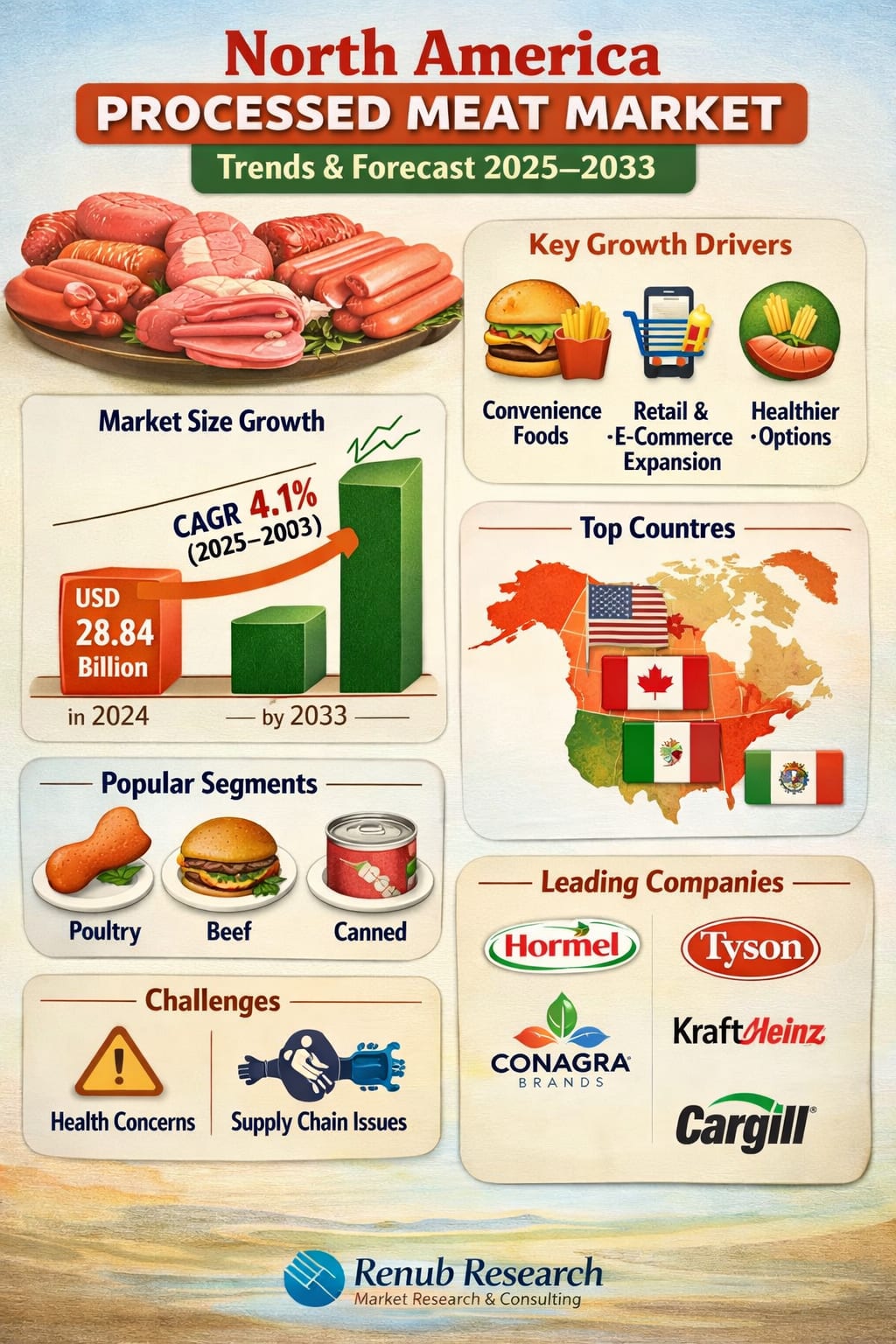
The North American processed meat market continues to play a central role in the region’s food ecosystem, balancing consumer demand for convenience with evolving expectations around health, quality, and sustainability. According to Renub Research, the market is expected to grow from USD 28.84 billion in 2024 to USD 41.39 billion by 2033, registering a compound annual growth rate (CAGR) of 4.1% from 2025 to 2033.
This steady expansion is being driven by multiple factors: busy urban lifestyles, rising consumption of fast and ready-to-eat foods, continuous improvements in food processing technologies, and the rapid expansion of both physical and digital retail channels. From supermarkets and hypermarkets to online grocery platforms and meal-kit services, processed meat products are more accessible to North American consumers than ever before.
At the same time, the industry is navigating a complex landscape shaped by health concerns, regulatory scrutiny, supply chain volatility, and shifting consumer preferences. The result is a market that is not only growing, but also transforming—moving toward cleaner labels, healthier formulations, and more diversified product portfolios.
Understanding Processed Meat in the North American Context
Processed meat refers to meat that has been modified through methods such as curing, smoking, salting, fermentation, or the addition of preservatives to enhance flavor, texture, and shelf life. Common examples include sausages, bacon, ham, hot dogs, deli meats, nuggets, and canned meat products.
In North America, processed meat has long been a staple of household consumption and food service operations. Its popularity is rooted in three core advantages: convenience, extended shelf life, and strong flavor profiles. For working professionals, students, and families with busy schedules, processed meat offers quick meal solutions that require minimal preparation time.
The fast-food and quick-service restaurant (QSR) sector also relies heavily on processed meat products, further reinforcing demand across the region. While health concerns have led some consumers to moderate their intake, the overall market remains resilient, supported by innovation in product formulation and packaging, as well as the growing availability of premium, organic, and alternative protein options.
Key Growth Drivers in the North America Processed Meat Market
1. Rising Demand for Ready-to-Eat and Convenient Foods
One of the strongest growth engines for the market is the increasing demand for ready-to-eat and easy-to-cook food products. North American lifestyles are becoming progressively faster-paced, with more dual-income households, longer working hours, and a greater emphasis on time-saving solutions in daily life.
Pre-packaged deli meats, frozen nuggets, sausages, and ready-to-cook meal components have become everyday grocery items. The growth of meal delivery services and quick-service restaurants has further accelerated the consumption of processed meat.
Advancements in packaging and preservation technologies have also extended product shelf life while maintaining taste and texture, making these products even more appealing to both consumers and retailers. However, the industry is not without challenges, as highlighted by events such as the October 2024 recall by BrucePac of nearly 11.8 million pounds of ready-to-eat poultry and meat products due to possible Listeria contamination, underscoring the importance of food safety and quality control.
2. Expansion of Retail and E-Commerce Channels
The rapid expansion of retail infrastructure across North America has significantly boosted the processed meat market. Large retail chains such as Walmart, Costco, and Kroger offer extensive product assortments, competitive pricing, and strong promotional strategies that encourage high-volume sales.
At the same time, e-commerce has reshaped how consumers purchase food. Platforms like Amazon Fresh, Instacart, and retailer-owned online stores have made it easier than ever to order processed meat products for home delivery. High internet penetration rates—97.1% in the United States, 94.3% in Canada, and 83.2% in Mexico as of 2024—have further supported this digital shift.
Improved cold-chain logistics, smart packaging, and faster delivery systems have helped ensure product quality, even in online retail environments. As a result, processors and brands can now reach wider consumer bases while offering greater convenience and choice.
3. Product Innovation and Healthier Options
Consumer awareness around health and nutrition is reshaping the processed meat industry. In response, manufacturers are investing heavily in product innovation, focusing on reduced-sodium, lower-preservative, organic, antibiotic-free, and hormone-free offerings.
The demand for grass-fed and ethically sourced meat is also rising, particularly among urban and health-conscious consumers. At the same time, alternative protein and plant-based products are gaining traction, creating a new sub-segment of “processed meat alternatives” that appeal to vegetarians, flexitarians, and sustainability-focused buyers.
A notable example of innovation is the April 2023 launch by the HERDEZ® brand of its Mexican Refrigerated Entrées line, including products like shredded chicken in mild chipotle sauce and slow-cooked pork carnitas, reflecting the industry’s push toward convenient yet flavor-rich meal solutions.
Challenges Facing the Market
Health Concerns and Regulatory Pressure
Despite its popularity, processed meat faces increasing scrutiny from health organizations and regulators. The World Health Organization (WHO) has classified processed meat as a carcinogen, which has influenced consumer perceptions and encouraged some to reduce consumption.
Governments across North America have introduced stricter labeling requirements and food safety regulations to ensure transparency in ingredients and processing methods. For manufacturers, this means higher compliance costs and greater pressure to reformulate products without compromising taste or consumer appeal.
Raw Material Price Volatility and Supply Chain Disruptions
The cost of raw materials—meat, spices, and packaging—can fluctuate due to factors such as climate change, livestock diseases, and trade restrictions. In addition, global and regional supply chains remain vulnerable to disruptions caused by transportation delays, labor shortages, and geopolitical uncertainties.
These challenges create pricing volatility for both producers and consumers, pushing companies to focus on cost efficiency, local sourcing, and supply chain optimization to maintain stable operations and consistent product availability.
Segment Insights
Poultry Processed Meat
Poultry-based processed meat, including nuggets, sausages, deli cuts, and frozen wings, continues to dominate the market. Its popularity is driven by affordability, perceived health benefits compared to red meat, and versatility across cuisines. The growing demand for high-protein, low-fat options further supports this segment’s expansion.
Beef Processed Meat
Beef-based products such as burgers, hot dogs, and corned beef remain deeply embedded in North American food culture. Premium and grass-fed beef options are gaining ground, while health concerns are encouraging the development of leaner and lower-preservative formulations.
Frozen Processed Meat
Frozen processed meats benefit from long shelf life and convenience. Technological advances in freezing methods have improved taste and texture retention, making these products more appealing to consumers seeking quick meal solutions.
Canned Processed Meat
Canned meats like spam, corned beef, and canned chicken continue to serve as affordable, long-lasting protein sources. Their popularity is especially strong among cost-conscious consumers and in situations where long shelf life is a priority.
Distribution Channel Trends
Hypermarkets and Supermarkets
These remain the dominant sales channels, offering wide product ranges, promotional deals, and private-label options that attract value-seeking consumers.
Online Retail
E-commerce is rapidly gaining share, supported by home delivery, subscription meal kits, and digital payment options. Convenience and competitive pricing are key drivers of this shift.
Country-Level Outlook
United States
The U.S. leads the regional market, supported by strong consumer demand, a vibrant fast-food culture, and advanced processing and distribution infrastructure. In July 2024, the USDA highlighted investments by the Biden-Harris Administration to strengthen food supply chains and improve meat and poultry processing, reinforcing long-term industry stability.
Canada
Canada’s market is shaped by demand for high-quality, locally sourced meat and strong regulatory oversight. In January 2025, Maple Leaf Foods announced efforts to expand its plant-based and alternative protein portfolio, reflecting the country’s growing focus on health and sustainability.
Mexico
Mexico continues to offer growth opportunities driven by urbanization, expanding retail networks, and rising demand for convenient food products.
Competitive Landscape
Key players shaping the North American processed meat market include:
Hormel Foods
Tyson Foods
Conagra Brands Inc.
General Mills
The Kraft Heinz Company
Cargill, Incorporated
Pilgrim’s Pride Corp
These companies compete through product innovation, brand strength, pricing strategies, and expanding distribution networks, while also investing in sustainability and health-focused product lines.
Final Thoughts
The North America processed meat market is on a clear growth trajectory, projected to reach USD 41.39 billion by 2033. While convenience and affordability remain its strongest pillars, the industry is undergoing a meaningful transformation driven by health awareness, regulatory pressures, and evolving consumer expectations.
Companies that successfully balance innovation, transparency, and operational efficiency will be best positioned to thrive in this changing landscape. As retail and digital channels continue to expand and product portfolios become more diversified, processed meat will remain a significant—though increasingly sophisticated—part of North America’s food economy.
About the Creator
North America Automotive Robotics Market Size and Forecast 2025–2033
Introduction: Robots at the Heart of Modern Car Factories The North America Automotive Robotics Market is entering a decisive growth phase, driven by the region’s rapid shift toward smart manufacturing, electric vehicles, and highly automated production lines. According to Renub Research, the market is expected to reach US$ 7.09 billion by 2033, up from US$ 3.05 billion in 2024, growing at a CAGR of 9.81% from 2025 to 2033.
By Sakshi Sharma2 days ago in Trader




Comments
There are no comments for this story
Be the first to respond and start the conversation.