
Photo Printing and Merchandise Market Size & Forecast 2025–2033
How Personalization, Digital Printing, and E-Commerce Are Reshaping the Global Photo Merchandise Industry

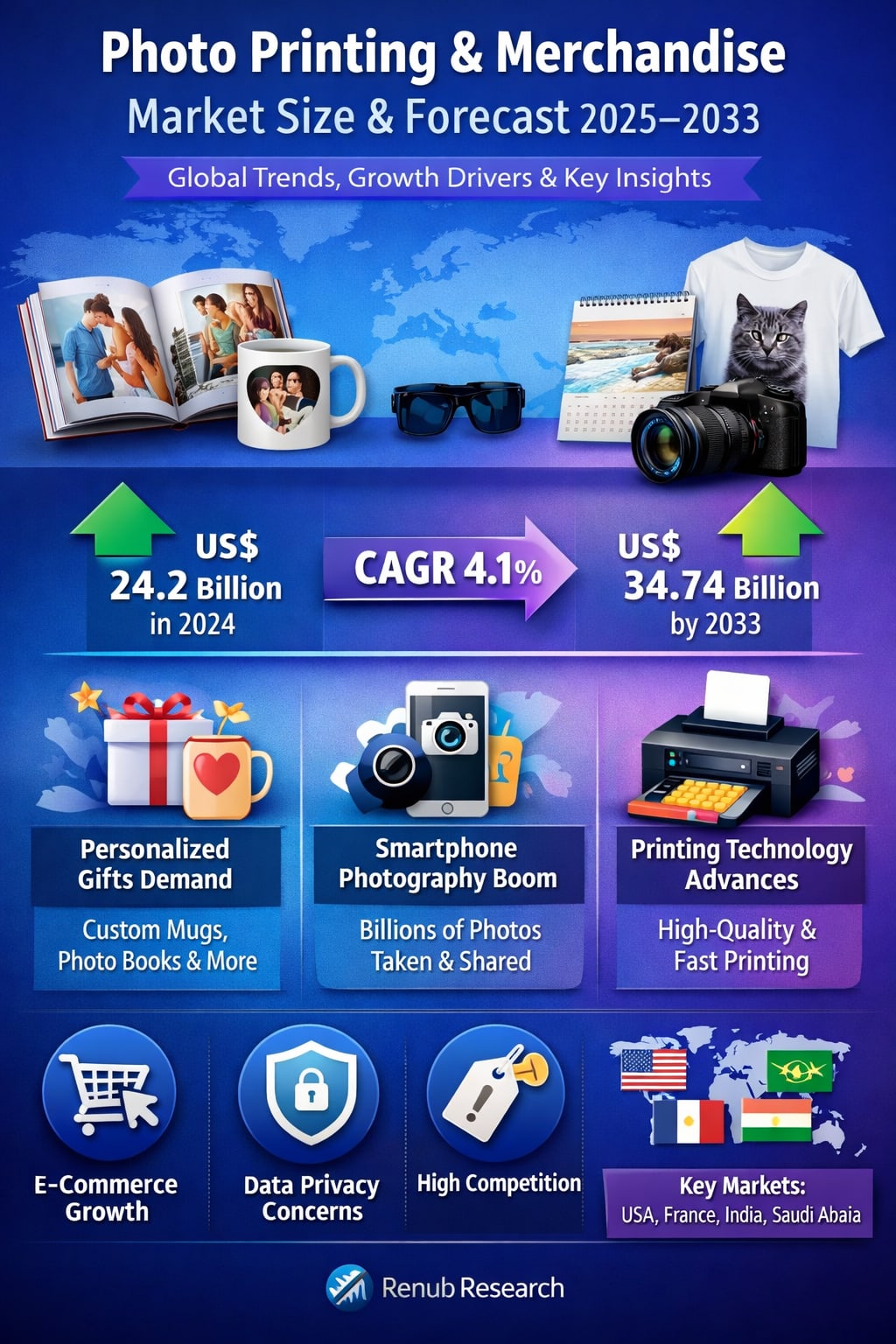
Global Photo Printing and Merchandise Market at a Glance
The Global Photo Printing and Merchandise Market was valued at US$ 24.2 billion in 2024 and is projected to reach US$ 34.74 billion by 2033, expanding at a CAGR of 4.1% between 2025 and 2033. This steady growth trajectory reflects a powerful mix of emotional consumer behavior and technological progress. Rising demand for personalized gifts, rapid improvements in digital printing technologies, and the growing popularity of photo-based merchandise through online platforms and e-commerce channels are among the primary forces shaping the market.
Photo printing and merchandise represent more than just a commercial service—they sit at the intersection of memory, creativity, and technology. From photo books and wall canvases to mugs, t-shirts, and calendars, consumers increasingly want to transform digital moments into tangible keepsakes. In an era dominated by smartphones and social media, the desire to preserve memories in physical form continues to keep this market relevant and resilient.
Photo Printing and Merchandise Market Outlook
Photo printing and merchandise involve converting digital images into physical products such as photo books, framed prints, posters, apparel, home décor items, and customized gifts. The industry blends photography, design, printing technology, and e-commerce into a single value chain that serves both individual consumers and businesses.
The market has expanded rapidly alongside the mass adoption of smartphones and social media platforms. Every day, billions of photos are captured and shared globally, yet many of these images remain confined to digital storage. Consumers increasingly seek physical ways to display, gift, or archive their favorite moments, whether through albums, wall art, or personalized products.
E-commerce platforms and mobile applications have further simplified the process. Today, users can upload images, edit designs, preview products, and place orders within minutes. This convenience has transformed photo merchandise from a niche service into a mainstream consumer product category. Additionally, photo-based merchandise has become a popular choice for corporate branding, promotional campaigns, and event memorabilia, expanding the market beyond personal use.
With continuous improvements in print quality, faster turnaround times, and declining production costs, the global photo printing and merchandise market is expected to maintain a stable growth path throughout the forecast period.
Key Growth Drivers in the Photo Printing and Merchandise Market
1. Increasing Demand for Personalized Gifts
Personalization has become one of the strongest trends in modern consumer markets, and photo merchandise sits at the heart of this movement. Customized photo products—such as mugs, calendars, cushions, and t-shirts—carry emotional value that mass-produced items simply cannot replicate. Consumers increasingly prefer meaningful, personalized gifts for birthdays, weddings, anniversaries, and festive occasions.
The rise of user-friendly digital platforms has made customization effortless. With simple upload and editing tools, even non-technical users can design unique products within minutes. This ease of access, combined with the emotional appeal of personalized items, continues to fuel demand, especially among millennials and Gen Z consumers who value individuality and self-expression.
In January 2024, Etsy introduced a new generative AI-driven feature called “Gift Mode,” aimed at improving customized gift discovery. Such innovations highlight how technology is being used to further accelerate personalization trends in the global market.
2. Proliferation of Smartphones and Digital Photography
The global explosion of smartphone usage has transformed everyone into a potential photographer. High-quality cameras, easy editing tools, and instant sharing options have resulted in an unprecedented volume of digital images. While these photos are primarily stored and shared online, many consumers still desire physical formats to preserve special memories.
Photo books, framed prints, and wall art have become popular ways to convert digital moments into long-lasting keepsakes. The seamless integration between smartphones and printing services—often through dedicated apps—has made ordering prints and merchandise more convenient than ever.
In March 2025, HMD Global launched new phones emphasizing “human-first” technology and digital wellbeing, underlining the continued evolution of mobile devices. As smartphone photography continues to improve, the demand for high-quality photo prints and merchandise is expected to rise alongside it.
3. Printing Technology Innovations
Technological progress in digital printing has been a major catalyst for market growth. Advanced inkjet, dye-sublimation, and UV printing technologies now allow for sharper images, richer colors, and greater durability across a wide range of materials. These innovations have expanded the scope of products that can be customized with photos, from fabrics and ceramics to metal and glass surfaces.
Shorter production cycles and lower costs have also made customized printing more accessible to both consumers and businesses. Companies can now offer on-demand, small-batch production without sacrificing quality, which is ideal for personalized merchandise.
In February 2025, FUJIFILM India showcased its latest printing solutions at Printpack India 2025, including new Revoria Press models and Apeos multifunction products. Such developments reflect how continuous innovation is strengthening the overall value proposition of photo printing and merchandise services.
Key Challenges in the Photo Printing and Merchandise Market
1. Intense Competition and Price Pressure
The market is highly fragmented, with numerous global and local players offering similar products and services. This intense competition often leads to price wars, squeezing profit margins and making it difficult for smaller players to sustain growth.
To remain competitive, companies must continuously invest in new technologies, marketing strategies, and customer experience enhancements. While innovation can create differentiation, it also requires significant resources. As a result, balancing profitability with competitive pricing remains one of the biggest challenges in this industry.
2. Privacy and Data Security Concerns
Photo printing services rely heavily on user-uploaded images, many of which are personal or sensitive. This makes data privacy and security a critical concern. Any breach, misuse of images, or lack of transparency in data handling can severely damage a company’s reputation and lead to legal consequences.
To maintain consumer trust, companies must invest in secure data storage, encryption technologies, and clear privacy policies. In regions with strict data protection regulations, such as Europe, compliance is not just a best practice but a legal necessity.
Market Segmentation Insights
Photographs Segment
The photographs segment includes printed photos, albums, and wall-mounted prints. Despite the dominance of digital media, physical photographs continue to hold strong emotional and sentimental value. They are especially popular for milestones such as weddings, graduations, and family celebrations.
Consumers are increasingly opting for premium formats like canvas prints, metal prints, and high-quality photo paper, transforming photographs into décor items as well as keepsakes. This blend of nostalgia and modern design continues to support steady demand in this segment.
Merchandise Segment
The merchandise category covers customized items such as t-shirts, mugs, phone cases, cushions, and calendars. This segment serves both individual consumers and corporate clients. Businesses frequently use personalized merchandise for promotions, branding, and employee engagement, while consumers buy them as unique and thoughtful gifts.
Creativity, print quality, and affordability are key factors influencing purchasing decisions. With the growth of e-commerce and social media-driven trends, demand for expressive and personalized products in this segment is expected to remain strong.
Digital Printing Segment
Digital printing plays a central role in the modern photo merchandise ecosystem. Unlike traditional printing methods, digital printing allows for fast, cost-effective, and on-demand production without requiring large batch sizes.
Technologies such as UV printing and dye-sublimation enable vibrant, durable prints on a wide variety of surfaces. This flexibility makes digital printing ideal for personalized products and short-run orders, reinforcing its dominance in the market.
Online Distribution Channel
Online platforms have revolutionized how consumers order photo prints and merchandise. Through websites and mobile apps, users can upload images, customize designs, preview products, and place orders from anywhere. These platforms often offer a wide range of templates and product options, making the process accessible even to first-time users.
The shift toward e-commerce has given online channels a significant advantage in terms of reach, convenience, and operational efficiency. As digital adoption continues to grow, the online segment is expected to remain the primary distribution channel.
Kiosk Distribution Channel
Photo printing kiosks, typically located in retail stores and shopping malls, provide instant printing services for quick photo needs. Users can print directly from smartphones or USB devices without staff assistance.
While kiosks offer speed and convenience, they generally provide a more limited range of products compared to online platforms. Nevertheless, they remain popular for last-minute prints and in regions where quick, on-the-spot service is valued.
Regional Market Highlights
United States
The United States represents a mature and technologically advanced market with high adoption of photo printing services. Strong smartphone usage, high disposable incomes, and a well-established gifting culture drive consistent demand. Seasonal events such as holidays, weddings, and graduations create predictable peaks in sales.
Sustainability is also becoming an important factor, with consumers increasingly favoring eco-friendly materials and packaging. In January 2025, Epson demonstrated its fine art printing solutions at the West Coast Art & Frame event, highlighting ongoing innovation in digital imaging and professional printing.
France
France’s market is shaped by strong consumer interest in art, design, and personalization. High internet penetration and cultural appreciation for photography support steady demand for customized photo products. French consumers tend to prioritize quality and elegant design, often favoring local or European providers due to faster delivery and compliance with data protection regulations such as GDPR.
In January 2023, Kodak Moments expanded its partnership with Carrefour in France by launching a co-branded multi-channel photo platform, reinforcing the role of strategic collaborations in this market.
India
India is one of the fastest-growing markets in this sector, driven by rapid smartphone adoption, rising middle-class incomes, and a strong culture of celebrations and social events. Weddings, festivals, and family occasions generate significant demand for photo books, albums, and customized gifts.
The young population and widespread use of social media are accelerating mobile-based ordering. With improving logistics and digital infrastructure, tier-2 and tier-3 cities are emerging as new growth hubs. In February 2025, HP India, along with Redington and TechNova, showcased its latest digital printing technologies at Printpack India 2025, highlighting the country’s growing importance in the global printing ecosystem.
Saudi Arabia
Saudi Arabia’s market is evolving alongside rising e-commerce adoption, youth-driven social media usage, and increasing digital content creation. Demand for wall décor, photo gifts, and customized products is growing, particularly around weddings, religious celebrations, and national holidays.
Cultural considerations play an important role in shaping product offerings, but overall market development is supported by expanding online payment systems and logistics networks. In January 2025, Gulf Print & Pack 2025 in Riyadh showcased solutions aimed at improving efficiency and workflows in the region’s expanding print industry.
Market Segmentation Overview
By Product Type:
Photographs
Photo Books
Posters
Calendars
Merchandise
By Printing Type:
Film Printing
Digital Printing
By Distribution Channel:
Online
Retail
Kiosk
By Geography:
North America (United States, Canada)
Europe (France, Germany, Italy, Spain, United Kingdom, Belgium, Netherlands, Turkey)
Asia Pacific (China, Japan, India, South Korea, Thailand, Malaysia, Indonesia, Australia, New Zealand)
Latin America (Brazil, Mexico, Argentina)
Middle East & Africa (Saudi Arabia, UAE, South Africa)
Key Players Profiled (4 Viewpoints: Overview, Key Persons, Recent Developments & Strategies, Revenue Analysis)
American Greetings Corporation
Bay Photo Inc.
Card Factory
Cimpress NV
Digitalab Ltd.
Eastman Kodak Company
Hallmark Cards Inc.
Hewlett Packard Enterprise Development LP
These companies are focusing on product innovation, digital platform expansion, partnerships, and technology upgrades to strengthen their market positions.
Final Thoughts
The global Photo Printing and Merchandise Market is evolving at the crossroads of emotion, technology, and e-commerce. While digital media dominates everyday life, the desire to preserve memories in physical form remains strong. With the market expected to grow from US$ 24.2 billion in 2024 to US$ 34.74 billion by 2033, opportunities continue to expand for companies that can combine quality, convenience, and personalization.
Advancements in digital printing, rising demand for customized products, and the ongoing shift toward online platforms will remain the core growth engines. At the same time, companies must navigate challenges such as intense competition and data privacy concerns. Those that successfully balance innovation, trust, and customer experience are likely to emerge as long-term winners in this emotionally driven yet technology-powered industry.
About the Creator
Snowflake Stock Analysis: Can Snowflake Maintain Growth in the Cloud Data Market?
Introduction Snowflake stock has emerged as one of the most prominent names in cloud data and analytics. Snowflake provides a data platform-as-a-service that enables enterprises to store, manage, and analyze vast amounts of structured and unstructured data. With cloud adoption accelerating globally and businesses increasingly relying on data-driven insights, Snowflake stock has attracted significant investor attention. The critical question is whether Snowflake can sustain high growth rates while navigating competition and scaling operations.
By Hammad Nawaza day ago in Trader
The Cave Part 6
If you have ever heard a tale about yourself that you cannot remember and doubtless think is made up, you will know how I felt when Tharkin related all that the eagle had seen of me before my memories were scattered. Of far distances and traveling companions that I did not recall, camping out under the stars and making our way to the mountains with deliberate purpose. The great bird had lost contact with my party once we entered the forests, and the seven other members were not seen again by him or his brethren since.
By Jamye Sharp4 days ago in Chapters



Comments
There are no comments for this story
Be the first to respond and start the conversation.