
Precision Irrigation Market Size and Forecast 2025–2033
How Smart Water Management Is Reshaping Global Agriculture

Introduction
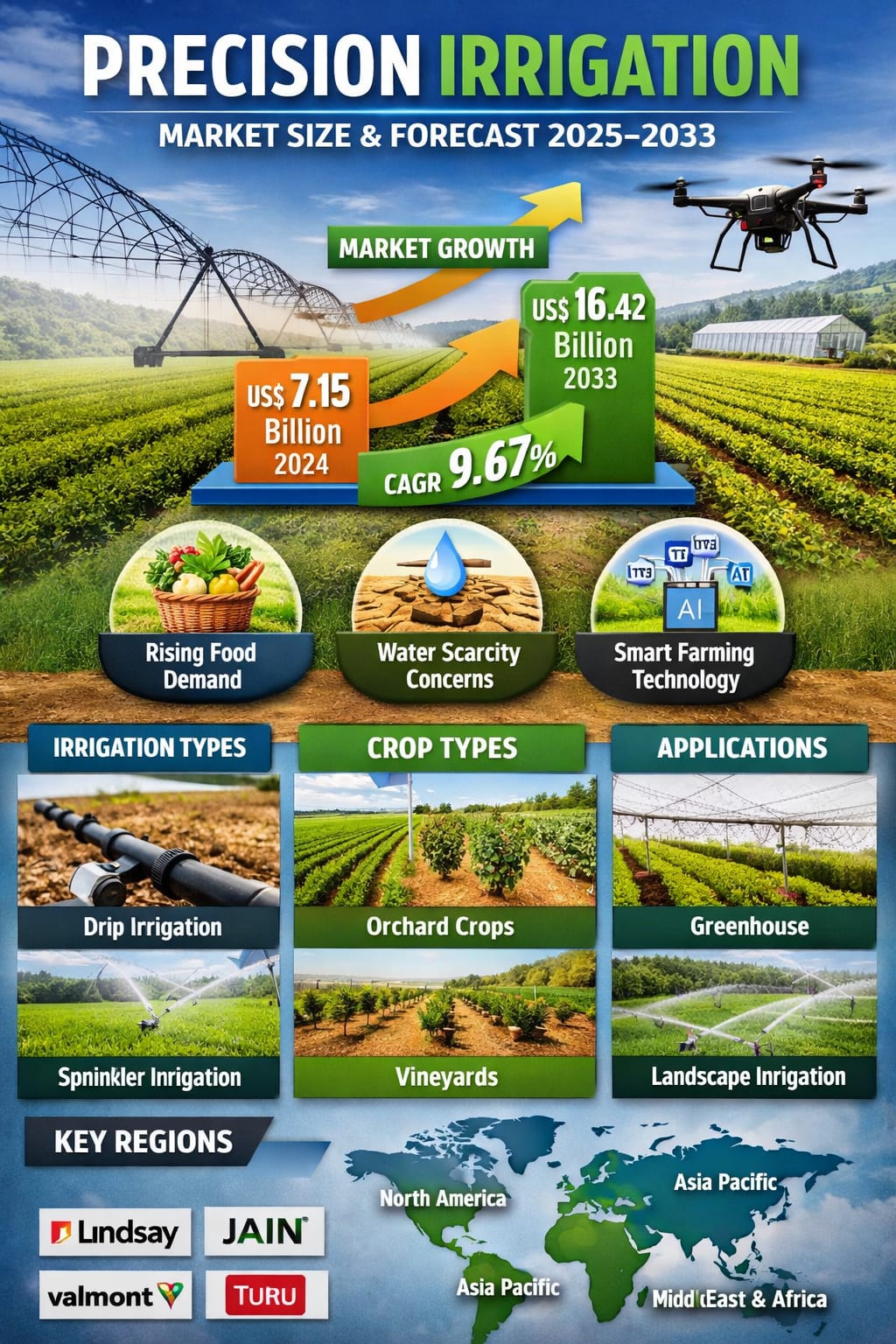
The global agricultural sector is undergoing a quiet but powerful transformation, driven by the urgent need to produce more food using fewer natural resources. Among the most impactful innovations leading this change is precision irrigation—an advanced farming approach that optimizes water use through technology, data, and automation. According to industry projections, the Precision Irrigation Market is expected to reach US$ 16.42 billion by 2033, up from US$ 7.15 billion in 2024, growing at a compound annual growth rate (CAGR) of 9.67% from 2025 to 2033.
This impressive growth reflects a convergence of global challenges and opportunities: rising food demand, increasing water scarcity, climate change pressures, rapid technological advancements, supportive government policies, and the expanding adoption of smart farming practices. Precision irrigation is no longer a niche solution—it is becoming a cornerstone of modern, sustainable agriculture worldwide.
Global Precision Irrigation Market Overview
Growing concerns over water scarcity and the need for sustainable agricultural practices are driving significant change in the precision irrigation sector. Studies have shown that subsurface drip irrigation systems can increase crop water yield by around 25% while reducing evapotranspiration by up to 26% compared to traditional flood irrigation methods. These efficiency gains highlight why farmers and agribusinesses are rapidly turning toward smarter irrigation solutions.
The integration of Internet of Things (IoT) technologies, automated control systems, and real-time monitoring tools has revolutionized how water is managed on farms. Today’s precision irrigation systems rely on soil moisture sensors, weather monitoring stations, and data-driven software platforms that allow farmers to schedule irrigation with remarkable accuracy. This ensures crops receive exactly the amount of water they need—no more, no less—reducing waste, conserving resources, and improving yields.
The market is also being reshaped by strategic mergers, acquisitions, and technology partnerships aimed at expanding product portfolios and strengthening global reach. For instance, in early 2023, Netafim enhanced its digital irrigation solutions by adding automated irrigation management systems and advanced soil sensor technologies. This move underscored a broader industry trend: the shift from standalone irrigation equipment toward fully integrated, intelligent agricultural ecosystems.
Artificial intelligence (AI) and machine learning (ML) are further elevating the sector. Smart irrigation controllers can now automatically adjust watering schedules based on real-time environmental data, historical patterns, and predictive analytics. This not only improves efficiency but also reduces the need for constant human intervention, making large-scale farm management more practical and cost-effective.
Government initiatives are another major catalyst for market growth, especially in emerging economies. Programs promoting agricultural modernization, water conservation, and climate-resilient farming are accelerating adoption. In some regions, subsidies cover up to 60% of the installation costs for modern irrigation systems, significantly lowering the barrier for small and medium-sized farmers to enter the precision irrigation ecosystem.
Growth Drivers for the Precision Irrigation Market
Rising Global Food Demand
By 2050, the world’s population is expected to exceed 9 billion, placing unprecedented pressure on global food production systems. Meeting this demand will require a significant increase in agricultural output, even as arable land and freshwater resources become more constrained. Traditional farming methods, which often rely on inefficient water use, are increasingly unsustainable under these conditions.
Precision irrigation offers a powerful solution. By delivering water and nutrients precisely where and when crops need them, these systems help maximize yields while minimizing waste. This is especially critical in regions facing chronic water shortages or unpredictable rainfall patterns. As food security becomes a central global priority, the ability to produce more with less is pushing precision irrigation from a “nice-to-have” technology to an essential agricultural investment.
Growing Awareness of Sustainable Practices
Environmental sustainability is no longer just a policy goal—it is a business and social imperative. Concerns about soil degradation, groundwater depletion, and the ecological impact of conventional farming are driving farmers, agribusinesses, governments, and consumers toward greener solutions.
Precision irrigation aligns perfectly with these sustainability objectives. It reduces water runoff, minimizes nutrient leaching, lowers energy consumption, and helps preserve soil health. As sustainability standards become more embedded in agricultural regulations and consumer expectations, farmers are increasingly motivated to adopt smart irrigation systems that support both environmental compliance and long-term farm profitability.
Rapid Adoption of Smart Agriculture
Smart agriculture is transforming the farming landscape by combining technologies such as IoT, AI, GPS, drones, and big data analytics into integrated farm management systems. Precision irrigation plays a central role in this digital ecosystem by enabling real-time, data-driven water management.
When connected with other smart farming tools, precision irrigation systems help farmers optimize input costs, improve crop quality, and increase overall productivity. The ability to monitor fields remotely, analyze performance trends, and make informed decisions based on accurate data is redefining what modern farming looks like. As smart agriculture continues to expand, precision irrigation is emerging as one of its most critical building blocks.
Challenges in the Precision Irrigation Market
Lack of Technical Knowledge
Despite its clear benefits, the adoption of precision irrigation is still hindered by a lack of technical expertise among many farmers. These systems often involve complex components such as sensors, GPS tools, automated controllers, and software platforms, which require a certain level of digital literacy to operate and maintain.
In many developing regions, access to training programs and agricultural extension services is limited. As a result, farmers may find these technologies intimidating or difficult to use, even when they recognize the potential benefits. Bridging this knowledge gap through education, training initiatives, and user-friendly system designs will be essential for achieving broader adoption.
High Initial Investment
Another major barrier is the high upfront cost of precision irrigation systems. Installing components such as drip lines, sprinkler systems, soil moisture sensors, weather stations, automated controllers, and integrated software platforms requires a significant financial commitment.
While the long-term benefits—such as reduced labor costs, improved yields, and water savings—are substantial, they are not always immediately visible. For small and medium-sized farmers, especially in developing countries, this cost barrier can be prohibitive. Expanding access to subsidies, financing options, and more affordable technology solutions will be crucial for unlocking the market’s full potential.
United States Precision Irrigation Market
The United States stands as a global leader in precision irrigation, supported by advanced farming practices, strong technological innovation, and significant investment in agricultural infrastructure. Key industry players such as Valmont Industries, Netafim, Hunter Industries Inc., The Toro Company, and Rain Bird Corporation are driving innovation and expanding access to smart irrigation technologies.
Government programs focused on water conservation and smart agriculture further support market growth. However, high initial investment costs remain a challenge, particularly for small-scale farmers. Even so, the overall market trajectory reflects a strong commitment to adopting intelligent irrigation systems to enhance both productivity and sustainability in U.S. agriculture.
United Kingdom Precision Irrigation Market
In the United Kingdom, precision irrigation is gaining momentum as farmers seek to improve efficiency and sustainability. By using sensors, automation, and data analytics, these systems help ensure crops receive the right amount of water at the right time, significantly reducing waste.
The growing need to manage water scarcity, combined with increased awareness of sustainable farming practices, is fueling adoption. Government initiatives supporting sustainable agriculture and ongoing advancements in smart technologies are further strengthening the market. This transition is expected to deliver long-term benefits in both environmental protection and agricultural productivity.
India Precision Irrigation Market
India represents one of the most dynamic growth markets for precision irrigation, driven by strong government support and rapid technological progress. The Pradhan Mantri Krishi Sinchayee Yojana (PMKSY) promotes micro-irrigation methods such as drip and sprinkler systems by offering financial assistance to farmers, with the goal of improving water use efficiency.
Additionally, the PM KUSUM program encourages the adoption of solar-powered irrigation pumps, reducing dependence on fossil fuels and promoting sustainable energy use. Innovations like the Nano Ganesh system, which allows farmers to control irrigation pumps remotely via mobile devices, are further improving efficiency and convenience. Together, these initiatives are accelerating the nationwide adoption of precision irrigation technologies and supporting a shift toward high-value, technology-driven agriculture.
United Arab Emirates Precision Irrigation Market
In the arid climate of the United Arab Emirates (UAE), precision irrigation is not just an option—it is a necessity. The country is активно promoting smart irrigation systems to enhance agricultural productivity while conserving scarce water resources.
In August 2023, Netafim partnered with E20 Investment to form a joint venture aimed at promoting sustainable agriculture and precision irrigation solutions in the UAE and beyond. This collaboration focuses on improving food security, combating desertification, and optimizing water use through digital agricultural tools. The growing adoption of sensor-based, data-driven irrigation systems reflects the UAE’s strong commitment to technology-led, sustainable farming.
Precision Irrigation Market Segmentation
By Type (3 viewpoints):
Sprinkler Irrigation
Drip Irrigation
Others
By Crop Type (5 viewpoints):
Field Crops
Vegetable Crops
Orchard Crops
Vineyards
Other Crops
By Application (5 viewpoints):
Agricultural Fields
Landscape and Turf Irrigation
Greenhouse
Residential
Others
Regional Market Analysis
North America:
United States
Canada
Europe:
France
Germany
Italy
Spain
United Kingdom
Belgium
The Netherlands
Turkey
Asia Pacific:
China
Japan
India
Australia
South Korea
Thailand
Malaysia
Indonesia
New Zealand
Latin America:
Brazil
Mexico
Argentina
Middle East & Africa:
South Africa
Saudi Arabia
United Arab Emirates
Company Analysis (Covered from 5 Viewpoints)
All key players are evaluated based on:
Overview
Key Persons
Product Portfolio
Recent Developments & Strategies
Revenue Analysis
Major Companies Profiled:
Jain Irrigation Systems Ltd
Lindsay Corporation
The Toro Company
Valmont
Final Thoughts
The precision irrigation market is entering a decisive decade. With the global market projected to grow from US$ 7.15 billion in 2024 to US$ 16.42 billion by 2033, the message is clear: smart water management is no longer optional—it is essential for the future of agriculture.
Driven by rising food demand, sustainability goals, and rapid technological innovation, precision irrigation is transforming how the world grows food. While challenges such as high initial costs and limited technical knowledge remain, supportive government policies, improving affordability, and increasing awareness are steadily breaking down these barriers.
In a world facing climate uncertainty and resource constraints, precision irrigation stands out as a powerful tool for building a more resilient, efficient, and sustainable agricultural system—one that can feed a growing population without exhausting the planet’s most precious resources.
About the Creator
Tom Shane
Tom Shane is a content writer specializing in SEO-driven blogs, product descriptions, and thought leadership. He crafts engaging, research-backed content that connects with audiences and drives results.
Philippines Bakery Market 2026: Rising to USD 5.4 Billion by 2034 on Changing Consumer Lifestyles
Philippines Bakery Market Overview The Philippines bakery market size has emerged as a steadily expanding segment of the nation’s broader food and retail economy, driven by evolving consumer preferences and shifts in lifestyle and spending patterns. According to the latest IMARC Group report, the market was valued at USD 3.7 billion in 2025 and is projected to grow to USD 5.4 billion by 2034, exhibiting a compound annual growth rate (CAGR) of 4.42% over the 2026–2034 forecast period.
By Manisha Dixit2 days ago in Trader
Germany Flight Disruptions Expose Growing Strain on European Air Travel
Germany flight disruptions have once again disrupted travel plans for thousands of passengers, underscoring the growing strain on Europe’s aviation network. A large number of flights were delayed or canceled in a single day, creating chaos across airports and raising concerns about the system’s ability to cope with rising travel demand. The situation reflects deeper structural challenges that continue to affect air travel across the region.
By Hammad Nawaza day ago in Trader



Comments
There are no comments for this story
Be the first to respond and start the conversation.