
Radiofrequency Ablation Device Market Size and Forecast 2025
Minimally Invasive Medicine Powers a Billion-Dollar Transformation in Global Healthcare

Introduction: A Market Heating Up with Innovation
The global healthcare industry is in the middle of a major transformation, driven by the demand for safer, faster, and more cost-effective treatments. Among the technologies benefiting from this shift is radiofrequency ablation (RFA)—a minimally invasive technique that uses heat generated by radiofrequency energy to destroy abnormal tissue. From treating cardiac arrhythmias and tumors to managing chronic pain, RFA has become an essential tool in modern medicine.
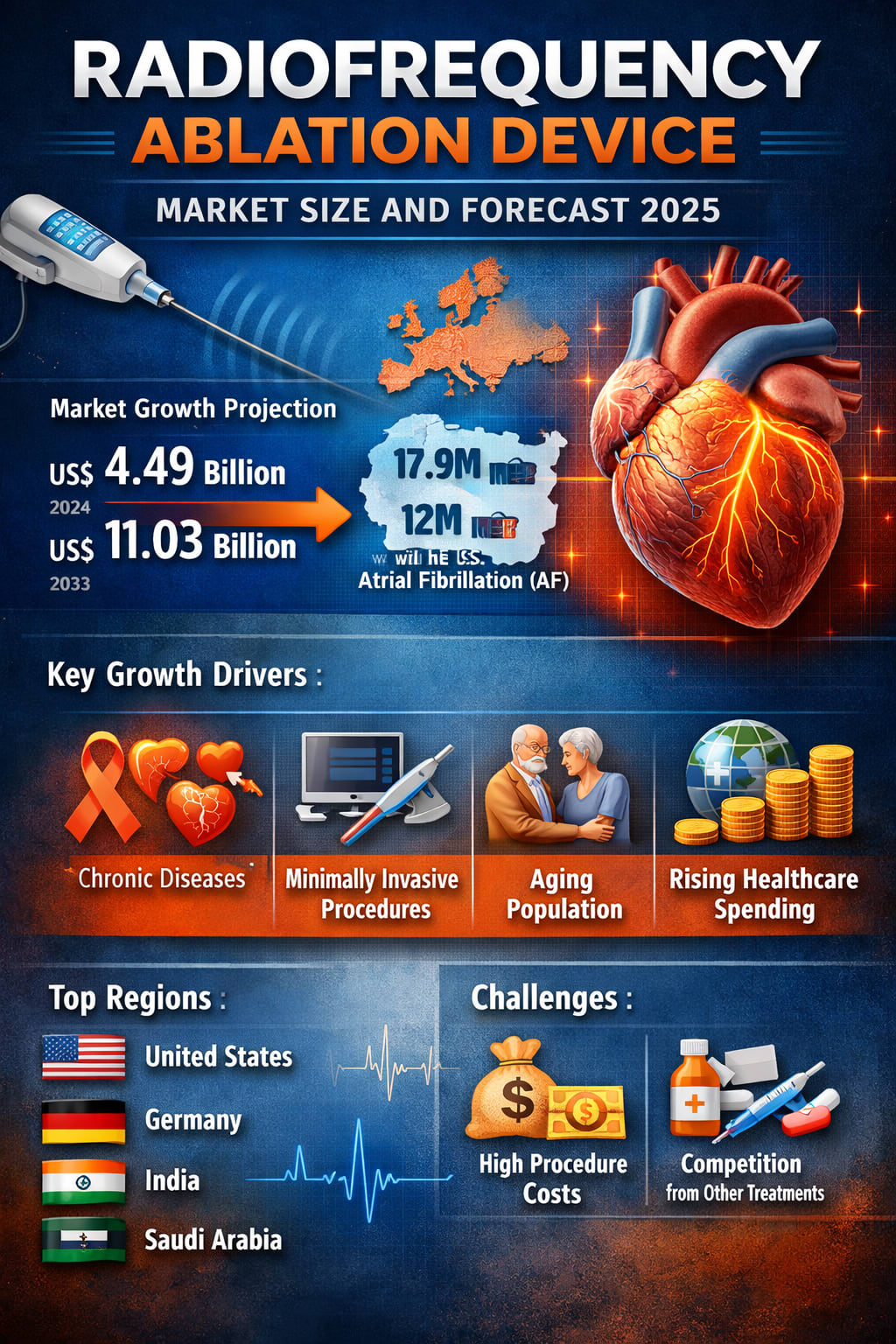
According to Renub Research, the Radiofrequency Ablation Device Market is expected to grow from US$ 4.49 billion in 2024 to US$ 11.03 billion by 2033, registering a strong compound annual growth rate (CAGR) of 10.51% from 2025 to 2033. This impressive growth trajectory reflects not only technological progress but also deep structural changes in global healthcare—especially the rising burden of chronic diseases and the increasing preference for minimally invasive procedures.
One of the most important drivers behind this growth is the expanding patient pool suffering from cardiovascular diseases and other chronic conditions. For example, by 2060, 17.9 million people in Europe and 12 million in the United States are expected to suffer from atrial fibrillation (AF), according to data referenced from the Centers for Disease Control and Prevention (CDC). Such trends are pushing hospitals and clinics to adopt advanced, efficient, and patient-friendly treatment technologies—placing radiofrequency ablation devices at the center of future care pathways.
Understanding Radiofrequency Ablation: Why It Matters
Radiofrequency ablation is a medical procedure that uses electrical energy converted into heat to target and destroy abnormal tissues. It is widely used in oncology for tumor ablation, in cardiology for treating arrhythmias such as atrial fibrillation, and in pain management for chronic nerve-related pain. Compared to traditional open surgeries, RFA offers several key advantages:
Smaller or no incisions
Reduced hospital stays
Faster recovery times
Lower risk of complications
Improved patient comfort and outcomes
These benefits have made RFA a preferred choice for both physicians and patients, especially in an era where healthcare systems are under pressure to improve efficiency while maintaining high standards of care.
Technological advancements are further strengthening the role of RFA in modern medicine. Innovations such as robot-assisted systems, multi-electrode devices, and improved imaging guidance have increased procedural accuracy and safety. As a result, the scope of RFA applications continues to expand across multiple medical specialties.
Market Growth Drivers: What’s Fueling the Expansion?
1. Rising Prevalence of Chronic Diseases
One of the most powerful growth drivers for the radiofrequency ablation device market is the increasing prevalence of chronic diseases such as cancer, cardiovascular disorders, and chronic pain conditions. With aging populations worldwide, the number of patients requiring long-term and effective treatment solutions is rising steadily.
RFA plays a crucial role in treating cardiac arrhythmias, particularly atrial fibrillation, as well as in the ablation of tumors in organs such as the liver, kidneys, and lungs. It is also widely used in pain management, especially for conditions related to spinal and nerve disorders. As the global disease burden increases, healthcare providers are turning more frequently to RFA as a reliable, minimally invasive solution—driving consistent demand for advanced ablation devices.
2. Strong Shift Toward Minimally Invasive Procedures
Modern healthcare is increasingly focused on reducing patient trauma, shortening hospital stays, and lowering overall treatment costs. Minimally invasive procedures like radiofrequency ablation perfectly align with these goals.
Unlike conventional surgeries, RFA typically requires only small incisions—or sometimes none at all—resulting in less scarring, fewer complications, and faster recovery. For hospitals and ambulatory surgical centers, this also means improved patient turnover and more efficient use of resources. As both patients and healthcare providers continue to favor minimally invasive options, the adoption of RFA devices is expected to accelerate further.
3. Growing Healthcare Awareness and Technology Adoption
Another important factor driving market growth is rising healthcare awareness among patients and clinicians. With better access to medical information and increased emphasis on early diagnosis and treatment, more patients are actively seeking advanced treatment options.
At the same time, healthcare professionals are becoming more familiar with the clinical benefits of RFA in treating tumors, arrhythmias, and chronic pain. Continuous training, medical conferences, and clinical research are helping expand the acceptance of radiofrequency ablation as a standard treatment option in many therapeutic areas.
4. Aging Global Population and Rising Healthcare Spending
Demographic changes are also playing a major role. The World Health Organization (WHO) estimates that by 2050, the global population aged 60 years and above will reach 2 billion, up from 900 million in 2015. Older adults are more prone to chronic illnesses, which increases the demand for effective, low-risk treatment options such as RFA.
In parallel, global healthcare spending is rising. The U.S. Census Bureau projects worldwide healthcare expenditure to reach USD 18.28 trillion by 2040, growing at a CAGR of 2.6%. In Europe, countries such as Germany, the UK, Sweden, Norway, and Italy already allocate a significant share of GDP to healthcare, according to the WHO Global Health Expenditure Database. This expanding financial commitment to healthcare is expected to positively influence investments in advanced medical technologies, including radiofrequency ablation devices.
Market Challenges: Barriers to Wider Adoption
1. High Procedure and Equipment Costs
Despite its advantages, radiofrequency ablation is not without challenges. One of the biggest barriers is the high cost of both the equipment and the procedures. Advanced RFA systems, along with associated imaging and monitoring tools, represent a significant investment for healthcare providers.
For patients, especially in developing countries or those without adequate insurance coverage, the cost of RFA procedures can limit access. This financial barrier may slow down adoption in cost-sensitive markets and restrict the overall growth potential in certain regions.
2. Competition from Alternative Treatment Modalities
The RFA market also faces strong competition from other treatment options such as cryoablation, chemotherapy, radiation therapy, and conventional surgery. Depending on the type and stage of disease, physicians may prefer these alternatives over RFA.
For example, cryoablation may be chosen for specific tumor types, while surgery might still be preferred for larger or more complex cases. This wide range of available treatment modalities can limit the market share of RFA devices in certain clinical scenarios.
Regional Market Insights
United States
The United States represents one of the largest markets for radiofrequency ablation devices, driven by a high prevalence of chronic diseases, strong healthcare infrastructure, and rapid adoption of advanced medical technologies. RFA is widely used for treating cardiac arrhythmias, cancers, and chronic pain, and ongoing innovations—such as robotic-assisted systems—are further improving clinical outcomes.
However, high procedure costs and competition from alternative treatments remain challenges. Even so, strong patient awareness, continuous technological innovation, and a well-established healthcare system are expected to keep the U.S. market on a solid growth path.
Germany
Germany’s RFA device market benefits from a highly developed healthcare system, strong medical expertise, and widespread adoption of advanced technologies. The demand for minimally invasive treatments for cancer, cardiac conditions, and pain management continues to rise.
While regulatory requirements and treatment costs can pose challenges, the growth of outpatient care centers and ongoing medical research are expected to support steady market expansion in the country.
India
In India, the market for radiofrequency ablation devices is growing rapidly due to improving healthcare infrastructure, rising awareness, and increasing demand for cost-effective, minimally invasive treatments. RFA is gaining popularity for treating cancer, cardiac arrhythmias, and chronic pain, especially in urban healthcare centers.
Challenges such as limited access in rural areas, a shortage of trained specialists, and cost constraints still exist. However, technological progress and a stronger focus on improving patient care are likely to boost adoption in the coming years.
Saudi Arabia
Saudi Arabia’s RFA device market is expanding as part of the country’s broader efforts to modernize its healthcare system. Increased government investment, rising awareness, and growing demand for advanced treatments are driving adoption.
Although high costs and the need for skilled professionals remain concerns, ongoing healthcare reforms and technology upgrades are expected to support long-term market growth.
Market Segmentation Overview
By Product:
Capital Equipment
Disposable Equipment
Reusable Equipment
By Application:
Oncology
Cardiology
Cosmetic Surgery
Gynecology
Others
By End User:
Hospitals
Ambulatory Surgical Centers
Others
By Country:
United States, Canada, Mexico, Brazil, United Kingdom, Germany, France, Italy, Spain, Netherlands, China, Japan, India, South Korea, Australia, South Africa, United Arab Emirates, and Rest of the World.
Competitive Landscape: Key Players Shaping the Market
The global radiofrequency ablation device market is moderately competitive, with several major players focusing on innovation, product launches, and strategic partnerships. Leading companies covered in the market include:
Boston Scientific Corporation, Inc.
Abbott Laboratories
AtriCure, Inc.
Medtronic plc
Stryker
Smith & Nephew plc
Conmed Corporation
Hologic, Inc.
These companies compete across multiple dimensions, including technology, product portfolio, geographic presence, and clinical outcomes. Continuous investment in research and development is helping them introduce more precise, safer, and user-friendly RFA systems, further accelerating market growth.
Final Thoughts: A Market with Strong Long-Term Potential
The global radiofrequency ablation device market is clearly on a strong growth trajectory. With the market projected to rise from US$ 4.49 billion in 2024 to US$ 11.03 billion by 2033, the technology is set to play an increasingly important role in the future of minimally invasive medicine.
Rising chronic disease prevalence, aging populations, growing healthcare spending, and continuous technological innovation are all working together to fuel demand. While challenges such as high costs and competition from alternative treatments remain, the overall outlook remains highly positive.
As healthcare systems worldwide continue to prioritize efficiency, patient safety, and better clinical outcomes, radiofrequency ablation devices are likely to become an even more integral part of modern medical practice—making this market one of the most exciting segments in the global medical device industry over the next decade.
About the Creator
Sakshi Sharma
Content Writer with 7+ years of experience crafting SEO-driven blogs, web copy & research reports. Skilled in creating engaging, audience-focused content across diverse industries.
Keep reading
More stories from Sakshi Sharma and writers in Trader and other communities.
China Energy Drinks Market Trends & Summary (2025–2033)
Introduction: China’s Energy Drink Boom Is Just Getting Started China’s beverage market is no stranger to rapid change, but few categories have evolved as quickly and as dynamically as energy drinks. Once considered a niche product aimed mainly at athletes and late-night workers, energy drinks have now become a mainstream choice for students, office professionals, gamers, fitness enthusiasts, and urban consumers looking for a quick boost in performance and focus.
By Sakshi Sharmaabout 18 hours ago in Trader
Buried for 33 Years: The Dream to Revive One of the Country’s Largest Gold Mines Suddenly Back on the Map
For more than three decades, it remained buried under layers of bureaucracy, political uncertainty, and unrealized potential. Once hailed as one of the country’s largest and most promising gold deposits, the mine was effectively frozen in time—its vast reserves untouched, its future uncertain. Now, after 33 years of dormancy, the long-forgotten dream of reviving the massive gold mining project has suddenly reentered national discussion, igniting optimism, skepticism, and renewed debate in equal measure.
By Ayesha Lashari2 days ago in Trader



Comments
There are no comments for this story
Be the first to respond and start the conversation.