
Recreational Vehicle Market Size and Forecast 2025–2033
Global RV Market Set to More Than Double by 2033 as Eco-Tourism, Remote Work, and Smart Mobility Redefine Travel

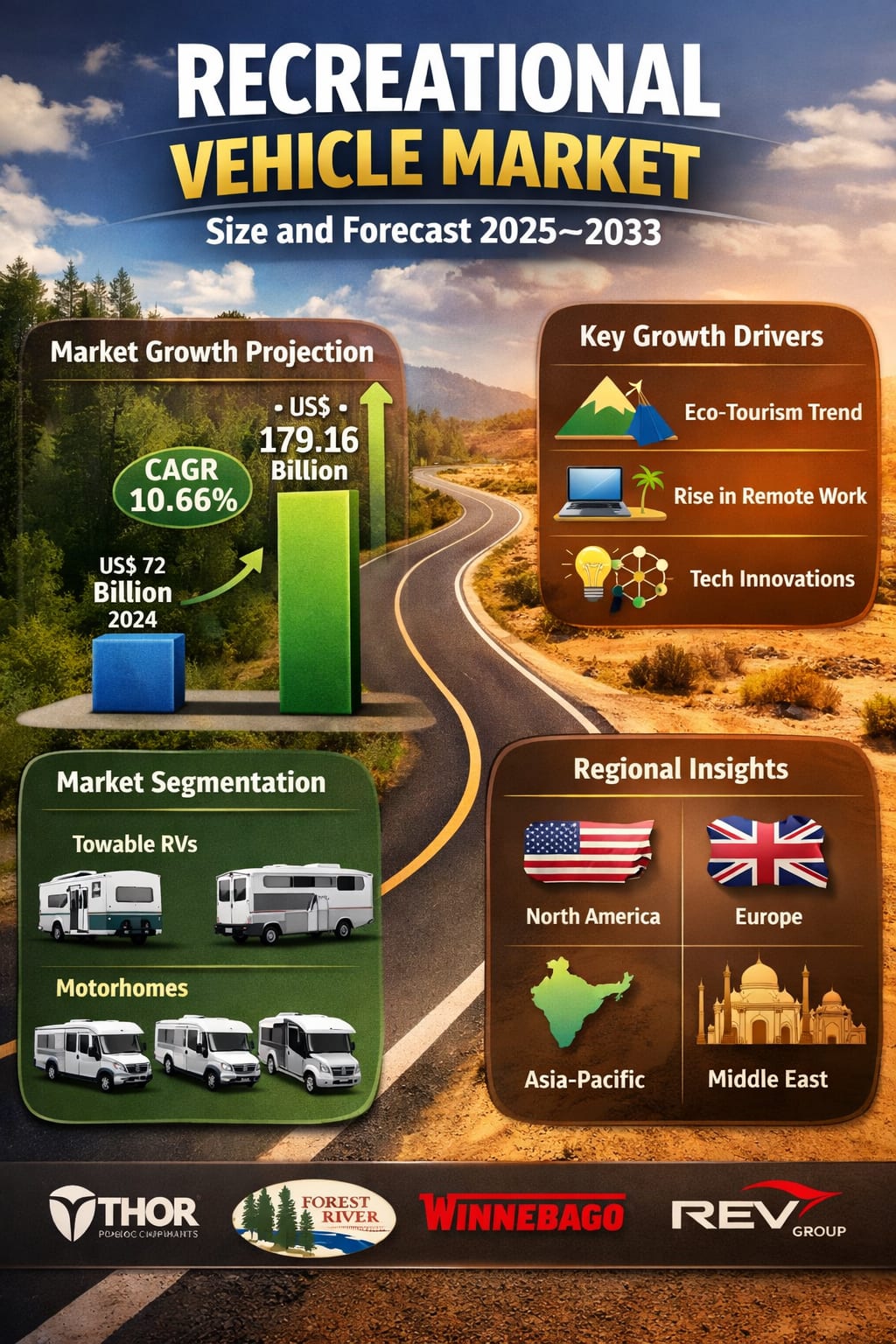
Recreational Vehicle (RV) Market: A New Era of Mobile Travel
The global recreational vehicle (RV) market is entering a transformative phase, driven by changing travel preferences, rising interest in outdoor lifestyles, and rapid technological innovation. According to Renub Research, the Recreational Vehicle Market is expected to reach US$ 179.16 billion by 2033, up from US$ 72 billion in 2024, expanding at a robust CAGR of 10.66% from 2025 to 2033. This impressive growth reflects a broader shift in how people perceive travel, work, and leisure.
RVs, once seen mainly as niche vehicles for retirees or adventure enthusiasts, have now become symbols of freedom, flexibility, and self-sufficient travel. From compact camper vans to luxury motorhomes equipped with smart technology, the sector caters to a wide range of consumers including families, digital nomads, and outdoor explorers. The global trend toward eco-tourism and sustainable travel is also playing a critical role in reshaping the market, as travelers increasingly seek environmentally responsible and experience-driven journeys.
In addition, the rise of remote and hybrid work models has blurred the line between work and travel. RVs are no longer just vacation vehicles—they are becoming mobile homes and even mobile offices. This structural shift in lifestyle behavior is one of the strongest long-term growth engines for the industry.
Global Recreational Vehicle Industry Overview
As more people look for flexible and immersive travel experiences, the RV market continues to gain momentum. Recreational vehicles offer a unique combination of mobility and comfort, allowing travelers to explore diverse destinations while retaining the conveniences of home. This appeal has become especially strong in a post-pandemic world, where travelers value privacy, independence, and control over their travel environments.
The industry spans a wide range of products, from towable RVs such as travel trailers and fifth-wheel trailers to motorhomes classified into Type A, Type B, and Type C. Each category serves different customer needs, budgets, and usage patterns. While towable RVs remain popular among cost-conscious buyers, motorhomes attract consumers looking for premium comfort and all-in-one mobility solutions.
Technological progress is also redefining the RV experience. Modern vehicles now feature smart climate control systems, advanced navigation, energy-efficient appliances, and enhanced connectivity solutions. These innovations not only improve comfort and convenience but also make RV travel more accessible to younger, tech-savvy consumers.
At the same time, sustainability is becoming a core theme across the industry. With growing concerns about climate change, emissions, and environmental degradation, manufacturers are investing in electric and hybrid RV prototypes, lightweight materials, and energy-efficient systems. A notable example is Winnebago’s zero-emission electric RV concept showcased in early 2023, highlighting the industry’s commitment to greener mobility solutions.
Key Factors Driving the Recreational Vehicle Market Growth
Growing Interest in Outdoor Activities
One of the strongest drivers of the RV market is the rising global interest in outdoor recreation. Activities such as camping, hiking, road trips, and nature tourism have seen a surge in popularity as people seek healthier, more immersive, and experience-based travel options. RVs fit perfectly into this trend by offering a comfortable and flexible way to explore remote and scenic locations.
The shift away from crowded tourist destinations toward nature-based experiences has made RVs particularly attractive. Families, couples, and solo travelers alike are choosing RV travel for its combination of safety, convenience, and adventure. This trend, initially accelerated by the COVID-19 pandemic, has now become a lasting lifestyle preference for many consumers.
Flexibility Enabled by Remote Work
The global rise of remote work has significantly expanded the potential user base for recreational vehicles. Professionals are no longer tied to fixed office locations, allowing them to combine work and travel in ways that were previously impractical. RVs have emerged as ideal mobile living and working spaces, offering both mobility and the essential comforts needed for long-term stays.
Digital nomads, freelancers, and remote employees are increasingly using RVs as mobile offices, traveling across regions while staying connected and productive. This lifestyle shift has broadened the appeal of RV ownership beyond traditional vacationers and retirees, creating a new and younger customer segment that values flexibility, autonomy, and work-life integration.
Technological Advancements
Technology is playing a crucial role in making RVs more attractive, efficient, and user-friendly. Today’s RVs are equipped with smart home features, advanced safety systems, improved navigation tools, and better energy management solutions. These upgrades significantly enhance the overall travel experience and reduce many of the traditional barriers associated with RV ownership.
Improvements in battery technology, solar power integration, and energy-efficient appliances are also expanding off-grid capabilities, which is especially appealing to outdoor enthusiasts. At the same time, better materials and engineering designs are helping manufacturers improve fuel efficiency and reduce environmental impact. Together, these innovations are drawing in a wider range of consumers and supporting sustained market growth.
Challenges in the Recreational Vehicle Market
High Costs of Purchase and Upkeep
Despite its strong growth potential, the RV market faces notable challenges, with high costs being one of the most significant. The initial purchase price of recreational vehicles can be substantial, particularly for motorhomes and high-end models. For many first-time buyers, this financial barrier can delay or prevent ownership altogether.
Beyond the purchase price, owners must also consider ongoing expenses such as maintenance, repairs, insurance, fuel, and storage. Premium and technologically advanced RVs often require specialized servicing, which further increases long-term ownership costs. These financial considerations limit market accessibility and keep RV ownership concentrated among higher-income consumers in many regions.
Environmental Issues and Fuel Efficiency
Environmental concerns and fuel efficiency remain critical issues for the RV industry. Traditional RVs, especially larger motorhomes, consume significant amounts of fuel and generate considerable emissions. As global awareness of climate change grows, consumers are becoming more conscious of the environmental footprint of their travel choices.
While manufacturers are working on electric and hybrid alternatives, the transition is not without challenges. Developing efficient, affordable, and reliable electric RVs is technically complex, and charging infrastructure for large vehicles is still limited in many regions. Addressing these sustainability challenges will be essential for the industry to attract environmentally conscious consumers and align with global climate goals.
Recreational Vehicle Market Overview by Regions
The global RV market shows strong regional variation. North America and Europe continue to dominate due to their established outdoor travel cultures and well-developed infrastructure. Meanwhile, Asia-Pacific is emerging as a high-growth region, supported by rising incomes, expanding tourism, and changing lifestyle preferences. In some developing regions, however, growth is constrained by economic limitations and infrastructure gaps.
United States Recreational Vehicle Market
The United States represents one of the largest and most mature RV markets in the world. With a strong culture of road trips, camping, and outdoor recreation, RVs are deeply embedded in American travel habits. The market offers a wide range of options, from affordable towable trailers to luxury motorhomes designed for long-distance travel and extended stays.
Innovation remains a key focus in the U.S. market, with manufacturers investing in fuel efficiency, smart technologies, and eco-friendly solutions. Although high costs and maintenance expenses remain challenges, strong consumer interest in flexible and independent travel continues to support market resilience and long-term growth.
United Kingdom Recreational Vehicle Market
In the United Kingdom, the RV market is growing steadily, driven by rising interest in domestic tourism and staycations. Motorhomes are particularly popular among British travelers seeking flexible and cost-effective ways to explore the countryside and coastal regions.
Technological improvements, including better connectivity and more sustainable designs, are helping attract a broader customer base. The expansion of RV parks and camping facilities across the country is also supporting market growth by improving accessibility and convenience for RV owners.
India Recreational Vehicle Market
India’s RV market is still in a developing stage but shows promising growth potential. Rising interest in road trips, domestic tourism, and outdoor experiences is gradually increasing awareness and adoption of recreational vehicles. Motorhomes are gaining attention among travelers seeking unique and flexible travel options.
While high costs and limited infrastructure remain obstacles, improvements in tourism facilities and growing interest in experiential travel are expected to support the market’s long-term expansion.
Saudi Arabia Recreational Vehicle Market
Saudi Arabia’s RV market is benefiting from increasing demand for domestic tourism and outdoor recreation. As the country continues to diversify its tourism sector, RVs are becoming an attractive option for travelers looking to explore natural landscapes and remote destinations.
Motorhomes are the most popular category, and the growing development of camping sites and recreational facilities is further supporting market growth. Technological upgrades and improved vehicle features are also helping broaden consumer interest in the region.
Recent Developments in the Recreational Vehicle Industry
The RV industry continues to witness strategic partnerships and product innovations. In January 2022, Ford and Erwin Hymer Group (EHG) announced a framework agreement to supply customer-ready recreational vehicles and motorhomes based on the Ford Transit and Ford Transit Custom platforms. Such collaborations highlight the increasing integration between automotive manufacturers and RV producers to deliver more efficient, modern, and reliable vehicles.
Market Segmentation
By Type
Towable RVs
Travel Trailers
Fifth Wheel Trailers
Folding Camp Trailers
Truck Campers
Motorhomes
Type A
Type B
Type C
By Application
Domestic
Commercial
Regional Outlook
North America
United States
Canada
Europe
France
Germany
Italy
Spain
United Kingdom
Belgium
Netherlands
Turkey
Asia Pacific
China
Japan
India
Australia
South Korea
Thailand
Malaysia
Indonesia
New Zealand
Latin America
Brazil
Mexico
Argentina
Middle East & Africa
South Africa
Saudi Arabia
United Arab Emirates
Company Analysis and Competitive Landscape
The global recreational vehicle market is characterized by the presence of several established players focusing on product innovation, geographic expansion, and strategic partnerships. Key companies covered in the market include:
Thor Industries Inc.
Forest River Inc.
Winnebago Industries Inc.
REV Group
NeXus RV
Tiffin Motorhomes Inc.
Triple E Recreational Vehicles
Dethleffs GmbH & Co. KG
Bürstner GmbH & Co. KG
The Swift Group
These companies compete on factors such as product quality, technological features, brand reputation, and after-sales service. Continuous investment in research and development, especially in electric and sustainable RV solutions, is expected to shape the future competitive landscape.
Final Thoughts
The global recreational vehicle market is on a strong growth trajectory, supported by changing travel behaviors, rising interest in outdoor lifestyles, and rapid technological advancements. With the market projected to grow from US$ 72 billion in 2024 to US$ 179.16 billion by 2033, at a CAGR of 10.66%, RVs are clearly moving from niche products to mainstream mobility and lifestyle solutions.
While challenges such as high costs and environmental concerns remain, ongoing innovation in electric mobility, smart technologies, and sustainable design is expected to address many of these issues over time. As consumers continue to seek flexible, personalized, and experience-driven travel, recreational vehicles are well-positioned to play a central role in the future of global tourism and mobility.
About the Creator
Risk Management in Investing: How Successful Investors Limit Losses
Investing is inherently risky. Every market participant faces the possibility of losing money, whether due to economic downturns, company-specific events, or global crises. While risk cannot be entirely eliminated, successful investors understand how to manage it effectively. Proper risk management protects capital, reduces emotional stress, and increases the likelihood of long-term wealth creation.
By Hammad Nawaz2 days ago in Trader
Australia’s Instant Coffee Market 2026: Convenience Culture, Premium Blends and Home Consumption Growth
Australia Instant Coffee Market Overview Australia’s instant coffee market continues to demonstrate steady expansion as convenience-led consumption, product innovation and omnichannel retail availability reshape consumer behaviour. Instant coffee has evolved beyond its traditional perception as a basic alternative to brewed coffee, emerging as a diversified category offering premium blends, specialty formats and single-serve innovations. As Australians increasingly balance strong café culture with rising at-home beverage preparation, instant coffee remains a practical and cost-effective solution for daily consumption.
By Amyra Singh3 days ago in Trader




Comments
There are no comments for this story
Be the first to respond and start the conversation.